A wooden cylinder floats vertically in water with half of its length immersed. The density of wood is
Easy


Download our appand get started for free
Experience the future of education. Simply download our apps or reach out to us for more information. Let's shape the future of learning together!No signup needed.*
Similar Questions
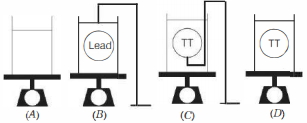
- 1Four identical beakers contain same amount of water as shown below. Beaker $A$ contains only water. A lead ball is held submerged in the beaker $B$ by string from above. A same sized plastic ball, say a table tennis $(TT)$ ball, is held submerged in beaker $C$ by a string attached to a stand from outside. Beaker $D$ contains same sized $TT$ ball which is held submerged from a string attached to the bottom of the beaker. These beakers (without stand) are placed on weighing pans and register readings $w_{A}, w_{B}, w_{C}$ and $w_{D}$ for $A, B, C$ and $D$, respectively. Effects of the mass and volume of the stand and string are to be neglected.View Solution
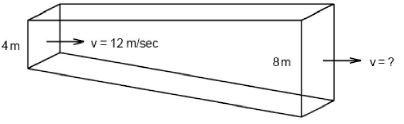
- 2A river gradually deepens, from a depth of $4 \ m$ to a depth of $8\ m$ as shown. The width, $W$, of the river does not change. At the depth of $4 \ m$, the river's speed is $12\ m/sec.$ Its elocity at the $8\ m$ depth is ......... $m/sec$View Solution
- 3A Newtonian fluid fills the clearance between a shaft and a sleeve. When a force of $800$ $N$ is applied to the shaft, parallel to the sleeve, the shaft attains a speed of $1.5$ $cm/sec$. If a force of $2.4$ $kN$ is applied instead, the shaft would move with a speed of ......... $ cm/sec$View Solution
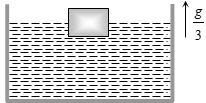
- 4A cubical block is floating in a liquid with half of its volume immersed in the liquid. When the whole system accelerates upwards with acceleration of $g/3,$ the fraction of volume immersed in the liquid will beView Solution
- 5An air bubble of volume $1\,cm ^3$ rises from the bottom of a lake $40\,m$ deep to the surface at a temperature of $12^{\circ}\,C$. The atmospheric pressure is $1 \times 10^5 Pa$, the density of water is $1000\,kg / m ^3$ and $g =10\,m / s ^2$. There is no difference of the temperature of water at the depth of $40\,m$ and on the surface. The volume of air bubble when it reaches the surface will be $..........\,cm^{3}$View Solution
- 6View SolutionTwo pieces of metal when immersed in a liquid have equal upthrust on them; then
- 7View SolutionIn which one of the following cases will the liquid flow in a pipe be most streamlined
- 8View SolutionThe term 'fluid' is used for ............
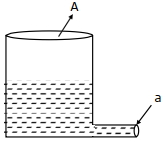
- 9A light cylindrical vessel is kept on a horizontal surface. Area of base is A. A hole of crosssectional area $'a'$ is made just at its bottom side. The minimum coefficient of friction necessary to prevent sliding the vessel due to the impact force of the emerging liquid is $(a\,<\,<\,A)$View Solution
- 10A concrete sphere of radius $R$ has a cavity of radius $ r$ which is packed with sawdust. The specific gravities of concrete and sawdust are respectively $2.4$ and $0.3$ for this sphere to float with its entire volume submerged under water. Ratio of mass of concrete to mass of sawdust will beView Solution