A Newtonian fluid fills the clearance between a shaft and a sleeve. When a force of $800$ $N$ is applied to the shaft, parallel to the sleeve, the shaft attains a speed of $1.5$ $cm/sec$. If a force of $2.4$ $kN$ is applied instead, the shaft would move with a speed of ......... $ cm/sec$
Diffcult
Download our app for free and get started
Using the relation $\tau=\mu \frac{d u}{d y} .$ Here $\tau$ is the shear stress between the layers of the liquid which is equal to $\frac{F}{A} . d u$ is the change of velocity $=u-0=u$ and $d y$ is the clearance which is equal to $y$
Thus we get
$\frac{F}{A}=\mu \frac{u}{y}$
or
$F=\frac{A \mu u}{y} \propto u$
Thus we get
$\frac{F_{1}}{u_{1}}=\frac{F_{2}}{u_{2}}$
Substituting the values we get
$\frac{800}{1.5}=\frac{2400}{u_{2}}$
Thus we get $u_{2}=4.5 \mathrm{cm} / \mathrm{s}$

Download our appand get started for free
Experience the future of education. Simply download our apps or reach out to us for more information. Let's shape the future of learning together!No signup needed.*
Similar Questions
- 1The bulk modulus of a liquid is $3 \times 10^{10}\, Nm ^{-2}$. The pressure required to reduce the volume of liquid by $2 \%$ is ........ $\times 10^{8}\; Nm ^{-2}$View Solution
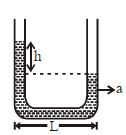
- 2In a $U-$ tube, the liquid level stands at same level when it is at rest. When $U-$ tube is accelerated towards right, as shown in figure, the difference $h$ between level of two arms will beView Solution
- 3A hydraulic press containing water has two arms with diameters as mentioned in the figure. A force of $10 \mathrm{~N}$ is applied on the surface of water in the thinner arm. The force required to be applied on the surface of water in the thicker arm to maintain equilibrium of water is_________.${N}$.View Solution

- 4A cylinder containing water, stands on a table of height $H$. A small hole is punched in the side of cylinder at its base. The stream of water strikes the ground at a horizontal distance $R$ from the table. Then the depth of water in the cylinder is ............View Solution
- 5A flat plate of area $10\,cm^2$ is separated from a large plate by a layer of glycerine $1\, mm$ thick. If the coefficient of viscosity of glycerine is $20$ poise, the force required to keep the plate moving with a velocity of $1\,cm/sec$ is .......... $dyne$View Solution
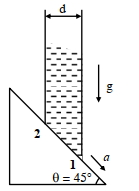
- 6A cylindrical tube, with its base as shown in the figure, is filled with water. It is moving down with a constant acceleration $a$ along a fixed inclined plane with angle $\theta=45^{\circ} . P_1$ and $P_2$ are pressures at points 1 and 2 , respectively, located at the base of the tube. Let $\beta=\left(P_1-P_2\right) /(\rho g d)$, where $\rho$ is density of water, $d$ is the inner diameter of the tube and $g$ is the acceleration due to gravity. Which of the following statement($s$) is(are) correct?View Solution
$(A)$ $\beta=0$ when $a= g / \sqrt{2}$
$(B)$ $\beta>0$ when $a= g / \sqrt{2}$
$(C)$ $\beta=\frac{\sqrt{2}-1}{\sqrt{2}}$ when $a= g / 2$
$(D)$ $\beta=\frac{1}{\sqrt{2}}$ when $a= g / 2$
- 7A liquid drop of mass $m$ and radius $r$ is falling from great height. Its velocity is proportional to ............View Solution
- 8A table tennis ball has radius $(3 / 2) \times 10^{-2} m$ and mass $(22 / 7) \times 10^{-3} kg$. It is slowly pushed down into a swimming pool to a depth of $d=0.7 m$ below the water surface and then released from rest. It emerges from the water surface at speed $v$, without getting wet, and rises up to a height $H$. Which of the following option(s) is (are) correct?View Solution
[Given: $\pi=22 / 7, g=10 ms ^{-2}$, density of water $=1 \times 10^3 kg m ^{-3}$, viscosity of water $=1 \times 10^{-3} Pa$-s.]
$(A)$ The work done in pushing the ball to the depth $d$ is $0.077 J$.
$(B)$ If we neglect the viscous force in water, then the speed $v=7 m / s$.
$(C)$ If we neglect the viscous force in water, then the height $H=1.4 m$.
$(D)$ The ratio of the magnitudes of the net force excluding the viscous force to the maximum viscous force in water is $500 / 9$.
- 9View SolutionThe property of a liquid by which it opposes the flow of itself is called ..........
- 10Two identical cylindrical vessels are kept on the ground and each contain the same liquid of density $d.$ The area of the base of both vessels is $S$ but the height of liquid in one vessel is $x_{1}$ and in the other, $x_{2}$. When both cylinders are connected through a pipe of negligible volume very close to the bottom, the liquid flows from one vessel to the other until it comes to equilibrium at a new height. The change in energy of the system in the process isView Solution