Question
A1. Simple Factual Activities :
Write whether the following sentences are True or False: 

(i) In the beginning, Anil taught Hari to cook and write his name.
(ii) Anil writes for magazines for a living.
(iii) Hari liked working for Anil.
(iv) Anil kept a small bundle of notes in a cupboard.

   He took me to his room over the Jumna Sweet Shop and told me I could sleep in the balcony. But the meal I cooked that night must have been terrible because Anil gave it to a stray dog and told me to be off. But I just hung around, smiling in my most
appealing way, and he couldn’t help laughing.
  Later, he patted me on the head and said never mind, he’d teach me to cook. He also taught me to write my name and said he would soon teach me to write whole sentences and to add numbers. I was grateful. I knew that once I could write like an educated man there would be no limit to what I could achieve.
   It was quite pleasant working for Anil. I made the tea in the morning and then would take my time buying the day’s supplies, usually making a profit of
about a rupee a day. I think he knew I made a little money this way but he did not seem to mind.
   Anil made money by fits and starts. He would borrow one week, lend the next. He kept worrying about his next cheque, but as soon as it arrived he would go
out and celebrate. It seems he wrote for magazines a queer way to make a living!
   One evening he came home with a small bundle of notes, saying he had just sold a book to a publisher. At night, I saw him tuck the money under the mattress.

A2. Complex Factual Activities:
Complete the following:
(i) Hari was grateful because ............... .
(ii) Hari continued making money ................ .
A3. Activities based on Vocabulary:

(1) Find from the passage the collocations for the following:
(i)  ............. dog     (ii)  ............. sentences.
(2)  Insert the appropriate word/phrase given below, in the sentence that follows:
(flattery, appealing, by fits and starts, dashed to, undetected, spirits rose)
(i) The artist completes his paintings by ................... .
A4. Activities based on Contextual Grammar:
Pick out the finite verbs from the following sentences and write their tense:
(i) Anil gave it to a stray dog and told me to be off.
(ii) It seems he wrote for magazines a queer way to make a living.
A5. Personal Response:
(i) Anil knew he was being robbed; yet he did not say anything. What would you have done in Anil's place?
Answer

A1. Simple Factual Activities :
(i) True
(ii) True
(iii) True
(iv) False
A2. Complex Factual Activities:
(i) Hari was grateful because Anil was teaching him to read, write and add numbers, and all this would be useful to him in his life.
(ii) Hari continued making money by cheating Anil while buying the day's supplies.
A3. Activities based on Vocabulary:
(1) (i) stay dog (ii) whole sentences
(2) (i) The artist completes his paintings by fits and starts. .
A4. Activities based on Contextual Grammar:
(i) gave, told-simple past tense.
(ii) seems simple present tense; wrote - simple past tense.
A5. Personal Response:
(i) Cheating and robbing small amounts can lead to bigger thefts. If I were Anil, the moment I knew that I was being robbed, I would have warned him. If he cheated again, I would certainly have told him to be off.

Need a full question paper?

Generate a complete, print-ready paper with questions like this in minutes — across 16+ boards, with answer keys.

Start Generating Free

Similar questions

A1. Choose the correct alternative:
(i) Which state does Mary Kom belong to?
(a) Mizoram               (b) Manipur 
(c) Gujarat                 (d) Assam
(ii) Who inspired Mary Kom to choose Boxing as a career?
(a) Dingko Singh       (b) Sushil Kumar
(c) Vijender Singh     (d) Adams
(iii) What were her parents?
(a) Teachers              (b) Boxers
(c) Tenant farmers     (d) Horticulturists
(iv) When did Mary Kom make her International debut in Boxing?
(a) At 20                     (b) At 18
(c) At 48                     (d) At 38

  There had to be one successful story if Indians were to survive in sports and we have that story now. Enough has been said about this great warrior who
conquered the world. This warrior is none other than Mary Mangte Kom-the Komqueror and the Komrade.She is famed as a five times World Boxing Champion and the only boxer to win a medal in every one of the six world championships. In the 2012 Olympics, she became the first Indian woman boxer to qualify and win a bronze medal in the 51 Kg flyweight category of Boxing.
   Kom was born in Kangthei village, Moirang Lamkhai in Churachandpur district of rural Manipur in eastern India. She came from a poor family. Her
parents, Mangte Tonpa Kom and Mangte Akham Kom were tenant farmers who worked in jhum fields. Kom grew up in humble surroundings, helping her parents with farm related chores, going to school and learning athletics initially and later boxing simultaneously. Her father was a keen wrestler in his younger age.
   She had an eager interest in athletics since childhood and the success of Dingko Singh a fellow Manipuri, who returned from the 1998 Bangkok Asian
games with a gold medal, Kom recollects, had inspired many youngsters in Manipur to try boxing and she too thought of giving it a try.
    Mary Kom’s career started in 2000 after her victory in the Manipur State Women’s Boxing Championship and the regional championship in West
Bengal. In 2001, she started competing at international level. She was only 18 years old when she made her international debut at the first AIBA Women’s World Boxing Championship in United States, winning a silver medal in the 48 kg weight category. Her greatness is reinforced by the way she apologised to the whole nation for not being able to win the Gold. She is a legend for sure and an idol for all the sportswomen to look up to.

A2. What difficulties did Mary Kom face in her childhood?
A3. Find out one word for the following from the passage:
(a) shifting cultivation - ......................
(b) strengthened - ......................
(c) first public appearance - ......................
(d) one who makes history -  ......................
A4. Do as directed:
(i) She started competing at international level.
(Rewrite using an infinitive.)
(ii) Her father was a keen wrestler.
(Rewrite as an exclamatory sentence.)
A5. 'Sports are Important in our life'. Explain.
A1. Simple Factual Activities:
Write True or False for these statements:
(i) Steve Jobs slept in his dorm room.
(ii) Steve took his required courses as a registered student of Reed College.
(iii) During Steve's College days, one had to pay 5 cents deposit for a Coke bottle.
(iv) Steve had comfortable college experiences.

   Today I want to tell you three stories from my life. That’s it. Just three stories. The first story is about connecting the dots. I dropped out of Reed College after the first 6 months, but then stayed around as a drop-in for another 18 months before I really quit.
Looking back, it was one of the best decisions I ever made. I could stop taking the required classes that didn’t interest me, and begin dropping in on the ones that looked interesting.
   I didn’t have a dorm room, so I slept on the floor in friends’ rooms. I returned Coke bottles for the 5 cent deposits to buy food with, and I would walk seven miles across town every Sunday night to get one good meal a week at the Hare Krishna temple. I loved it. And much of what I stumbled into by following my curiosity and intuition turned out to be priceless later on. Here’s one example : Reed College offered perhaps the best calligraphy instruction in the country. Because I had to take a calligraphy class, I learned about serif and san serif typefaces, about what makes great typography great.

A2. Complex Factual Activities:
(i) What did Steve Jobs do for two years after he joined Reed College?
A3. Activities based on Vocabulary:
Use the following idioms/phrases in sentences of your own:
(i) drop in
(ii) drop out
(iii) turned out to be
(iv) stumbled into
A4. Activities based on Contextual Grammar:
Name the tense of the underlined verbs to include time and aspect:
(i) I shall be telling you three stories.
(ii) I slept on the floor.
A5. Personal Response:
(i) What impression of Steve Jobs do you get from this passage?
A1. Simple Factual Activities:
Name the following:
(i) The world's most successful animation studio.
(ii) The company that Steve Jobs took ve years to establish.
(iii) The company that bought Next.
(iv) Steve Jobs' wife.

   My second story is about love and loss. I found what I loved to do early in life. Woz (Steve Wozniak) and I started Apple when I was 20. In 10 years Apple had grown from just the two of us in a garage into a $2 billion company. And then I got fired. It was
devastating.
    But something slowly began to dawn on me - I still loved what I did. And so I decided to start over.
   The heaviness of being successful was replaced by the lightness of being a beginner again. It freed me to enter one of the most creative periods of my life.
    During the next five years, I started a company Next, another company named Pixar, and fell in love with an amazing woman who would become my wife. Pixar is now the world’s most successful animation studio, Apple bought Next. I returned to Apple and
the technology we developed at Next is at the heart of Apple’s current renaissance. And Laurene and I have a wonderful family together.
   Sometimes life hits you in the head with a brick. Don’t lose faith. The only way to do great work is to love what you do. If you haven’t found it yet, keep looking. Don’t settle.

A2. Complex Factual Activities:
Say how:
(i) What setback did Jobs suffer when he was thirty?
A3. Activities based on Vocabulary:
(i) When the father learned about his son's misdeeds, it .................. .
(ii) Even if you don't succeed at first, don't .................. in yourself.
(iii) It is corruption in high places that lies ................. of the non-development of this locality.
(iv) On reading exactly the same essays in both answer sheets, it ................ the examiner that the students had cheated during the exams.
A4. Activities based on Contextual Grammar:
(i) You haven't found it. (Name the tense of the verbs underlined to include Time and Aspect.)
(ii) I got fired.(Rewrite changing to the future perfect tense.)
A5. Personal Response:
(i) Which quality of Steve Jobs impresses you the most? How would you apply it in your life?
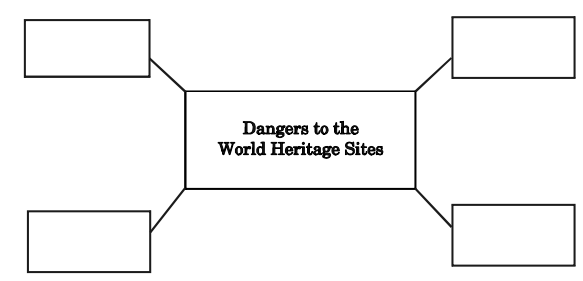
As of 2009, there are 890 World Heritage Sites that are located in 148 countries (map). 689 of these sites are cultural and include places like the Sydney Opera House in Australia and the Historic Center of Vienna in Austria 176 are natural and feature such locations as the U.S.'s Yellowstone and Grand Canyon National Parks. 25 of the World Heritage Sites are considered mixed i.e. natural and cultural Peru's Machu Picchu is one of these. Italy has the highest number of World Heritage Sites with 44. India has 36 (28 cultural, 7 natural and 1 mixed) World Heritage Sites. The World Heritage Committee has divided the world's countries into five geographic zones which include (1) Africa, (2) Arab States, (3) Asia Pacific (including Australia and Oceania), (4) Europe and North America and (5) Latin America and the Caribbean.
WORLD HERITAGE SITES IN DANGER
Like many natural, historic and cultural sites around the world, many World Heritage Sites are in danger of being destroyed or lost due to war, poaching, natural disasters like earthquakes, uncontrolled urbanization, heavy tourist traffic and environmental factors like air pollution and acid rain.

A1. Match the World Heritage Sites given in Column 'A' with the names of

the countries given in Column 'B' :
Column 'AColumn 'B
World Heritage SitesCountries
(i) Machu Picchu(a) Australia
(ii) Sydney Opera House(b) Austria
(iii) Yellowstone National Park(c) The U.S.
(iv) Historic Centre of Vienna(d) Peru
A2. Complete the following web :
Image

A3. Classify the following words in the given table :
(natural, allocate, protect, heavy)
AdjectivesVerbs
A4. Do as directed :
(i) Pick out the subordinate clause and name it :
There are 890 World Heritage Sites that are located in 148 countries.
(ii) World Heritage Sites are in danger.
(Frame a Verbal Question)

A5. How can we preserve our Historical monuments ?
A1. Simple Factual Activities:
Arrange these incidents in proper sequence:
(i) The bearded man resolved to kill the king.
(ii) The king executed the bearded man's brother.
(iii) The bearded man came out of the ambush.
(iv) The bearded man laid an ambush to kill the king.

    Meanwhile the sun had set and it had become cool. So the king, with the hermit’s help, carried the wounded man into the hut. The man lay there quietly with his eyes closed. By now, the king was so tired after his walk and the work he had done, that he lay down himself and also fell asleep. When he awoke in the morning, it took him some time to remember where he was and who was the strange bearded man lying by his side and gazing intently at him. “Forgive me !” said the bearded man in a weak voice, when he saw that the king was awake and was looking at him.‘‘I do not know you, and I’ve nothing to forgive you for,” said the king. “
   You do not know me, but I know you. I am that enemy of yours who swore to revenge himself on you because you executed his brother and seized his property. I knew you had gone alone to see the hermit, and I resolved to kill you on your way back. But the day passed and you did not return. So I came out of my ambush to find you. Your bodyguards recognised me and wounded me. I escaped from them but would have bled to death had you not dressed my wound. I wished to kill you but you have saved my life. Now if I live, and if you wish it, I’ll serve you all my life.”

A2. Complex Factual Activities:
(i) The king's enemy was repentant. How do you know?
A3. Activities based on Vocabulary:
(i) From the passage, find the collocations for the following:

(a) ............. closed  (b) ............. intently 
(ii) The following compound words from the passage are spelt in jumbled order. Rearrange the letters to make them meaningful:
(a) h e i l n e w a m (b) d a d e b e r 
A4. Activities based on Contextual Grammar:
(i) 'Forgive me,' said the bearded man. (Rewrite in indirect speech.)
(ii) Pick out the finite and non-finite verbs in the sentences:
*Forgive me.
A5. Personal Response:
(i) Whom do you consider your guide when you are in difficulty? Why? (March '20)
A1. Simple Factual Activity:
Pick out the statements that are false and write Them correctly:
(i) On the beach, the author found rocks carved and sculpted by the wind.
(ii) The hibiscus flower smiles with the sun and Hances with the wind.
(iii) Rocks take the shape that the water commands.
(iv) Our problems are big and so are we.

To see a world in a grain of sand
And a heaven in a wild flower,
Hold infinity in the palm of your hand
And eternity in an hour

   Something, as tiny as a grain of sand, can spark off an idea or imagination of a huge
significance to the world. One can witness and experience the beauty of Heaven in something as small as wild flower and derive joy forever. Only one should have the eyes and time to see it.
   Infinity is endless space; but your small palm can hold the destiny of earth through your efforts.Eternity is endless time; but just an hour in your life can make a difference to the world forever.
(Great deeds can surpass the limits of time and space. They never die.)
   We instinctively turn to outdoor activities and nature as a way of relaxing and enhancing our well being. Nature soothes and nurtures. Nature fulfils and
motivates. Nature whispers and commands.
    Are you listening?
   When I do, it leaves me in complete awe.
   We have a hibiscus plant in our garden. Every fortnight a flower blooms on it-big, bright and tender. Through the day it smiles with the sun and dances with the wind, but as evening approaches, it starts wilting. The morning after, it withers completely and by evening it falls and becomes one with the earth again. The flower comes to life only for a day, yet it does so in full splendour. What if we too lived our life, however short, to its fullest ?
   We went to a rocky beach and saw the spread of the majestic ocean and the rocks alongside, carved, sculpted and shaped by the water. Water is so gentle, rock so hard, yet, as the water flows over it every day, for years, the rock gives in. It takes the shape that the water commands. Our problems are so colossal and we are so small, yet if we persist...

A2. Complex Factual Activities:
(i) The writer explains the contrasting features of 'water' and 'rock' in the lesson. Write all the features of both water and rock in the given table.
A3. Activities based on Vocabulary:
(i) Pick out the examples of concrete nouns from the passage.
Concrete nouns nouns that we can touch or see.
(ii) Pick out the examples of abstract nouns from the passage.
Abstract nouns nouns that we can't touch or see.
A4. Activities based on Contextual Grammar:
(i) Choose the correct 'not only ... but also..." form of the sentence:
Natures soothes and nurtures.
(a) Not only nature soothes but nurtures also.
(b) Nature soothes not only but also nurtures.
(c) Nature soothes but also nurtures not only.
(d) Nature not only soothes but also nurtures.
(ii) By evening it falls and becomes one with the earth again. (Rewrite using the -ing form of the underlined word.)"
A5. Personal Response:
(i) How do you deal with difficulties and problems?

A1.Simple Factual Activities:
(i) The gift Jim had brought for Della was __________ .
(ii) The beautiful present flashed with __________ .

   White fingers and nimble tore at the string and paper. And then an ecstatic scream of joy; and then, alas! a quick feminine change to hysterical tears and wails, necessitating the immediate employment of all the comforting powers of the lord of the flat.
   For there lay The Combs—the set of combs, side and back, that Della had worshipped long in a Broadway window. Beautiful combs, pure tortoise shell, with jeweled rims—just the shade to wear in the beautiful vanished hair. They were expensive combs, she knew, and her heart had simply craved and yearned over them without the least hope of possession. And now, they were hers, but the tresses that should have adorned the coveted adornments were gone.
   But she hugged them to her bosom, and at length she was able to look up with dim eyes and a smile and say: “My hair grows so fast, Jim!”
   And then Della leaped up like a little singed cat and cried, “Oh, oh!”
   Jim had not yet seen his beautiful present. She held it out to him eagerly upon her open palm. The dull precious metal seemed to flash with a reflection of her bright and ardent spirit.
   “Isn’t it a dandy, Jim? I hunted all over town to find it. You’ll have to look at the time a hundred times a day now. Give me your watch. I want to see how it looks on it.”
   Instead of obeying, Jim tumbled down on the couch and put his hands under the back of his head and smiled.
  “Dell,” said he, “let’s put our Christmas presents away and keep ‘em a while. They’re too nice to use just at present. I sold the watch to get the money to buy your combs. And now suppose you put the chops on.”
   The magi, as you know, were wise men— wonderfully wise men—who brought gifts to the Babe in the manger. They invented the art of giving Christmas presents. Being wise, their gifts were, no doubt, wise ones, possibly bearing the privilege of exchange in case of duplication. And here I have lamely related to you the uneventful chronicle of two foolish children in a flat who most unwisely sacrificed for each other the greatest treasures of their house. But in a last word to the wise of these days let it be said that of all who give gifts, these two were the wisest. Of all who give and receive gifts, such as they are wisest. Everywhere they are wisest. They are the magi.

A2. Complex Factual Activity:
Pick out and rewrite the exact sentences which indirectly imply the following :
(i) Della's elated mood underwent a change as she opened her gift.
(ii) Jim wanted to put the Christmas presents away and get back to daily life.
A3. Activity based on Vocabulary:
FIII in the blanks with words from the passage that are the opposites of the underlined words :
(i) Something that is not ______ is ______ .
(ii) Something that is not ______ is ______ .
(iii) Men who are not ______ are ______ .
(iv) Something that is not ______ is ______.
A4. Activities based on Contextual Grammar:
Add the appropriate Guestion Tags :
(i) Della leaped up, ....... ?
(ii) You'll have to look at the time, ........ ?
(iii) They were expensive combs, ........ ?
(iv) My hair grows so fast, ........ ?.
A5. Personal Response:
(i) Justify the title of the story, 'The Gift of the Magi'.

A1. Simple Factual Activities:
Arrange the following incidents from Steve Jobs' life in proper sequence based on this passage:
(i) Jobs married Laurene.
(ii) Jobs returned to Apple Inc.
(iii) Jobs started Next.
(iv) Jobs got fired.

   My second story is about love and loss. I found what I loved to do early in life. Woz (Steve Wozniak) and I started Apple when I was 20. In 10 years Apple had grown from just the two of us in a garage into a $2 billion company. And then I got fired. It was
devastating.
    But something slowly began to dawn on me - I still loved what I did. And so I decided to start over.
   The heaviness of being successful was replaced by the lightness of being a beginner again. It freed me to enter one of the most creative periods of my life.
    During the next five years, I started a company Next, another company named Pixar, and fell in love with an amazing woman who would become my wife. Pixar is now the world’s most successful animation studio, Apple bought Next. I returned to Apple and
the technology we developed at Next is at the heart of Apple’s current renaissance. And Laurene and I have a wonderful family together.
   Sometimes life hits you in the head with a brick. Don’t lose faith. The only way to do great work is to love what you do. If you haven’t found it yet, keep looking. Don’t settle.

A2. Complex Factual Activities:
Say how:
(i) Jobs reacted later on, after the shock of being fired from Apple.
A3. Activities based on Vocabulary:
Match the words/phrases in column A with their meanings in column B:

(A)(B)
 (i) renaissance (a) causing great destruction
 (ii) to start over (b) lost one's job
 (iii) fired (c) revival
 (iv) devastating (d) to begin again

A4. Activities based on Contextual Grammar:
(i) I started a company. (Rewrite changing to the present continuous tense.)
(ii) Life hits you in the head. (Rewrite in the present perfect continuous tense.)
A5. Personal Response:
(i) What does this second story of Jobs convey to you?

A1. Simple Factual Activities:
Fill in the blanks with the correct alternatives:
(i) The .................. is called a 'blockhead' by the squire.(Robert/steward)
(ii) The squire's name is .................... . (Robert/Dauphin)
(iii)The price of a horse is ................... .(17 to 18 francs/sixteen francs)
(iv) The ................. will give the girl whatever she needs to free Orleans. (Dauphin/Squire)

   The war fought between England and France from 1337 to 1453 has come to be known as the Hundred Years War. Joan was a peasant girl born in eastern France, who
led the French army to several victories during this war.
   This play begins at the time when all of northern France and some parts of the south-west were under foreign control. The English controlled some parts and the Burgundians controlled the others. The city of New Orleans, one of the few remaining French cities was held by the English. The year is 1429. Captain Robert de Baudricourt, a military officer is seated at the table.His steward stands facing him.

Robert :
I told you to throw the girl out. You have fifty armed soldiers and dozens of
strong servants to carry out my orders. Are they afraid of her ?
Steward : No sir, we are afraid of you, but she puts courage in us. She really doesn’t
seem to be afraid of anything. Perhaps you could frighten her, sir.
Robert : (grimly) Perhaps, where is she now?
Steward : Down in the courtyard, sir.(Robert goes to the window and asks the soldiers to send the girl up.)
(The girl enters. She is a well-built,strong country girl of 17 to 18 years.The squire’s glare neither frightens hernor stops her. She speaks confidently.)
Joan : Good morning, Captain Squire. You are to give me a horse and armour
and some soldiers, and send me to the Dauphin.
Robert : This girl is mad. Why didn’t you tell me so, you blockhead?
Steward : Sir, do not anger her. Give her what she wants.
Robert : I shall send you back to your father with orders to put you under lock and key.
Joan : You think you will, squire. But it won’t happen that way. You said you would
not see me. But here I am.
Robert : So, you are assuming that I’ll give you what you want.
Joan : Yes, squire. (Continues busily) A horse will cost sixteen francs. It is a big amount of money. But I can save it on the armour. I don’t need beautiful armour made to my measure. I can find a soldier’s armour that will fit me well enough. I shall not want many soldiers. The Dauphin will give me, all I need, to free Orleans.

A2. Complex Factual Activities:
Give reasons:
(i) Explain why Joan wanted to meet Captain Squire.
A3. Activities based on Vocabulary:
Classify the following words into adjectives and nouns and complete the table given below:
armed, courage, brave, armour, orders, well-built, squire, strong, amount, beautiful. Orleans
A4. Activities based on Contextual Grammar: 
Make the following sentences affirmative without changing the meaning:

(i) Sir, do not anger her.
(ii) I shall not want many soldiers.
A5. Personal Response:
(i) What, according to you, is the steward's opinion about Joan?<
A1.Simple Factual Activities:
Complete the following :
(i) The couple's prized possessions were ____________ .
(ii) Della's beautiful hair fell about __________ .
(iii) __________  could have outshone the Queen of Sheba's jewels.
(iv) Della sold her lovely long hair __________ .

   Now, there were two possessions of James Dillingham Young in which they both took a mighty pride. One was Jim’s gold watch that had been his father’s and his grandfather’s.The other was Della’s hair. Had the queen of Sheba lived in the flat across the airshaft, Della would have let her hair hang out the window some day to dry just to depreciate Her Majesty’s jewels and gifts. Had King Solomon been the janitor, with all his treasures piled up in the basement, Jim would have pulled out his watch every time he passed, just to see him pluck at his beard from envy.
   So now Della’s beautiful hair fell about her rippling and shining like a cascade of brown waters. It reached below her knee and made itself almost a garment for her. And then she did it up again nervously and quickly. Once she faltered for a minute and stood still while a tear or two splashed on the worn red carpet.
   On went her old brown jacket; on went her old brown hat. With a whirl of skirts and with the brilliant sparkle still in her eyes, she fluttered out the door and
down the stairs to the street.
   Where she stopped the sign read: “Mme. Sofronie. Hair Goods of All Kinds.” One flight up Della ran, and collected herself, panting. Madame, large, too white, chilly, hardly looked the “Sofronie.”
   “Will you buy my hair?” asked Della.
   “I buy hair,” said Madame. “Take yer hat off and let’s have a sight at the looks of it.”
Down rippled the brown cascade.
   “Twenty dollars,” said Madame, lifting the mass with a practiced hand.
    “Give it to me quick,” said Della.

A2. Complex Factual Activity:

(i)  Why and how did Della sell her hair? Do you think she did it willingly?
A3. Activity based on Vocabulary:
Write the adjective forms of the following words and pick out those that are participles :
(i) possessions
(ii) treasures
(iii) envy
(iv) sparkle
A4. Activities based on Contextual Grammar:
(i) Frame a 'Wh'-question to get the underlined part as the answer :
Her hair reached below her knee.
(ii)  Add a question tag.
Give it to me quick, _________?
A5. Personal Response:
(i) Gifts that you buy have fixed prices. Explain how the buyer can increase the value of a gift bought for someone very dear in the family.