Question
A1. Simple Factual Activities:
Write True or False for these statements:
(i) Steve Jobs slept in his dorm room.
(ii) Steve took his required courses as a registered student of Reed College.
(iii) During Steve's College days, one had to pay 5 cents deposit for a Coke bottle.
(iv) Steve had comfortable college experiences.

   Today I want to tell you three stories from my life. That’s it. Just three stories. The first story is about connecting the dots. I dropped out of Reed College after the first 6 months, but then stayed around as a drop-in for another 18 months before I really quit.
Looking back, it was one of the best decisions I ever made. I could stop taking the required classes that didn’t interest me, and begin dropping in on the ones that looked interesting.
   I didn’t have a dorm room, so I slept on the floor in friends’ rooms. I returned Coke bottles for the 5 cent deposits to buy food with, and I would walk seven miles across town every Sunday night to get one good meal a week at the Hare Krishna temple. I loved it. And much of what I stumbled into by following my curiosity and intuition turned out to be priceless later on. Here’s one example : Reed College offered perhaps the best calligraphy instruction in the country. Because I had to take a calligraphy class, I learned about serif and san serif typefaces, about what makes great typography great.

A2. Complex Factual Activities:
(i) What did Steve Jobs do for two years after he joined Reed College?
A3. Activities based on Vocabulary:
Use the following idioms/phrases in sentences of your own:
(i) drop in
(ii) drop out
(iii) turned out to be
(iv) stumbled into
A4. Activities based on Contextual Grammar:
Name the tense of the underlined verbs to include time and aspect:
(i) I shall be telling you three stories.
(ii) I slept on the floor.
A5. Personal Response:
(i) What impression of Steve Jobs do you get from this passage?
Answer

A1. Simple Factual Activities:
(i) False
(ii) False
(iii) True
(iv) True
A2. Complex Factual Activities:
(i) After joining Reed College, for two years Steve would stop taking the required classes that didn't interest him. Instead he began dropping in on the ones that looked interesting.
A3. Activities based on Vocabulary:
(i) Though I am not a member of the club. I often play tennis there as a drop in.
(ii) I decided to drop out of karate classes as it was taking too much of my time.
(iii) The advice given by our doctor friend turned out to be quite useful during our travel to Singapore.
(iv) While surfing the net, he stumbled into a portal that showed only horror movies.
A4. Activities based on Contextual Grammar:

(i) Time - Future; Aspect-Progressive (continuous).
(ii) Time Past: Aspect - Simple.
A5. Personal Response:
(i) In this passage, it appears that Steve Jobs is a student who goes by his impulses. He has a thirst for knowledge, but prefers subjects that he finds interesting and avoids those that he finds uninteresting, even though he has enrolled for them. He is ready to face all kinds of hardships in order to study what he wants to. Steve Jobs had a natural
curiosity and intuition. He also had an instinct about what makes something really great and the habit of storing it away in his mind for future use.

Need a full question paper?

Generate a complete, print-ready paper with questions like this in minutes — across 16+ boards, with answer keys.

Start Generating Free

Similar questions

A1. Simple Factual Activities:
State whether the following statements are True or False:
(i) The hermit was well known.
(ii) The hermit spoke usually to everyone.
(iii) The hermit dug the ground easily
(iv) The hermit was strong.

   Equally varied were the answers to the second question. Some said, the people, the king most needed,were his councillors; others the priests; others the doctors while some said the warriors were the most necessary.
  To the third question about what was the most important occupation, some replied that the most important thing in the world was science. Others said     it was skill in warfare; and others, again, that it was religious worship. The king was convinced by none of
these answers and gave the reward to none.
   He decided, instead to go to a hermit who was widely renowned for his wisdom. The hermit lived in a small hut in a forest which he never left. He spoke only to common folk. So the king put on simple clothes and approaching the hermit’s cell, dismounted his horse and left his bodyguard behind.
   When the king arrived, the hermit was digging the ground in front of his hut. He greeted the king but went on digging. The hermit was frail and weak, and each time he struck the ground with the spade and turned over a little earth, he breathed heavily. The king went up to him and said, “I have come to you, wise hermit,to ask you to answer three questions-How can I learn to do the right thing at the right time ? Who are the
people I most need, and to whom should I, therefore,pay most attention? And what affairs are the most aimportant and need my first attention?”
    The hermit listened to the king but said nothing. He just spat on his hand and resumed digging. The king watched in silence for a while. 

A2. Complex Factual Activities:
State whether you agree/disagree with the following statements: (March 20)
(i) The hermit was strong and agile.
(ii) The king came to the hermit to ask three questions. 
A3. Activities based on Vocabulary:
(i) From the passage, find the collocations for the following:

(a) frail and .................. .  (b) simple ................. .
(ii) The following compound words from the passage are spelt in jumbled order.
Rearrange the letters to make them meaningful.

(a) d u b g y r o a d      (b) f r a w e r a
A4. Activities based on Contextual Grammar:
Do as directed: (March 20)
(i) When the king arrived the hermit was digging the ground. (Name and identify the subordinate clause.)
(ii) The hermit listened to the king but said nothing. (Rewrite the sentence beginning Though......)
A5. Personal Response:
(i) The learned people were sometimes divided in their opinions, different people giving quite different answers; at other times, none of them gave an answer. They all suggested ways to look for an answer. Can you point out one example of each?
A1.Simple Factual Activities:
Complete the following :
(i) The cost of the fob chain was  ____________ .
(ii) Della went through the goods in the stores when  __________ .
(iii) Jim avoided checking the time on his gold watch in a public place because __________ .
(iv) The gift Della bought for Jim was  __________ .

   Oh, and the next two hours tripped by on rosy wings. Forget the hashed metaphor. She was ransacking the stores for Jim’s present.
   She found it at last. It surely had been made for Jim and no one else. There was no other like it in any of the stores, and she had turned all of them inside out. It was a platinum fobchain simple and chaste in design, properly proclaiming its value by substance alone and not by meretricious ornamentation—as all good things should do. It was even worthy of The Watch. As soon as she saw it she knew that it must be Jim’s. It was like him. Quietness and value—the description applied to both. Twenty-one dollars they took from her for it, and she hurried home with the 87 cents. With that chain on his watch Jim might be properly anxious about the time in any company. Grand as the watch was, he sometimes looked at it on the sly on account of the old leather strap that he used in place of a chain.
   When Della reached home her intoxication gave way a little to prudence and reason. She got out her curling irons and lighted the gas and went to work repairing the ravages made by generosity added to love which is always a tremendous task, dear friends--a mammoth task.
   Within forty minutes her head was covered with tiny, close-lying curls that made her look wonderfully like a truant schoolboy. She looked at her reflection in the mirror-long, carefully, and critically.
    “If Jim doesn’t kill me,” she said to herself, “before he takes a second look at me, he’ll say I look like a Coney Island chorus girl. But what could I do—oh! what could I do with a dollar and eighty seven cents?”
 
A2. Complex Factual Activity:

(i) Explain why Della looked at her reflection critically.
A3. Activity based on Vocabulary:
Pick out from the story words that mean the following, and state if it is a Noun, Verb or Adjective :

PhraseWord From the
 passage
Part of Speech
 (i) wisdom  
 (ii) very huge  

A4. Activities based on Contextual Grammar:
(i) Frame a Wh-question to get the underlined part as the answer:
She was ransacking the store for Jim's present.
(ii) Rewrite the following sentence using 'No sooner.. than..':
As soon as she saw it she knew that it must be Jim's.
A5. Personal Response:
(i) How beautiful was the watch chain? Would you have liked to own it?

A1. Simple Factual Activities:
Complete the following:
(i) The Squire's opinion of miracles was that ....................... .
(ii) Robert accused Poulengey ........................ .

Poulengey : (Slowly) There is something about her. It may be worth trying.
Robert : Oh, come on Polly ! You must be out of your mind !
Poulengey : (Unmoved) What is wrong with it ? The Dauphin is in Chinon, like a rat in a corner, except that he won’t fight. The English will take Orleans. He’ll not be
able to stop them.
Robert : He beat the English the year before last at Montargis. I was with him.
Poulengey : But his men are cowed and now he can’t work miracles. And I tell you that
nothing can save our side now but a miracle.
Robert : Miracles are alright, Polly. The only difficulty about them is that they don’t happen nowadays.
Poulengey : I used to think so. I’m not so sure now.There is something about her. I think the girl herself is a bit of a miracle. Anyhow, this is our last chance.Let’s see what she can do.
Robert : (Wavering) You really think that ?
Poulengey : (Turning) Is there anything else left for us to think? Let’s take a chance. Her words have put fire into me.
Robert : (Giving up) Whew! You’re as mad as she is.
Poulengey : (Obstinately) We want a few mad people now. See where the same ones
have landed us!
Robert : I feel like a fool. Still, if you feel sure... ?
Poulengey : I feel sure enough to take her to Chinon unless you stop me.
Robert : Do you think I ought to have another talk with her ?
Poulengey : (Going to the window) Yes! Joan, come up. (Joan enters)

A2. Complex Factual Activities:
Give reasons:
(i) Poulengey, Jack and Dick had offered to accompany Joan.
A3. Activity based on Vocabulary:
Make sentences of your own using the words/ expressions given below:
(i) worth trying (ii)  out of your mind
A4. Activities based on Contextual Grammar:
Make the following sentences Affirmative without changing the meaning:
(i) I am not so sure, now.
(ii) He will not be able to stop them.
A5. Personal Response:
(i)  After talking to Poulengey what change do you notice in Robert?
A1.Simple Factual Activities:
Complete the following :
(i) The couple's prized possessions were ____________ .
(ii) Della's beautiful hair fell about __________ .
(iii) __________  could have outshone the Queen of Sheba's jewels.
(iv) Della sold her lovely long hair __________ .

   Now, there were two possessions of James Dillingham Young in which they both took a mighty pride. One was Jim’s gold watch that had been his father’s and his grandfather’s.The other was Della’s hair. Had the queen of Sheba lived in the flat across the airshaft, Della would have let her hair hang out the window some day to dry just to depreciate Her Majesty’s jewels and gifts. Had King Solomon been the janitor, with all his treasures piled up in the basement, Jim would have pulled out his watch every time he passed, just to see him pluck at his beard from envy.
   So now Della’s beautiful hair fell about her rippling and shining like a cascade of brown waters. It reached below her knee and made itself almost a garment for her. And then she did it up again nervously and quickly. Once she faltered for a minute and stood still while a tear or two splashed on the worn red carpet.
   On went her old brown jacket; on went her old brown hat. With a whirl of skirts and with the brilliant sparkle still in her eyes, she fluttered out the door and
down the stairs to the street.
   Where she stopped the sign read: “Mme. Sofronie. Hair Goods of All Kinds.” One flight up Della ran, and collected herself, panting. Madame, large, too white, chilly, hardly looked the “Sofronie.”
   “Will you buy my hair?” asked Della.
   “I buy hair,” said Madame. “Take yer hat off and let’s have a sight at the looks of it.”
Down rippled the brown cascade.
   “Twenty dollars,” said Madame, lifting the mass with a practiced hand.
    “Give it to me quick,” said Della.

A2. Complex Factual Activity:

(i)  Why and how did Della sell her hair? Do you think she did it willingly?
A3. Activity based on Vocabulary:
Write the adjective forms of the following words and pick out those that are participles :
(i) possessions
(ii) treasures
(iii) envy
(iv) sparkle
A4. Activities based on Contextual Grammar:
(i) Frame a 'Wh'-question to get the underlined part as the answer :
Her hair reached below her knee.
(ii)  Add a question tag.
Give it to me quick, _________?
A5. Personal Response:
(i) Gifts that you buy have fixed prices. Explain how the buyer can increase the value of a gift bought for someone very dear in the family.
A1.Simple Factual Activities:
Complete the following :
(i) Della had saved __________.
(ii) The current family income was __________.

    One dollar and eighty-seven cents. That was all. And sixty cents of it was in pennies. Pennies saved one and two at a time by bulldozing the grocer and the vegetable man and the butcher until one’s cheeks burned with the silent imputation of parsimony that
such close dealing implied. Three times Della counted it. One dollar and eighty-seven cents. And the next day would be Christmas.
   There was clearly nothing to do but flop down on the shabby little couch and howl. So Della did it which instigates the moral reflection that life is made up of sobs, sniffles, and smiles, with sniffles predominating.
   While the mistress of the home is gradually subsiding from the first stage to the second, take a look at the home. A furnished flat at $8 per week. It did not exactly beggar description, but it certainly had that word on the look out for the mendicancy squad.
   In the vestibule below was a letter-box into which no letter would go, and an electric button from which no mortal finger could coax a ring. Also appertaining there unto was a card bearing the name “Mr. James Dillingham Young.”
  The “Dillingham” had been flung to the breeze during a former period of prosperity when its possessor was being paid $30 per week. Now, when the income was shrunk to $20, though, they were thinking seriously of contracting to a modest and unassuming D. But whenever Mr. James DillinghamYoung came home and reached his flat above he was called ‘‘Jim” and greatly hugged by Mrs. James Dillingham Young, already 
introduced to you as Della which is all very good. 

A2. Complex Factual Activity:

(i) List the signs that indicate that Della was very poor.
A3. Activity based on Vocabulary:
Pick out from the passage words that mean the following, and state if it is a Noun, Verb or Adjective :

PhraseWord From
the passage
Part of Speech
(1) Reluctance to spend money  
(2) Relating to  
(3) Urge  
(4) provokes  

A4. Activities based on Contextual Grammar:
Frame 'Wh'-questions to get the underlined parts as the answers :
(i) Life is made up of sobs, sniffles and smiles.
(ii) Many a happy hour she had spent plauning something nice for him.
A5. Personal Response:
(i) Della counted the money thrice. Explain what you think the reason for this may be.

A1.Simple Factual Activities:
Choose the correct alternative and complete the given sentences:
(i) The tenure of the World Heritage Committee is __________ years.
(a) four (b) five (c) six
(ii) The World Heritage Committee consists of representatives from _____  State Parties. 
(a) 6 (b) 20 (c) 21
(iii) The World Heritage Committee meets __________ .
(a) once a year (b) twice a year (c) three times a year
(iv) A nominated site has to be first included in a  __________ .
(a) World Heritane List (b) Nomination File (c) Tentative List

    Today, the World Heritage Committee is the main group responsible for establishing which sites will be listed as a UNESCO World Heritage Site. The Committee meets once a year and consists of representatives from 21 State Parties that are elected for six year terms by the World Heritage Center’s General Assembly. The State Parties are then responsible for identifying and nominating new sites within their territory to be considered for inclusion on the World Heritage list.
   There are five steps in becoming a World Heritage Site, the first of which is for a country or State Party to take an inventory of its significant cultural and  natural sites. This is called the Tentative List and it is important because nominations to the World Heritage List will not be considered unless the nominated sitewas first included on the Tentative List. Next, countries are then able to select sites from their Tentative Lists to be included on a Nomination File. The third step is a review of the Nomination File by two Advisory Bodies consisting of the International Council on Monuments and Sites and the World Conservation Union, who then make recommendations to the World Heritage Committee. The World Heritage Committee
meets once a year to review these recommendations and decide which sites will be added to the World Heritage List. The final step in becoming a World Heritage Site is determining whether or not a nominated site meets at least one of the ten selection criteria. If the site meets these criteria, it can then be inscribed on the World Heritage List. Once a site goes through this process and is chosen, it remains the property of the country on whose territory it sits, but it also becomes considered within the international community.

A2. Complex Factual Activity:
(i) Explain what the World Heritage Committee is responsible for.
(ii) Who makes recommendations to the World Heritage Committee?
A3. Activity based on Vocabulary:
Choose the correct noun forms from those given in the brackets :
(i) inscribed      (inscription/inscribtion) 
(ii) responsible (responsive/responsibility) 
(iii) nominated  (nominative/nomination) 
(iv) included     (inclusion/inclution)
A4. Activities based on Contextual Grammar:
(i) Use 'not only...but also' in the following sentence :
The State Parties are responsible for identifying and nominating new sites.
(ii) Identify whether the following sentence is Simple, Compound or Complex :
If the site meets with these criteria,
it can be inscribed on the World Heritage List.
A5. Personal Response:
(i) What is the role of World Heritage Sites in developing tourism in any country?
A1.Simple Simple l Factual Activities:
Name the following from the passage:
(i) The great personalities from India:
(ii) The two centres of global peace and brotherhood:

   My journey from the great land of Lord Buddha, Guru Nanak and Mahatma Gandhi; India to Norway is a connect between the two centres of global peace and brotherhood, ancient and modern.
   Friends, the Nobel Committee has generously invited me to present a “lecture.” Respectfully, I am unable to do that. Because, I am representing here the sound of silence. The cry of innocence. And, the face of invisibility. I represent millions of those
children who are left behind and that’s why I have kept an empty chair here as a reminder.
   I have come here only to share the voices and dreams of our children - because they are all our children - (gesture to everyone in the audience). I have looked into their frightened and exhausted eyes.I have held their injured bodies and felt their broken spirits.
   Twenty years ago, in the foothills of the Himalayas, I met a small, skinny child labourer. He asked me: “Is the world so poor that it cannot give me a toy and a book, instead of forcing me to take a gun or a tool?”
   I met with a Sudanese child-soldier. He was kidnapped by an extremist militia. As his first training lesson, he was forced to kill his friends and family. He asked me: “What is my fault?” 

A2. Complex Factual Activity:

(i) Explain the reason why a chair is kept empty on the podium by Shri Satyarthi.
A3. Activities based on Vocabulary:
 Find the odd man out:
(i) dream, tiny, militia, expenditure
(ii) compassion, liberty, children, pessimism
A4. Activities based on Contextual Grammar:
Pick out the verbs from the following sentences and state their tense:
(i) I met a small, skinny child labourer.
(ii) I am representing here the sound of silence.
A5. Personal Response:
(i) "Write any two efforts that you can make to enrol deprived children/out of school children into a school. One is given for you:
i.c. will persuade parents of such children to send them to school.
A1. Simple Factual Activities :
Choose the correct alternatives from the given options and rewrite the sentences:
(appealing, casually, flattery, well-otled)
(i) I followed __________.
(ii) Anil talked about the __________ wrestlers.
(iii) I gave him my most __________ smile.
(iv) A little __________ helps in making friends.

   I was still a thief when I met Anil. And though only only 15. I was an experienced and fairly successful hand.
   Anil was watching a wrestling match when I approached him. He was about 25 a tall, lean fellow - and he looked easy-going, kind and simple enough for my purpose. I hadn't had much luck of late and thought I might be able to get into the young man's confidence.
   "You look a bit of a wrestler yourself." I said. A little flattery helps in making friends.
   "So do you," he replied, which put me off for a moment because at that time I was rather thin.
   "Well," I said modestly, "I do wrestle a bit."
   "What's your name?"
   "Hari Singh," I lied. I took a new name every month. That kept me ahead of the police and my former employers.
    After this introduction, Anil talked about the well-oiled wrestlers who were grunting, lifting and throwing each other about. I didn't have much to say. Anil walked away. I followed casually.
   "Hello again," he said.
    I gave him my most appealing smile. "I want to work for you," I said.
   "But I can't pay you."
    I thought that over for a minute. Perhaps I had misjudged my man.
    I asked, "Can you feed me?"
    "Can you cook?"
    "I can cook." I lied again.
    "If you can cook, then may be I can feed you."

A2. Complex Factual Activities:
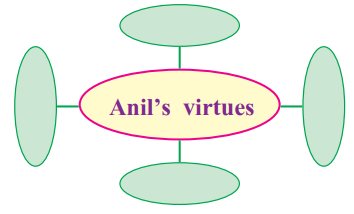
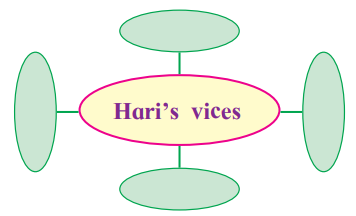
Complete the web diagrams:
(i) 

Image
(ii)
Image

A3. Activities based on Vocabulary:
Find similar meanings from the passage for the following:
(i) endearing
(ii) miscalculated
(iii) humbly
(iv) awful
A4. Do as directed:
(i) I can't pay you. (Rewrite making it affirmative.)
(ii) "I want to work for you," I said. (Change into Indirect speech.)
A5. Personal Response:
(i) Why did Anil employ Hari as a cook, even though he could not afford to pay him?

A1.Simple Factual Activities:
(i) The gift Jim had brought for Della was __________ .
(ii) The beautiful present flashed with __________ .

   White fingers and nimble tore at the string and paper. And then an ecstatic scream of joy; and then, alas! a quick feminine change to hysterical tears and wails, necessitating the immediate employment of all the comforting powers of the lord of the flat.
   For there lay The Combs—the set of combs, side and back, that Della had worshipped long in a Broadway window. Beautiful combs, pure tortoise shell, with jeweled rims—just the shade to wear in the beautiful vanished hair. They were expensive combs, she knew, and her heart had simply craved and yearned over them without the least hope of possession. And now, they were hers, but the tresses that should have adorned the coveted adornments were gone.
   But she hugged them to her bosom, and at length she was able to look up with dim eyes and a smile and say: “My hair grows so fast, Jim!”
   And then Della leaped up like a little singed cat and cried, “Oh, oh!”
   Jim had not yet seen his beautiful present. She held it out to him eagerly upon her open palm. The dull precious metal seemed to flash with a reflection of her bright and ardent spirit.
   “Isn’t it a dandy, Jim? I hunted all over town to find it. You’ll have to look at the time a hundred times a day now. Give me your watch. I want to see how it looks on it.”
   Instead of obeying, Jim tumbled down on the couch and put his hands under the back of his head and smiled.
  “Dell,” said he, “let’s put our Christmas presents away and keep ‘em a while. They’re too nice to use just at present. I sold the watch to get the money to buy your combs. And now suppose you put the chops on.”
   The magi, as you know, were wise men— wonderfully wise men—who brought gifts to the Babe in the manger. They invented the art of giving Christmas presents. Being wise, their gifts were, no doubt, wise ones, possibly bearing the privilege of exchange in case of duplication. And here I have lamely related to you the uneventful chronicle of two foolish children in a flat who most unwisely sacrificed for each other the greatest treasures of their house. But in a last word to the wise of these days let it be said that of all who give gifts, these two were the wisest. Of all who give and receive gifts, such as they are wisest. Everywhere they are wisest. They are the magi.

A2. Complex Factual Activity:
Pick out and rewrite the exact sentences which indirectly imply the following :
(i) Della's elated mood underwent a change as she opened her gift.
(ii) Jim wanted to put the Christmas presents away and get back to daily life.
A3. Activity based on Vocabulary:
FIII in the blanks with words from the passage that are the opposites of the underlined words :
(i) Something that is not ______ is ______ .
(ii) Something that is not ______ is ______ .
(iii) Men who are not ______ are ______ .
(iv) Something that is not ______ is ______.
A4. Activities based on Contextual Grammar:
Add the appropriate Guestion Tags :
(i) Della leaped up, ....... ?
(ii) You'll have to look at the time, ........ ?
(iii) They were expensive combs, ........ ?
(iv) My hair grows so fast, ........ ?.
A5. Personal Response:
(i) Justify the title of the story, 'The Gift of the Magi'.

A1. Simple Factual Activities:
Complete the following :
Image

    Ten years later, when we were designing the first Macintosh computer, it all came back to me. And we designed it all into the Mac. If I had never dropped in on that course in college the Mac would have never had multiple typefaces or for that matter even proportionally spaced fonts.
   And since Windows just copied Mac, it’s likely no personal computer would have them. Of course it was impossible to connect the dots looking forward when I was in college. But it was very clear looking backwards 10 years later.
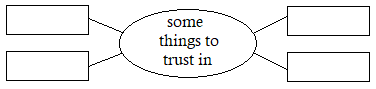
   You can’t connect the dots looking forward; you can only connect them looking backwards. So you have to trust that the dots will somehow connect in your future. You have to trust in some things - your gut,destiny, life, karma, whatever. This approach has never let me down, and it has made all the difference in my life.

A2. Complex Factual Activities:
Say how:
(i) You can connect dots.
A3. Activities based on Vocabulary:
Match the words/phrases in column A with their meanings in column B:

(A)(B)
 (i) gut (a) Macintosh computer.
 (ii) destiny (b) having several parts.
 (iii) Mac (c) the power believed to control events.
 (iv) multiple (d) courage and determination.

A4. Activities based on Contextual Grammar:
(i) It was impossible to connect the dots looking forward.(Pick out the verbs and say if they are finite or non-finite.)
(ii) It was very clear.(Rewrite as an exclamatory sentence.)
A5. Personal Response:
(i) Write about something which you learned in the past and which has helped you in the present.