Question
A1. Simple Factual Activities:
Answer in one-two words:
(1) Coach
(2) Interviewer
(3) Place of Training
(4) Total medals won in 2012 Olympics by India

     In an exclusive interview with Sportskeeda correspondent Taruka Srivastava, Olympic Bronze medalist Mary Kom talked about her preparation for the Olympics and her elation at winning a medal.
Interviewer : First things first- you’re the first Indian female boxer to win an Olympics medal for India. Has the feeling completely sunk in ?
Mary Kom : I am really happy with my achievement and yes it is yet to sink in. I am just so exhilarated.
Interviewer : You were the only female representative from India in boxing. Did that put additional pressure on you?
Mary Kom : No, not at all. I was pretty confident about myself. I knew.
Interviewer : Your coach Charles Atkinson was not allowed to accompany you to the Olympics. How did that affect your preparations ?
Mary Kom : Well I did miss him there but thankfully, we had already done our homework and I was well prepared.
Interviewer : During your preparations for the Olympics, you sparred with the male boxers of the Indian contigent. Who was your favourite sparring partner ?
Mary Kom : (Laughs) Well, I trained hard in Pune and the male boxers were kind enough to practise with me whenever I required them. To name a favourite would be unfair.
Interviewer : You were quoted saying “Adams was very clever, a counter - puncher but, although she carried power, she wasn’t very tactical. I was scoring but the judges were not pressing the buttons.” Do you think dodgy judging was part of the reason for
your loss in the semi - finals?
Mary Kom : Yes, I think some of the decisions were unfortunate and did not work to my benefit.
Interviewer : India managed just 6 medals in the 2012 Olympics even though we are a nation of 1.3 billion people. Where do you think a change is required to help us win medals that are proportionate with our population ?
Mary Kom : I think more and more people should take up sports as a full - time career if we want more gold medals. More corporates should come in and sponsor players so that the players don’t have any financial pressure and can just focus on their games.

A2. Complex Factual Activities:
(1) What failed to pressurize Mary Kom during the Olympics? 
A3. Activities based on Vocabulary:
Make sentences of your own using the following words:
(1) elation:
(2) sponsor:
A4. Activities based on Contextual Grammar:
Do as directed:
(1) Charles Atkinson was not allowed to accompany Mary to the Olympics.
(Make it affirmative.)
(2) Some of the decisions did not work to my benefit. (Make it Affirmative.)
A5. Personal Response:
(1) Do you think financial support is very necessary for the sportsmen? Why? 
Answer

A1. Simple Factual Activities:
(1) Charles Atkinson
(2) Sportskeeda correspondent Tarukal Srivastava
(3) Pune
(4) 6
A2. Complex Factual Activities:
(1) She was the only female representative from India and her coach Charles Atkinson was not allowed to accompany her to the Olympics failed to pressurize Mary Kom during the Olympics.
A3. Activities based on Vocabulary:
(1) My father is a man who seldom gives away to elation of mind.
(2) The sports events of the club were sponsored nsored by Seth Narayandas Zaveri.
A4. Activities based on Contextual Grammar:
(1) Charles Atkinson was prevented from accompanying Mary to the Olympics.
(2) Some of the decisions hardly worked to my benefit.
A5. Personal Response:
(1) The sportsmen whose financial condition is not good cannot afford proper diet due to lack of money. They can neither buy sports material necessary for them nor participate in some important events due to shortage of money. If they get good financial support, they can get training from a good coach to improve their game. So it is very necessary for them to get financial support.

Need a full question paper?

Generate a complete, print-ready paper with questions like this in minutes — across 16+ boards, with answer keys.

Start Generating Free

Similar questions

A1. Simple Factual Activities:
(1) Complete the following sentences:
Small groups, local organisations and individuals are  _______________ .
(2) Name the following:
The daughters of Kailash Satyarthi mentioned in this passage: 

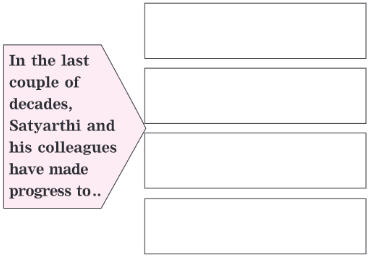
     We have made progress in the last couple of decades. We have reduced the number of out-ofschool children by half. We have reduced the number of child labourers by a third. We have reduced child mortality and malnutrition, and we have prevented millions of child deaths.
     But, let us make no mistake, great challenges still remain.
     Friends! The biggest challenge or biggest crisis knocking on the doors of humankind is fear and intolerance.
     We have utterly failed our children in imparting an education. An education that gives the meaning and objective of life. An education that gives a sense of global citizenship among the youth.
     I am afraid that the day is not very far away when the cumulative result of this failure, will culminate in an unprecedented violence, and that will be suicidal for humankind.
     Rights, security, hope can only be restored through education.
     Young people like Malala ... I’ve started calling her my daughter Malala not just Malala ... So my daughter Malala and other daughters including Kayanat.. in fact.. two Kayanats, and Shazia, and the daughters from Africa, and from all over the world. They are rising up and choosing peace over violence, tolerance over extremism, and courage over fear.
     The solutions are emerging. But these solutions cannot be found in the deliberations in conferences alone, and cannot be found in prescriptions from a distance.
     They lie in small groups and local organisations and individuals, who are confronting with the problem every day. Even if they remain unacknowledged, unrecognised and unknown to the world the solution are with them.

A2. Complex Factual Activities:
Complete the following web stating the sign of progress mentioned by Satyarthi :
Image
A3. Activities based on Vocabulary:

Find out the describing words used for the following nouns and make your own sentences by using any three combinations:
(1) challenges
(2) organisations
(3) citizenship
(4) groups
A4. Activities based on Contextual Grammar:

(1) Find out and write four sentences from the passage that are in Present Perfect Tense:
A5. Personal Response:
(1) What is the role of education in nation building? 
A1. Simple Factual Activity:
Complete the sentences using the information from the passage:
(1) Sitaram was looking out for any job _______________ .
(2) The lady of the house was _______________.

    Nathu grumbled to himself as he swept the steps of the Pipalnagar Bank, owned by Seth Govind Ram. He used the small broom hurriedly and carelessly, and the dust, after rising in a cloud above his head settled down again on the steps. As Nathu was
banging his pan against a dustbin, Sitaram, the washerman’s son, passed by.
    Sitaram was on his delivery round. He had a bundle of freshly pressed clothes balanced on his head.
    ‘Don’t raise such dust!’ he called out to Nathu. ‘Are you annoyed because they are still refusing to pay you an extra two rupees a month?’
    ‘I don’t wish to talk about it,’ complained the sweeper-boy. ‘I haven’t even received my regular pay. And this is the twentieth of the month. Who would think a bank would hold up a poor man’s salary? As soon as I get my money, I’m off! Not another week I work in this place.’ And Nathu banged the pan against the dustbin several times, just
to emphasize his point and giving himself confidence.
    ‘Well, I wish you luck,’ said Sitaram. ‘I’ll keep a lookout for any jobs that might suit you.’ And he plodded barefoot along the road, the big bundle ofclothes hiding most of his head and shoulders.
     At the fourth home he visited, Sitaram heard the lady of the house mention that she was in need of a sweeper. Tying his bundle together, he said; ‘I know of a sweeper boy who’s looking for work. He can start from next month. He’s with the bank just now but they aren’t giving him his pay, and he wants to leave.’
    ‘Is that so?’ said Mrs. Srivastava. ‘Well, tell him to come and see me tomorrow.’ 

A2. Complex Factual Activity:
Write in your own words a few sentences about the following:
(i) Nathu
A3. Activities based on Vocabulary:

Do as directed:
(1) He called out to Nathu. (Rewrite the sentence in Past Continuous Tense.)
(2) Mrs Srivastava said, "Tell him to come and see me tomorrow." (Change into indirect speech.)
A4. Activities based on Contextual Grammar:

Column 'A'Column 'B'
 (1) small (a) man
 (2) pressed (b) pay
 (3) regular (c) clothes
 (4) poor (d) broom

A5. Personal Response:
(1) What makes you angry? What do you do then?

A1. Simple Factual Activities:
State whether the following statements are Right or Wrong. Correct the wrong ones:
(i) The beggar and the young girl were playing on the road because there was a lot of traffic.
(ii) The scene of the beggar and the girl made Meena peep into her own life. 
(iii) The beggar became Meena's role model.
(iv) It took Meena almost two years to put the change into effect.

     ‘Yes, a beggar,’ she repeated, as if to reassure me. ‘He was old and used to stay in front of my house with his five-year old granddaughter. As you know, I was a chronic pessimist. I used to give my leftovers to this beggar every day. I never spoke to him. Nor did he speak to me. One monsoon day, I looked out of my bedroom window and started cursing the rain. I don’t know why I did that because I wasn’t even getting wet. That day I couldn’t give the beggar and his granddaughter their daily quota of leftovers. They went hungry, I am sure.
     ‘However, what I saw from my window surprised me. The beggar and the young girl were playing on the road because there was no traffic. They were laughing, clapping and screaming joyously, as if they were in paradise. Hunger and rain did not matter.They were totally drenched and totally happy. I envied their zest for life.
     ‘That scene forced me to look at my own life. I realized I had so many comforts, none of which they had. But they had the most important of all assets, one which I lacked. They knew how to be happy with life as it was. I felt ashamed of myself. I even started to make a list of what I had and what I did not have. I found I had more to be grateful for than most people could imagine. That day, I decided to change my attitude towards life, using the beggar as my role model.’
      After a long pause, I asked Meena how long it had taken her to change.
     ‘Once this realization dawned’, she said, ‘it took me almost two years to put the change into effect. Now nothing matters. I am always happy. I find happiness in every small thing, in every situation and in every person.’
     ‘Did you give any gurudakshina to your guru ?’ I asked.
     ‘No. Unfortunately, by the time I understood things, he was dead. But I sponsored his granddaughter to a boarding school as a mark of respect to him.’

A2. Complex Factual Activities:

(1) Meena sponsored the granddaughter of the beggar because _______________.
(a) she was alone in her life after his death.
(b) it was a token of respect to the beggar.
(c) she was rich and so she wanted to help.
(2) _______________ was the most important of all assets, that the beggar and his granddaughter had but the writer was lacking.
(a) Attitude towards life
(b) So many comforts
(c) Hunger. 
A3. Activities based on Vocabulary:
Match the synonyms:

Column 'A'Column 'B'
 (1) paradise (a) enthusiasm
 (2) zest (b) valuable thing
 (3) asset (c) wet
 (4) drenched (d) heaven

A4. Activities based on Contextual Grammar:
(1) Do as directed:
He used to stay in front of my house.
(Rewrite the sentence by using 'would'.)
(2) Change the voice:
That scene forced me to look at my own life.
(Begin the sentence with "I .....)
A5. Personal Response:
(1) According to you, how can we help beggars?

A1. Simple Factual Activities:
Complete the following sentences:
(1) Soldiers called Joan _______________.
(2) Joan wanted _______________.
(3) The shortest way to save your skin is to _______________.
(4) According to Joan, their soldiers are always beaten because they fight _______________.

Poulengey : (Going to the window) Yes! Joan, come up. (Joan enters.)
Poulengey : (Gravely) Be seated, Joan.
Robert : What is your name ?
Joan : They always called me Jenny, in Lorraine. Here in France, I am Joan. The soldiers call me the Maid.
Robert : How old are you ?
Joan : Seventeen, so they tell me. It might be nineteen. I don’t remember.
Robert : I suppose you think raising a siege is as easy as chasing a cow out of a meadow. You think soldiering is anybody’s job ?
Joan : I don’t think it can be very difficult if God is on your side.
Robert : (Grimly) Have you ever seen English soldiers fighting? Have you ever seen them plundering, burning, turning the countryside into a desert ? Have you heard no tales of their prince who is the devil himself, or of the English king’s father ?
Joan : You do not understand, squire. Our soldiers are always beaten because they are fighting only to save their skins and the shortest way to save your skin is to run away. But I will teach them all to fight for France. Then, they will drive the soldiers before them like sheep. You and Polly will live to see the day when there will not be a single English soldier on the soil of France.
Robert : (To Poulengey) This may all be nonsense, Polly. But the troops might just be inspired by it though nothing that we say seems to put any fire into them. Even the Dauphin might believe it. And if she can put some fire into him, she can put it into anybody.
Robert : (Turning to Joan) Now you, listen to me and don’t cut in before I have time to think. Your orders are that you are to go to Chinon under the escort of this gentleman and three of his friends.
Joan : (Radiant, clasping her hands) Oh, thank you, squire !
Poulengey : How is she to get into the royal presence ?
Robert : I don’t know. How did she get into my presence ? I will send her to Chinon and she can say I sent her. Then, let come what may. I can do no more.
Joan : And the dress ? I may have a soldier’s dress, squire ?
Robert : Take what you please. I wash my hands off it.
Joan : (Wildly excited by her success) Come, Polly. (She dashes out.)
Robert : (Shaking Poulengey’s hand) Goodbye, old man, I am taking a big chance. Few other men would have done it.

A2. Complex Factual Activities:
(1) What shows Joan was a person of immense faith?
A3. Activities based on Vocabulary:
Find out synonyms:
(1) looting - 
(2) seriously - 
(3) following - 
(4) hayfield - 
A4. Activities based on Contextual Grammar:
Rewrite as affirmative sentences:
(1) I don't remember.
(2) YYou do not understand Squire.
A5. Personal Response:
(1) Do you love your country? Why? 
A1. Simple Factual Activities:
Match the comparisons as given in the passage:

'A' 'B'
 (1) The Dauphin is (a) she is
 (2) Joan of Arc (b) like a rat in a corner
  (c) a bit of miracle

Robert : (To the steward) Is this true about Monsieur de Poulengey ?
Steward : (Eagerly) Yes, sir, and about Monsieur de Metz too. They both want to go with her.
Robert : (Goes to the window, and shouts into the court-yard) Send Monseiur de Poulengey to me, will you ? (He turns to Joan) Get out and wait in the yard.
Joan : (Smiling brightly at him) Right, squire. (She goes out).
Robert : (To the steward) Go with her. Stay within call and keep your eye on her. I shall have her up here again. (The steward retreats hastily. Bertran de Poulengey, a French guard, enters, salutes and stands waiting.)
Robert : She says you, Jack and Dick have offered to go with her. What for ? Do you take her crazy idea of going to the Dauphin seriously ?
Poulengey : (Slowly) There is something about her. It may be worth trying.
Robert : Oh, come on Polly! You must be out of your mind !
Poulengey : (Unmoved) What is wrong with it ? The Dauphin is in Chinon, like a rat in a corner, except that he won’t fight. The English will take Orleans. He’ll not be able to stop them.
Robert : He beat the English the year before last at Montargis. I was with him. Poulengey : But this time, his men are cowed and now he can’t work miracles. And I tell you that nothing can save our side now but a miracle.
Robert : Miracles are all right, Polly. The only difficulty about them is that they don’t happen nowadays.
Poulengey : I used to think so. I’m not so sure now. There is something about her. I think the girl herself is a bit of a miracle. Anyhow, this is our lastchance. Let’s see what she can do.
Robert : (Wavering) You really think that ?
Poulengey : (turning) Is there anything else left for us to think? Let’s take a chance. Her words have put fire into me.
Robert : (Giving up) Whew! You’re as mad as she is.
Poulengey : (Obstinately) We want a few mad people now. See where the sane ones have landed us !
Robert : I feel like a fool. Still, if you feel sure... ?
Poulengey : I feel sure enough to take her to Chinon unless you stop me.
Robert : Do you think I ought to have another talk with her ?

A2. Complex Factual Activities:
Answer the following:
(1) What did Robert tell the Steward? 
(2) What did Robert accuse Poulengey of?
A3. Activities based on Vocabulary:
(1) Find out two adjectives and two adverbs from the passage:
A4. Activities based on Contextual Grammar:
Choose the correct question tag:
(1) The Steward retreats hastily, _______________
(2) You are as mad as she is, _______________
(3) I am not so sure now, _______________
(4) Jack and Dick have offered to go with her, _______________
A5. Personal Response:
(1) What is your opinion about Joan?

A1. Simple Factual Activities:
Name the following: 
(1) Original name of Madame Curie.
(2) Her place of birth.

     The history of men’s progress from the darkness of ignorance to the glorious light of knowledge and enlightenment is full of chapters that tell of extraordinary men and women. These men and women worked with great courage, commitment, dedication and singleness of purpose in their effort to attain what seemed to be unattainable. These men and women were driven in their effort to uncover the truth and mystery of the universe with an indomitable spirit which characterises the human spirit. And this is the spirit that drove Columbus and Vasco de Gama to sail to the unknown seas, Robert Peary to race to the Pole, Sir Ronald Ross to fight against malaria, Hillary and Tenzing to reach the top of Everest, and Armstrong and his team to go to the moon. 
     One great woman who dedicated her life to the cause of science and to the welfare of humanity is Madame Curie, the discoverer of radium. The mere statement that Madame Curie discovered the radium will never tell the true story of the extraordinary courage, determination and singleness of purpose that this noble woman showed in the face of extreme poverty, pain and suffering that comes along with such condition.
     Born Maria Sklodowska in Warsaw, Poland on November, 7 1867, Marie Curie’s childhood dream was to study science in Paris, but her father could not afford the expense for this. So Maria took a job as a governess and saved a little money. With that little money she finally went to Sorbonne, the University of Paris, to study science. Her father could send her only a small amount and her life in the university was a disheartening experience in poverty and hunger. She lived only on bread, butter and tea, and she often fainted for lack of food. In spite of all this she pursued her studies indomitably and she topped her class with Honours in Physics and Mathematics.
     It was at the university that she met a Frenchman, Pierre Curie, a brilliant but poor scientist. Then they together began to work in a shabby laboratory. Soon, their friendship turned into love and in less than a year, in July, 1895, they were married. The couple then took a flat in Paris with scarcely any furniture in it except their books, a lamp, a white wooden table and two chairs.
      After the birth of a daughter, Irene, the next year, Marie and Pierre set up a laboratory in a wooden shed near their flat, It had a leaky skylight and an earthen floor. Here Marie, after her daily household work, settled down to study.

A2. Complex Factual Activities:
Complete the following sentences: 
(1) Madame Curie dedicated her life to the cause _______________ and to the _______________.
(2) The qualities that great achievers possess are _______________ and _______________.
A3. Activities based on Vocabulary:
Find out the words from the passage which mean:
(1) unbeatable
(2) discouraging
(3) hardly
(4) illiteracy
A4. Activities based on Contextual Grammar:
(1) took a job as a governess and saved a little money. (Rewrite using 'by' + ing.)
(2) Marie Curie's childhood dream was to study science in Paris, but her father could not afford the expense for this. (Rewrite using "Though')
A5. Personal Response:
(1) Describe your favourite scientist.
A1. Simple Factual Activity:
Complete the following sentences with the help of the information from the passage:
(1) Dr. Stephen Hawking was born on _______________.
(2) Courage is the quality _______________.

    Exactly 300 years after the death of the great scientist Galileo, Dr Stephen Hawking was born in Oxford, London on the eighth day of January 1942. Little did his parents know that one day their little boy would be hailed as one of the greatest scientists
of this century. Neither could anybody imagine that his mind would soar up into space like light. More importantly, none could predict that he would be the very epitome of courage.
    Courage is a wonderful thing. It is that quality, which makes people not lose heart when faced with a great calamity. It would not be an exaggeration to say that Dr Stephen Hawking, a living legend of Cosmology, is the very personification of courage
and hope. Except his mind, his whole body is bound to a wheelchair, thanks to a cruel quirk of fate. Yet, he is one of the greatest scientists of this century.
     An average child, Stephen grew up to be a normal teenager, full of mischief and lots of love for music and mathematics. Even though his father wanted him to study medicine, he was bent on studying mathematics. The University of Oxford, at that time, did not have a course in mathematics so he opted to study physics instead. 

A2. Complex Factual Activity:
(1) What do you know about Dr. Stephen Hawking from this passage? 
A3. Activities based on Vocabulary:
Classify the following words into verbs, adjectives and nouns:
whole, know, little, predict, calamity, legend, mind, physics, great, imagine, wonderful, cruel, courage, faced, grew, heart, fate, course.people.
A4. Activities based on Contextual Grammar:
Make the following sentences exclamatory:
(i) Courage is truly a wonderful thing.
(ii) He was very clumsy.
A5. Personal Response:
(1) Do you think, that courage is a wonderful thing? Why do you think so?
A1. Simple Factual Activity:
State whether you Agree or Disagree with the following statements:
(1) Swami is a close-mouthed little kid.
(2) Swami hated Mathematics even worse.

     A little bit about the book...
     Anything I mention about the book can be mistakenly understood as 'spoilers', so I would rather give a glance into the book without mentioning any events or plots of the story.
     Swami is a mischievous little kid of about 10 years old and living in the era where India was under the British rule... Like most kids of that age, Swami is a kid who cannot stay at one place and absolutely hates school, even worse Mathematics. School is his absolute nightmare. Anyway the story unfolds around the happenings of this kid and how he constantly gets into trouble and gets a good beating from his father.
      Swami is a talkative little kid and thinks that’s his way of facing life, talking himself out of everything. But he does learn the truth the harsh way. As many teens back then, all he wants to do is play under the sun, kick something, climb a tree, break something and harass somebody (unlike kids today!!!). This, in fact, was (and in most parts of India, still is) the life of a typical boy growing up. Technology isn’t big in a kid's life. All they want is to play havoc!!!
       In what ways is Swami a typical boy in his growing years ?
       In this regard, Narayan gets deeply into the workings of Swami’s ten year old mind, explaining exquisitely how he thinks and what his perspective of the world is. The reader does feel like Swami and gets very attached with the character as the story progresses. That's the magic of Narayan.

A2. Complex Factual Activity:
(1) Describe Swami's characteristics in 3-4 sentences. 
A3. Activities based on Vocabulary:
Underline the odd man:
(i) mentioning, happenings, everything, facing
(ii) mischievous, truth, talkative, typical
(iii) give, mention, stay, life
(iv) constantly, absolutely, lovely, deeply
A4. Activities based on Contextual Grammar:
Frame Wh-questions to get the underlined parts as answers:
(1) Narayan gets deeply into the working of Swami's mind.
(2) That's the magic of Narayan.
A5. Personal Response:
(1) Do you think, that even today most of our kids like to live the life Swami was living?
A1. Simple Factual Activities:
Who said to whom :
(1) "Yes, Aunty, you are right. You all thought I was a dumb-driven cow."
(2) "I will serve you and mother and I will teach in the same school where I learnt so much."

      Bholi turned violently on the old woman, “Yes, Aunty, you are right. You all thought I was a dumbdriven cow. That’s why you wanted to hand me over to this heartless creature. But now the dumb cow, the stammering fool, is speaking. Do you want to hear more ?”
     Bishamber Nath, the grocer, started to go back with his party. The confused bandsmen thought this was the end of the ceremony and struck up a closing song.
     Ramlal stood rooted to the ground, his head bowed low with the weight of grief and shame.
     The flames of the sacred fire slowly died down.Everyone was gone. Ramlal turned to Bholi and said, “But what about you, no one will ever marry you now. What shall we do with you ?”
     And Sulekha said in a voice that was calm and steady, “Don’t you worry, “Pitaji! In your old age I will serve you and mother and I will teach in the same school where I learnt so much. Isn’t that right, Ma’am ?”
    The teacher had all along stood in a corner, watching the drama. “Yes, Bholi, of course,” she replied. And in her smiling eyes was the light of a deep satisfaction that an artist feels when contemplating the completion of her masterpiece.

A2. Complex Factual Activities:
Complete the following:
(1) Beside the humiliation and grief, Ramlal was afraid of Bholi's marriage as he thought that no one would ever marry Bholi.
(2) Bholi told her father in a calm and steady voice that she would serve him and mother in their old age and she would teach in the same school where she learnt so much.
A3. Activities based on Vocabulary:
Complete the following sentences by choosing the words given in the brackets:
(1) We are _______________ seriously about buying a new apartment (completing/contemplating)
(2) She _______________ disagreed with what we said. (slowly/violently)
A4. Activities based on Contextual Grammar:
Correct the error in the following sentence.Focus on verb and subject:
(1) Do you wants to hear more?
(2) Aren't that right?
A5. Personal Response:
(1) 'The teacher is an artist. Do you agree with the statement? Justify your answer. 
A1. Simple Factual Activities:
Name the following:
(1) Military officer
(2) A peasant girl
(3) The oldest son of the King France
(4) The persons who Joan needed to free Orleans

    The war fought between England and France from 1337 to 1453 has come to be known as the Hundred Years War. Joan was a peasant girl born in eastern
France who led the French army to several victories during this war.
    This play begins at the time when all of northern France and some parts of the south-west were under foreign control. The English controlled some parts and the Burgundians controlled the others. The city of New Orleans, one of the few remaining French cities was held by the English. The year is 1429. Captain Robert de Baudricourt, a military officer is seated at the table. His steward stands facing him.
Robert : I told you to throw the girl out. You have fifty armed soldiers and dozens of strong servants to carry out my orders. Are they afraid of her ?
Steward : No sir, we are afraid of you, but she puts courage in us. She really doesn’t seem to be afraid of anything. Perhaps you could frighten her, sir.
Robert : (grimly) Perhaps, where is she now ?
Steward : Down in the courtyard, sir.
(Robert goes to the window and asks the soldiers to send the girl up)
(The girl enters. She is a well-built, strong country girl of 17 to 18 years. The squire’s glare neither frightens her nor stops her. She speaks confidently.)
Joan : Good morning, captain squire. You are to give me a horse and armour and some soldiers, and send me to the Dauphin.
Robert : This girl is mad. Why didn’t you tell me so, you blockhead ?
Steward : Sir, do not anger her. Give her what she wants.
Robert : I shall send you back to your father with orders to put you under lock and
key.
Joan : You think you will, squire. But it won’t happen that way. You said you would not see me. But here I am.
Robert : So, you are assuming that I’ll give
you what you want.
Joan : Yes, squire. (Continues busily) A horse will cost sixteen francs. It is a big
amount of money. But I can save it on the armour. I don’t need beautiful armour made to my measure. I can find a soldier’s armour that will fit me well enough. I shall not want many soldiers. The Dauphin will give me, all I need, to free Orleans.
Robert : (Shocked) To free Orleans !
Joan : (Simply) Yes, squire. Three men will be enough for you to send with me.
Polly and Jack have promised to come with me.
Robert : You mean Monsieur de Poulengey ?
Joan : Yes, Squire Jack will come willingly. He is a very kind gentleman, and gives me money to give to the poor. I think John Godsave will come, and Dick the Archer, and their servants, John of Honecourt and Julian. There will be no trouble for you, squire. I have arranged it all. You have only to give the order.

A2. Complex Factual Activities:
(1) Why had Joan wanted to meet the Captain Squire? 
A3. Activities based on Vocabulary:
Give one word for the following:
(1) A person of high rank
(2) A stupid person
(3) To take for granted
(4) Military unit consisting of armoured fighting vehicles
A4. Activities based on Contextual Grammar:
(1) He is a very kind gentleman. (Make it exclamatory.)
(2) She is a well-built strong country girl. (Make it exclamatory.)
A5. Personal Response:
(1) Describe any brave lady as Joan of Arc, from India who fought for her nation.