Question
A1. Simple Factual Activity:
State whether you Agree or Disagree with the following statements:
(1) Swami is a close-mouthed little kid.
(2) Swami hated Mathematics even worse.

     A little bit about the book...
     Anything I mention about the book can be mistakenly understood as 'spoilers', so I would rather give a glance into the book without mentioning any events or plots of the story.
     Swami is a mischievous little kid of about 10 years old and living in the era where India was under the British rule... Like most kids of that age, Swami is a kid who cannot stay at one place and absolutely hates school, even worse Mathematics. School is his absolute nightmare. Anyway the story unfolds around the happenings of this kid and how he constantly gets into trouble and gets a good beating from his father.
      Swami is a talkative little kid and thinks that’s his way of facing life, talking himself out of everything. But he does learn the truth the harsh way. As many teens back then, all he wants to do is play under the sun, kick something, climb a tree, break something and harass somebody (unlike kids today!!!). This, in fact, was (and in most parts of India, still is) the life of a typical boy growing up. Technology isn’t big in a kid's life. All they want is to play havoc!!!
       In what ways is Swami a typical boy in his growing years ?
       In this regard, Narayan gets deeply into the workings of Swami’s ten year old mind, explaining exquisitely how he thinks and what his perspective of the world is. The reader does feel like Swami and gets very attached with the character as the story progresses. That's the magic of Narayan.

A2. Complex Factual Activity:
(1) Describe Swami's characteristics in 3-4 sentences. 
A3. Activities based on Vocabulary:
Underline the odd man:
(i) mentioning, happenings, everything, facing
(ii) mischievous, truth, talkative, typical
(iii) give, mention, stay, life
(iv) constantly, absolutely, lovely, deeply
A4. Activities based on Contextual Grammar:
Frame Wh-questions to get the underlined parts as answers:
(1) Narayan gets deeply into the working of Swami's mind.
(2) That's the magic of Narayan.
A5. Personal Response:
(1) Do you think, that even today most of our kids like to live the life Swami was living?
Answer

A1. Simple Factual Activity:
(1) Dr Hawking is a very humble man, though he is considered Einstein's equal in intelligence.
(2) Dr Hawking expressed his thoughts with the help of his finger and with a computer.
A2. Complex Factual Activity:
(1) Swami is a mischievous and talkative little kid of about 10 years old. He cannot stay at one place. He hates going to school, hates Mathematics even worse. School is a frightening and unpleasant experience for him. He always gets into trouble and a good beating from his father. All he wants to do is play under the sun, kick something, climb a tree, break or damage something and harass (trouble) somebody. This is a typical life of the kid.
A3. Activities based on Vocabulary:
(i) mentioning, happenings, everything, facing
(ii) mischievous, truth, talkative, typical
(iii) give, mention, stay, life
(iv) constantly, absolutely, lovely, deeply
A4. Activities based on Contextual Grammar:
(1) How does Narayan get into working of Swami's mind?
(2) Whose magic is that?
A5. Personal Response:
(1) Yes, I definitely think so. It is the natural instinct of most of the kids to play, to make fun, to play mischiefs and enjoy the life like Swami. They try to avoid going to school under some pretext and dislike to learn some particular subjects. They often get beaten for their naughtiness, mistakes and their mischievous deeds. They do anything that comes to their mind, unintentionally.

Need a full question paper?

Generate a complete, print-ready paper with questions like this in minutes — across 16+ boards, with answer keys.

Start Generating Free

Similar questions

A1. Simple Factual Activities:
Say whether the following statements are True or False:
(1) A big male langur did not intend to kill the baby langur.
(2) The narrator ignored the commotion at first.
(3) The narrator rushed to the veranda to see where his family was.
(4) According to the custom of animal clan, a dominant male protects another male baby or adult.

   Suddenly, I heard a group of street dogs barking furiously in the distance. I chose to ignore the commotion thinking that the pack of dogs might have cornered a hapless pig. But soon, the barking became louder and more aggressive and the alarmed cawing of a flock of crows added to the cacophony. I also heard the disturbance approaching closer.       
    Curiosity got the better of me. Leaving the book aside, I rushed to the veranda to see what was going on.
    I glanced towards the roof of the club house and saw something horrible. A big male langur, apparently the leader of its group, was holding a baby langur in his hands and mercilessly biting it all over with a definite intent to kill. The helpless mother of the baby and other lesser members of the langur group were scattered on the roofs of the buildings nearby watching the baby being killed. I recalled the terrible custom in the animal clan according to which a dominant male usually does not allow another male baby or adult to survive within its group.
    Without losing any time, I gathered a stout stick in one hand and hurled a piece of stone at the marauding langur. The langur was so infuriated that it hardly took any notice of my assault. But then I started throwing more stones. The dogs on their part raised their pitch of cry.

A2. Complex Factual Activities:
(1) What wicked custom is practised by animals who live in groups?
A3. Activities based on Vocabulary:
Match the phrases given in Column 'A' with their meanings in Column 'B':

Column 'A'Column 'B'
 (1) to take notice of (a) overpowered someone
 (2) got the better of (b) was happening
 (3) pitch of cry (c) to observe and give attention
 (4) was going on (d) high sound of cry

A4. Activities based on Contextual Grammar:
(1) Rewrite the sentence as per the tense mentioned in the brackets:
The big male langur was holding a baby langur in his hands. (Past Perfect Continuous Tense.)
(2) Do as directed:
I started throwing more stones.(Begin with 'More stones were ....')
A5. Personal Response:
(1) Do you think that the custom of baby killing by dominant male in animal clan is good? Explain.

A1. Simple Factual Activity:
Complete the following sentences with the help of the passage:
(1) Specific goals make it easier to _______________.
(2) It is important to create goals that are _______________.

SMART goals have a specific rubric:
    Specific: Involves identifying a specific area for improvement. The more specific the area, the more refined the achievement of one’s goal can be. It makes it easier to set parameters and work towards the goal. For exaxmple, if it is building a house, what exactly is the capacity required and how long can it stretch ?
    Measurable: Quantifying goals provides specific ways to track progress against goals. This makes it easy to benchmark performance throughout the goal period, including areas to improve. While playing football, one’s exact role and position has to be clearly defined.
     Achievable: Setting goals that can be completed in the designated period of time. Often, these goals may act like stepping stones to help meet broader goals that further define a career. As students, we can’t become a President, a Prime Minister, but can hope to reach those heights in future.
      Realistic: It is important to create goals that are within one’s current skill set or area of expertise. Building expertise takes time, so expecting to become an expert in a short amount of time is unrealistic. Being realistic will make it easy to be successful at attaining goals. If defensive and not aggressive, the goal perhaps lacks realism. We must have the clear picture in mind and must have the ability to adhere to that picture.

A2. Complex Factual Activities:
(1) How does quantifying goals help us?
A3. Activities based on Vocabulary:
Find from the passage adjectives for the following:
(1) area
(2) period
(3) role
(4) stones 
A4. Activities based on Contextual Grammar:
Underline the Present Participles/ Infinitives: 
(1) It makes it easier to set parameters.
(2) These goals may act like stepping stones to help broader goals.
A5. Personal Response:
(1) Why is it necessary that our goals should be realistic?
A1. Simple Factual Activities:
Answer in few words:
(1) The age in which we live -
(2) The serious disconnect of the world -
(3) We can unite the world through -
(4) Children are questioning and watching our-

     We can do it ...
     You may ask that - what can one person do? I would recall a story of my childhood: A heavy fire had broken out in the forest. All the animals were running away, including lion, the king of the forest. Suddenly, then he saw a tiny bird rushing towards the fire. He asked the bird, “What are you doing?” To the lion’s surprise, the bird replied “I am going to extinguish the fire.” The lion laughed and said, “How can you do it keeping just one drop of water, in your beak?” The bird was adamant, and she said, “I am doing my bit.”
     Eighteen years ago, millions of individuals marched across the globe. And demanded a new international law for the abolition of worst form of child labour, and it has happened, we did it, millions of individuals did it.
     Friends! We live in an age of rapid globalisation. We are connected through high-speed Internet. We exchange our goods and services in one single global market. Thousands of flights every day connect us from one corner to another corner of the globe. But there is one serious disconnect and there is a lack of compassion. Let us inculcate and transform these individuals’ compassion into a global compassion.
Let us globalise compassion.
     Mahatma Gandhi said, “If we are to teach real peace in this world... we shall have to begin with the children.” I humbly add, let us unite the world through the compassion for our children.
     I ask - Whose children are they who stitch footballs, yet never played with one?
     Whose children are they who harvest cocoa, yet have never tasted chocolate?
     Whose children are they who are dying of Ebola?
     Whose children are they who are kidnapped and held hostage?
     They are all our children.
     I remember an eight-year-old girl we rescued from intergenerational forced labour from stone quarries. When she was sitting in my car right after her rescue, she asked me: “Why did you not come earlier?”
     Her angry question still shakes me – and has the power to shake the whole world. Her question is for all of us. What are we doing? What are we waiting for? How many girls will we allow to go without rescue?
     Children are questioning our inaction and watching our actions. We need collective actions with a sense of urgency.
     Every single minute matters, every single child matters, every single childhood matters.
     Therefore, I challenge the passivity and pessimism surrounding our children. I challenge this culture of silence and this culture of passivity, this culture of neutrality.

A2. Complex Factual Activities:

Complete the following web:
Image

A3. Activities based on Vocabulary:
Find out the describing words used for the following nouns and make your own sentence by using any one combination:
(1) _______________ globalisation
(2) _______________ compassion
A4. Activities based on Contextual Grammar:
Change these sentences into indirect speech:
(1) The lion asked the bird, "What are you doing?"
(2) The bird said to the lion, "I am going to extinguish the fire."
A5. Personal Response:
(1) What will you do for our country?
A1. Simple Factual Activities:
(1) Complete the following sentences:
Small groups, local organisations and individuals are  _______________ .
(2) Name the following:
The daughters of Kailash Satyarthi mentioned in this passage: 

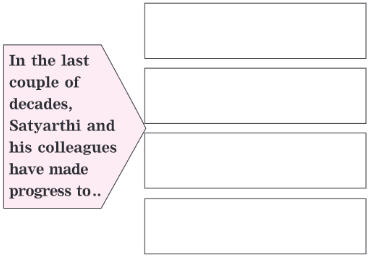
     We have made progress in the last couple of decades. We have reduced the number of out-ofschool children by half. We have reduced the number of child labourers by a third. We have reduced child mortality and malnutrition, and we have prevented millions of child deaths.
     But, let us make no mistake, great challenges still remain.
     Friends! The biggest challenge or biggest crisis knocking on the doors of humankind is fear and intolerance.
     We have utterly failed our children in imparting an education. An education that gives the meaning and objective of life. An education that gives a sense of global citizenship among the youth.
     I am afraid that the day is not very far away when the cumulative result of this failure, will culminate in an unprecedented violence, and that will be suicidal for humankind.
     Rights, security, hope can only be restored through education.
     Young people like Malala ... I’ve started calling her my daughter Malala not just Malala ... So my daughter Malala and other daughters including Kayanat.. in fact.. two Kayanats, and Shazia, and the daughters from Africa, and from all over the world. They are rising up and choosing peace over violence, tolerance over extremism, and courage over fear.
     The solutions are emerging. But these solutions cannot be found in the deliberations in conferences alone, and cannot be found in prescriptions from a distance.
     They lie in small groups and local organisations and individuals, who are confronting with the problem every day. Even if they remain unacknowledged, unrecognised and unknown to the world the solution are with them.

A2. Complex Factual Activities:
Complete the following web stating the sign of progress mentioned by Satyarthi :
Image
A3. Activities based on Vocabulary:

Find out the describing words used for the following nouns and make your own sentences by using any three combinations:
(1) challenges
(2) organisations
(3) citizenship
(4) groups
A4. Activities based on Contextual Grammar:

(1) Find out and write four sentences from the passage that are in Present Perfect Tense:
A5. Personal Response:
(1) What is the role of education in nation building? 
A1. Simple Factual Activities:
Answer in one-two words:
(1) Coach
(2) Interviewer
(3) Place of Training
(4) Total medals won in 2012 Olympics by India

     In an exclusive interview with Sportskeeda correspondent Taruka Srivastava, Olympic Bronze medalist Mary Kom talked about her preparation for the Olympics and her elation at winning a medal.
Interviewer : First things first- you’re the first Indian female boxer to win an Olympics medal for India. Has the feeling completely sunk in ?
Mary Kom : I am really happy with my achievement and yes it is yet to sink in. I am just so exhilarated.
Interviewer : You were the only female representative from India in boxing. Did that put additional pressure on you?
Mary Kom : No, not at all. I was pretty confident about myself. I knew.
Interviewer : Your coach Charles Atkinson was not allowed to accompany you to the Olympics. How did that affect your preparations ?
Mary Kom : Well I did miss him there but thankfully, we had already done our homework and I was well prepared.
Interviewer : During your preparations for the Olympics, you sparred with the male boxers of the Indian contigent. Who was your favourite sparring partner ?
Mary Kom : (Laughs) Well, I trained hard in Pune and the male boxers were kind enough to practise with me whenever I required them. To name a favourite would be unfair.
Interviewer : You were quoted saying “Adams was very clever, a counter - puncher but, although she carried power, she wasn’t very tactical. I was scoring but the judges were not pressing the buttons.” Do you think dodgy judging was part of the reason for
your loss in the semi - finals?
Mary Kom : Yes, I think some of the decisions were unfortunate and did not work to my benefit.
Interviewer : India managed just 6 medals in the 2012 Olympics even though we are a nation of 1.3 billion people. Where do you think a change is required to help us win medals that are proportionate with our population ?
Mary Kom : I think more and more people should take up sports as a full - time career if we want more gold medals. More corporates should come in and sponsor players so that the players don’t have any financial pressure and can just focus on their games.

A2. Complex Factual Activities:
(1) What failed to pressurize Mary Kom during the Olympics? 
A3. Activities based on Vocabulary:
Make sentences of your own using the following words:
(1) elation:
(2) sponsor:
A4. Activities based on Contextual Grammar:
Do as directed:
(1) Charles Atkinson was not allowed to accompany Mary to the Olympics.
(Make it affirmative.)
(2) Some of the decisions did not work to my benefit. (Make it Affirmative.)
A5. Personal Response:
(1) Do you think financial support is very necessary for the sportsmen? Why? 
A1. Simple Factual Activities:
State whether the following statements are Right or Wrong. Correct the wrong ones:
(1) The author and Meena were great enemies.
(2) Meena was a very cheerful person initially.

     Meena is a good friend of mine. She is an LIC officer earning a good salary. But there was always something strange about her. She was forever unhappy. Whenever I met her, I would start to feel depressed. It was as though her gloom and cynicism had a way of spreading to others. She never had anything positive to say on any subject or about any person.      
     For instance, I might say to her, ‘Meena, did you know Rakesh has come first in his school ?’     
     Meena’s immediate response would be to belittle the achievement. ‘Naturally, his father is a school teacher’, she would say.      
     If I said, ‘Meena, Shwetha is a very beautiful girl, isn’t she ?’ Meena would be pessimistic. ‘When a pony is young, he looks handsome. It is age that matters. Wait for some time. Shwetha will be uglier than anyone you know.’      
     ‘Meena, it’s a beautiful day. Let’s go for a walk’. 
     ‘No, the sun is too hot and I get tired if I walk too much. Besides, who says walking is good for health ? There’s no proof.’
     That was Meena. She stayed alone in an apartment as her parents lived in Delhi. She was an only child and had the habit of complaining about anything and everything. Naturally, she wasn’t a very pleasant company and nobody wanted to visit her. Then one day, Meena was transferred to Bombay and soon we all forgot about her.
     Many years later, I found myself caught in the rain at Bombay’s Flora Fountain. It was pouring and I didn’t have an umbrella. I was standing near Akbarallys, a popular department store, waiting for the rain to subside. Suddenly, I spotted Meena. My first reaction was to run, even in that pouring rain. I was anxious to avoid being seen by her, having to listen to her never-ending complaints. However, I couldn’t escape. She had already seen me and caught hold of my hand warmly. What’s more, she was very cheerful.
     ‘Hey ! I am really excited. It’s nice to meet old friends. What are you doing here ?’
     I explained that I was in Bombay on an official work.

A2. Complex Factual Activities:
Choose the correct alternative and rewrite the sentences:
(1) Meena who is an LIC officer, is _______________.
(a) a pessimistic person
(b) an optimistic person
(c) a disabled person.
(2) The writer was standing near Akbarallys, a popular department store because _______________.
(a) she was waiting for her friend Meena.
(b) she was waiting for the rain to stop.
(c) she wanted to buy something in Akbarallys.
A3. Activities based on Vocabulary:
Match the words with their meanings:

Group 'A'Group 'B'
 (1) gloom (a) to abate
 (2) cynicism (b) expecting the worst
 (3) subside (c) feeling of sadness
 (4) pessimistic (d) a distrustful attitude

A4. Activities based on Contextual Grammar:
(1) Choose the correct alternative of affirmative sentence:
She wasn't a very pleasant company.
(a) She was a very unpleasant company.
(b) She wasn't a very unpleasant company.
(c) She was a very pleasant company.
(d) She was a very beautiful company.
(2) Do as directed:
Meena is a LIC Officer.
(Frame a wh-question to get the underlined part as an answer)
A5. Personal Response:
(1) If you have a friend like Meena, what would be your attitude towards her?

A1. Simple Factual Activities:
Complete the sentences:
(1) A tiny bird was rushing towards _________.
(2) A heavy fire had broken out in the _________.
(3) The speaker is appealing to globalise _________.
(4) The tiny bird was going to _________.

     We can do it ...
     You may ask that - what can one person do? I would recall a story of my childhood: A heavy fire had broken out in the forest. All the animals were running away, including lion, the king of the forest. Suddenly, then he saw a tiny bird rushing towards the fire. He asked the bird, “What are you doing?” To the lion’s surprise, the bird replied “I am going to extinguish the fire.” The lion laughed and said, “How can you do it keeping just one drop of water, in your beak?” The bird was adamant, and she said, “I am doing my bit.”
     Eighteen years ago, millions of individuals marched across the globe. And demanded a new international law for the abolition of worst form of child labour, and it has happened, we did it, millions of individuals did it.
     Friends! We live in an age of rapid globalisation. We are connected through high-speed Internet. We exchange our goods and services in one single global market. Thousands of flights every day connect us from one corner to another corner of the globe. But there is one serious disconnect and there is a lack of compassion. Let us inculcate and transform these individuals’ compassion into a global compassion.
Let us globalise compassion.
     Mahatma Gandhi said, “If we are to teach real peace in this world... we shall have to begin with the children.” I humbly add, let us unite the world through the compassion for our children.
     I ask - Whose children are they who stitch footballs, yet never played with one?
     Whose children are they who harvest cocoa, yet have never tasted chocolate?
     Whose children are they who are dying of Ebola?
     Whose children are they who are kidnapped and held hostage?
     They are all our children.
     I remember an eight-year-old girl we rescued from intergenerational forced labour from stone quarries. When she was sitting in my car right after her rescue, she asked me: “Why did you not come earlier?”
     Her angry question still shakes me – and has the power to shake the whole world. Her question is for all of us. What are we doing? What are we waiting for? How many girls will we allow to go without rescue?
     Children are questioning our inaction and watching our actions. We need collective actions with a sense of urgency.
     Every single minute matters, every single child matters, every single childhood matters.
     Therefore, I challenge the passivity and pessimism surrounding our children. I challenge this culture of silence and this culture of passivity, this culture of neutrality.

A2. Complex Factual Activities:

Complete the following web:
Image

A3. Activities based on Vocabulary:
(1) Use the word 'stitch' as a Noun and a Verb in separate meaningful sentences.
A4. Activities based on Contextual Grammar:
Add a question tag:
(1) We are connected through high-speed internet.
(2) We exchange our goods and services in one single global market.
A5. Personal Response:
(1) What lesson does the story of the lion and the tiny bird teach us? 
A1. Simple Factual Activity:
Name the following:
(1) The International World Heritage Programme is administered by-
(2) The Nile valley contains many ancient-

     A World Heritage Site is a site determined by the United Nations Educational, Scientific and Cultural Organization (UNESCO) to have significant cultural or natural importance to humanity. As such the sites are protected and maintained by the
International World Heritage Programme which is administered by the UNESCO World Heritage Committee. Because World Heritage Sites are places that are significant culturally and naturally, they vary in type and include forests, lakes, monuments, buildings and cities.
    World Heritage Sites can also be a combination of both cultural and natural areas. For example, Mount Huangshan in China is a site with significance to human culture because it played a role in historical Chinese art and literature. The mountain is also
significant because of its physical landscape characteristics.
     Although the idea of protecting cultural and natural heritage sites around the world began in the early twentieth century, momentum for its actual creation was not until the 1950s. In 1954, Egypt started plans to build the Aswan High Dam to collect and control water from the Nile River. The initial plan for the dam’s construction would have flooded the valley containing the Abu Simbel Temples and scores of ancient Egyptian artefacts. To protect the temples and artifacts, UNESCO launched an international campaign in 1959 that called for the dismantling and movement of the temples to higher ground. The project cost an estimated US $80 million, $40 million of which came from 50 different countries. Because of the project’s success, UNESCO and the
International Council on Monuments and Sites initiated a draft convention to create an international organization responsible for protecting cultural heritage
 
A2. Complex Factual Activity:
(1) Why did UNESCO launch an international campaign in 1959? 
A3. Activities based on Vocabulary:
Find from the passage adjective forms for the following:
(1) culture (2) history (3) nature (4) significance
A4. Activities based on Contextual Grammar:
This does not mean that the book is filled with heavy Grammar.Rewrite the following sentences using 'not only ... but also' and 'as well as in two separate sentences:
(1) To protect the temples and artifacts, UNESCO launched an international campaign.
A5. Personal Response:
(1) What are our duties towards preservation of any historical site?
A1. Simple Factual Activities:
Say whether the following statements are True or False:
(1) The baby langur sensed the presence of his mother.
(2) The mother langur was sitting on the floor of the coop.
(3) The writer cuddled the baby langur tightly in his bosom.
(4) The writer's attention was fixed on the revival of the baby langur.

    My attention was fixed on the revival of the baby langur. Suddenly, I had an uncanny feeling of being watched. I turned away from the coop and looked up. There sat the mother langur on our kitchen roof, watching every move I made. She simply sat there quietly, as if convinced that no harm was being done to her child.
   Meanwhile, the baby sensed the presence of his mother and started to sob and cry a little louder. I retreated from the door of the coop to allow the mother access to her baby.
    Immediately, the mother descended on the floor of the coop and picked up the baby in her arms. She gave the baby a thorough body inspection to check his injuries and then cuddled him tightly in her bosom. The baby found great solace in her caring arms. The mother sat still with the baby in her lap for a few minutes. It was almost as if she was pondering over her options and trying to figure out how she could keep the baby safe from further assault.

A2. Complex Factual Activities:
Complete the following:
(1) Mother langur simply sat quietly because _______________.
(2) The baby langur started to sob and cry because _______________.
 
A3. Activities based on Vocabulary:
Match the words in column 'A' with their meanings in column 'B':

 Column 'A'Column 'B'
 (1) to figure out (a) to find comfort and peace.
 (2) to ponder over (b) the act of checking with complete attention and care.
 (3) to find solace (c) to be able to think until you solve the problem.
 (4) thorough inspection (d) think over something deeply.

A4. Activities based on Contextual Grammar:
Do as directed:
(1) I turned away from the coop and looked up.
(Begin the sentence with - Turning ... and rewrite it.) 
(2) She gave the baby a thorough body inspection.
(Change the sentence into passive voice. Begin with The baby...)
A5. Personal Response:
(1) What is your mother's state of mind during your illness?

A1. Simple Factual Activity:
Complete the following sentences:
(1) The inventory of the State Party is called _______________.
(2) Tentative List is included on the _______________ File.

     BECOMING A WORLD HERITAGE SITE
     There are five steps in becoming a World Heritage Site, the first of which is for a country or State Party to take an inventory of its significant cultural and natural sites. This is called the Tentative List and it is important because nominations to the World Heritage List will not be considered unless the nominated site was first included on the Tentative List. Next, countries are then able to select sites from their Tentative Lists to be included on a Nomination File. The third step is a review of the Nomination File by two Advisory Bodies consisting of the International Council on Monuments and Sites and the World Conservation Union, who then make recommendations to the World Heritage Committee. The World Heritage Committee meets once a year to review these recommendations and decide which sites will be added to the World Heritage List. The final step in becoming a World Heritage Site is determining whether or not a nominated site meets at least one of ten selection criteria. If the site meets these criteria, it can then be inscribed on the World Heritage List. Once a site goes through this process and is chosen, it remains the property of the country on whose territory it sits, but it also becomes considered within the international community.
 
A2. Complex Factual Activity:
Complete the following flow-chart by choosing from the options given below to show how any site of any country can become a World Heritage Site: 
(1) Inclusion of the name of a site from the tentative list to the nomination file.
(2) Name of the site is inscribed on the World Heritage list after meeting the criteria.
(3) Inclusion of the name of site for the nomination in a tentative list after an inventory in the country or the state.
(4) Decision of the World Heritage Committee after the review of the nominated file.
(5) A review of the file included by the advisory bodies.
A3. Activities based on Vocabulary:
Match the words in Column 'A' with their meanings in Column 'B':

 Column 'A' Column 'B'
 (1) inventory (a) fixed basis to judge
 (2) territory (b) suggestions
 (3) criteria (c) region
 (4) recommendations (d) a written list of material

A4. Activities based on Contextual Grammar:
Add a tailtag :
(1) There are five steps in becoming a World. Heritage Site, _______________?
(2) It remains the property of the country, ______________
A5. Personal Response:
(1) Why, do you think, should we preserve the World Heritage Sites?