Question
A1. Simple Factual Activities:
State whether the following statements are Right or Wrong. Correct the wrong ones:
(i) The beggar and the young girl were playing on the road because there was a lot of traffic.
(ii) The scene of the beggar and the girl made Meena peep into her own life. 
(iii) The beggar became Meena's role model.
(iv) It took Meena almost two years to put the change into effect.

     ‘Yes, a beggar,’ she repeated, as if to reassure me. ‘He was old and used to stay in front of my house with his five-year old granddaughter. As you know, I was a chronic pessimist. I used to give my leftovers to this beggar every day. I never spoke to him. Nor did he speak to me. One monsoon day, I looked out of my bedroom window and started cursing the rain. I don’t know why I did that because I wasn’t even getting wet. That day I couldn’t give the beggar and his granddaughter their daily quota of leftovers. They went hungry, I am sure.
     ‘However, what I saw from my window surprised me. The beggar and the young girl were playing on the road because there was no traffic. They were laughing, clapping and screaming joyously, as if they were in paradise. Hunger and rain did not matter.They were totally drenched and totally happy. I envied their zest for life.
     ‘That scene forced me to look at my own life. I realized I had so many comforts, none of which they had. But they had the most important of all assets, one which I lacked. They knew how to be happy with life as it was. I felt ashamed of myself. I even started to make a list of what I had and what I did not have. I found I had more to be grateful for than most people could imagine. That day, I decided to change my attitude towards life, using the beggar as my role model.’
      After a long pause, I asked Meena how long it had taken her to change.
     ‘Once this realization dawned’, she said, ‘it took me almost two years to put the change into effect. Now nothing matters. I am always happy. I find happiness in every small thing, in every situation and in every person.’
     ‘Did you give any gurudakshina to your guru ?’ I asked.
     ‘No. Unfortunately, by the time I understood things, he was dead. But I sponsored his granddaughter to a boarding school as a mark of respect to him.’

A2. Complex Factual Activities:

(1) Meena sponsored the granddaughter of the beggar because _______________.
(a) she was alone in her life after his death.
(b) it was a token of respect to the beggar.
(c) she was rich and so she wanted to help.
(2) _______________ was the most important of all assets, that the beggar and his granddaughter had but the writer was lacking.
(a) Attitude towards life
(b) So many comforts
(c) Hunger. 
A3. Activities based on Vocabulary:
Match the synonyms:

Column 'A'Column 'B'
 (1) paradise (a) enthusiasm
 (2) zest (b) valuable thing
 (3) asset (c) wet
 (4) drenched (d) heaven

A4. Activities based on Contextual Grammar:
(1) Do as directed:
He used to stay in front of my house.
(Rewrite the sentence by using 'would'.)
(2) Change the voice:
That scene forced me to look at my own life.
(Begin the sentence with "I .....)
A5. Personal Response:
(1) According to you, how can we help beggars?
Answer

A1. Simple Factual Activities:
(1) Wrong
Corrected sentence: The beggar and the young girl were playing on the road because there was no traffic.
(2) Right
(3) Right
(4) Right
A2. Complex Factual Activities:
(1) (b) it was a token of respect to the beggar.
(2) (a) Attitude towards life
A3. Activities based on Vocabulary:
(1) paradise - heaven
(2) zest - enthusiasm
(3) asset - valuable thing
(4) drenched - wet
A4. Activities based on Contextual Grammar:
(1) He would stay in front of my house.
(2) I was forced to look at my own life by that scene.
A5. Personal Response:
(1) We should convince beggars that begging is not good. We should tell them the importance of 'Self respect. If possible we will provide them opportunities to earn money and insist them to give up begging.

Need a full question paper?

Generate a complete, print-ready paper with questions like this in minutes — across 16+ boards, with answer keys.

Start Generating Free

Similar questions

A1. Simple Factual Activities:
Write one sentence each, why the following years were landmarks in the lives of Pierre and Marie Curie: 
(1) 1906 -
(2) 1911-

    The Curies continued their work for four more years. Wearing an acid stained, dust covered mask, Marie toiled along stirring large pots of pitchblende ensuring that the fires beneath were active throughout the day and the night. Then in 1902, success finally came. On a September night the Curies, after a day’s tiresome work, went home. Then just as they were about to go to bed they went to the laboratory to have another look at the hundreds of small bowls into which they had poured filtered pitchblende. In the dark laboratory as they moved cautiously forward there were all around them rays of soft, bluish purple light coming from the small, glass covered bowls. Radium had been discovered ! Marie said to her husband, ‘Do you remember the day when you told me that you wanted radium to have a beautiful colour? Look …. look!’’
     Actually, what they had produced was just a tiny pinch of white powder that looked like salt. But it was to become one of the wonders of the world. With its rays people would be able to see through the hardest of substances except lead.
     The benefits of radium in the world of medicine are incalculable. It has been used with great effect in the treatment of cancer. The bacteria of such diseases as typhus, cholera and anthrax can also be killed by radium.
     In 1903 the Curies along with Henry Becquesel, were awarded the Nobel Prize for physics for the discovery of Radium and Polonium. They wished, they could have patented their discovery and become rich, but this noble woman refused to do so and gave it free to the world to be used properly.
     In 1906, Pierre was knocked down and killed by a horse-drawn wagon. Marie clung to his lifeless body and remained disconsolate.
      In 1911, Marie was awarded the Nobel prize for the second time and this was for Chemistry. Madame Curie remained comparatively poor and when asked why she did not make money by her discoveries, she replied, ‘‘I am working for science. Radium belongs to the people, not to me.’’
      In 1934, the health of Marie Curie failed and in the July of that year this great scientist, who had given her life for the cause of science and humanity, died. In every great man and woman there is a compulsive desire to discover the truth. Madame Curie, who pursued her life’s goal with great courage, endurance, dedication and strength of character, is a living example of this statement.
      There are also men and women who show extreme courage when they are face to face with great danger. But greater is the courage of men and women who display a strength of mind that is not defeated by extremely hostile and unfavourable conditions of life. Madame Curie certainly belongs to this latter group.

A2. Complex Factual Activities:
(1) What makes Marie Curie an exceptional scientist?  
A3. Activities based on Vocabulary:
Write down the describing words used for the following nouns :
(1) _______________ work
(2) _______________ pitchblende
(3) _______________ colour
(4) _______________ desire.
A4. Activities based on Contextual Grammar:
Change the voice:
(1) In 1906, Pierre was knocked down by a horse- drawn wagon.
(Begin the sentence with 'A horse-drawn wagon'.)'
(2) In 1911, Marie was awarded the Nobel Prize.
(Begin the sentence with 'They'.)
A5. Personal Response:
(1) Besides the uses of Radium and Polonium mentioned in the text, in what other way do you think, it is used in the field of medicine?
A1. Simple Factual Activity:
Complete the following sentences:
(1) The writer's house was in  _______________.
(2) The officer's club was _______________.

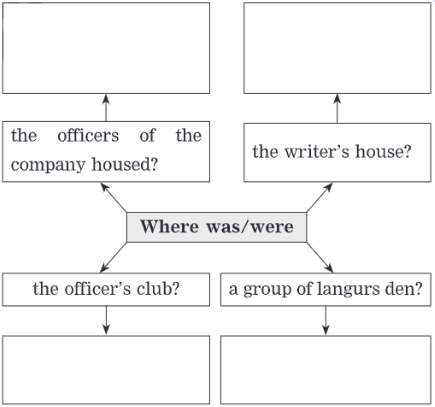
     My father was a medical professional working for a private company in Raniganj in West Bengal. The officers of the company were housed in individual bungalows inside a large campus. Our house was in a corner of the campus. The officer’s club was adjacent to the boundary wall of our garden. The compound was luxurious with green grass, colourful flowers and a host of tall and majestic trees. The seasonal vegetables in the kitchen gardens of the households and the magnificent trees constantly attracted squirrels and many species of birds; a group of langurs had even made their den in an aswatha tree nearby. They had all become a part and parcel of our existence and daily life.
     A small incident on a Saturday afternoon left a profound effect on me and unfolded before my eyes a whole new dimension to the wonders of God’s creation. It was a few days into the Puja vacation. Just like for any other child, the holidays provided an opportunity for me to become engrossed in various magazines and storybooks published specially for children in the festive season.
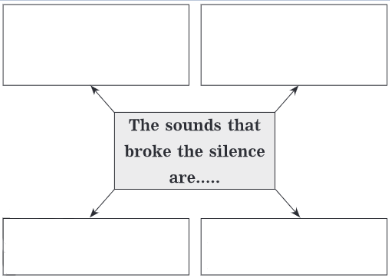
     After a hearty lunch, my parents and my younger sisters lay down for an afternoon nap and I settled down with a storybook. The quiet afternoon presented the perfect backdrop for reading an adventure story. The silence was occasionally broken by the sound of my family snoring, the intermittent chirping of house sparrows, the harsh cawing of a crow the shrill call of a kite flying high above the ground. Minutes ticked by. I became deeply absorbed in the book.

A2. Complex Factual Activities:
Complete the web describing the campus where writer's family lived:
Image
A3. Activities based on Vocabulary:
Match the synonyms:

Column 'A'

Column 'B'

(1) a part and parcel of

(a) get into a comfortable position

(2) to be engrossed in

(b) penned up a new aspect

(3) settle down with

(c) to be essential or integral part of something

(4) chanceunfolded a new dimension

(d) was completely occupied in


A4. Activities based on Contextual Grammar: 
(1) The compound was luxurious with green grass. (Choose the correct question tag.) 
(a) doesn't it?  (b) does it? (c) wasn't it? (d) was it?
(2) The writer's house was in a corner of the ampus.
(Make 'Wh-question' to get underlined part as an answer.) 
A5. Personal Response :
(1) Describe the surroundings where you live.

A1. Simple Factual Activity:
(1) Dr Hawking is a very humble man, though he is considered _______________ .
(2) Dr Hawking expressed his thoughts with the help of his _______________.

    Though confined to a wheel chair with no control over his body save a finger and with
a computer to help him express his thoughts. Dr Hawking is an authority on profound subjects of science. Numerous honorary doctorates and awards have been bestowed
on him. He is a Fellow of The Royal Society and a Member of the US National Academy of Sciences.
     In spite of being considered Einstein’s equal in intelligence, Dr. Hawking is a very humble man. A simple, down to earth man, he has authored many books dealing with his awesome ideas keeping a layman in mind. His writing is full of wit and humour. His style is so lucid that non-scientists can also understand him. His book, “A Brief History of Time” is one of the best selling books of our times.
     On being asked, how he feels about having the dreadful ALS, Dr Hawking, the quintessence of optimism and hope, says, “Not very different from the rest. I try and lead as normal a life as possible, and not think about my condition or regret the things it prevents me from doing, which are not many.”
      Dr Hawking firmly believes that in the next millenium, science will discover the core secrets of the universe, its origin, its history and maybe even predict its ultimate demise.
      Like Dr Hawking, there are many people who display exemplary courage in their lives. Let us salute all those brave people, who in spite of being disabled strive to do their best.

A2. Complex Factual Activity:
(1) What does the writer say about the books authored by Dr Hawking? 
A3. Activities based on Vocabulary:
Match the words in Column 'A' with their meanings in Column 'B':

Column 'A'Column 'B'
 (1) profound (a) a person without any special skill
 (2) awesome (b) a perfect example
 (3) layman (c) showing very great (knowledge) 
 (4) quintessence (d) very impressive

A4. Activities based on Contextual Grammar:
Convert the following to Interrogative (Question) Form:
(1) The prognosis was bad.
(2) Stephen decided to continue his research.
A5. Personal Response:
(1) How do you know that Dr Hawking is a perfect example of optimism and hope?

A1. Simple Factual Activity:
Complete the sentences using the information from the passage:
(1) Sitaram was looking out for any job _______________ .
(2) The lady of the house was _______________.

    Nathu grumbled to himself as he swept the steps of the Pipalnagar Bank, owned by Seth Govind Ram. He used the small broom hurriedly and carelessly, and the dust, after rising in a cloud above his head settled down again on the steps. As Nathu was
banging his pan against a dustbin, Sitaram, the washerman’s son, passed by.
    Sitaram was on his delivery round. He had a bundle of freshly pressed clothes balanced on his head.
    ‘Don’t raise such dust!’ he called out to Nathu. ‘Are you annoyed because they are still refusing to pay you an extra two rupees a month?’
    ‘I don’t wish to talk about it,’ complained the sweeper-boy. ‘I haven’t even received my regular pay. And this is the twentieth of the month. Who would think a bank would hold up a poor man’s salary? As soon as I get my money, I’m off! Not another week I work in this place.’ And Nathu banged the pan against the dustbin several times, just
to emphasize his point and giving himself confidence.
    ‘Well, I wish you luck,’ said Sitaram. ‘I’ll keep a lookout for any jobs that might suit you.’ And he plodded barefoot along the road, the big bundle ofclothes hiding most of his head and shoulders.
     At the fourth home he visited, Sitaram heard the lady of the house mention that she was in need of a sweeper. Tying his bundle together, he said; ‘I know of a sweeper boy who’s looking for work. He can start from next month. He’s with the bank just now but they aren’t giving him his pay, and he wants to leave.’
    ‘Is that so?’ said Mrs. Srivastava. ‘Well, tell him to come and see me tomorrow.’ 

A2. Complex Factual Activity:
Write in your own words a few sentences about the following:
(i) Nathu
A3. Activities based on Vocabulary:

Do as directed:
(1) He called out to Nathu. (Rewrite the sentence in Past Continuous Tense.)
(2) Mrs Srivastava said, "Tell him to come and see me tomorrow." (Change into indirect speech.)
A4. Activities based on Contextual Grammar:

Column 'A'Column 'B'
 (1) small (a) man
 (2) pressed (b) pay
 (3) regular (c) clothes
 (4) poor (d) broom

A5. Personal Response:
(1) What makes you angry? What do you do then?

A1. Simple Factual Activities:
Who said to whom?

 Sentence Who saidTo whom
 (1) "Let's chat."  
 (2) "We won't get a taxi in this rain."  

    ‘Then stay with me tonight,’ she said. ‘Let’s chat. Do you know that, old friends and memories are precious and rare ?’
     I couldn’t believe it. Was this really Meena ? I pinched myself hard to be sure it wasn’t a dream. But Meena was really standing there, right in front of me, squeezing my hand, smiling, and yes, she did look happy. In the three years she had been in Bangalore, I had never once seen her smiling like that. A few strands of grey in her hair reminded me that years had passed. There were a few wrinkles in her face, but the truth was that she looked more attractive than ever before.
     Finally, I managed to say, ‘No Meena, I can’t stay with you tonight. I have to attend a dinner. Give me your card and I’ll keep in touch with you, I promise.’
     For a moment, Meena looked disappointed, ‘Let’s go and have tea at least’, she insisted.
     ‘But Meena, it’s pouring.’
     ‘So what ? We’ll buy an umbrella and then go to the Grand Hotel,’ she said.
     ‘We won’t get a taxi in this rain’, I grumbled.
     ‘So what ? We’ll walk’.
      I was very surprised. This wasn’t the same Meena I had known. Today, she seemed ready to make any number of adjustments.
      We reached the Grand Hotel drenched. By then the only thought in my mind was to find out who or what had brought about such a change in the pessimistic Meena I had known. I was quite curious.
      ‘Tell me Meena, is there a Prince Charming who has managed to change you so ?’
       Meena was surprised by my question. ‘No, there isn’t anyone like that’, she said.
       ‘Then what’s the secret of your energy?’ I asked, like Tendulkar does in the  advertisement.
       She smiled, ‘A beggar changed my life.’ I was absolutely dumbfounded and she could see it.

A2. Complex Factual Activities:
Complete the following sentences:
(1) Old friends and memories are precious and rare.
(2) A few strands of grey in her hair had reminded the writer that years had passed.
A3. Activities based on Vocabulary:
Find out synonyms for the following from the passage:
(1) inquisitive -  _____________
(2) displeased -  _____________
(3) attractive -  _____________
(4) valued -  _____________.
A4. Activities based on Contextual Grammar:
Complete the following table:

 Present Tense Past Tense Past Participle
 (1) see _______ _______
 (2) pour _______ _______
 (3) _______ brought _______
 (4) _______ _______ known

A5. Personal Response:
(1) What, according to you, is the difference between an optimistic person and a pessimistic person?

A1. Simple Factual Activities:
State whether you agree or disagree with the following statements:
(1) The Holy Quran says the kingdom of God belongs to the children.
(2) Jesus says not to kill your children because of poverty.
(3) Denying the dreams of our children is greater violence.
(4) The writer has never given up against any threat or attack.

    I have come here only to share the voices and dreams of our children - because they are all our children - [gesture to everyone in the audience]. I have looked into their frightened and exhausted eyes. I have held their injured bodies and felt their broken spirits.
    Twenty years ago, in the foothills of the Himalayas, I met a small, skinny child labourer. He asked me: “Is the world so poor that it cannot give me a toy and a book, instead of forcing me to take a gun or a tool?”
    I met with a Sudanese child-soldier. He was kidnapped by an extremist militia. As his first training lesson, he was forced to kill his friends and family. He asked me: “What is my fault?”
    Friends, all the great religions teach us to care for our children. Jesus said: “Let the children come to me; do not hinder them, for the kingdom of God belongs to them.” The Holy Quran says: “Kill not your children because of poverty.”
    Friends! There is no greater violence than to deny the dreams of our children. Therefore ... I refuse to accept that all the temples and mosques and churches and prayer houses have no place for the dreams of our children.
    I refuse to accept that the world is so poor, when just one week of global military expenditure can bring all the children to classrooms. I refuse to accept that all the laws and constitutions, police and judges are unable to protect our children.
    I refuse to accept that the shackles of slavery can ever be stronger than the quest for freedom. I REFUSE TO ACCEPT here.
    My only aim in life is that every child is free to be a child,
- free to grow and develop,
- free to eat, sleep, and see daylight,
- free to laugh and cry,
- free to play and learn,
- free to go to school, and above all,
- free to dream.
    I have the privilege of working with many courageous people who have the same aim. We have never given up against any threat or attack and we never will.

A2. Complex Factual Activities:

Complete the following sentences:
(1) Satyarthi refuses to accept:
A3. Activities based on Vocabulary:
Find out the describing words used for the following nouns and make sentence on any one combination:
(1) _______________ militia
(2) _______________ eyes
A4. Activities based on Contextual Grammar:
Change the voice:
(1)He was kidnapped by an extremist militia.
(Begin the sentence with "An extremist militia....)
(2) He was forced to kill his friends and family.
(Begin the sentence with "They....".)
A5. Personal Response:
What will you do in the following situations?
(1) If you see a child working in a restaurant.
(2) If you find a child working on a construction site.
A1. Simple Factual Activity:
Write whether the following statements are 'true' or 'false":
(1) Writer's father was a medical professional.
(2) After a hearty lunch the narrator settled down with a story book.

     My father was a medical professional working for a private company in Raniganj in West Bengal. The officers of the company were housed in individual bungalows inside a large campus. Our house was in a corner of the campus. The officer’s club was adjacent to the boundary wall of our garden. The compound was luxurious with green grass, colourful flowers and a host of tall and majestic trees. The seasonal vegetables in the kitchen gardens of the households and the magnificent trees constantly attracted squirrels and many species of birds; a group of langurs had even made their den in an aswatha tree nearby. They had all become a part and parcel of our existence and daily life.
     A small incident on a Saturday afternoon left a profound effect on me and unfolded before my eyes a whole new dimension to the wonders of God’s creation. It was a few days into the Puja vacation. Just like for any other child, the holidays provided an opportunity for me to become engrossed in various magazines and storybooks published specially for children in the festive season.
     After a hearty lunch, my parents and my younger sisters lay down for an afternoon nap and I settled down with a storybook. The quiet afternoon presented the perfect backdrop for reading an adventure story. The silence was occasionally broken by the sound of my family snoring, the intermittent chirping of house sparrows, the harsh cawing of a crow the shrill call of a kite flying high above the ground. Minutes ticked by. I became deeply absorbed in the book.

A2. Complex Factual Activities:
Complete the web describing the campus where writer's family lived:
Image
A3. Activities based on Vocabulary:
Match the synonyms:

Column 'A'

Column 'B'

(1) revealed

(a) opportunity

(2) new factor

(b) engrossed in

(3) occupied in

(c) new dimension

(4) chance

(d) unfolded


A4. Activities based on Contextual Grammar: 
(1) The writer's house was in a corner of the ampus.
(Make 'Wh-question' to get underlined part as an answer.) 
(2) I became deeply absorbed in the book.
(Rewrite it in Simple Present Tense)
A5. Personal Response :
(1) Do you like to live in a bungalow? Why? 

A1. Simple Factual Activity:
Who said to whom?
(1) "The bird has flown!"
(2) "The Pipalnagar Bank is about to collapse."

     ‘What’s that?’ said Kamal Kishore, sitting up suddenly. ‘Which bank?’
     ‘Why the Pipalnagar bank of course. I hear they have stopped paying employees. Don’t tell me you have an account there, Mr. Kishore?’
     ‘No, but my neighbour has!’ he exclaimed; and he called out over the low partition to the keeper of the barber shop next door. ‘Deep Chand, have you heard the latest? The Pipalnagar Bank is about to collapse. You’d better get your money out as soon as you can!’
     Deep Chand who was cutting the hair of an elderly gentleman, was so startled that his hand shook and he nicked his customer’s right ear. The customer yelped with pain and distress: pain, because of the cut and distress because of the awful news he
had just heard. With one side of his neck still unshaven, he sped across the road to the general merchant’s store where there was a telephone. He dialled Seth Govind Ram’s number. The Seth was not at home. Where was he, then? The Seth was holidaying in Kashmir. Oh, was that so? The elderly gentleman did not believe it. He hurried back to the barber’s shop and told Deep Chand: ‘The bird has flown! Seth Govind Ram has left town. Definitely, it means a collapse.’ And then he dashed out of the shop, making a beeline for his office and chequebook.
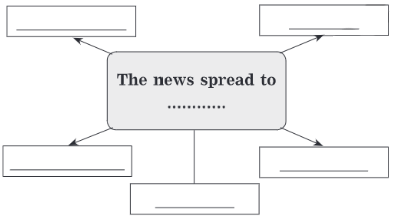
    The news spread through the bazaar with the rapidity of forest fire. From the general merchant’s it travelled to the shop, circulated amongst the customers, and then spread with them in various directions, to the betel-seller, the tailor, the free vendor, the jeweller, the beggar sitting on the pavement.   

A2. Complex Factual Activity:
Complete the web :
Image
A3. Activities based on Vocabulary:
Match the column with their meanings:

WordsMeanings
 (1) beeline (a) state of being upset
 (2) pavement (b) the direct route
 (3) nicked (c) the road for the people to walk
 (4) distress (d) cut slightly

A4. Activities based on Contextual Grammar:
Do as directed:
(1) Mr Kishore said, "Deep Chand, have you heard the latest?" (Change into indirect speech.)
(2) The bird has flown. (Rewrite the sentence using Past Perfect Tense)
A5. Personal Response:
(1) Do you think that rumour spreads faster than fire? Support your answer in two to three lines.

A1. Simple Factual Activities:
State whether the following statements are Right or Wrong:
(1) We should have vision for today not tomorrow.
(2) If we close our eyes and feel the child inside us, we can listen to that child.
(3) Mahatına Gandhi, Nelson Mandela and Martin Luther King are calling on us.
(4) Satyarthi's vision of tomorrow is to see that cobbler's boy sitting with him in his classroom.

     As a child, I had a vision of tomorrow. A vision of that cobbler boy sitting with me in my classroom.
     Now, that tomorrow has become TODAY.
     I am TODAY, and you are TODAY. TODAY it is time for every child to have a right to life, right to freedom, right to health, right to education, right to safety, right to dignity, right to equality, and right to peace.
     TODAY, beyond the darkness, I see the smiling faces of our children in the blinking stars. TODAY, in every wave of every ocean, I see my children are playing and dancing. TODAY, in every plant, in every tree, and mountain, I see our children growing freely with dignity.
     Friends, I want you to see and feel this TODAY inside you.
     My dear sisters and brothers, as I said many interesting things are happening today. May I please request you to put your hand close to your heart - close your eyes and feel the child inside you?
     I am sure you can - Now, listen to that child.Listen please.
     Today, I see thousands of Mahatma Gandhis, Nelson Mandelas and Martin Luther Kings calling on us.
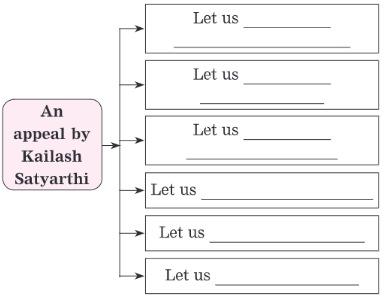
     Let us democratise knowledge. Let us universalise justice. Together, let us globalise compassion!
     I call upon you in this room, and all across the world. I call for a march from exploitation to education, I call for a march from poverty to shared prosperity, a march from slavery to liberty, and a march from violence to peace.
     Let us march from ignorance to awakening. Let us march from darkness to light. Let us march from mortality to divinity.
     Let us march!  

A2. Complex Factual Activities:
Complete the following web-chart :
Image
A3. Activities based on Vocabulary:
Write the infinitive forms of the following and use any two of them in your own sentences:
(1) dancing
(2) playing
(3) growing 
(4) happening 
A4. Activities based on Contextual Grammar:
Make nouns of the following:
(1) universal
(2) global
(3) knowledge
(4) exploitation
A5. Personal Response:
(1) What do you mean by 'Every child has a right to life'? 
A1. Simple Factual Activity:
Who am I? (Identify the character)
(1) I am the washerman's son. - _______________
(2) I am the sweeper. - _______________

    Nathu grumbled to himself as he swept the steps of the Pipalnagar Bank, owned by Seth Govind Ram. He used the small broom hurriedly and carelessly, and the dust, after rising in a cloud above his head settled down again on the steps. As Nathu was
banging his pan against a dustbin, Sitaram, the washerman’s son, passed by.
    Sitaram was on his delivery round. He had a bundle of freshly pressed clothes balanced on his head.
    ‘Don’t raise such dust!’ he called out to Nathu. ‘Are you annoyed because they are still refusing to pay you an extra two rupees a month?’
    ‘I don’t wish to talk about it,’ complained the sweeper-boy. ‘I haven’t even received my regular pay. And this is the twentieth of the month. Who would think a bank would hold up a poor man’s salary? As soon as I get my money, I’m off! Not another week I work in this place.’ And Nathu banged the pan against the dustbin several times, just
to emphasize his point and giving himself confidence.
    ‘Well, I wish you luck,’ said Sitaram. ‘I’ll keep a lookout for any jobs that might suit you.’ And he plodded barefoot along the road, the big bundle ofclothes hiding most of his head and shoulders.
     At the fourth home he visited, Sitaram heard the lady of the house mention that she was in need of a sweeper. Tying his bundle together, he said; ‘I know of a sweeper boy who’s looking for work. He can start from next month. He’s with the bank just now but they aren’t giving him his pay, and he wants to leave.’
    ‘Is that so?’ said Mrs. Srivastava. ‘Well, tell him to come and see me tomorrow.’ 

A2. Complex Factual Activity:
Arrange the following sentences as per their sequence occurred in the passage:
(1) Nathu complained about his irregular pay.
(2) Nathu used the small broom hurriedly.
(3) Sitaram called out to Nathu.
(4) Nathu grumbled as he swept the steps of the bank.
A3. Activities based on Vocabulary:

Cross out the odd man:
(1) sweeper, hooligan, beggar, declare, locker
(2) hurriedly, carelessly, salary, definitely, suddenly
(3) imminent, latest, pavement, awful, shocking
(4) morning, scattering, raising, collecting, shouting
A4. Activities based on Contextual Grammar:
(1) He called out to Nathu. (Rewrite the sentence in Past Continuous Tense.)
(2) Mrs Srivastava said, "Tell him to come and see me tomorrow." (Change into indirect speech.)
A5. Personal Response:
(1) What qualities do you find in Sitaram?