Question
A1. Simple Factual Activities:
Choose the correct alternative to answer the following questions:
(1) Who was the old man?
(a) a king (b) a sage (c) a guard (d) a stranger
(2) Who had a wonderful fate in his next life?
(a) the king       (b) the disciple
(c) the sage      (d) the hangmanWho said to whom

Voices and shouts heard from outside. All re-enter in a rush with another elderly man.
King : What ? Why have you all returned with this  stranger alive ? And who is this man ?
First Guard : I beg your pardon, Your highness but we  are confused indeed. This old man rushed towards  us as we were about to hang the young stranger  and begged and pleaded that he should be hanged  instead.
Second Guard : At first we thought the old man had  lost his mental balance. What sane man would  wish to suffer such a drastic death willingly ?
First Guard : But this young man says that he is a  wise and learned sage from the forest yonder and  he himself was this man’s disciple.
Sage : O Noble King, You are most generous. Be kind  and allow me to be hanged in place of my  disciple. I beg of you.
King : What a strange appeal ! And why  does such a wise and holy man wish to  obstruct the course of justice, may I ask ? 
Sage : (showing reluctance to let out his  secret) Your Majesty.... the truth is... no....  no.... I cannot say it.
King : I demand an explanation or I shall  not have you hanged in place of your  disciple.
Sage : You see........ uh........ it has been  predicted by the great prophets..... uh......  no...... no..... I shouldn’t say this.
King : (annoyed) Speak out at once or your disciple  will be hanged.
Sage : The.... the great prophets have foretold that the one who will be hanged on this day, in this kingdom, shall .... shall become the next king and conquer many more nations. I want to become the next great king, Your Majesty, and reign over a greater country ... I will go down in history as a famous royal monarch. The future generations will read about me and my greatness for milleniums to come. I shall never earn that fame if I remain a recluse - a sage. So do grant me this favour, O King, let me die at the gallows today.
King : Humm ...... The next king ? And this kingdom will expand ? Glory for milleniums to come ! Why, no one but I should be entitled to this privilege. Guards ! Take me to the gallows and hang me at once without any delay. Hurry up ! Don’t waste time. What a wonderful fate in my next life - a king once again ! Goodbye, world. See you again.

A2. Complex Factual Activities:
(1) What was the sage's request? Why did he make such a strange request? 
(2) What does the King want to know?
A3. Activities based on Vocabulary:
Match the following words in Column 'A' with their meaning in Column 'B':

'A''B'
 (1) yonder (a) give the right to
 (2) conquer (b) over there
 (3) recluse (c) favouring a solitary life
 (4) entitled (d) capture

A4. Activities based on Contextual Grammar:
Make the following sentences Assertive :
(1) What a strange appeal!
(2) What a wonderful fate in my next life - a king once again!
A5. Personal Response:
What is your opinion about the king? Is he wicked, greedy, stupid or all of these? Which of his actions/words show that?
Answer

A1. Simple Factual Activities:
(1) (b) a sage
(2) (a) the king  
A2. Complex Factual Activities:
(1) The sage's request was that he should be hanged instead of his disciple because he wanted to save his disciple at any cost by using some tricks
(2) The King wants to know why the sage, being a wise and holy man wishes to obstruct the course of justice. He also wants to know why the sage wanted to be hanged in place of his disciple. 
A3. Activities based on Vocabulary :
(1) yonder - over there
(2) conquer - capture
(3) recluse - favouring a solitary life
(4) entitled - give the right to
A4. Activities based on Contextual Grammar:
(1) It was indeed a strange appeal.
(2) A king once again in my next life is really a wonderful fate.
A5. Personal Response:
I think the king is stupid. He believes every person of his kingdom without any proof. "Guards! Take me to the gallows and hang me at once without any delay." This action shows that he was really stupid. Being a king he should have thought of his action.Yes, I think the Goldsmith was telling the truth. After making that ladies ornaments the Goldsmith could have received the money from her. But he did not think about the money whereas he thought about the respect and honour of the King. So he started making the Queen's ornaments instead of that lady's bridal ornaments.

Need a full question paper?

Generate a complete, print-ready paper with questions like this in minutes — across 16+ boards, with answer keys.

Start Generating Free

Similar questions

A1. Simple Factual Activities:
Correct the following sentences using facts from the passage:
(a) Helen escaped with Menelaus.
(b) Troy was attacked because it was a strong rich city.

      The Iliad is the story of Ilium or Troy, a rich trading city in Asia Minor near the narrow sea that leads from the Aegean to the Black Sea. It was well situated, both for commerce and agriculture. In front of the city was the sea over which sailed the ships of Troy, carrying goods and grain. At the back rose the high peak of Mount Ida, from which flowed many rivers and streams. The valleys among the hills were well-watered and fertile, with corn growing in fertile fields and cattle feeding on the rich grass of the meadows while sheep fed on the slopes of the hills.
      Round their city the Trojans had built a strong wall so that no enemy should attack them from the sea. The wall was so broad that people could stand and sit and walk on it. The great gates stood open, and people could go to the seashore outside and come in as they pleased. But in time of war the gates would be closed; and then the city was like a strong fortress, quite safe from all attack, protected by the walls surrounding it, as well as by the hills behind.
      Thus, Troy was a strong city, strongly protected by its walls and strongly defended by its brave soldiers. But all the kings and heroes of Greece had declared war against the Trojans, because Paris, a prince of Troy, had persuaded Helen, wife of a Greek king Menelaus, to elope with him. He had brought her to Troy. The Greeks wanted to take revenge on Troy for the wrong done to Menelaus. They sailed to Troy and laid siege to the city. The Trojans, too, fought hard and the siege continued for ten long years.

A2. Complex Factual Activities:
(1) How did the location of Troy help it to grow into a very rich/prosperous city?
A3. Activities based on Vocabulary:
Match the adjectives in Column 'A' with the nouns in Column 'B':

'A''B'
 (1) high (a) fortress
 (2) brave (b) peak
 (3) fertile (c) fields
 (4) strong (d) soldiers

A4. Activities based on Contextual Grammar:
Underline the infinitives in the sentences
(1) Paris persuaded Helen to elope with him.
(2) The Greeks wanted to take revenge.
A5. Personal Response:
Do you know one of the wars in ancient India which was fought over a woman? Describe it in short.

A1. Simple Factual Activities:
Answer the following in words:
(1) Mark Twain received a letter from the editor of a small Missouri newspaper.
(2) Finding a spider in a paper is good luck for the reader according to Mark Twain.
(3) Mark Twain's birth was heralded by the return of Halley's comet.
(4) Mark Twain died in November 1835.

      One day during his tenure as the editor of a small Missouri newspaper, Mark Twain received a letter from a reader who had found a spider in his paper. He wondered whether this portended good or bad luck.
       “Finding a spider in your paper,” Twain replied, “is neither good luck nor bad. The spider was merely looking over our paper to see which merchant was not advertising so that he could go to that store, spin his web across the door, and lead a life of undisturbed peace ever afterward.”
      Mark Twain’s birth in November 1835 was heralded by the return of Halley’s comet. Twain, who often remarked upon this curiosity, came to think of himself and the comet as ‘unaccountable freaks,’ cosmically linked: having come in together, he declared, they would go out together.
      In fact, Twain was proven right. On the night of his death in April 1910, Halley’s comet once again blazed through the sky...
Some Quotations
April Fool’s Day - This is the day upon which we are reminded of what we are on the other three hundred and sixty-four.
 A man cannot be comfortable without his own approval.
A person with a new idea is a crank until the idea succeeds.
Age is an issue of mind over matter. If you don’t mind, it doesn’t matter.
All generalizations are false, including this one 
Be careful about reading health books. You may die of a misprint.
Be careless in your dress if you will, but keep a tidy soul.
‘Classic’ - A book which people praise and don’t read. Humour is mankind’s greatest blessing.
I am an old man and have known a great many troubles, but most of them never happened.
I must have a prodigious quantity of mind; it takes me as much as a week sometimes to make it up.
If you tell the truth, you don’t have to remember anything.
 It is better to deserve honours and not have them than to have them and not deserve them.
It is better to keep your mouth closed and let people think you are a fool than to open it and 
remove all doubt.
It’s no wonder that truth is stranger than fiction. Fiction has to make sense.
Whenever you find yourself on the side of the majority, it is time to pause and reflect.
Why is it that we rejoice at a birth and grieve at a funeral? It is because we are not the person 
involved.
Thousands of geniuses live and die undiscovered either by themselves or by others.
Thunder is good, thunder is impressive; but it is lightning that does the work.
When I was younger I could remember anything, whether it happened or not.
When your friends begin to flatter you on how young you look, it’s a sure sign you’re getting old.

A2. Complex Factual Activities:
Which episode shows that Mark Twain did not believe in superstitions? 
A3. Activities based on Vocabulary:
Read the following and write the two meanings of 'mind' and 'matter'.
Age is an issue of mind over matter. If you don't mind, it doesn't matter.
A4. Activities based on Contextual Grammar:
Frame a wh-question to get the underlined part as an answer in each sentences:
(1) Mark Twain received a letter from a reader.
(2) Mark Twain's birth was heralded by the return of Halley's comet.
A5. Personal Response:
(1) Why should we take part in humorous sessions?
A1. Simple Factual Activities:
Who said this to whom:
(1) "I might have needed it."
(2) "Don't sell it for three days."

     In a shop at the Palais Royal, they found a string of diamonds which seemed to be exactly what they were looking for. It was worth forty thousand francs They could have it for thirty-six thousand.
     So they begged the jeweller not to sell it for three days. And they made an arrangement that he would take it back for thirty-four thousand francs if the other necklace was found before the end of February.
     Loisel had eighteen thousand francs which his father had left him. He would borrow the rest.
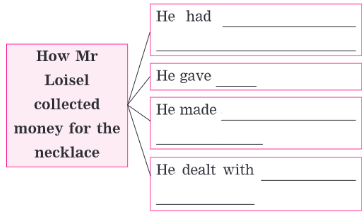
And he did borrow. He gave notes, made ruinous agreements, dealt with every type of money-lender Then he went to get the new necklace, and laid down on the jeweller’s counter thirty-six thousand francs.
     When Madame Loisel took the necklace back, Madame Forestier said coldly, “You should have returned it sooner, I might have needed it.”

A2. Complex Factual Activities:
Complete the web: 
Image
A3. Activities based on Vocabulary:
(1) Find and write all the numbers mentioned in the passage:
(2) Write from the passage words related to money matters.
A4. Activities based on Contextual Grammar:
(1) It was worth forty thousand francs.
(Use 'They' in place of 'Itzz' and rewrite the correct sentence.)
(2) He went to get the new necklace.
(Rewrite the sentence using simple present tense for the underlined verb.)
A5. Personal Response:
Write what you think about the following thoughts and actions of Mathilde:
(a) Mathilde returned the diamond necklace to her friend.
A1. Simple Factual Activities:
Find the following matter in the passage and copy the missing words:
(1) When he was twelve, his mother was forced to take him out of school.
(2) One day he came across a book on electricity which had been sent to his master for binding.

     Michael Faraday is regarded as one of the most distinguished scientists and inventors of modern times, and his work on electricity is still a subject of study, in the form of Faraday’s Laws. But few know his inspirational life story, which is all about courage and fighting against the odds.
      Michael Faraday was born into a poverty-stricken family in a dirty London suburb. He suffered from a speech defect as a child. He would pronounce ‘rabbit’ as ‘wabbit’. He could not even say his own name and would call himself ‘Fawaday’. Other children laughed at him and teachers did not help him either. When he was twelve, his mother was forced to take him out of school, thus putting an end to his formal education.
       At thirteen, however, he started working with a bookbinder, binding hundreds of books during the day and staying up all night to read them. Reading thus became his obsession. One day he came across a book on electricity which had been sent to his master for binding. He started reading it and was completely hooked. That was his first introduction to the subject of electricity, which soon became a lifelong fascination. Faraday was still poor at twenty-one. Once, a friend gave him a free ticket to a public lecture and demonstration by the renowned chemist Humphry Davy at London’s Royal Institution. Davy’s work on chemicals and electrical lighting was the subject of conversation among the scientists of that age. Seventy years later, across the Atlantic Ocean in the USA, the same work enabled Thomas Edison to produce the first consistent light bulb.

A2. Complex Factual Activities:
(1) What were the odds against Faraday in his childhood?
A3. Activities based on Vocabulary :
What is the meaning of the following sentences:
(1) Reading became his obsession.
(2) Electricity became his lifelong fascination.
A4. Activities based on Contextual Grammar:
Write any four words that begin with 're-' as a prefix;
A5. Personal Response:

(1) Write what is implied in the following sentence: 
But few know his inspirational life story, which is all about courage and fighting against the odds.
(What does it tell you about Faraday's life?)
A1. Simple Factual Activities:
Say whether the following statements are True or False:
Statements
(1) When young Helen stretched out her hand, her mother took it.
(2) Young Helen learnt to spell many words without understanding them.
(3) Young Helen did not try to put the pieces of doll together.
(4) Young Helen felt sorry that she had broken the doll.

      I felt approaching footsteps. I stretched out my  hand as I supposed it was my mother. Someone took  it, and I was caught up and held close in the arms  of her who had come to reveal all things to me, and,  more than all things else, to love me.
      The morning after my teacher came she led me  into her room and gave me a doll. The little blind  children at Perkins Institution had sent it and Laura  Bridgman had dressed it; but I did not know this until  afterward. When I played with it a little while, Miss  Sullivan slowly spelled into my hand the word “d-o- l-l.” I was at once interested in this finger play and  tried to imitate it. When I finally succeeded in making  the letters correctly I was flushed with childish pleasure  and pride. Running downstairs to my mother I held  up my hand and made the letters for doll. I did not  know that I was spelling a word or even that words  existed; I was simply making my fingers go in  monkey-like imitation. In the days that followed I  learned to spell in this uncomprehending way a great  many words, among them pin, hat, cup, and a few  verbs like sit, stand and walk. But my teacher had  been with me several weeks before I understood that  everything has a name.
      One day, while I was playing with my new doll,  Miss Sullivan put my big rag doll into my lap also,  spelled ‘d-o-l-l’ and tried to make me understand that  ‘d-o-l-l’ applied to both. Earlier in the day we had a  tussle over the words ‘m-u-g’ and ‘w-a-t-e-r’. Miss  Sullivan had tried to impress it upon me that ‘m-u-g’  is mug and that ‘w-a-t-e-r’ is water, but I persisted  in confounding the two. In despair she had dropped  the subject for the time, only to renew it at the first  opportunity. I became impatient at her repeated  attempts and, seizing the new doll, I dashed it upon  the floor. I was keenly delighted when I felt the fragments of the broken doll at my feet. Neither  sorrow nor regret followed my passionate outburst. I  had not loved the doll. In the still, dark world in  which I lived there was no strong sentiment or  tenderness. I felt my teacher sweep the fragments to  one side of the hearth, and I had a sense of satisfaction  that the cause of my discomfort was removed. She  brought me my hat, and I knew I was going out into  the warm sunshine. This thought, if a wordless  sensation may be called a thought, made me hop and  skip with pleasure.

A2. Complex Factual Activities:
(1) Helen learnt many words without understanding them.
(2) Helen learnt the word 'doll' by imitation from her teacher for the very first time.
(3) She realised that everything has a name.
(4) When she was successful in making the letters of 'doll', she showed it to her mother.
A3. Activities based on Vocabulary:
Pick out 4 infinitives from the passage:
A4. Activities based on Contextual Grammar:
(1) Read the following sentences and frame at least two relevant questions on each:
One day I was playing with the new doll.
(2) Rewrite the following sentence using 'Helen Keller/Young Helen' appropriately in place of 'I' and making other necessary changes in the sentence:
The morning after my teacher came she led me into her room and gave me a doll.
A5. Personal Response:
(1) What is the difference between wordless sensation and thought?

A1. Simple Factual Activities:
Complete the following sentences with the help of the given passage:
(1) The real name of Mark Twain was ______________.
(2) Mark Twain went to ______________ for a shave.
(3) ______________ are told and enjoyed even today.
(4) The young Mark Twain ran over early to say goodbye to ______________.

    Mark Twain was the pen name of Samuel Langhome Clemens, a popular American writer. He was famous for his humorous stories, novels and other writings. His ready wit shone through everyday conversations. Many anecdotes related to Mark Twain are told and enjoyed even today.
     It should be noted that he was a great defender of human values like liberty, equality and fraternity. He opposed wars and imperialism and supported the cause of labourers and of the black people in his country, America. Given below are some anecdotes from his life and some quotations from his speeches and writings.
     One day during a lecture tour, Mark Twain entered a local barber shop for a shave. This, Twain told the barber, was his first visit to the town.
     "You've chosen a good time to come," he declared.
     "Oh?" Twain replied.
     "Mark Twain is going to lecture here tonight. You'll want to go, I suppose?"
     "I guess so..."
     "Have you bought your ticket yet?"
     "No, not yet."
     "Well, it's sold out, so you'll have to stand."
     "Just my luck," said Twain with a sigh. "I always have to stand when that fellow lectures!"
     Mrs Stowe was leaving for Florida one morning, and Clemens (the young Mark Twain) ran over early to say goodbye. On his return Mrs Clemens regarded him disapprovingly: 
     “Why”, she said, “you haven’t on any collar and tie.” 
     He said nothing, but went up to his room, did up these items in a neat package, and sent it over to Mrs Stowe by a servant, with a line: 
     ‘Herewith receive a call from the rest of me.’

A2. Complex Factual Activities:
(1) Was Twain particular about how he dressed when he was visiting friends?
A3. Activities based on Vocabulary:
Find out similar meaning words (synonyms) for the following from the passage:
(1) freedom - ______________
(2) protector -  ______________
(3) brotherhood - ______________
(4) considered - ______________
A4. Activities based on Contextual Grammar:
Change the following sentences in indirect speech:
(1) "You have chosen a good time to come," the barber said to Mark Twain.
(2) The barber said to Mark Twain, "Have you bought your ticket?"
A5. Personal Response:
(1) What is the importance of humour in our life?
A1. Simple Factual Activities:
Complete the following :
(1) Harsh words are like scattered bits of paper carried away by the wind because ______________________.
(2) The young man said that he had spoken very harsh and unkind words to his friend and ______________________.

     A young man went to his spiritual teacher and said, “I have spoken very harsh and unkind words to my friend, and he is deeply hurt. I am afraid I have lost my friendship with him. How can I make amends?”
      The wise teacher gave him a fresh sheet of blank paper and a pen; he said to the young man, “Write down on this paper all the harsh things you said to him.”
      The young man did as he was told, and showed the paper to the teacher.
      “Now tear up this sheet of paper into as many small bits as you can,” the wise teacher said. Soon, the single sheet was torn into a hundred tiny bits of paper.
     “Throw the bits out of this window,” the teacher told him. 
      That was easily done! It was a windy day and the tiny bits were scattered far and wide even as the young man watched. 
     “Now, go out into the street and collect as many bits of the paper as you can,” the teacher ordered him.
     The young man was taken aback. “But…but, that will be difficult …” he stammered.
     “It will be difficult indeed, but do give it a try,” the teacher suggested. 
      The young man went out. He returned half an hour later, exhausted. He had not been able to get hold of a single torn bit from the paper he had torn up just a while earlier! 
     “This is what happens with the spoken word,” the teacher said to him. “Once you have spoken the words aloud, it is very difficult to take them back. Therefore, learn to think before you speak in anger.

A2. Complex Factual Activities:
(1) How did the spiritual teacher teach a lesson to the young man about his harsh and unkind words to his friend? 
A3. Activities based on Vocabulary :
Match the following words in column 'A' with their antonyms in column 'B':

'A'

'B'

(1) harsh

(a) easy

(2) earlier

(b) narrow

(3) difficult

(c) soft

(4) wide

(d) later

A4. Activities based on Contextual Grammar:
Make two sentences of your own with each of the words given below, using the same words as a noun and as a verb in another:
(1) throw:
A5. Personal Response:

(1) What do you do when someone speaks to you angrily. Do you also speak angrily?

A1. Simple Factual Activities:
State whether the following statements are True or False:
Statements
(1) Prospero was the duke of Milan, in the kingdom of Naples.
(2) Prospero's brother Gonzalo was a very treacherous man.
(3) Books were Prospero's most valued possessions.
(4) The king Antonio landed safely on an enchanted island.

      Prospero was the Duke of Milan, in the kingdom of Naples. He was such a studious and learned scholar that he spent most of his time reading books, while his brother Antonio managed the business of ruling his dukedom.
      Now, Antonio was a treacherous man, and he wanted to become Duke of Milan in his brother place. In fact, Antonio would not have hesitated to kill Prospero - but he knew that the people loved their Duke, and would never forgive his murderer. So Antonio got together with Alonso, the king of Naples who was Prospero’s enemy. They took Prospero to sea, and when they were far away from land, they put Prospero and his baby daughter Miranda into a broken, old boat and sailed away. Prospero and Miranda were left to drift into the wide, open sea Thus Antonio managed to take over the Dukedom of Milan, with all its wealth and power.
      Now, among Prospero’s courtiers was a true and loyal Lord called Gonzalo. Out of love and loyalty for the rightful Duke, Gonzalo had secretly placed in the boat fresh water, food and clothes - and along with them, Prospero’s most valued possessions, his books.
       You can imagine the hardships faced by Prospero cast adrift in an oarless boat, with a baby girl to care for! However, they were fortunate that the boat reached an island, and they landed in safety.
      The island was an enchanted island. For years together, it had come under the spell of an evil witch Sycorax, who had imprisoned all the good spirits she found on the island. She herself had died before Propspero arrived on the island, but the spirits remained trapped in their ‘prisons’ - the trunks of the large trees on the island.

A2. Complex Factual Activity:
What had the faithful Lord Gonzalo done to help Prospero? 
A3. Activities based on Vocabulary:
Choose the correct alternative given for the synonym of the words given below:
(1) studious: ___________
(a) outstanding (b) concerned (c) bookish (d) clever
(2) treacherous: ___________
(a) foolish (b) tricky (c) unreliable (d) favourite
A4. Activities based on Contextual Grammar:
Add a question tag:
(1) Prospero was the Duke of Milan, ___________?
(2) Antonio would not have hesitated to kill Prospero, ___________?
A5. Personal Response:
What will you do if you are left alone on an isolated island by your friends?
A1. Simple Factual Activities:
Complete the following sentences:
(1) The writer and her teacher were attracted by ______________.
(2) As the cool stream gushed over Helen's hand, she realised that water meant ______________.

     We walked down the path to the well-house, attracted by the fragrance of the honeysuckle with which it was covered. Someone was drawing water and my teacher placed my hand under the spout. As the cool stream gushed over one hand she spelled into the other the word water, first slowly, then rapidly. I stood still, my whole attention fixed upon the motions of her fingers. Suddenly I felt a misty consciousness as of something forgotten - a thrill of returning thought; and somehow the mystery of language was revealed to me. I knew then that ‘w-a-t-e-r’ meant the wonderful cool something that was flowing over my hand. That living word awakened my soul, gave it light, hope, joy, set it free ! There were barriers still, it is true, but barriers that could in time be swept away.
     I left the well-house eager to learn. Everything had a name, and each name gave birth to a new thought. As we returned to the house, every object that I touched seemed to quiver with life. That was because I saw everything with the strange, new sight that had come to me. On entering the door I remembered the doll I had broken. I felt my way to the hearth and picked up the pieces. I tried vainly to put them together. Then my eyes filled with tears; for I realised what I had done, and for the first time I felt repentance and sorrow.
     I learned a great many new words that day. I do not remember what they all were; but I do know that mother, father, sister, teacher were among them - words that were to make the world blossom for me ‘like Aaron’s rod, with flower.’ It would have been difficult to find a happier child than I was as I lay in my crib at the close of that eventful day and lived over the joys it had brought me, and for the first time longed for a new day to come.
     Helen went on to become a graduate cum laude from Radcliffe. She then devoted the rest of her life to teaching and giving hope to the blind and deaf, as her teacher had done. She and Anne remained friends until  Anne’s death.

A2. Complex Factual Activities:
(1) Why did young Helen feel repentance and sorrow? 
A3. Activities based on Vocabulary:
Find out four compound words from the lesson: 
A4. Activities based on Contextual Grammar:
Rewrite the sentences by using 'As soon as':
On entering the door, I remembered the doll I had broken.
Rewrite the sentences by using 'As soon as':
We walked down the path to the well-house, we got attracted by the fragrance of the honeysuckle.
A5. Personal Response:
Why should we help disabled people?
A1. Simple Factual Activities:
Complete the following sentences using the information given in the passage:
(1) Most people agree that tea is a ______________.
(2) Emperor Shennong was called the father of ______________.
(3) Bodhidharma found that chewing tea leaves acted as ______________.
(4) Tea got its distinctive flavour by its theanine as well as ______________.

       Most people agree that tea is a refreshing drink. It contains no carbohydrates, fat, or proteins. What gives tea its special and distinctive flavour is theanine as well as caffeine, which give the drink its stimulating quality.
       How and when did people first begin to drink tea? An amusing story has come down to us from Chinese legends. It is said that Emperor Shennong, the father of Chinese agriculture and medicine, was on his travels, when a servant was boiling some water for the emperor to drink. Just then, a few leaves from a nearby tree blew into the boiling water. The water immediately changed colour. On drinking the water, the emperor was amazed by the rich flavour and the refreshing quality of the resulting infusion. Excited by the unknown plant and its amazing flavour, he carried out further investigations, and discovered that tea had many healing and restorative properties and could also be used as an antidote to certain poisons.
       Yet another legend tells us that it was a Buddhist monk named Bodhidharma who was the first to use tea as a drink. He was keen to find a herb or a medicinal plant which would help him stay awake and alert for long periods of time in prayer and meditation. After considerable search and trial, he found that chewing leaves from the tea shrub acted as a stimulant, helping him stay awake. It was he who introduced tea among his disciples in China. It is said that Japanese priests studying under Buddhist teachers in China carried tea seeds and leaves back home with them. Turkish traders also began to bargain for tea on the border of Mongolia. In fact, the story goes that the Chinese Emperor Hui Tsung was so taken up with tea that he set up a research into the best tea- whisking methods and also hosted tea-making and tea-tasting tournaments in the court. So ‘tea minded’ was he, that he failed to notice that Mongolia had actually taken over his empire!

A2. Complex Factual Activities:
(1) Who was Emperor Shennong? Why did he carry out further investigations about tea? 
A3. Activities based on Vocabulary:
Match the words in Column 'A' with their meaning in Column 'B':

Column 'A'Column 'B'
(1) investigation(a) a substance (tea) that helps you to stay awake.
(2) stimulant(b) a drink made by leaving shrubs (leaves), etc. in boiling water.
(3) infusion(c) making you strong and healthy again.
(4) restorative(d) a scientific examination for finding the truth.

A4. Activities based on Contextual Grammar:
Find the subject and the object from the following sentences:
(1) The water immediately changed colour.
(2) He carried out further investigations.
A5. Personal Response:
What is the difference between legends or stories and history?