Question
A1. Simple Factual Activities:
Correct the following sentences using facts from the passage:
(a) Helen escaped with Menelaus.
(b) Troy was attacked because it was a strong rich city.

      The Iliad is the story of Ilium or Troy, a rich trading city in Asia Minor near the narrow sea that leads from the Aegean to the Black Sea. It was well situated, both for commerce and agriculture. In front of the city was the sea over which sailed the ships of Troy, carrying goods and grain. At the back rose the high peak of Mount Ida, from which flowed many rivers and streams. The valleys among the hills were well-watered and fertile, with corn growing in fertile fields and cattle feeding on the rich grass of the meadows while sheep fed on the slopes of the hills.
      Round their city the Trojans had built a strong wall so that no enemy should attack them from the sea. The wall was so broad that people could stand and sit and walk on it. The great gates stood open, and people could go to the seashore outside and come in as they pleased. But in time of war the gates would be closed; and then the city was like a strong fortress, quite safe from all attack, protected by the walls surrounding it, as well as by the hills behind.
      Thus, Troy was a strong city, strongly protected by its walls and strongly defended by its brave soldiers. But all the kings and heroes of Greece had declared war against the Trojans, because Paris, a prince of Troy, had persuaded Helen, wife of a Greek king Menelaus, to elope with him. He had brought her to Troy. The Greeks wanted to take revenge on Troy for the wrong done to Menelaus. They sailed to Troy and laid siege to the city. The Trojans, too, fought hard and the siege continued for ten long years.

A2. Complex Factual Activities:
(1) How did the location of Troy help it to grow into a very rich/prosperous city?
A3. Activities based on Vocabulary:
Match the adjectives in Column 'A' with the nouns in Column 'B':

'A''B'
 (1) high (a) fortress
 (2) brave (b) peak
 (3) fertile (c) fields
 (4) strong (d) soldiers

A4. Activities based on Contextual Grammar:
Underline the infinitives in the sentences
(1) Paris persuaded Helen to elope with him.
(2) The Greeks wanted to take revenge.
A5. Personal Response:
Do you know one of the wars in ancient India which was fought over a woman? Describe it in short.

Answer

A1. Simple Factual Activities:
(1) Helen eloped with Paris, a prince of Troy.
(2) Troy was attacked because the Greeks wanted to take revenge on Troy for the wrong done to their King Menelaus.
A2. Complex Factual Activities:
(1) The city was well situated for commerce and agriculture. Their ships sailed and carried goods and grains over the sea in front of the city. Many rivers and streams flowed from Mount Ida. Well-watered and fertile valleys among the hills grew corn in fertile fields; cattle were reared on the rich grass of the meadows. So Troy became a rich/ prosperous city.
A3. Activities based on Vocabulary :
(1) high - peak
(2) brave - soldiers
(3) fertile - fields
(4) strong - fortress
A4. Activities based on Contextual Grammar:
(1) Paris persuaded Helen to elope with him.
(2) The Greeks wanted to take revenge.
A5. Personal Response:
I know such a war was fought between Ram and Ravan. Ravan, the demon king of Lanka, came in disguise as a Sadhu and forcefully took away Seeta, the wife of Ram. Ram with his monkey army reached Lanka. He fought against Ravan, defeated him and killed Ravan and brought back Seeta to Ayodhya.

Need a full question paper?

Generate a complete, print-ready paper with questions like this in minutes — across 16+ boards, with answer keys.

Start Generating Free

Similar questions

A1. Simple Factual Activities:
Say whether the following statements are True or False:
(1) Madame Forestier recognised her dear friend immediately.
(2) Madame Forestier still looked young, beautiful and charming.
(3) It had taken them ten years to pay for the imitation diamond neclace.
(4) The imitation was not worth five hundred francs at most!

     One Sunday, as she was walking in the Champs Élysées suddenly she saw Madame Forestier, still young, still beautiful, still charming.
      Madame Loisel felt emotional. Should she speak to her ? Yes, of course. And now that she had paid, she would tell her all. Why not ?
      She went up to her, “Good morning, Jeanne.”
      The other, astonished to be addressed so familiarly by this common woman, did not recognise her. She stammered:
      “But - Madame - I don’t know. You must have made a mistake.”
      “No, I am Mathilde Loisel.”
       Her friend uttered a cry, “Oh !  ... my poor Mathilde, how you’ve changed ! ...”
      “Yes, I have had some hard times since I last saw you, and many miseries ... and all because of you ! ...”
      “Me ? How can that be ?”
      “You remember that diamond necklace that you lent me to wear to the Ministry party ?”
      “Yes. Well ?”
      “Well, I lost it.”
      “What do you mean ? You brought it back.”
       “I brought you back another exactly like it. And it has taken us ten years to pay for it. It wasn’t easy for us, we had very little. But at last it is over, and I am very glad.”
       Madame Forestier was stunned.
      “You say that you bought a diamond necklace to replace mine ?”
      “Yes; you didn’t notice then ? They were very similar.”
       And she smiled with proud and innocent pleasure.
       Madame Forestier, deeply moved, took both her hands.
      “Oh, my poor Mathilde ! Mine was an imitation ! It was worth five hundred francs at most !...”

A2. Complex Factual Activities:
Complete the following table:

Utterance

Who said it

To whom

When

(1) You must have made a mistake.


(2) Well, I lost it.


A3. Activities based on Vocabulary:
Match the words in Column 'A' with their meaning in Column 'B':

Column 'A'

Column 'B'

(1) familiarly

(a) artificial/not real

(2) astonished

(b) in a friendly manner

(3) imitation

(c) very surprised

(4) innocent

(d) having not done anything wrong

A4. Activities based on Contextual Grammar:
Do as directed:
(1) How you've changed! (Make an assertive sentence.)
(2) They were similar. (Make it negative without changing meaning.)
A5. Personal Response:
(1) Who do you think was responsible for Mathilde's misery? Was it her friend, she herself, her husband or the circumstances?

A1. Simple Factual Activities:
Complete the following sentences:
(1) The writer and her teacher were attracted by ______________.
(2) As the cool stream gushed over Helen's hand, she realised that water meant ______________.

     We walked down the path to the well-house, attracted by the fragrance of the honeysuckle with which it was covered. Someone was drawing water and my teacher placed my hand under the spout. As the cool stream gushed over one hand she spelled into the other the word water, first slowly, then rapidly. I stood still, my whole attention fixed upon the motions of her fingers. Suddenly I felt a misty consciousness as of something forgotten - a thrill of returning thought; and somehow the mystery of language was revealed to me. I knew then that ‘w-a-t-e-r’ meant the wonderful cool something that was flowing over my hand. That living word awakened my soul, gave it light, hope, joy, set it free ! There were barriers still, it is true, but barriers that could in time be swept away.
     I left the well-house eager to learn. Everything had a name, and each name gave birth to a new thought. As we returned to the house, every object that I touched seemed to quiver with life. That was because I saw everything with the strange, new sight that had come to me. On entering the door I remembered the doll I had broken. I felt my way to the hearth and picked up the pieces. I tried vainly to put them together. Then my eyes filled with tears; for I realised what I had done, and for the first time I felt repentance and sorrow.
     I learned a great many new words that day. I do not remember what they all were; but I do know that mother, father, sister, teacher were among them - words that were to make the world blossom for me ‘like Aaron’s rod, with flower.’ It would have been difficult to find a happier child than I was as I lay in my crib at the close of that eventful day and lived over the joys it had brought me, and for the first time longed for a new day to come.
     Helen went on to become a graduate cum laude from Radcliffe. She then devoted the rest of her life to teaching and giving hope to the blind and deaf, as her teacher had done. She and Anne remained friends until  Anne’s death.

A2. Complex Factual Activities:
(1) Why did young Helen feel repentance and sorrow? 
A3. Activities based on Vocabulary:
Find out four compound words from the lesson: 
A4. Activities based on Contextual Grammar:
Rewrite the sentences by using 'As soon as':
On entering the door, I remembered the doll I had broken.
Rewrite the sentences by using 'As soon as':
We walked down the path to the well-house, we got attracted by the fragrance of the honeysuckle.
A5. Personal Response:
Why should we help disabled people?
A1. Simple Factual Activities:
Complete the following sentences:
(1) The thieves were ______________ and ______________.
(2) Both the thieves were true ______________.

King : Let the court begin !
Fourth Guard Messenger : The first complainant !
Thief : (rushes forward and wails loudly) Justice ! Oh, Most Great King ! I beg for Justice.
King : And what is your complaint ?
Thief : In this great land of Andher Nagari, my friend and I have been truly hard-working honest thieves. All these years we have been true to our profession. And what is our reward ? Last night, with great efforts, we made a hole in the wall of a merchant’s house, when all his family were away. My friend peered through that hole into the house, when suddenly the wall collapsed (Wails louder).... and .... and my friend was instantly killed. I’ve lost my only friend and partner. O King ! It’s the merchant’s fault for living in a house with such weak walls.
King : Fetch the merchant at once. A life for life ! The merchant must be hanged ! (Third Guard leaves and returns with the merchant who bows before the king.)
Merchant : Mercy, O Noble King ! I had no intention of killing these skilled professionals. It is not my fault that the wall of my house collapsed. My house has been recently built. It is the fault of the bricklayer, who carelessly built such a weak wall.
King : Bring the careless bricklayer immediately. He must hang for his fault.
Bricklayer : O Most Kind Lord and King ! (kneeling to the king) Have mercy. I beg you, don’t send me to the gallows. I agree that I built the wall which collapsed and killed a man. But it was not due to my carelessness. The mortar which I used to lay the bricks was of very poor quality. There was too much of water mixed in it. It is entirely the mortar-maker’s fault.

A2. Complex Factual Activities:
Arrange the following sentences in chronological order:
(1) The wall collapsed while entering the house and the thief's friend was instantly killed.
(2) One day they made a hole in the wall of a merchant's house.
(3) There were two hardworking and honest thieves in the great land of Andher Nagari.
(4) They were very true to their profession from the last several years.
A3. Activities based on Vocabulary:
Find out the adverbs which are used along with the following verbs:
(1) ______________ killed
(2) ______________ built
(3) ______________ bring
(4) ______________ collapsed
A4. Activities based on Contextual Grammar:
Frame Verbal Questions:
(1) There was too much of water mixed in it.
(2) My friend was instantly killed.
A5. Personal Response:
Will a thief appear in a court on his own? Why does this thief dare to do so?
A1. Simple Factual Activities:
Read the passage on 'Gond Art' carefully. Then complete the following sentences without going back to the passage:
(1) Gond art is a tribal ___________.
(2) The Gondi language is similar to Telugu, a Dravidian ___________.
(3) Originally people used to draw pictures on the earthen walls of their ___________.
(4) In folk arts, you yourself prepare the 'canvas' - the surface on which to draw and the colours with which you ___________.

      Gond art has spread mainly in Central India. Originally, people used to draw  pictures on the earthen walls of their houses. Most folk arts involve natural  techniques of preparing colours and use of several mediums. They are transferred  from generation to generation in a smoothly flowing process. Gond art is no  exception to this. A house decorated with beautiful pictures creates a pleasant  atmosphere. Also, art is a medium of recording and preserving what is seen.
     In folk arts, you yourself prepare the ‘canvas’ - the surface on which to draw and the colours with which you draw. That is why creating folk art is a very enriching experience.

A2. Complex Factual Activity:
What are the common features of folk arts?
A3. Activities based on Vocabulary:
Spot the error in the spelling and rewrite them correctly:
(1) ___________ art
(2) ___________ tales
(3) ___________ walls
(4) ___________ mediums
A4. Activities based on Contextual Grammar:
(1) People draw pictures on the earthen walls of their house.
(Pick out the subject and the object from the sentence.)
A5. Personal Response:
Write few sentences about your favourite art:
A1. Simple Factual Activities:
Who said it and to whom:
(1) "I no longer have Madame Forestier's necklace."
(2) "What! ... How!... That's impossible!"

     The day of the party arrived. Madame Loisel was a success. She was prettier than all the other women, elegant, gracious, smiling, and full of joy.
     She danced wildly, with passion, forgetting everything in the triumph of her beauty and success, floating in a cloud of happiness.
     Mathilde and her husband left at about four o’clock in the morning. When they were finally in the street, they could not find a cab. They walked down toward the Seine, till they found one. They were dropped off at their door in the Rue des Martyrs, and sadly, it was all over, for her.
      In front of the mirror, she took a final look at herself in all her glory. But suddenly she uttered a cry. She no longer had the necklace round her neck ! “What is the matter ?” asked her husband.
      She turned towards him, panic-stricken, “I have ... I have ... I no longer have Madame Forestier’s necklace.”
      He stood up, distraught, “What !... How ! …That’s impossible !”

A2. Complex Factual Activities:
Complete the web :
Image
A3. Activities based on Vocabulary:
(1) Write any four adjectives from the passage.
(2) Write any four adverbs with '-ly' from the passage.
A4. Activities based on Contextual Grammar:
Find the determiners from the following sentences and underline them:
(1) They were dropped off at _______ door in _______ Rue des Martyrs.
(2) Forgetting everything in _______ triumph of _______ beauty.
A5. Personal Response:
Write what you think about the following actions of Mathilde :
(1) Mathilde borrowed a diamond necklace from her friend and wore it to the party.
A1. Simple Factual Activities:
Choose the correct alternative to answer the following questions:
(1) Who was the old man?
(a) a king (b) a sage (c) a guard (d) a stranger
(2) Who had a wonderful fate in his next life?
(a) the king       (b) the disciple
(c) the sage      (d) the hangmanWho said to whom

Voices and shouts heard from outside. All re-enter in a rush with another elderly man.
King : What ? Why have you all returned with this  stranger alive ? And who is this man ?
First Guard : I beg your pardon, Your highness but we  are confused indeed. This old man rushed towards  us as we were about to hang the young stranger  and begged and pleaded that he should be hanged  instead.
Second Guard : At first we thought the old man had  lost his mental balance. What sane man would  wish to suffer such a drastic death willingly ?
First Guard : But this young man says that he is a  wise and learned sage from the forest yonder and  he himself was this man’s disciple.
Sage : O Noble King, You are most generous. Be kind  and allow me to be hanged in place of my  disciple. I beg of you.
King : What a strange appeal ! And why  does such a wise and holy man wish to  obstruct the course of justice, may I ask ? 
Sage : (showing reluctance to let out his  secret) Your Majesty.... the truth is... no....  no.... I cannot say it.
King : I demand an explanation or I shall  not have you hanged in place of your  disciple.
Sage : You see........ uh........ it has been  predicted by the great prophets..... uh......  no...... no..... I shouldn’t say this.
King : (annoyed) Speak out at once or your disciple  will be hanged.
Sage : The.... the great prophets have foretold that the one who will be hanged on this day, in this kingdom, shall .... shall become the next king and conquer many more nations. I want to become the next great king, Your Majesty, and reign over a greater country ... I will go down in history as a famous royal monarch. The future generations will read about me and my greatness for milleniums to come. I shall never earn that fame if I remain a recluse - a sage. So do grant me this favour, O King, let me die at the gallows today.
King : Humm ...... The next king ? And this kingdom will expand ? Glory for milleniums to come ! Why, no one but I should be entitled to this privilege. Guards ! Take me to the gallows and hang me at once without any delay. Hurry up ! Don’t waste time. What a wonderful fate in my next life - a king once again ! Goodbye, world. See you again.

A2. Complex Factual Activities:
(1) What was the sage's request? Why did he make such a strange request? 
(2) What does the King want to know?
A3. Activities based on Vocabulary:
Match the following words in Column 'A' with their meaning in Column 'B':

'A''B'
 (1) yonder (a) give the right to
 (2) conquer (b) over there
 (3) recluse (c) favouring a solitary life
 (4) entitled (d) capture

A4. Activities based on Contextual Grammar:
Make the following sentences Assertive :
(1) What a strange appeal!
(2) What a wonderful fate in my next life - a king once again!
A5. Personal Response:
What is your opinion about the king? Is he wicked, greedy, stupid or all of these? Which of his actions/words show that?

A1. Simple Factual Activities:
Read the sentences and fill in the blanks with correct alternatives:
(1) The County Inspector was a round little man with a red face.
(a) The teacher   (b) The County Inspector
(2) Margie hated most was the slot where she had to put homework and test papers.
(a) the teacher    (b) the slot

    He was a round little man with a red face and a whole box of tools with dials and wires. He smiled at Margie and gave her an apple, then took the teacher apart. Margie had hoped he wouldn’t know how to put it together again, but he knew how all right, and, after an hour or so, there it was again, large and black and ugly, with a big screen on which all the lessons were shown and the questions were asked. That wasn’t so bad. The part Margie hated most was the slot where she had to put homework and test papers. She always had to write them out in a punch code they made her learn when she was six years old, and the mechanical teacher calculated the marks in no time.
    The Inspector had smiled after he was finished and patted Margie’s head. He said to her mother, “It’s not the little girl’s fault, Mrs Jones. I think the geography sector was geared a little too quick. Those things happen sometimes. I’ve slowed it up to an 
average ten-year level. Actually, the overall pattern of her progress is quite satisfactory.” And he patted Margie’s head again.
     Margie was disappointed. She had been hoping they would take the teacher away altogether. They had once taken Tommy’s teacher away for nearly a month because the history sector had blanked out completely.

A2. Complex Factual Activities:
Arrange the following in order of occurrence: 
(1) She wrote them out in a punch code.
(2) All the lessons were shown and questions were asked on the screen.
(3) The County Inspector took the teacher apart and then put it together again.
(4) The mechanical teacher calculated the marks.
A3. Activities based on Vocabulary:
Write what the following sentences would mean today, and what they mean in the context of the story: 
(1) She had been hoping they would take the teacher away altogether.
A4. Activities based on Contextual Grammar:

Rewrite the following using complete words instead of contracted forms:
(1) I've slowed it up.
(2) He wouldn't know.
A5. Personal Response:
Do you like to take tests? Give the reason for your answer.
A1. Simple Factual Activities:
Stay whether the following statements are True or False:
Statements
(1) Mathilde was married to a big officer at the Ministry of Education.
(2) Mathilde's former schoolmate was very rich.
(3) Mathilde had rich dresses, jewels and everything that she loved.
(4) Mathilde was happy with the invitation brought by her husband

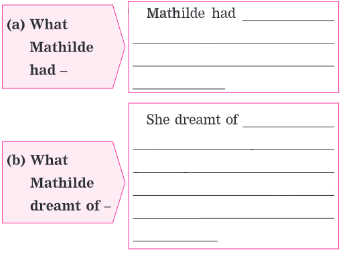
      Mathilde was a pretty and charming girl, born, as if by an error of fate, into a family of clerks. She had no means of becoming known, understood, loved or be wedded to an aristocrat; and so she let herself be married to a minor official at the Ministry of Education.
      She dressed plainly, because she had never been able to afford anything better. She suffered endlessly, feeling she was entitled to all the luxuries of life. She suffered because of her shabby, poorly furnished house. All these things, that another woman of her class would not even have noticed, tormented her and made her resentful. She dreamed of a grand, palatial mansion, with vast rooms and inviting smaller rooms, perfumed for afternoon chats with close friends.
      Yet, she had no rich dresses, no jewels, nothing; and these were the only things she loved. She wanted so much to charm, to be envied, to be sought after.
      She had a rich friend, a former schoolmate at the convent, whom she avoided visiting, because afterwards she would weep with regret, despair and misery.
      One evening her husband came home with an air of triumph, holding a large envelope in his hand. “Look,” he said, “here’s something for you.”
      She tore open the paper and drew out a card, on which was printed the words:
      “The Minister of Education and Mme. Georges Rampouneau request the pleasure of M. and Mme. Loisel’s company at the Ministry, on the evening of Monday, January 18th.”   
      Instead of being delighted, as her husband had hoped, she threw the invitation on the table resentfully, and muttered, “What do you want me to do with that ? And what do you expect me to wear if I go ?”

A2. Complex Factual Activities:
Complete the following:
Image
A3. Activities based on Vocabulary:
Match the words in Column 'A' with their meaning in Column 'B':

Column 'A'

Column 'B'

(1) aristocrat

(a) destiny

(2) fate

(b) great success

(3) shabby

(c) nobleman

(4) triumph

(d) nearly worn out

A4. Activities based on Contextual Grammar:
Find and write the adjectives from the passage for the following nouns:
(1) house (2) girl (3) official (4) mansion.
A5. Personal Response:
Write what you think about the following thoughts and actions of Mathilde :
(1) Mathilde was beautiful, and so she wanted to marry an aristocrat.
(2) Mathilde was sad because she did not get any luxuries.

A1. Simple Factual Activities:
State whether the following statements are True or False:
(1) The sage wanted to die on that day.
(2) The sage wanted to save his disciple.
(3) The king wanted to be king again in his next birth.
(4) The old man was a wise and learned sage.

Voices and shouts heard from outside. All re-enter in a rush with another elderly man.
King : What ? Why have you all returned with this  stranger alive ? And who is this man ?
First Guard : I beg your pardon, Your highness but we  are confused indeed. This old man rushed towards  us as we were about to hang the young stranger  and begged and pleaded that he should be hanged  instead.
Second Guard : At first we thought the old man had  lost his mental balance. What sane man would  wish to suffer such a drastic death willingly ?
First Guard : But this young man says that he is a  wise and learned sage from the forest yonder and  he himself was this man’s disciple.
Sage : O Noble King, You are most generous. Be kind  and allow me to be hanged in place of my  disciple. I beg of you.
King : What a strange appeal ! And why  does such a wise and holy man wish to  obstruct the course of justice, may I ask ? 
Sage : (showing reluctance to let out his  secret) Your Majesty.... the truth is... no....  no.... I cannot say it.
King : I demand an explanation or I shall  not have you hanged in place of your  disciple.
Sage : You see........ uh........ it has been  predicted by the great prophets..... uh......  no...... no..... I shouldn’t say this.
King : (annoyed) Speak out at once or your disciple  will be hanged.
Sage : The.... the great prophets have foretold that the one who will be hanged on this day, in this kingdom, shall .... shall become the next king and conquer many more nations. I want to become the next great king, Your Majesty, and reign over a greater country ... I will go down in history as a famous royal monarch. The future generations will read about me and my greatness for milleniums to come. I shall never earn that fame if I remain a recluse - a sage. So do grant me this favour, O King, let me die at the gallows today.
King : Humm ...... The next king ? And this kingdom will expand ? Glory for milleniums to come ! Why, no one but I should be entitled to this privilege. Guards ! Take me to the gallows and hang me at once without any delay. Hurry up ! Don’t waste time. What a wonderful fate in my next life - a king once again ! Goodbye, world. See you again.

A2. Complex Factual Activities:
(1) What was the sage's request? Why did he make such a strange request? 
(2) List the characters that appear for the first time in this part of the passage. Write one- two lines about each of them.
A3. Activities based on Vocabulary:
Write any suitable noun from the passage for the given adjectives to make correct combination!
(1) generous 
(2) wonderful
(3) great
(4) learned
A4. Activities based on Contextual Grammar:
(1) Make the following sentences Assertive:
What a strange appeal!
(2) Rewrite using 'as well as':
 He is a wise and learned sage from the forest.
A5. Personal Response:
Was the King willing to hang the Sage?Why?
A1. Simple Factual Activities:
Complete the following sentences using the information given in the passage:
(1) Most people agree that tea is a ______________.
(2) Emperor Shennong was called the father of ______________.
(3) Bodhidharma found that chewing tea leaves acted as ______________.
(4) Tea got its distinctive flavour by its theanine as well as ______________.

       Most people agree that tea is a refreshing drink. It contains no carbohydrates, fat, or proteins. What gives tea its special and distinctive flavour is theanine as well as caffeine, which give the drink its stimulating quality.
       How and when did people first begin to drink tea? An amusing story has come down to us from Chinese legends. It is said that Emperor Shennong, the father of Chinese agriculture and medicine, was on his travels, when a servant was boiling some water for the emperor to drink. Just then, a few leaves from a nearby tree blew into the boiling water. The water immediately changed colour. On drinking the water, the emperor was amazed by the rich flavour and the refreshing quality of the resulting infusion. Excited by the unknown plant and its amazing flavour, he carried out further investigations, and discovered that tea had many healing and restorative properties and could also be used as an antidote to certain poisons.
       Yet another legend tells us that it was a Buddhist monk named Bodhidharma who was the first to use tea as a drink. He was keen to find a herb or a medicinal plant which would help him stay awake and alert for long periods of time in prayer and meditation. After considerable search and trial, he found that chewing leaves from the tea shrub acted as a stimulant, helping him stay awake. It was he who introduced tea among his disciples in China. It is said that Japanese priests studying under Buddhist teachers in China carried tea seeds and leaves back home with them. Turkish traders also began to bargain for tea on the border of Mongolia. In fact, the story goes that the Chinese Emperor Hui Tsung was so taken up with tea that he set up a research into the best tea- whisking methods and also hosted tea-making and tea-tasting tournaments in the court. So ‘tea minded’ was he, that he failed to notice that Mongolia had actually taken over his empire!

A2. Complex Factual Activities:
(1) Who was Emperor Shennong? Why did he carry out further investigations about tea? 
A3. Activities based on Vocabulary:
Match the words in Column 'A' with their meaning in Column 'B':

Column 'A'Column 'B'
(1) investigation(a) a substance (tea) that helps you to stay awake.
(2) stimulant(b) a drink made by leaving shrubs (leaves), etc. in boiling water.
(3) infusion(c) making you strong and healthy again.
(4) restorative(d) a scientific examination for finding the truth.

A4. Activities based on Contextual Grammar:
Find the subject and the object from the following sentences:
(1) The water immediately changed colour.
(2) He carried out further investigations.
A5. Personal Response:
What is the difference between legends or stories and history?