Question
A1. Simple Factual Activities:
Complete the following sentences using the information given in the passage:
(1) Most people agree that tea is a ______________.
(2) Emperor Shennong was called the father of ______________.
(3) Bodhidharma found that chewing tea leaves acted as ______________.
(4) Tea got its distinctive flavour by its theanine as well as ______________.

       Most people agree that tea is a refreshing drink. It contains no carbohydrates, fat, or proteins. What gives tea its special and distinctive flavour is theanine as well as caffeine, which give the drink its stimulating quality.
       How and when did people first begin to drink tea? An amusing story has come down to us from Chinese legends. It is said that Emperor Shennong, the father of Chinese agriculture and medicine, was on his travels, when a servant was boiling some water for the emperor to drink. Just then, a few leaves from a nearby tree blew into the boiling water. The water immediately changed colour. On drinking the water, the emperor was amazed by the rich flavour and the refreshing quality of the resulting infusion. Excited by the unknown plant and its amazing flavour, he carried out further investigations, and discovered that tea had many healing and restorative properties and could also be used as an antidote to certain poisons.
       Yet another legend tells us that it was a Buddhist monk named Bodhidharma who was the first to use tea as a drink. He was keen to find a herb or a medicinal plant which would help him stay awake and alert for long periods of time in prayer and meditation. After considerable search and trial, he found that chewing leaves from the tea shrub acted as a stimulant, helping him stay awake. It was he who introduced tea among his disciples in China. It is said that Japanese priests studying under Buddhist teachers in China carried tea seeds and leaves back home with them. Turkish traders also began to bargain for tea on the border of Mongolia. In fact, the story goes that the Chinese Emperor Hui Tsung was so taken up with tea that he set up a research into the best tea- whisking methods and also hosted tea-making and tea-tasting tournaments in the court. So ‘tea minded’ was he, that he failed to notice that Mongolia had actually taken over his empire!

A2. Complex Factual Activities:
(1) Who was Emperor Shennong? Why did he carry out further investigations about tea? 
A3. Activities based on Vocabulary:
Match the words in Column 'A' with their meaning in Column 'B':

Column 'A'Column 'B'
(1) investigation(a) a substance (tea) that helps you to stay awake.
(2) stimulant(b) a drink made by leaving shrubs (leaves), etc. in boiling water.
(3) infusion(c) making you strong and healthy again.
(4) restorative(d) a scientific examination for finding the truth.

A4. Activities based on Contextual Grammar:
Find the subject and the object from the following sentences:
(1) The water immediately changed colour.
(2) He carried out further investigations.
A5. Personal Response:
What is the difference between legends or stories and history?
Answer

A1. Simple Factual Activities:
(1) Most people agree that tea is a refreshing drink.
(2) Emperor Shennong was called the father of Chinese agriculture and medicine.
(3) Bodhidharma found that chewing tea leaves acted as a stimulant.
(4) Tea got its distinctive flavour by its theanine as well as caffeine.
A2. Complex Factual Activities:
(1) Emperor Shennong was the father of Chinese agriculture and medicine. On drinking the boiled water of tea leaves, he was amazed by the rich flavour and the refreshing quality of the infusion. He was so excited that he decided to carry out further investigation.
A3. Activities based on Vocabulary:

(1) investigation - a scientific examination for finding the truth.
(2) stimulant - a substance (tea) that helps you to stay awake.
(3) infusion - a drink made by leaving shrubs (leaves), etc. in boiling water.
(4) restorative - making you strong and healthy again.
A4. Activities based on Contextual Grammar:
(1) Subject: The water; Object: colour
(2) Subject: He; Object: investigations.
A5. Personal Response:
Legends or stories may not be true but history tells you the facts and true events of the past. History is the written or recorded or spoken events of the past. They are concerned with the real persons, places, arts, etc. that really existed in the past whereas legends are mostly imaginary and passed down from generations to generations in the form of story telling. So they are likely to change but the events in history are generally unchangeable.

Need a full question paper?

Generate a complete, print-ready paper with questions like this in minutes — across 16+ boards, with answer keys.

Start Generating Free

Similar questions

A1. Simple Factual Activities:
State whether you Agree or Disagree with the following statements:
(1) Miranda had never ever seen any human being except her father.
(2) Prospero was not happy when his daughter saw Ferdinand.
(3) Miranda was the goddess of the island.
(4) Ariel was very faithful to Prospero.

      In reality, Ariel informed Prospero, the ship was  safely anchored in one corner of the island; Ferdinand  was all alone on the beach, and Alonso, Antonio,  Gonzalo and the others were wandering about on the  island, not knowing where to go.
      “Ariel, my joyful spirit,” Said Prospero. “Bring Ferdinand here at once, for my daughter must see him.”
      “Remember, Master, I have served you joyfully all these years. And you promised me that you would set me free one day.”             
      “Obey my commands now,” Prospero said to him “and in two days I shall set you free!”
       Ariel, assuming a form invisible to Ferdinand enchanted the prince with a beautiful song, leading him carefully into the presence of Prospero and Miranda And, all happened exactly as Prospero had planned.
       Miranda, who had never ever seen any human being except her father, looked at the handsome young prince and was thrilled.
      “I might call him a thing divine,” she exclaimed “for nothing natural I ever saw so noble!”
       Ferdinand too, was astonished to see such a beautiful young girl in a desolate place like the island “Most sure, she is the goddess of the island !” he thought to himself.
       As they gazed at each other in wonder, admiration and love, Prospero was secretly pleased. But outwardly he pretended to be angry. He accused the Prince of spying on the island, to capture it for himself. “Follow me,” he said to the Prince, “I shall tie you up, neck and feet together.”
      The brave prince drew his sword to defend himself - but Prospero waved his magic stick, and the prince was forced to stand like a statue, as still as stone.. 

A2. Complex Factual Activity:
Who said to whom and when :
(1) "Remember, Master, I have served you joyfully all these years!"
(2) "Obey my commands now, and in two days I shall set you free!"
(3) Most sure, she is the goddess of the island!
(4) "Follow me, I shall tie you up, neck and feet together."
A3. Activities based on Vocabulary:
writing related words to the given mood:
(1) Happy mood : ___________, ___________
(2) Surprise mood : ___________, ___________
A4. Activities based on Contextual Grammar:
Rewrite the following sentences as per the instructions:
(1) Prospero waved his magic stick.
(Rewrite the sentence in past continuous tense.)
(2) Ariel informed Prospero that the ship was safely anchored in one corner of the island.
(Rewrite the sentence in past perfect tense.)
A5. Personal Response:
Do you think the power of magic can make you successful? Why?
A1. Simple Factual Activities:
Complete the following sentences:
(1) The thieves were ______________ and ______________.
(2) Both the thieves were true ______________.

King : Let the court begin !
Fourth Guard Messenger : The first complainant !
Thief : (rushes forward and wails loudly) Justice ! Oh, Most Great King ! I beg for Justice.
King : And what is your complaint ?
Thief : In this great land of Andher Nagari, my friend and I have been truly hard-working honest thieves. All these years we have been true to our profession. And what is our reward ? Last night, with great efforts, we made a hole in the wall of a merchant’s house, when all his family were away. My friend peered through that hole into the house, when suddenly the wall collapsed (Wails louder).... and .... and my friend was instantly killed. I’ve lost my only friend and partner. O King ! It’s the merchant’s fault for living in a house with such weak walls.
King : Fetch the merchant at once. A life for life ! The merchant must be hanged ! (Third Guard leaves and returns with the merchant who bows before the king.)
Merchant : Mercy, O Noble King ! I had no intention of killing these skilled professionals. It is not my fault that the wall of my house collapsed. My house has been recently built. It is the fault of the bricklayer, who carelessly built such a weak wall.
King : Bring the careless bricklayer immediately. He must hang for his fault.
Bricklayer : O Most Kind Lord and King ! (kneeling to the king) Have mercy. I beg you, don’t send me to the gallows. I agree that I built the wall which collapsed and killed a man. But it was not due to my carelessness. The mortar which I used to lay the bricks was of very poor quality. There was too much of water mixed in it. It is entirely the mortar-maker’s fault.

A2. Complex Factual Activities:
Arrange the following sentences in chronological order:
(1) The wall collapsed while entering the house and the thief's friend was instantly killed.
(2) One day they made a hole in the wall of a merchant's house.
(3) There were two hardworking and honest thieves in the great land of Andher Nagari.
(4) They were very true to their profession from the last several years.
A3. Activities based on Vocabulary:
Find out the adverbs which are used along with the following verbs:
(1) ______________ killed
(2) ______________ built
(3) ______________ bring
(4) ______________ collapsed
A4. Activities based on Contextual Grammar:
Frame Verbal Questions:
(1) There was too much of water mixed in it.
(2) My friend was instantly killed.
A5. Personal Response:
Will a thief appear in a court on his own? Why does this thief dare to do so?
A1. Simple Factual Activities:
Write whether the following statements are True or False:
(1) The first Indian tea was sent to England for public sale in 1823.
(2) Tea became a fashionable and popular drink in Europe.
(3) Our body produces chemicals called free radicals.
(4) The word 'chai' is now sometimes used in English to refer to China tea.

      Thus the habit of drinking tea spread to Japan, Europe and England, where it became a fashionable and popular drink among the people.
     How did this magical beverage get its name? The Chinese character t’u was first used in early inscriptions to describe tea. But later, a new character, ch’a, was developed to refer specifically to tea. The word ch’a is now sometimes used in English to refer to China tea. And, as we all know, it is very close to the Hindi word chai, which is used all over India to refer to tea.
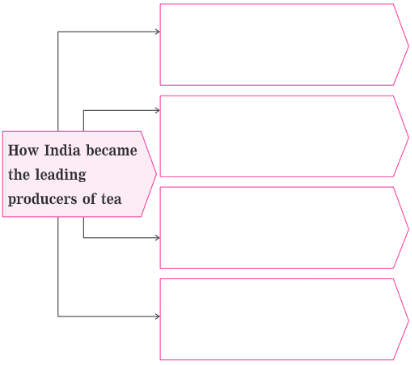
      How did tea first come to India? Historians think that tea had been known in India as a medicinal plant since ancient times, but tea was not drunk for pleasure until the British began to establish plantations in the 19th century. In the 1770s, the British East India Company made several unsuccessful attempts to grow tea in Bhutan and Assam, with seeds from China. Although these attempts failed, the botanist Robert Bruce in 1823 discovered tea plants growing wild in the Upper Brahmaputra valley. In May 1838, the first Indian tea from Assam was sent to England for public sale. Since then India has gone on to become one of the leading producers of tea in the world.
      Tea lovers claim that tea may be able to reduce the risk of cancer, control blood pressure, fight viruses in our body and actually help us live longer!
      Our body produces chemicals called free radicals. They can damage our body and our health. Tea contains antioxidants called flavonoids. Scientists believe these help to protect our system against free radicals.

A2. Complex Factual Activities:

Complete the web :
Image
A3. Activities based on Vocabulary:
Match the verbs in 'A' with the related phrases/words in 'B' from the passage:

 'A' 'B'
(1) reduce(a) viruses in our body
(2) control(b) us live longer
(3) fight(c) the risk of cancer
(4) help(d) blood pressure

A4. Activities based on Contextual Grammar:
Underline the infinitives in the following sentences:
(1) The word ch'a' is used in English to refer to China tea.
(2) Tea may be able to reduce the risk of cancer
A5. Personal Response:
What is the difference between 'claim' and 'fact'?

A1. Simple Factual Activities:
Complete the following sentences using the information from the passage:
(1) The last man who entered the wooden horse was  ______________.
(2) Troy was taken, not by force but  ______________.

       At last Troy was taken, not by force but by a  trick. It was the cunning Odysseus who thought of a  plan to obtain the victory.
        “Let us build a great wooden horse”, he said, “big  enough to hold men inside it, and let some of our  best fighters hide in the horse. Then let us burn our  tents and pretend to sail away in our ships. But instead  of sailing away, we will return in the night. When  the Trojans are asleep, we will attack the city and  burn and kill.”
       The Greek leaders decided to follow the advice  of the wise Odysseus. So a great horse of wood was  made by a skilful engineer, and the greatest heroes,  Menelaus, Odysseus himself, and others entered it, the  last man to go in being the architect himself who  knew the secret of opening and shutting the entrance.  That evening the Greeks burned their tents and sailed  away in their ships, but they did not go very far.  Only one man was left behind to persuade the Trojans  to drag the horse into their city.
        Next day the Trojans woke up, expecting to go  out and fight as they had done for the past ten years.  What delight and surprise they felt at the sight they  saw on the seashore outside the walls ! It seemed that  the long siege was over at last. The tents had been  burnt. The shore was deserted. The Greek ships had  all gone.
       “It’s peace at last,” they cried, and opened wide  their gates and came out in large numbers on the  plain, glad to be free again to go where they pleased.  Then they saw on the sands the huge, wooden horse.  They gathered round it in astonishment, for it was  indeed a wonderful piece of work.

A2. Complex Factual Activities:
How did Odysseus plan to defeat the Trojans? 
A3. Activities based on Vocabulary:
Arrange the letters properly to make a meaningful word:
(1) aagni
(2) bndeih
(3) rohse
(4) seegi.
A4. Activities based on Contextual Grammar:
Read the following constructions carefully and then use them to express your ideas:
(1) A horse big enough to hold men inside it.
(2) The Greeks were tired of the long war.
A5. Personal Response:
Was it enough to use the wooden horse to hide some soldiers? What was done to make the Trojans take it inside the city? 
A1. Simple Factual Activities:
Fill in the blanks with one word:
(1) Prospero took the prince to a cave.
(2) Ferdinand wanted to be the king of Naples.
(3) Many more tricks were played on Prospero's enemies by Ariel.
(4) Antonio wanted to kill king Alonso.

      Miranda begged her father to be kind to the sweet prince; but Prospero took the prince to a cave, where he was made to work, carrying heavy logs. This was only as a trial of his love, for as he watched them from afar, he saw the young people talking to each other, getting to know each other, and very soon, falling in love with each other. 
     “I shall be king of Naples one day,” Ferdinand said to Miranda, “and you shall be my Queen, I promise you !”
     At this, Prospero smiled, and appearing before them, said to Ferdinand, “All your troubles were merely trials of your love; and you have nobly stood the test. Now, I give you my daughter, a priceless gift.”
     In the meanwhile, in another part of the island, the evil and treacherous Antonio was once again plotting a murder. This time he planned to kill king Alonso, so that his brother Sebastian could become the king. The two wicked men were about to kill the sleeping king, when Ariel woke him up, saving his life in the nick of time.
     Many more tricks did Ariel play on Prospero’s enemies. He caused them to wander about; he filled their ears with strange and frightful noises; when they were faint with hunger, he set a huge banquet before them, only to take it away when they touched the food.
     When the men were nearly out of their senses with fear and hunger, Ariel reminded them of their treachery and wickedness in the past.
      King Alonso and the loyal lord Gonzalo were filled with grief, for all the injustice that had been done to Prospero. In this repentant mood, Ariel brought them before Prospero.
      At first, they could hardly recognise the former Duke of Milan, for he was clothed in his magic robe. But Prospero revealed himself to them in his own form. He thanked Gonzalo for his kindness, and reproached the king and Antonio for their treachery.

A2. Complex Factual Activity:
(1) What tricks did Ariel play on Prospero's enemies? 
A3. Activities based on Vocabulary:
(1) Find out two words from the passage with suffix 'ness' and write your own two words with suffix 'ness'.
A4. Activities based on Contextual Grammar:
Begin the sentences with the underlined object and rewrite it:
(1) Ariel brought them before Prospero.
(2) He thanked Gonzalo for his kindness.
A5. Personal Response:
'Ariel was a faithful spirit' - why do you think so? 
A1. Simple Factual Activities:
Who said to whom?
(1) "How can I make amends?"
(2) "Go out into the street and collect the bits of paper."
(3) "Write all the harsh things you said to him."
(4) "Learn to think before you speak in anger."

     A young man went to his spiritual teacher and said, “I have spoken very harsh and unkind words to my friend, and he is deeply hurt. I am afraid I have lost my friendship with him. How can I make amends?”
      The wise teacher gave him a fresh sheet of blank paper and a pen; he said to the young man, “Write down on this paper all the harsh things you said to him.”
      The young man did as he was told, and showed the paper to the teacher.
      “Now tear up this sheet of paper into as many small bits as you can,” the wise teacher said. Soon, the single sheet was torn into a hundred tiny bits of paper.
     “Throw the bits out of this window,” the teacher told him. 
      That was easily done! It was a windy day and the tiny bits were scattered far and wide even as the young man watched. 
     “Now, go out into the street and collect as many bits of the paper as you can,” the teacher ordered him.
     The young man was taken aback. “But…but, that will be difficult …” he stammered.
     “It will be difficult indeed, but do give it a try,” the teacher suggested. 
      The young man went out. He returned half an hour later, exhausted. He had not been able to get hold of a single torn bit from the paper he had torn up just a while earlier! 
     “This is what happens with the spoken word,” the teacher said to him. “Once you have spoken the words aloud, it is very difficult to take them back. Therefore, learn to think before you speak in anger.

A2. Complex Factual Activities:
(1) How did the spiritual teacher teach a lesson to the young man about his harsh and unkind words to his friend? 
A3. Activities based on Vocabulary :
Write any four adverbs each with '-ly' that express (a) anger and (b) loving nature in our talk:
A4. Activities based on Contextual Grammar:
Make two sentences of your own with each of the words given below, using the same words as a noun and as a verb in another:
(1) return:
A5. Personal Response:

(1) What do you do when someone speaks to you angrily. Do you also speak angrily?
A1. Simple Factual Activities:
Correct the following sentences using facts from the passage:
(a) Helen escaped with Menelaus.
(b) Troy was attacked because it was a strong rich city.

      The Iliad is the story of Ilium or Troy, a rich trading city in Asia Minor near the narrow sea that leads from the Aegean to the Black Sea. It was well situated, both for commerce and agriculture. In front of the city was the sea over which sailed the ships of Troy, carrying goods and grain. At the back rose the high peak of Mount Ida, from which flowed many rivers and streams. The valleys among the hills were well-watered and fertile, with corn growing in fertile fields and cattle feeding on the rich grass of the meadows while sheep fed on the slopes of the hills.
      Round their city the Trojans had built a strong wall so that no enemy should attack them from the sea. The wall was so broad that people could stand and sit and walk on it. The great gates stood open, and people could go to the seashore outside and come in as they pleased. But in time of war the gates would be closed; and then the city was like a strong fortress, quite safe from all attack, protected by the walls surrounding it, as well as by the hills behind.
      Thus, Troy was a strong city, strongly protected by its walls and strongly defended by its brave soldiers. But all the kings and heroes of Greece had declared war against the Trojans, because Paris, a prince of Troy, had persuaded Helen, wife of a Greek king Menelaus, to elope with him. He had brought her to Troy. The Greeks wanted to take revenge on Troy for the wrong done to Menelaus. They sailed to Troy and laid siege to the city. The Trojans, too, fought hard and the siege continued for ten long years.

A2. Complex Factual Activities:
(1) How did the location of Troy help it to grow into a very rich/prosperous city?
A3. Activities based on Vocabulary:
Match the adjectives in Column 'A' with the nouns in Column 'B':

'A''B'
 (1) high (a) fortress
 (2) brave (b) peak
 (3) fertile (c) fields
 (4) strong (d) soldiers

A4. Activities based on Contextual Grammar:
Underline the infinitives in the sentences
(1) Paris persuaded Helen to elope with him.
(2) The Greeks wanted to take revenge.
A5. Personal Response:
Do you know one of the wars in ancient India which was fought over a woman? Describe it in short.

A1. Simple Factual Activities:
Complete the following sentences:
(1) The mortar-maker's family comprised of ______________.
(2) According to the mortar-maker excess water poured down into ______________.

King : Summon the mortar-maker at once. He must pay with his life for his thoughtlessness.
(First Guard exits and returns with the mortar-maker who rushes and throws himself before the king.)
Mortar-maker : (wailing loudly) Forgive me, O Merciful King. Please do not hang me to death. I have a wife and two young children. Who will look after them ?
King : Your carelessness has cost a life. You must pay with your life.
Mortar-maker : No... no... no, my Royal Lord. I am not to blame. The pot which I used to pour water into the mortar had an extra-ordinarily large mouth. So excess water poured down into the mortar mixture. I was helpless. It is the potter’s fault for making such a useless pot.
King : Let the potter be brought here at once. He must be executed for moulding such useless pots.
(Fourth Guard leaves and re-enters with the potter.)
Potter : (cowering before the king) Your Majesty, show mercy to this humble potter. I agree the pot I made and sold to the mortar-maker was a defective one. But I am not guilty. As I was moulding that pot, I heard the sweet delicate tinkling of anklets. It was the money-lender’s daughter. She distracted me just as I was shaping the mouth and it became too wide.
King : Bring the money-lender’s daughter here, this very instant. She must be sent to the gallows for disturbing this poor potter at work.
(First Guard leaves and enters with the money-lender and his daughter.)
Money-lender : (in a desperate voice) O Just King ! Spare my daughter. She is my only child and to be wedded next Monday.
Daughter : Oh, do not fret, father. The king will not hang me. (To the king) Your Most Esteemed 
Highness, I rarely step outside the threshold of my home. But as my father said, I am to be married next week and my jewellery is not ready. I had to go to the goldsmith’s shop to urge him to work faster and hand over my ornaments on time ... The potter’s shop is on the way. I could not help it. It is all the goldsmith’s fault. Had he delivered my ornaments on time. I would not have been forced to go past the potter’s shop.
King : Then send for the goldsmith and without any delay, he must be hanged.

A2. Complex Factual Activities:
(1) Is the Daughter's complaint about the Goldsmith true? 
A3. Activities based on Vocabulary:
(1) Find out minimum four infinitives from the passage:
A4. Activities based on Contextual Grammar:
Read the following sentences and separate the subject and the verb in each:

SentenceSubjectverb
 (1) You are a stranger.  
 (2) I am a visitor here.  

A5. Personal Response:
Why is the daughter so confident that the king will not hang her? Does her prediction come true?

A1. Simple Factual Activities:
Read the sentences and fill in the blanks with correct alternatives:
(1) The County Inspector was a round little man with a red face.
(a) The teacher   (b) The County Inspector
(2) Margie hated most was the slot where she had to put homework and test papers.
(a) the teacher    (b) the slot

    He was a round little man with a red face and a whole box of tools with dials and wires. He smiled at Margie and gave her an apple, then took the teacher apart. Margie had hoped he wouldn’t know how to put it together again, but he knew how all right, and, after an hour or so, there it was again, large and black and ugly, with a big screen on which all the lessons were shown and the questions were asked. That wasn’t so bad. The part Margie hated most was the slot where she had to put homework and test papers. She always had to write them out in a punch code they made her learn when she was six years old, and the mechanical teacher calculated the marks in no time.
    The Inspector had smiled after he was finished and patted Margie’s head. He said to her mother, “It’s not the little girl’s fault, Mrs Jones. I think the geography sector was geared a little too quick. Those things happen sometimes. I’ve slowed it up to an 
average ten-year level. Actually, the overall pattern of her progress is quite satisfactory.” And he patted Margie’s head again.
     Margie was disappointed. She had been hoping they would take the teacher away altogether. They had once taken Tommy’s teacher away for nearly a month because the history sector had blanked out completely.

A2. Complex Factual Activities:
Arrange the following in order of occurrence: 
(1) She wrote them out in a punch code.
(2) All the lessons were shown and questions were asked on the screen.
(3) The County Inspector took the teacher apart and then put it together again.
(4) The mechanical teacher calculated the marks.
A3. Activities based on Vocabulary:
Write what the following sentences would mean today, and what they mean in the context of the story: 
(1) She had been hoping they would take the teacher away altogether.
A4. Activities based on Contextual Grammar:

Rewrite the following using complete words instead of contracted forms:
(1) I've slowed it up.
(2) He wouldn't know.
A5. Personal Response:
Do you like to take tests? Give the reason for your answer.
A1. Simple Factual Activities:
Find the following matter in the passage and copy the missing words:
(1) He went on to prove that ______________________ .
(2) It was Maxwell ______________________ .

      He then took the age - old experiment of sprinkling iron filings on a sheet of paper near a magnet, making circular patterns. He went on to prove that these patterns were not a property of the iron filings; in fact they were due to the invisible magnetic fields that filled the empty space around the magnet and hence disturbed the filings. This is where his lack of formal education went against him. Faraday did not know much about advanced mathematics, so he just copied the iron filing patterns with his hand. He was unable to explain them in the form of mathematical equations. He made hundreds of such drawings but without equations, they were not accepted.
      Fortune favoured the brave Faraday once again when he met James Maxwell, a wealthy, educated physicist well versed in mathematics. He was willing to work with Faraday. It was Maxwell who translated Faraday’s idea into a set of equations that are now called Maxwell’s equations. Their combined work has helped us in many ways. Electronics and communication system today are designed around their discoveries. Some day, we might even be able to communicate with aliens across different galaxies using the products of these discoveries.
     Faraday’s life started with difficulties, but as a great scientist he met each difficulty with perseverance and conviction. He was given impossible tasks, which he undertook as challenges and opportunities. He epitomises what the Walt Disney character Pinocchio said : ‘
When you wish upon a star
It does not matter who you are’.

A2. Complex Factual Activity:
Why were Faraday's drawings not accepted? Does it mean they were wrong?
A3. Activities based on Vocabulary:
Find and write the past tense verbs with '-ed' from the passage:
A4. Activities based on Contextual Grammar:
Do as directed:
(1) He was unable to explain them. (Make it a negative sentence without changing meaning.)
(2) He made hundreds of such drawings. (Choose the correct sentence of passive voice.)
(a) Hundreds of such drawings are made by him.
(b) Hundreds of such drawings will be made by him.
(c) Hundreds of such drawings were made by him.
(d) Hundreds of such drawings have made by him.
A5. Personal Response:
When you wish to achieve some goal, does it matter what you are?