Question
A1. Simple Factual Activities:
Complete the following sentences using the information from the passage:
(1) The arithmetic lesson was on ______________.
(2) And the teachers were ______________.
(3) ______________ was flashing on the screen.
(4) Margie inserted yesterday's homework in the slot ______________.

    The screen was lit up, and it said: “Today’s arithmetic lesson is on the addition of proper fractions. Please insert yesterday’s homework in the proper slot.” Margie did so with a sigh. She was thinking about the old schools they had when her grandfather’s 
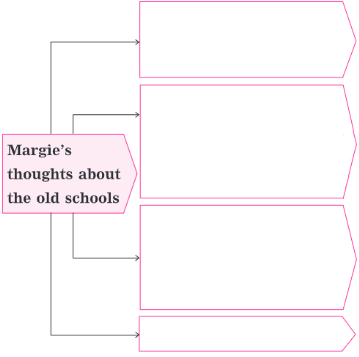
grandfather was a little boy. All the kids from the whole neighbourhood came, laughing and shouting in the schoolyard, sitting together in the schoolroom, going home together at the end of the day. They learned the same things, so they could help one another with the homework and talk about it.
     And the teachers were people ...
    The mechanical teacher was flashing on the screen : When we add fractions 1/2 and 1/4 ...”
    Margie was thinking about how the kids must have loved it in the old days. She was thinking about the fun they had.

A2. Complex Factual Activities:

Complete the web:
Image
A3. Activities based on Vocabulary:
Write the words from the passage that show actions taken place in the old school.
A4. Activities based on Contextual Grammar:
(1) The kids were laughing and shouting.(Use simple past tense and rewrite the sentence.)
(2) I sing a song. (Change the subject 'T' to 'she' and rewrite the sentence.)
A5. Personal Response:
Would you like to have your own mechanical teacher? why?
Answer

A1. Simple Factual Activities:
(1) The arithmetic lesson was on the addition of proper fractions.
(2) And the teachers were people.
(3) The mechanical teacher was flashing on the screen.
(4) Margie inserted yesterday's homework in the slot with a sigh.
A2. Complex Factual Activities:
(1) Unlike the mechanical teacher, the teacher in old times didn't live in the house. They went to a special building called school to teach the children who also went there. The students learnt the same things if they were in the same age group or the same class.
A3. Activities based on Vocabulary:
came, laughing, shouting, sitting, going, learned, help, talk.
A4. Activities based on Contextual Grammar:
(1) It is probably time for lunch.
(2) They had a special invitation.
A5. Personal Response:
Yes, I would like to have my own mechanical teacher if it is affordable to my family. Though my school teachers are there to guide me in my school, this mechanical teacher will help me to have individual teaching and guidance. I can prepare well in all my subjects with the help provided by the mechanical teacher.

Need a full question paper?

Generate a complete, print-ready paper with questions like this in minutes — across 16+ boards, with answer keys.

Start Generating Free

Similar questions

A1. Simple Factual Activities:
Correct the following sentences using facts from the passage:
(a) Troy traded in cattle and grass with other cities.
(b) During war, Trojans jumped over the fort gates.

      The Iliad is the story of Ilium or Troy, a rich trading city in Asia Minor near the narrow sea that leads from the Aegean to the Black Sea. It was well situated, both for commerce and agriculture. In front of the city was the sea over which sailed the ships of Troy, carrying goods and grain. At the back rose the high peak of Mount Ida, from which flowed many rivers and streams. The valleys among the hills were well-watered and fertile, with corn growing in fertile fields and cattle feeding on the rich grass of the meadows while sheep fed on the slopes of the hills.
      Round their city the Trojans had built a strong wall so that no enemy should attack them from the sea. The wall was so broad that people could stand and sit and walk on it. The great gates stood open, and people could go to the seashore outside and come in as they pleased. But in time of war the gates would be closed; and then the city was like a strong fortress, quite safe from all attack, protected by the walls surrounding it, as well as by the hills behind.
      Thus, Troy was a strong city, strongly protected by its walls and strongly defended by its brave soldiers. But all the kings and heroes of Greece had declared war against the Trojans, because Paris, a prince of Troy, had persuaded Helen, wife of a Greek king Menelaus, to elope with him. He had brought her to Troy. The Greeks wanted to take revenge on Troy for the wrong done to Menelaus. They sailed to Troy and laid siege to the city. The Trojans, too, fought hard and the siege continued for ten long years.

A2. Complex Factual Activities:
State the counteraction for the following actions:
(a) Helen eloped with Paris.
(b) The Greeks sailed to Troy and attacked it.
A3. Activities based on Vocabulary:
(1) Write the words related to 'Geography' from the passage.
A4. Activities based on Contextual Grammar:
(1) A prince of Troy had persuaded Helen.
(Begin with Helen had and change the voice.)
Ans. Helen had been persuaded by a prince of Troy.
(2) The city was strongly defended by its brave soldiers.
(Choose the correct option of Active voice.)
(a) Its brave soldiers defended strongly by the city.
(b) Its brave soldiers defended the city strongly.
A5. Personal Response:
Do you know one of the wars in ancient India which was fought over a woman? Describe it in
short.
A1. Simple Factual Activities:
Complete the following sentences using the information from the passage:
(1) The most popular beverage in the world is ______________.
(2) ______________ is an evergreen plant that grows in tropical and sub-tropical climates.
(3) Tea plants require at least ______________ cm of rainfall a year.
(4) The teas we buy are usually classified according to the ______________.

      Let us begin with a question : can you name the most widely consumed beverage in the world, after water?
      Perhaps many of you have guessed the answer : the most popular beverage in the world is tea - the fresh, aromatic brew with which people like to begin their day. It has a refreshing, astringent flavour. It is actually made by brewing, that is by infusing in boiling water, the leaves and shoots of a plant whose botanical name is the Camellia sinensis. The leaves are at first dried, cured and processed before they are packed and sold to us.
      Camellia sinensis is an evergreen plant that grows in tropical and sub-tropical climates. Tea plants require at least 100-125 cm of rainfall a year and prefer acidic soils. Many of the world’s best tea estates are located on hill slopes at elevations of up to 1500 metres : it is said that the tea plants grow slowly and acquire a richer flavour at this height.
      When the plants mature, only the top 1-2 inches of the plant are picked. These buds and leaves are called flushes. A new flush appears on the plant every seven to ten days during the peak growing season. Left to grow on its own, the tea plant may actually grow into a small tree. But in all tea gardens, the plants are pruned and kept at a height of about three feet (waist high) to enable easy plucking of the leaves. The teas we buy are usually classified according to their leaf size. Accordingly we have (1) Assam type of tea, characterised by the largest leaves; (2) China type, characterised by the smallest leaves; and (3) Cambod, characterised by leaves of intermediate size.
      We have three very distinct and different tea growing regions in India. Each of these regions is famous for the special type of tea it produces, which are unique in taste, aroma, strength and flavour. The three regions are : Darjeeling in North-Eastern India, Assam in far North-East India and Nilgiris in South India.

A2. Complex Factual Activities:
(1) Why are tea plants pruned? 
(2) How is tea the beverage made?
A3. Activities based on Vocabulary:
(1) List all the names of geographical places mentioned in the passage:
(2) List the qualities of the special type of tea.
A4. Activities based on Contextual Grammar:
(1) A new flush ______________ on the plant every seven to ten days. (appear/appears)
(2) Tea plants ______________ at least 100-125 cm of rainfall a year. (require/requires)
(3) Each of these regions ______________ famous for the specialtype of tea. (is/are)
(4) It ______________ said that the tea plants grow slowly. (are/is)
A5. Personal Response:
What are botanical names? How are they decided?
A1. Simple Factual Activities:
Say whether the following statements are True or False:
(1) Madame Forestier recognised her dear friend immediately.
(2) Madame Forestier still looked young, beautiful and charming.
(3) It had taken them ten years to pay for the imitation diamond neclace.
(4) The imitation was not worth five hundred francs at most!

     One Sunday, as she was walking in the Champs Élysées suddenly she saw Madame Forestier, still young, still beautiful, still charming.
      Madame Loisel felt emotional. Should she speak to her ? Yes, of course. And now that she had paid, she would tell her all. Why not ?
      She went up to her, “Good morning, Jeanne.”
      The other, astonished to be addressed so familiarly by this common woman, did not recognise her. She stammered:
      “But - Madame - I don’t know. You must have made a mistake.”
      “No, I am Mathilde Loisel.”
       Her friend uttered a cry, “Oh !  ... my poor Mathilde, how you’ve changed ! ...”
      “Yes, I have had some hard times since I last saw you, and many miseries ... and all because of you ! ...”
      “Me ? How can that be ?”
      “You remember that diamond necklace that you lent me to wear to the Ministry party ?”
      “Yes. Well ?”
      “Well, I lost it.”
      “What do you mean ? You brought it back.”
       “I brought you back another exactly like it. And it has taken us ten years to pay for it. It wasn’t easy for us, we had very little. But at last it is over, and I am very glad.”
       Madame Forestier was stunned.
      “You say that you bought a diamond necklace to replace mine ?”
      “Yes; you didn’t notice then ? They were very similar.”
       And she smiled with proud and innocent pleasure.
       Madame Forestier, deeply moved, took both her hands.
      “Oh, my poor Mathilde ! Mine was an imitation ! It was worth five hundred francs at most !...”

A2. Complex Factual Activities:
Complete the following table:

Utterance

Who said it

To whom

When

(1) You must have made a mistake.


(2) Well, I lost it.


A3. Activities based on Vocabulary:
Match the words in Column 'A' with their meaning in Column 'B':

Column 'A'

Column 'B'

(1) familiarly

(a) artificial/not real

(2) astonished

(b) in a friendly manner

(3) imitation

(c) very surprised

(4) innocent

(d) having not done anything wrong

A4. Activities based on Contextual Grammar:
Do as directed:
(1) How you've changed! (Make an assertive sentence.)
(2) They were similar. (Make it negative without changing meaning.)
A5. Personal Response:
(1) Who do you think was responsible for Mathilde's misery? Was it her friend, she herself, her husband or the circumstances?

A1. Simple Factual Activities:
Answer the following in words:
(1) Henry Irving asked Mark Twain if he had heard the story before ______________
(2) Mark Twain could not lie the third time at any cost because ______________

     One day Henry Irving, in the midst of telling Mark Twain a humorous story, abruptly stopped and examined his friend’s face. “You haven’t heard this, have you ?” he asked. Twain assured him that he had not. 
     When, some time later, Irving again paused, and again posed the question, Twain again reassured him. Then, approaching the climax, Irving broke off once more. “Are you quite sure you haven’t heard this?” he demanded suspiciously. “I can lie once,” Twain finally replied. “I can lie twice for courtesy’s sake, but I draw the line there. I can’t lie the third time at any price. I not only heard the story, I invented it !”
Mark Twain once proposed a ‘Plan for the Improvement of English Spelling’: 
     For example, in Year 1 that useless letter ‘c’ would be dropped to be replased either by ‘k’ or 
‘s,’ and likewise, ‘x’ would no longer be part of the alphabet. 
The only kase in which ‘c’ would be retained  would be the ‘ch’ formation, which will be dealt with later.
     Year 2 might reform ‘w’ spelling, so that ‘which’ and ‘one’ would take the same konsonant, wile Year 3 might well abolish ‘y’ replasing it with ‘i’ and Iear 4 might fiks the ‘g/j’ anomali wonse and for all. 
     Jenerally, then, the improvement would kontinue iear bai iear with Iear 5 doing awai with useless double konsonants, and Iears 6-12 or so modifaiing vowlz and the rimeining voist and unvoist konsonants. Bai Iear 15 or sou, it wud fainali bi posibl to meik ius ov thi ridandant letez ‘c,’ ‘y’ and ‘x’ — bai now jast a memori in the maindz ov ould doderez — tu riplais ‘ch,’ ‘sh,’ and ‘th’ rispektivli. 
     Fainali, xen, aafte sam 20 iers ov orxogrefkl riform, wi wud hev a lojikl, kohirnt speling in ius xrewawt xe Ingliy-spiking werld. 

A2. Complex Factual Activities:
(1) Was Twain particular about what words he used?
(2) What did Mark Twain propose? What was his plan at the year 6-12?
A3. Activities based on Vocabulary:
Find out words from the passage that are used in place of the following words:
(1) world - ______________
(2) replace - ______________
(3) respectively - ______________
(4) modifying - ______________
A4. Activities based on Contextual Grammar:
Identify the tense:"
(1) Henry Irving was telling a humorous story.
(2) Mark Twain proposed a plan for the improvement of English Spelling.
A5. Personal Response:
(1) How can you improve English spellings?
A1. Simple Factual Activities:
Read the sentences and fill in the blanks with correct alternatives:
(1) The County Inspector was a round little man with a red face.
(a) The teacher   (b) The County Inspector
(2) Margie hated most was the slot where she had to put homework and test papers.
(a) the teacher    (b) the slot

    He was a round little man with a red face and a whole box of tools with dials and wires. He smiled at Margie and gave her an apple, then took the teacher apart. Margie had hoped he wouldn’t know how to put it together again, but he knew how all right, and, after an hour or so, there it was again, large and black and ugly, with a big screen on which all the lessons were shown and the questions were asked. That wasn’t so bad. The part Margie hated most was the slot where she had to put homework and test papers. She always had to write them out in a punch code they made her learn when she was six years old, and the mechanical teacher calculated the marks in no time.
    The Inspector had smiled after he was finished and patted Margie’s head. He said to her mother, “It’s not the little girl’s fault, Mrs Jones. I think the geography sector was geared a little too quick. Those things happen sometimes. I’ve slowed it up to an 
average ten-year level. Actually, the overall pattern of her progress is quite satisfactory.” And he patted Margie’s head again.
     Margie was disappointed. She had been hoping they would take the teacher away altogether. They had once taken Tommy’s teacher away for nearly a month because the history sector had blanked out completely.

A2. Complex Factual Activities:
Arrange the following in order of occurrence: 
(1) She wrote them out in a punch code.
(2) All the lessons were shown and questions were asked on the screen.
(3) The County Inspector took the teacher apart and then put it together again.
(4) The mechanical teacher calculated the marks.
A3. Activities based on Vocabulary:
Write what the following sentences would mean today, and what they mean in the context of the story: 
(1) She had been hoping they would take the teacher away altogether.
A4. Activities based on Contextual Grammar:

Rewrite the following using complete words instead of contracted forms:
(1) I've slowed it up.
(2) He wouldn't know.
A5. Personal Response:
Do you like to take tests? Give the reason for your answer.
A1. Simple Factual Activities:
Write if the following statements are True or False:
(1) Margie's school was in her house.
(2) In those old days kids went to a special building for learning.
(3) Margie was not interested in reading the old book.
(4) Tommy went home with the book.

    Tommy screamed with laughter. “You don’t know much, Margie. The teachers didn’t live in the house. They had a special building and all the kids went there.”
    “And all the kids learned the same things ?”
    “Sure, if they were the same age.”
    “But my mother says a teacher has to be adjusted to fit the mind of each boy and girl it teaches and that each kid has to be taught differently.” 
    “Just the same they didn’t do it that way then. If you don’t like it, you don’t have to read the book.”
    “I didn’t say I didn’t like it”, Margie said quickly. She wanted to read about those funny schools.
    They weren’t even half finished when Margie’s mother called, “Margie ! School !”
Margie looked up. “Not yet, Mamma.”
   “Now !” said Mrs Jones. “And it’s probably time for Tommy, too.”
    Margie said to Tommy, “Can I read the book some more with you after school ?”
   “May be.” he said nonchalantly. He walked away whistling, the dusty old book tucked beneath his arm. 
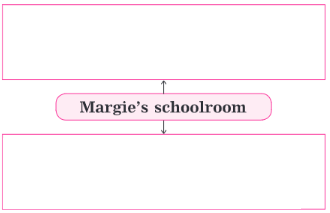
   Margie went into the schoolroom. It was right next to her bedroom, and the mechanical teacher was on and waiting for her. It was always on at the same time every day except Saturday and Sunday, because her mother said little girls learned better if they learned at regular hours.

A2. Complex Factual Activities:

Complete the web :
Image
A3. Activities based on Vocabulary:
Match the similar meaning words:

Column 'A'

Column 'B'

(1) kid

(a) under

(2) same

(b) fast

(3) beneath

(c) similar

(4) quickly

(d) child

A4. Activities based on Contextual Grammar:
Write the following using complete words instead of contracted forms:
(1) They weren't even half finished.
(2) And it's probably time for Tommy, too.
A5. Personal Response:
Would you like your own mechanical teacher? Support your answer.

A1. Simple Factual Activities:
Name the following:
(1) Name of the kingdom
(2) Name of the king
(3) The person who was not alert
(4) The forest from where a visitor came

Scene I : A King’s Court. The court awaits the arrival of the king. Two guards are standing front right of the stage.
First Guard : (To the second guard) Be alert, the king is about to arrive.
Second Guard : Who wants to be alert ? Life seems like one long sleep in this land. I am at ease, all day, though I am a guard.
First Guard : How boring ! I wonder if some interesting drama will unfold at the court today. It would enliven the atmosphere.
Second Guard : I would be equally happy if there was none. (Enter the disciple looking around.)
First Guard : Halt ! You are a stranger. Give your identity.
Disciple : You are right. I am a visitor here - a disciple of the Wise Sage from the Ghangor forest which lies to the east of your kingdom.
First Guard : What brings you here ?
Disciple : I have heard amazing stories about this kingdom of Andher Nagari and the great King Chaupat. I am especially impressed by the fact that everything in the market is sold at the same price. No complications.
First Guard : You have heard right. In our land, you can buy the most rich and delectable sweets for the same price as an equal measure of vegetables. Taka ser bhaji, taka ser khaja. I am quite happy about it. It makes life easy.
Disciple : So it should. It would be a good idea to settle in this land. But first I would like to attend the court today and pay my respects to the mighty King Chaupat.
Second Guard : You may stand there (pointing out) with those people who are in a queue.
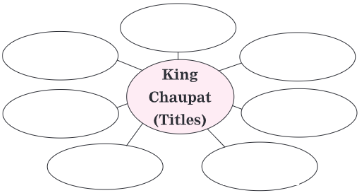
(Loud Voice from backstage : Hear you people. Here comes the most noble, most revered, most 
gracious, most learned King Chaupat of this vast kingdom. Make way for the king - Bow to the Royal Monarch.)
(King Chaupat arrives to the fanfare of bugles and drums and takes his place on the throne.)

A2. Complex Factual Activities:
Why did a disciple of the Wise Sage from the Ghangor forest come to Andher Nagari?
A3. Activities based on Vocabulary:
Make a list of describing words used for King Chaupat in the form of a web:
Image
A4. Activities based on Contextual Grammar:
Identify the types of the following sentences: 
(1) Give your identity.
(2) How boring!
(3) You have heard right.
(4) What brings you here?
A5. Personal Response:

Do you think this is a good land to settle in? why?
A1. Simple Factual Activities:
Complete the following sentences with the help of the given passage:
(1) The real name of Mark Twain was ______________.
(2) Mark Twain went to ______________ for a shave.
(3) ______________ are told and enjoyed even today.
(4) The young Mark Twain ran over early to say goodbye to ______________.

    Mark Twain was the pen name of Samuel Langhome Clemens, a popular American writer. He was famous for his humorous stories, novels and other writings. His ready wit shone through everyday conversations. Many anecdotes related to Mark Twain are told and enjoyed even today.
     It should be noted that he was a great defender of human values like liberty, equality and fraternity. He opposed wars and imperialism and supported the cause of labourers and of the black people in his country, America. Given below are some anecdotes from his life and some quotations from his speeches and writings.
     One day during a lecture tour, Mark Twain entered a local barber shop for a shave. This, Twain told the barber, was his first visit to the town.
     "You've chosen a good time to come," he declared.
     "Oh?" Twain replied.
     "Mark Twain is going to lecture here tonight. You'll want to go, I suppose?"
     "I guess so..."
     "Have you bought your ticket yet?"
     "No, not yet."
     "Well, it's sold out, so you'll have to stand."
     "Just my luck," said Twain with a sigh. "I always have to stand when that fellow lectures!"
     Mrs Stowe was leaving for Florida one morning, and Clemens (the young Mark Twain) ran over early to say goodbye. On his return Mrs Clemens regarded him disapprovingly: 
     “Why”, she said, “you haven’t on any collar and tie.” 
     He said nothing, but went up to his room, did up these items in a neat package, and sent it over to Mrs Stowe by a servant, with a line: 
     ‘Herewith receive a call from the rest of me.’

A2. Complex Factual Activities:
(1) Was Twain particular about how he dressed when he was visiting friends?
A3. Activities based on Vocabulary:
Find out similar meaning words (synonyms) for the following from the passage:
(1) freedom - ______________
(2) protector -  ______________
(3) brotherhood - ______________
(4) considered - ______________
A4. Activities based on Contextual Grammar:
Change the following sentences in indirect speech:
(1) "You have chosen a good time to come," the barber said to Mark Twain.
(2) The barber said to Mark Twain, "Have you bought your ticket?"
A5. Personal Response:
(1) What is the importance of humour in our life?
A1. Simple Factual Activities:
Read the passage on 'Gond Art' carefully. Then complete the following sentences without going back to the passage:
(1) Gond art is a tribal ___________.
(2) The Gondi language is similar to Telugu, a Dravidian ___________.
(3) Originally people used to draw pictures on the earthen walls of their ___________.
(4) In folk arts, you yourself prepare the 'canvas' - the surface on which to draw and the colours with which you ___________.

      Gond art has spread mainly in Central India. Originally, people used to draw  pictures on the earthen walls of their houses. Most folk arts involve natural  techniques of preparing colours and use of several mediums. They are transferred  from generation to generation in a smoothly flowing process. Gond art is no  exception to this. A house decorated with beautiful pictures creates a pleasant  atmosphere. Also, art is a medium of recording and preserving what is seen.
     In folk arts, you yourself prepare the ‘canvas’ - the surface on which to draw and the colours with which you draw. That is why creating folk art is a very enriching experience.

A2. Complex Factual Activity:
Complete the following sentences:
(1) A house decorated with beautiful pictures creates _____________________.
(2) Creating folk art is ______________________.
(3) Gond art is developed and prepared by ______________________.
(4) Gond art has spread mainly in  ______________________.
A3. Activities based on Vocabulary:
Spot the error in the spelling and rewrite them correctly:
(1) mithology (2) tibel (3) midiam (4) erthen. 
A4. Activities based on Contextual Grammar:
Complete the following table with the help of the passage: 
AdjectiveAdverb
large___________
main___________
___________beautifully
___________traditionally
A5. Personal Response:
Write few sentences about your favourite art:
A1. Simple Factual Activities:
Choose the correct alternatives and complete the following sentences:
(1) In Russia, tea is made and served in  ____________.
(a) cups (b) pots (c) samovars
(2) In Japan, tea is made using  ____________. 
(a) a bamboo whisk (b) sugar (c) green tea

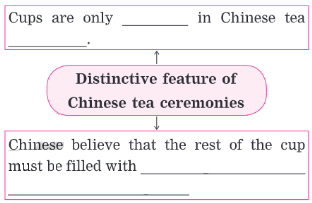
     In most areas of China the tea is made in small clay teapots. At tea ceremonies, 
cups are only half-filled. The Chinese believe that the rest of the cup must be filled with friendship and affection.
      In Russia, tea is made and served in samovars - a special Russian tea kettle, made of metal.
     Vietnam produces special varieties of tea such as lotus tea and jasmine tea.
     In Japan, tea is made using powdered green tea called ‘matcha’. The tea is mixed with boiled water using a bamboo whisk and served in small bowls.And how about India ? A cup of tea is offered to any guest or visitor as a token of hospitality even in the humblest of homes. Most Indians like their tea hot with a good deal of milk and sugar in it. In the rainy season, it is brewed with ginger to give it additional medicinal properties. Others add spices, like cardamom, cloves or mace, to add to its taste and flavour. Tea is a must after a plate of spicy snacks, especially in the morning and evenings.
    Some connoisseurs relish delicately flavoured jasmine tea, green tea, lemon tea and even iced tea ! How about you ? 
   
A2. Complex Factual Activities:
Complete the web using the information from the passage :
Image
A3. Activities based on Vocabulary:
(1) List the things from the passage that are used for making tea.
A4. Activities based on Contextual Grammar:
Read the sentences and fill in the blanks with correct prepositions given in the brackets:
(1) Tea is served ________ a small clay pot. (in, on, with)
(2) The tea is mixed ________ boiled water using cloves. (for, with, at)
(3) They still have tea ceremonies ________ important occasions. (for, to, in)
(4) Some people use mace ________ add to its taste. (for, to, with)
A5. Personal Response:
What is your favourite beverage? Tell your reasons.