Question
A1. Simple Factual Activities:
Complete the following sentences using the information from the passage:
(1) The most popular beverage in the world is ______________.
(2) ______________ is an evergreen plant that grows in tropical and sub-tropical climates.
(3) Tea plants require at least ______________ cm of rainfall a year.
(4) The teas we buy are usually classified according to the ______________.

      Let us begin with a question : can you name the most widely consumed beverage in the world, after water?
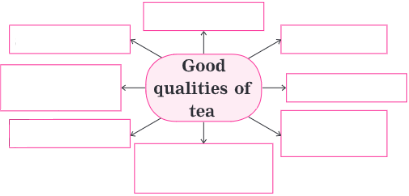
      Perhaps many of you have guessed the answer : the most popular beverage in the world is tea - the fresh, aromatic brew with which people like to begin their day. It has a refreshing, astringent flavour. It is actually made by brewing, that is by infusing in boiling water, the leaves and shoots of a plant whose botanical name is the Camellia sinensis. The leaves are at first dried, cured and processed before they are packed and sold to us.
      Camellia sinensis is an evergreen plant that grows in tropical and sub-tropical climates. Tea plants require at least 100-125 cm of rainfall a year and prefer acidic soils. Many of the world’s best tea estates are located on hill slopes at elevations of up to 1500 metres : it is said that the tea plants grow slowly and acquire a richer flavour at this height.
      When the plants mature, only the top 1-2 inches of the plant are picked. These buds and leaves are called flushes. A new flush appears on the plant every seven to ten days during the peak growing season. Left to grow on its own, the tea plant may actually grow into a small tree. But in all tea gardens, the plants are pruned and kept at a height of about three feet (waist high) to enable easy plucking of the leaves. The teas we buy are usually classified according to their leaf size. Accordingly we have (1) Assam type of tea, characterised by the largest leaves; (2) China type, characterised by the smallest leaves; and (3) Cambod, characterised by leaves of intermediate size.
      We have three very distinct and different tea growing regions in India. Each of these regions is famous for the special type of tea it produces, which are unique in taste, aroma, strength and flavour. The three regions are : Darjeeling in North-Eastern India, Assam in far North-East India and Nilgiris in South India.

A2. Complex Factual Activities:
(1) Why are tea plants pruned? 
(2) How is tea the beverage made?
A3. Activities based on Vocabulary:
(1) List all the names of geographical places mentioned in the passage:
(2) List the qualities of the special type of tea.
A4. Activities based on Contextual Grammar:
(1) A new flush ______________ on the plant every seven to ten days. (appear/appears)
(2) Tea plants ______________ at least 100-125 cm of rainfall a year. (require/requires)
(3) Each of these regions ______________ famous for the specialtype of tea. (is/are)
(4) It ______________ said that the tea plants grow slowly. (are/is)
A5. Personal Response:
What are botanical names? How are they decided?
Answer

A1. Simple Factual Activities:
(1) The arithmetic lesson was on the addition of proper fractions.
(2) And the teachers were people.
(3) The mechanical teacher was flashing on the screen.
(4) Margie inserted yesterday's homework in the slot with a sigh.
A2. Complex Factual Activities:
(1) The tea plants are pruned and kept at height of about three feet to make it possible for them to pluck the tea leaves easily.
(2) Tea is made by brewing, that is by infusing tea leaves in boiling water.
A3. Activities based on Vocabulary:
(1) Assam, China, Cambod, Darjiling, Nilgiris.
(2) unique in taste, aroma, strength, flavour.
A4. Activities based on Contextual Grammar:
(1) A new flush appears on the plant every seven to ten days. (appear/appears)
(2) Tea plants require at least 100-125 cm of rainfall a year. (require/requires)
(3) Each of these regions is famous for the specialtype of tea. (is/are)
(4) It is said that the tea plants grow slowly. (are/is)
A5. Personal Response:
     Botanical names are actually scientific names. These names are according to binomial (two words) naming system. The first name tells us the genus (जाती) of a plant and the second name is the species (प्रजाती) of the plant. Throughout the world there should be only one uniform name, that is why the scientific naming system is used.
    They are decided according to their characters and classification to which they belong.

Need a full question paper?

Generate a complete, print-ready paper with questions like this in minutes — across 16+ boards, with answer keys.

Start Generating Free

Similar questions

A1. Simple Factual Activities:
Complete the following sentences with the help of the information given in the passage:(1) In many countries around the world, tea drinking is ______________.
(2) Tea ceremonies give people the time ______________.

    For many people tea is a popular drink to have with friends. In many countries around the world, tea drinking is an important social occasion.
    Japan, China, Russia and Korea have special tea ceremonies and traditions. These ceremonies give people the time to relax and enjoy the taste and the smell of the tea.
     Most people in Japan belong to a ‘tea club’ where they go every week to take part in the tea ceremony. Ordinary people also feel that tea ceremonies are spiritual occasions that are closely associated with their religion. ‘Tea,’ they say, ‘is a healthy, enjoyable and stimulating drink, full of good qualities. It reduces loneliness and calms your heart; it is a comfort in everyday life’.
     Many Koreans today still have tea ceremonies for important occasions including special birthdays and anniversaries.
   
A2. Complex Factual Activities:
Complete the web using the information from the passage :
Image
A3. Activities based on Vocabulary:
Fill in the blanks with describing words used for the following nouns from the passage:(1) ______________ drink
(2) ______________ tea
(3) ______________ occasions
(4) ______________ qualities
A4. Activities based on Contextual Grammar:
Choose the proper article from the given brackets to complete the sentences.
(1) He has to attend ______________ important meeting. (a, an)
(2) He was looking at ______________ setting sun. (the, a, an)
A5. Personal Response:
Do you have any ceremonies associated with food items?
A1. Simple Factual Activities:
Read the sentences and fill in the blanks with correct alternatives:
(1) The County Inspector was a round little man with a red face.
(a) The teacher   (b) The County Inspector
(2) Margie hated most was the slot where she had to put homework and test papers.
(a) the teacher    (b) the slot

    He was a round little man with a red face and a whole box of tools with dials and wires. He smiled at Margie and gave her an apple, then took the teacher apart. Margie had hoped he wouldn’t know how to put it together again, but he knew how all right, and, after an hour or so, there it was again, large and black and ugly, with a big screen on which all the lessons were shown and the questions were asked. That wasn’t so bad. The part Margie hated most was the slot where she had to put homework and test papers. She always had to write them out in a punch code they made her learn when she was six years old, and the mechanical teacher calculated the marks in no time.
    The Inspector had smiled after he was finished and patted Margie’s head. He said to her mother, “It’s not the little girl’s fault, Mrs Jones. I think the geography sector was geared a little too quick. Those things happen sometimes. I’ve slowed it up to an 
average ten-year level. Actually, the overall pattern of her progress is quite satisfactory.” And he patted Margie’s head again.
     Margie was disappointed. She had been hoping they would take the teacher away altogether. They had once taken Tommy’s teacher away for nearly a month because the history sector had blanked out completely.

A2. Complex Factual Activities:
Arrange the following in order of occurrence: 
(1) She wrote them out in a punch code.
(2) All the lessons were shown and questions were asked on the screen.
(3) The County Inspector took the teacher apart and then put it together again.
(4) The mechanical teacher calculated the marks.
A3. Activities based on Vocabulary:
Write what the following sentences would mean today, and what they mean in the context of the story: 
(1) She had been hoping they would take the teacher away altogether.
A4. Activities based on Contextual Grammar:

Rewrite the following using complete words instead of contracted forms:
(1) I've slowed it up.
(2) He wouldn't know.
A5. Personal Response:
Do you like to take tests? Give the reason for your answer.
A1. Simple Factual Activities:
Complete the following sentences:
(1) M. Hamel lived ___________.
(2) ___________ lived with him.
(3) M. Hamel wrote "___________"! on the blackboard with all his might.
(4) M. Hamel wrote ___________ on the grammar copy.

       After the grammar, we had a lesson in writing. That day M. Hamel had new copies for us, on which were written in a beautiful round hand : ‘France, Alsace, France, Alsace.’ They looked like little flags fluttering everywhere in the school room, hung from the rod at the top of our desks. You ought to have seen how every one set to work and how quiet it was. The only sound was the scratching of the pens over the paper. On the roof, the pigeons cooed very low, and I thought to myself :
      “Will they make them sing in German, even the pigeons ?”
       Whenever I looked up from my writing I saw M. Hamel sitting motionless in his chair and gazing at one thing, then at another, as if he wanted to fix in his mind just how everything looked in the little school-room. Fancy ! For forty years he had been there in the same place, with his garden outside the window and his class in front of him, just like that. Only the desks and benches had been worn smooth and the walnut trees in the garden were taller. How it must have broken his heart to leave it all, poor man; to hear his sister moving about in the room above, packing their trunks ! For they must leave the country next day.
        After the writing, we had a lesson in history, and then the babies chanted their ba, be, bi, bo, bu. Ah, how well I remember it, that last lesson !
       All at once the church clock struck twelve. At the same moment the trumpets of the Prussians, returning from drill, sounded under our windows. M. Hamel stood up, very pale, in his chair. I never saw him look so tall.
       “My friends”, said he, “I - I -” But something was choking him. He could not go on.
       Then he turned to the blackboard, took a piece of chalk, and, bearing on with all his might, he wrote as large as he could :
      “VIVE LA FRANCE !”
      Then he stopped and leaned his head against the wall, and, without a word, he made a gesture to us with his hand:
      “School is dismissed - you may go.”

A2. Complex Factual Activities:
Complete the following sentences:
(1) The only sound in the classroom was ___________.
(2) M. Hamel's sister moved in the room above to ___________.
(3) The gesture to students with his hand by M. Hamel was ___________.
(4) Only the ___________ had been worn smooth.
A3. Activities based on Vocabulary:
Write the meaning of:
(1) hold fast to something : ___________.
(2) at one stroke : ___________.
A4. Activities based on Contextual Grammar:
Do as directed:
(1) He could not go on. (Use to be able to")
(2) He took a piece of chalk, he wrote as large as he could. (Begin the sentence with 'After taking ...)
A5. Personal Response:
With the coming of Prussians, will language be the only thing that will change? What other changes may take place?
A1. Simple Factual Activities:
Complete the following sentences:
(1) M. Hamel lived ___________.
(2) ___________ lived with him.
(3) M. Hamel wrote "___________"! on the blackboard with all his might.
(4) M. Hamel wrote ___________ on the grammar copy.

       After the grammar, we had a lesson in writing. That day M. Hamel had new copies for us, on which were written in a beautiful round hand : ‘France, Alsace, France, Alsace.’ They looked like little flags fluttering everywhere in the school room, hung from the rod at the top of our desks. You ought to have seen how every one set to work and how quiet it was. The only sound was the scratching of the pens over the paper. On the roof, the pigeons cooed very low, and I thought to myself :
      “Will they make them sing in German, even the pigeons ?”
       Whenever I looked up from my writing I saw M. Hamel sitting motionless in his chair and gazing at one thing, then at another, as if he wanted to fix in his mind just how everything looked in the little school-room. Fancy ! For forty years he had been there in the same place, with his garden outside the window and his class in front of him, just like that. Only the desks and benches had been worn smooth and the walnut trees in the garden were taller. How it must have broken his heart to leave it all, poor man; to hear his sister moving about in the room above, packing their trunks ! For they must leave the country next day.
        After the writing, we had a lesson in history, and then the babies chanted their ba, be, bi, bo, bu. Ah, how well I remember it, that last lesson !
       All at once the church clock struck twelve. At the same moment the trumpets of the Prussians, returning from drill, sounded under our windows. M. Hamel stood up, very pale, in his chair. I never saw him look so tall.
       “My friends”, said he, “I - I -” But something was choking him. He could not go on.
       Then he turned to the blackboard, took a piece of chalk, and, bearing on with all his might, he wrote as large as he could :
      “VIVE LA FRANCE !”
      Then he stopped and leaned his head against the wall, and, without a word, he made a gesture to us with his hand:
      “School is dismissed - you may go.”

A2. Complex Factual Activities:
(1) Why does the author say, "I never saw him look so tall"? 
A3. Activities based on Vocabulary:
Find out synonyms from the passage for -
(1) awesome - ___________
(2) flapping - ___________
(3) intone - ___________
(4) discharged - ___________
A4. Activities based on Contextual Grammar:
Do as directed:
(1) He could not go on. (Use to be able to")
(2) He took a piece of chalk, he wrote as large as he could. (Begin the sentence with 'After taking ...)
A5. Personal Response:
Why M. Hamel was leaving the country?
A1. Simple Factual Activities:
Answer the following in words:
(1) How many times did Mark Twain hear the story?
(2) Who was telling the story?

     One day Henry Irving, in the midst of telling Mark Twain a humorous story, abruptly stopped and examined his friend’s face. “You haven’t heard this, have you ?” he asked. Twain assured him that he had not. 
     When, some time later, Irving again paused, and again posed the question, Twain again reassured him. Then, approaching the climax, Irving broke off once more. “Are you quite sure you haven’t heard this?” he demanded suspiciously. “I can lie once,” Twain finally replied. “I can lie twice for courtesy’s sake, but I draw the line there. I can’t lie the third time at any price. I not only heard the story, I invented it !”
Mark Twain once proposed a ‘Plan for the Improvement of English Spelling’: 
     For example, in Year 1 that useless letter ‘c’ would be dropped to be replased either by ‘k’ or 
‘s,’ and likewise, ‘x’ would no longer be part of the alphabet. 
The only kase in which ‘c’ would be retained  would be the ‘ch’ formation, which will be dealt with later.
     Year 2 might reform ‘w’ spelling, so that ‘which’ and ‘one’ would take the same konsonant, wile Year 3 might well abolish ‘y’ replasing it with ‘i’ and Iear 4 might fiks the ‘g/j’ anomali wonse and for all. 
     Jenerally, then, the improvement would kontinue iear bai iear with Iear 5 doing awai with useless double konsonants, and Iears 6-12 or so modifaiing vowlz and the rimeining voist and unvoist konsonants. Bai Iear 15 or sou, it wud fainali bi posibl to meik ius ov thi ridandant letez ‘c,’ ‘y’ and ‘x’ — bai now jast a memori in the maindz ov ould doderez — tu riplais ‘ch,’ ‘sh,’ and ‘th’ rispektivli. 
     Fainali, xen, aafte sam 20 iers ov orxogrefkl riform, wi wud hev a lojikl, kohirnt speling in ius xrewawt xe Ingliy-spiking werld. 

A2. Complex Factual Activities:
(1) Why was Henry Irving asking Mark Twain the same question again and again?
A3. Activities based on Vocabulary:
Find out any four wrongly spelled words from the passage and correct them:
(1) Iear - 
(2) konsonant - 
(3) fainali -
(4) lojikl -
A4. Activities based on Contextual Grammar:
Identify the mistakes in the following sentences and write the correct sentences:
(1) Jenerally, then, the improvement would kontinue iear bai iear.
(2) it wud fainali bi posibl to meik ius ov thi ridandant letez.
A5. Personal Response:
(1) Why should we avoid spelling mistakes while writing?
A1. Simple Factual Activities:
Complete the following sentences using the information from the passage:
(1) The arithmetic lesson was on ______________.
(2) And the teachers were ______________.
(3) ______________ was flashing on the screen.
(4) Margie inserted yesterday's homework in the slot ______________.

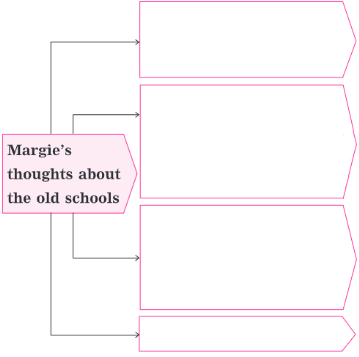
    The screen was lit up, and it said: “Today’s arithmetic lesson is on the addition of proper fractions. Please insert yesterday’s homework in the proper slot.” Margie did so with a sigh. She was thinking about the old schools they had when her grandfather’s 
grandfather was a little boy. All the kids from the whole neighbourhood came, laughing and shouting in the schoolyard, sitting together in the schoolroom, going home together at the end of the day. They learned the same things, so they could help one another with the homework and talk about it.
     And the teachers were people ...
    The mechanical teacher was flashing on the screen : When we add fractions 1/2 and 1/4 ...”
    Margie was thinking about how the kids must have loved it in the old days. She was thinking about the fun they had.

A2. Complex Factual Activities:

Complete the web:
Image
A3. Activities based on Vocabulary:
Write the words from the passage that show actions taken place in the old school.
A4. Activities based on Contextual Grammar:
(1) The kids were laughing and shouting.(Use simple past tense and rewrite the sentence.)
(2) I sing a song. (Change the subject 'T' to 'she' and rewrite the sentence.)
A5. Personal Response:
Would you like to have your own mechanical teacher? why?
A1. Simple Factual Activities:
List the profession/occupation of the people mentioned in the passage:
(1) Little Franz: ___________
(2) M. Hamel: ___________
(3) Watcher: ___________
(4) Classmates : ___________

     I started for school very late that morning and was in great dread of a scolding, especially because M. Hamel had said that he would question us on participles, and I did not know the first word about them. For a moment I thought of running away and spending the day out of doors. It was so warm, so bright ! The birds were chirping at the edges of the woods; and in the open field back of the sawmill the Prussian soldiers were drilling.
     When I passed the town hall there was a crowd in front of the bulletin board. For the last two years all our bad news had come from there. I thought myself. “What can be the matter now ?”
     Then, as I hurried by as fast as I could go, the blacksmith, Watcher, who was there with his apprentice, reading the bulletin, called after me :
     “Don’t go so fast, boy; you’ll get to your school in plenty of time !”
     I thought he was making fun of me, and reached M. Hamel’s little garden all out of breath.
     Usually, when school began, there was a great bustle, which could be heard out in the street - the opening and closing of desks, lessons repeated in unison, very loud, and the teacher’s great ruler rapping on the table. But now it was all so still !
     Through the window I saw my classmates, already in their place, and M. Hamel walking up and down with his terrible iron ruler under his arm. I had to open the door and go in before everybody. You can imagine how I blushed and how frightened I was.
     But nothing happened. M. Hamel saw me and said very kindly :"
     “Go to your place quickly, little Franz. We were beginning without you.”

A2. Complex Factual Activities:
(1) Describe the scene usually like when school begins. 
A3. Activities based on Vocabulary:
Choose the correct meaning from the given alternatives:
(1) was in great dread of
(a) was in a great hall
(b) was in great demand
(c) was afraid of
(d) was angry with.
(2) did not know the first word about them
(a) did not know anything about them
(b) did not care about them
(c) knew all the words except the first word
(d) had not learnt them by heart.
A4. Activities based on Contextual Grammar:
Frame a Wh-question to get underlined answer:
(1) The narrator was blushed and frightened.
(2) The morning was warm and bright.
A5. Personal Response:
How do your teachers punish you when you make a mistake in the class? 
A1. Simple Factual Activities:
State whether the following statements are True or False:
(1) The people of the village gathered in the school to thank M. Hamel.
(2) Franz can neither speak nor write French.
(3) Franz's parents were very much anxious in his studies.
(4) Franz had never listened M. Hamel so carefully before.

      Poor man ! It was in honour of this last lesson that he had put on his fine Sunday clothes; and now I understood why the old men of the village were sitting there in the back of the room. It was because they were sorry, too, that they had not gone to school more. It was their way of thanking our master for his forty years of faithful service and of showing their respect for the country that was theirs no more.
      While I was thinking of all this, I heard my name called. It was my turn to recite. I had not learnt my participles and so I could not say a single word. I heard M. Hamel say to me :
       “I don’t scold you, little Franz, you must feel bad enough. See how it is ! Every day we have said to ourselves : ‘Bah ! I’ve plenty of time. I’ll learn it tomorrow.’ And now you see where we’ve come out. Ah, that’s the great troubles with Alsace; she put off learning tomorrow. Now those fellows out there will have the right to say to you: ‘How is it; you pretend to be Frenchmen, and yet you can neither speak nor write your own language.’ But you are not the worst, poor little Franz. We’ve all a great deal to reproach ourselves with.
       “Your parents were not anxious enough to have you learn. They preferred to put you to work on a farm or at the mills, so as to have a little more money. And I’ve been to blame also. Have I not often sent you to water my flowers instead of making you learn your lessons ?”
      Then, from one thing to another, M. Hamel went on to talk of the French language saying that it was the most beautiful language in the world. We must guard it among us and never forget it, because when a people are enslaved, as long as they hold fast to their language, it is as if they had the key to their prison.Then he opened a grammar and read us our lesson. I was amazed to see how well I understood it. All he said seemed so easy, so easy ! I think, too, that I had never listened so carefully, and that he had never explained everything with so much patience. It seemed almost as if the poor man wanted to give us all he knew before going away, and to put it all into our heads at one stroke.

A2. Complex Factual Activities:
(1) Why does Franz understand his lesson well? 
A3. Activities based on Vocabulary:
Arrange the following words in alphabetical order:
prison, patience, people, poor, participles, plenty, pretend, parents.
A4. Activities based on Contextual Grammar:
Add a question tag :
(1) They had not gone to school, ___________?
(2) Your parents were not anxious enough to have you learn, ___________?
(3) You are not the worst, ___________?
(4) I had never listened so carefully, ___________?
A5. Personal Response:
We should be grateful to our teachers - support your views. 
A1. Simple Factual Activities:
Complete the sentences using the information from the passage:
(1) At the end of ten years, they ______________.
(2) How little is needed for one to be ______________
(3) Mathilde played her part ______________.
(4) She came to know the ______________.

      From then on, Madame Loisel knew the horrible life of the very poor. But she played her part heroically. The dreadful debt must be paid. She would pay it. They dismissed their maid; they changed their lodgings; they rented a garret under the roof.
    She came to know the drudgery of housework, the odious labours of the kitchen. She washed the dishes, the dirty linen, she carried the garbage down to the street every morning, and carried up the water, stopping at each landing to catch her breath and dressed like a commoner. She had to bargain at markets, quarrel and face insults over every miserable sou.
      Each month they had to pay some loans, renew others, get more time.
      Her husband worked extra, every evening, doing accounts for a tradesman, and often, late into the night, he sat copying a manuscript at five sous a page.
      And this life lasted ten years. At the end of ten years they had paid off everything, even the interest.
      Madame Loisel looked old now. Often, she brooded over the past - What would have happened if she had not lost that necklace ? How strange life is, how fickle ! How little is needed for one to be ruined or saved !

A2. Complex Factual Activities:
(1) How did life of Mathilde change after the horrible incident? 
A3. Activities based on Vocabulary:
Write from the passage the phrases related to 'housework'.
A4. Activities based on Contextual Grammar:
Change the following sentences in passive voice:
(1) They dismissed their maid.
(2) They rented a garret under the roof.
A5. Personal Response:
Write what you think about the following actions of Mathilde:
(1) Mathilde worked very very hard to pay the debt.
A1. Simple Factual Activities:
Answer the following in words:
(1) Mark Twain received a letter from the editor of a small Missouri newspaper.
(2) Finding a spider in a paper is good luck for the reader according to Mark Twain.
(3) Mark Twain's birth was heralded by the return of Halley's comet.
(4) Mark Twain died in November 1835.

      One day during his tenure as the editor of a small Missouri newspaper, Mark Twain received a letter from a reader who had found a spider in his paper. He wondered whether this portended good or bad luck.
       “Finding a spider in your paper,” Twain replied, “is neither good luck nor bad. The spider was merely looking over our paper to see which merchant was not advertising so that he could go to that store, spin his web across the door, and lead a life of undisturbed peace ever afterward.”
      Mark Twain’s birth in November 1835 was heralded by the return of Halley’s comet. Twain, who often remarked upon this curiosity, came to think of himself and the comet as ‘unaccountable freaks,’ cosmically linked: having come in together, he declared, they would go out together.
      In fact, Twain was proven right. On the night of his death in April 1910, Halley’s comet once again blazed through the sky...
Some Quotations
April Fool’s Day - This is the day upon which we are reminded of what we are on the other three hundred and sixty-four.
 A man cannot be comfortable without his own approval.
A person with a new idea is a crank until the idea succeeds.
Age is an issue of mind over matter. If you don’t mind, it doesn’t matter.
All generalizations are false, including this one 
Be careful about reading health books. You may die of a misprint.
Be careless in your dress if you will, but keep a tidy soul.
‘Classic’ - A book which people praise and don’t read. Humour is mankind’s greatest blessing.
I am an old man and have known a great many troubles, but most of them never happened.
I must have a prodigious quantity of mind; it takes me as much as a week sometimes to make it up.
If you tell the truth, you don’t have to remember anything.
 It is better to deserve honours and not have them than to have them and not deserve them.
It is better to keep your mouth closed and let people think you are a fool than to open it and 
remove all doubt.
It’s no wonder that truth is stranger than fiction. Fiction has to make sense.
Whenever you find yourself on the side of the majority, it is time to pause and reflect.
Why is it that we rejoice at a birth and grieve at a funeral? It is because we are not the person 
involved.
Thousands of geniuses live and die undiscovered either by themselves or by others.
Thunder is good, thunder is impressive; but it is lightning that does the work.
When I was younger I could remember anything, whether it happened or not.
When your friends begin to flatter you on how young you look, it’s a sure sign you’re getting old.

A2. Complex Factual Activities:
Which episode shows that Mark Twain did not believe in superstitions? 
A3. Activities based on Vocabulary:
Read the following and write the two meanings of 'mind' and 'matter'.
Age is an issue of mind over matter. If you don't mind, it doesn't matter.
A4. Activities based on Contextual Grammar:
Frame a wh-question to get the underlined part as an answer in each sentences:
(1) Mark Twain received a letter from a reader.
(2) Mark Twain's birth was heralded by the return of Halley's comet.
A5. Personal Response:
(1) Why should we take part in humorous sessions?