Question
A1. Simple Factual Activities:
Correct the following sentences using facts from the passage:
(a) Troy traded in cattle and grass with other cities.
(b) During war, Trojans jumped over the fort gates.

      The Iliad is the story of Ilium or Troy, a rich trading city in Asia Minor near the narrow sea that leads from the Aegean to the Black Sea. It was well situated, both for commerce and agriculture. In front of the city was the sea over which sailed the ships of Troy, carrying goods and grain. At the back rose the high peak of Mount Ida, from which flowed many rivers and streams. The valleys among the hills were well-watered and fertile, with corn growing in fertile fields and cattle feeding on the rich grass of the meadows while sheep fed on the slopes of the hills.
      Round their city the Trojans had built a strong wall so that no enemy should attack them from the sea. The wall was so broad that people could stand and sit and walk on it. The great gates stood open, and people could go to the seashore outside and come in as they pleased. But in time of war the gates would be closed; and then the city was like a strong fortress, quite safe from all attack, protected by the walls surrounding it, as well as by the hills behind.
      Thus, Troy was a strong city, strongly protected by its walls and strongly defended by its brave soldiers. But all the kings and heroes of Greece had declared war against the Trojans, because Paris, a prince of Troy, had persuaded Helen, wife of a Greek king Menelaus, to elope with him. He had brought her to Troy. The Greeks wanted to take revenge on Troy for the wrong done to Menelaus. They sailed to Troy and laid siege to the city. The Trojans, too, fought hard and the siege continued for ten long years.

A2. Complex Factual Activities:
State the counteraction for the following actions:
(a) Helen eloped with Paris.
(b) The Greeks sailed to Troy and attacked it.
A3. Activities based on Vocabulary:
(1) Write the words related to 'Geography' from the passage.
A4. Activities based on Contextual Grammar:
(1) A prince of Troy had persuaded Helen.
(Begin with Helen had and change the voice.)
Ans. Helen had been persuaded by a prince of Troy.
(2) The city was strongly defended by its brave soldiers.
(Choose the correct option of Active voice.)
(a) Its brave soldiers defended strongly by the city.
(b) Its brave soldiers defended the city strongly.
A5. Personal Response:
Do you know one of the wars in ancient India which was fought over a woman? Describe it in
short.
Answer

A1. Simple Factual Activities:
(1) Troy traded in goods and grain
(2) During war, Trojans would close the doors of the fort.
A2. Complex Factual Activities:
(1) Counteraction: The Greeks wanted to take revenge on Troy, they sailed and laid siege to the
city of Troy.
(2) Counteraction: The Trojans fought hard and the siege continued for ten long years.
A3. Activities based on Vocabulary :
(1) Asia Minor, trading city, Aegean, Black Sea, agriculture, grain, peak of Mount Ida, rivers, streams, valleys, hills, fertile fields, cattle, grass, fortress, meadows.
A4. Activities based on Contextual Grammar:
(1) Helen had been persuaded by a prince of Troy.
(2) Its brave soldiers defended the city strongly.
A5. Personal Response:
I know such a war was fought between Ram and Ravan. Ravan, the demon king of Lanka, came in disguise as a Sadhu and forcefully took away Seeta, the wife of Ram. Ram with his monkey army reached Lanka. He fought against Ravan, defeated him and killed Ravan and brought back Seeta to Ayodhya.

Need a full question paper?

Generate a complete, print-ready paper with questions like this in minutes — across 16+ boards, with answer keys.

Start Generating Free

Similar questions

A1. Simple Factual Activities:
Complete the following sentences:
(1) The writer and her teacher were attracted by ______________.
(2) As the cool stream gushed over Helen's hand, she realised that water meant ______________.

     We walked down the path to the well-house, attracted by the fragrance of the honeysuckle with which it was covered. Someone was drawing water and my teacher placed my hand under the spout. As the cool stream gushed over one hand she spelled into the other the word water, first slowly, then rapidly. I stood still, my whole attention fixed upon the motions of her fingers. Suddenly I felt a misty consciousness as of something forgotten - a thrill of returning thought; and somehow the mystery of language was revealed to me. I knew then that ‘w-a-t-e-r’ meant the wonderful cool something that was flowing over my hand. That living word awakened my soul, gave it light, hope, joy, set it free ! There were barriers still, it is true, but barriers that could in time be swept away.
     I left the well-house eager to learn. Everything had a name, and each name gave birth to a new thought. As we returned to the house, every object that I touched seemed to quiver with life. That was because I saw everything with the strange, new sight that had come to me. On entering the door I remembered the doll I had broken. I felt my way to the hearth and picked up the pieces. I tried vainly to put them together. Then my eyes filled with tears; for I realised what I had done, and for the first time I felt repentance and sorrow.
     I learned a great many new words that day. I do not remember what they all were; but I do know that mother, father, sister, teacher were among them - words that were to make the world blossom for me ‘like Aaron’s rod, with flower.’ It would have been difficult to find a happier child than I was as I lay in my crib at the close of that eventful day and lived over the joys it had brought me, and for the first time longed for a new day to come.
     Helen went on to become a graduate cum laude from Radcliffe. She then devoted the rest of her life to teaching and giving hope to the blind and deaf, as her teacher had done. She and Anne remained friends until  Anne’s death.

A2. Complex Factual Activities:
(1) Why did young Helen feel repentance and sorrow? 
A3. Activities based on Vocabulary:
Find out four compound words from the lesson: 
A4. Activities based on Contextual Grammar:
Rewrite the sentences by using 'As soon as':
On entering the door, I remembered the doll I had broken.
Rewrite the sentences by using 'As soon as':
We walked down the path to the well-house, we got attracted by the fragrance of the honeysuckle.
A5. Personal Response:
Why should we help disabled people?
A1. Simple Factual Activities:
Correct the following sentences using facts from the passage:
(1) The Greek armies and heroes always defeated the Trojans. 
(2) Both the enemies were eager to continue fighting.

     The fighting went on daily, but the siege did not end. On the one hand, the Greeks could not take the city, and on the other hand the Trojans could not force them to sail away. Every day the Trojans came out of their gates, and the Greeks came out of their tents and ships, and the fighting went on. Sometimes there were great battles between the two armies. Sometimes there were single fights between two great heroes. Sometimes the Trojans had the better of it and sometimes the Greeks. But still the fighting went on.
     Great heroes on both sides were killed in the course of the war. After leading the defence of his city for nine years, the brave Hector was at last killed by Achilles, whom none could resist. But Achilles himself was killed later on by a poisoned arrow that entered his heel, the only part of his body where he could be wounded. Still later, Paris himself was killed, also by a poisoned arrow. The Trojans were tired of being shut up in their city, and the Greeks were longing to see their homes again. But still the fighting went on.

A2. Complex Factual Activities:
(1) Who were the brave heroes on either side who were killed in the war? How? 
A3. Activities based on Vocabulary:
(1) Write the words related to war from the passage.
A4. Activities based on Contextual Grammar:
(1) The Trojans, too, fought hard. (Add a question tag.)
(2) Find the gerund from the sentence.
The fighting went on daily. 
A5. Personal Response:

Which of the following are the adverse effects of war? Tick ☑ in the given box:
(1) They lose peace in the land.   
(2) Thousands are wounded.  
(3) Soldiers enjoy fighting.
(4) Those who win the war become rich and famous.
A1. Simple Factual Activities:
Complete the following statements by giving reasons:
(1) Faraday forgot to applaud with the rest of the crowd because  ______________________.
(2) Faraday didn't just want to sell books because ______________________.

      That day in 1812 Faraday was spellbound by Davy’s lecture. He kept taking notes about the ‘mysterious force of electric fluid’. He was so engrossed in the lecture that he forgot to applaud with the rest of the crowd. When he went back, his notes were so comprehensive that he bound them into a book, meaning to gift it to Davy some day. Faraday decided that day that he didn’t just want to sell books, he wanted to be a great scientist - good enough to write his own books. Davy became his role model. But there was a problem. He did not have the social status, money or the education to pursue science. Faraday thought it would be wonderful if Davy became his mentor, but Davy did not agree initially. Faraday was not dejected; he just kept trying.
        Destiny had a strange plan in store for him. A few years later, a chemical explosion happened inside Davy’s lab and he was temporarily blinded. He now needed an assistant with an excellent memory to help him. He was reminded of Faraday and decided to hire him as his secretary. Davy never believed Faraday could do anything in the field of science going by his social status and education. He therefore dismissed Faraday’s aspirations and advised him to stick to bookbinding. But Faraday was relentless. He worked day and night and learnt as much as he could about Davy’s experiments. Soon Faraday became indispensable to Davy, and was promoted to his lab assistant. This was his first step towards a scientific career. Though much of his job now was cleaning labs, at least he got to see some of Davy’s leading experiments.

A2. Complex Factual Activity:
Was Davy fair in his treatment of Faraday? How did Faraday respond to that treatment?
A3. Activities based on Vocabulary:
Write four words from the passage that tell us the state of mind of a person:
A4. Activities based on Contextual Grammar:
Find and write from the passage the adjectives used for the following nouns:
(1) force (2) notes (3) explosion (4) memory
A5. Personal Response:
Is it necessary to have social status, money to pursue your goal? Explain why.
A1. Simple Factual Activities:
State whether the following statements are True or False:
Statements
(1) Prospero was the duke of Milan, in the kingdom of Naples.
(2) Prospero's brother Gonzalo was a very treacherous man.
(3) Books were Prospero's most valued possessions.
(4) The king Antonio landed safely on an enchanted island.

      Prospero was the Duke of Milan, in the kingdom of Naples. He was such a studious and learned scholar that he spent most of his time reading books, while his brother Antonio managed the business of ruling his dukedom.
      Now, Antonio was a treacherous man, and he wanted to become Duke of Milan in his brother place. In fact, Antonio would not have hesitated to kill Prospero - but he knew that the people loved their Duke, and would never forgive his murderer. So Antonio got together with Alonso, the king of Naples who was Prospero’s enemy. They took Prospero to sea, and when they were far away from land, they put Prospero and his baby daughter Miranda into a broken, old boat and sailed away. Prospero and Miranda were left to drift into the wide, open sea Thus Antonio managed to take over the Dukedom of Milan, with all its wealth and power.
      Now, among Prospero’s courtiers was a true and loyal Lord called Gonzalo. Out of love and loyalty for the rightful Duke, Gonzalo had secretly placed in the boat fresh water, food and clothes - and along with them, Prospero’s most valued possessions, his books.
       You can imagine the hardships faced by Prospero cast adrift in an oarless boat, with a baby girl to care for! However, they were fortunate that the boat reached an island, and they landed in safety.
      The island was an enchanted island. For years together, it had come under the spell of an evil witch Sycorax, who had imprisoned all the good spirits she found on the island. She herself had died before Propspero arrived on the island, but the spirits remained trapped in their ‘prisons’ - the trunks of the large trees on the island.

A2. Complex Factual Activity:
What had the faithful Lord Gonzalo done to help Prospero? 
A3. Activities based on Vocabulary:
Choose the correct alternative given for the synonym of the words given below:
(1) studious: ___________
(a) outstanding (b) concerned (c) bookish (d) clever
(2) treacherous: ___________
(a) foolish (b) tricky (c) unreliable (d) favourite
A4. Activities based on Contextual Grammar:
Add a question tag:
(1) Prospero was the Duke of Milan, ___________?
(2) Antonio would not have hesitated to kill Prospero, ___________?
A5. Personal Response:
What will you do if you are left alone on an isolated island by your friends?
A1. Simple Factual Activities:
Complete the following sentences:
(1) Prospero narrated the story of their past life to his daughter.
(2) Prospero raised a great tempest with his power of magic.
(3) He wanted to show how the ship was struggling on the wild waves due to his magic.
(4) Being kind-hearted, Miranda requested her father to have pity on the people caught in the storm.

     As the tempest raged, Prospero led his daughter to the shore of the island and showed her the ship struggling on the wild waves.
     Miranda, a kind-hearted girl, begged her father to have pity on the people caught in the storm “O Father!” she begged, “if by your art, you have raised this dreadful tempest, please, please quell the storm now! Save the poor souls on board!”
     Prospero told his daughter not to be afraid. “I have so ordered it that no person on that ship will be hurt in any way. I intend to save every one of them-but what I have done now is in your interest,” he said to her.
     Miranda was puzzled. Why should her father put the ship and its crew in peril for her sake?
     Then, for the first time, Prospero told her the story of their past life. He explained that he had caused the tempest in order to bring his enemies, Alonso and Sebastian, within his power.
      Having narrated this story, Prospero touched Miranda with his magic stick, and she fell fast asleep. Now Ariel appeared before him to give an account of the storm. He gave a lively story of the fears of the sailors, the anxiety of the lords and how Prince Ferdinand, king Alonso’s son, had leaped into the sea. His father and the rest of the royal party feared that he was dead; the Prince, for his part, believed that his father and the other lords had gone down with the ship.

Ariel’s Song

Full fathom five thy father lies,
      Of his bones are coral made:
Those are pearls that were his eyes,
      Nothing of him that doth fade,
But doth suffer a sea-change
      Into something rich, and strange:
Sea-nymphs hourly ring his knell -
      Hark ! now I hear them.
      Ding-dong bell.

.A2. Complex Factual Activity:
Find out supporting points from the story to prove the following facts:
(1) Miranda was very kind-hearted.
A3. Activities based on Vocabulary:
Make a word register related with 'sea'.
A4. Activities based on Contextual Grammar:
Use 'As soon as' in the following sentences:
(1) Prospero touched Miranda with his magic stick and she fell fast asleep.
(2) As the tempest raged, Prospero led his daughter to the shore of the island.
A5. Personal Response:
If you were given the power of magic for one day, what would you do? How would you use the power of magic?

A1. Simple Factual Activities:
Write down the relation between the characters given below:
(1) Prospero and Miranda - ___________
(2) Prospero and Antonio - ___________

      Prospero was the Duke of Milan, in the kingdom of Naples. He was such a studious and learned scholar that he spent most of his time reading books, while his brother Antonio managed the business of ruling his dukedom.
      Now, Antonio was a treacherous man, and he wanted to become Duke of Milan in his brother place. In fact, Antonio would not have hesitated to kill Prospero - but he knew that the people loved their Duke, and would never forgive his murderer. So Antonio got together with Alonso, the king of Naples who was Prospero’s enemy. They took Prospero to sea, and when they were far away from land, they put Prospero and his baby daughter Miranda into a broken, old boat and sailed away. Prospero and Miranda were left to drift into the wide, open sea Thus Antonio managed to take over the Dukedom of Milan, with all its wealth and power.
      Now, among Prospero’s courtiers was a true and loyal Lord called Gonzalo. Out of love and loyalty for the rightful Duke, Gonzalo had secretly placed in the boat fresh water, food and clothes - and along with them, Prospero’s most valued possessions, his books.
       You can imagine the hardships faced by Prospero cast adrift in an oarless boat, with a baby girl to care for! However, they were fortunate that the boat reached an island, and they landed in safety.
      The island was an enchanted island. For years together, it had come under the spell of an evil witch Sycorax, who had imprisoned all the good spirits she found on the island. She herself had died before Propspero arrived on the island, but the spirits remained trapped in their ‘prisons’ - the trunks of the large trees on the island.

A2. Complex Factual Activity:
What evil deed did Antonio do, to become a Duke himself? 
A3. Activities based on Vocabulary:
Find out adjectives used to describe the following nouns:
(1) ___________ island
(2) ___________ witch
(3) ___________ boat
(4) ___________ water
A4. Activities based on Contextual Grammar:
Make the following sentences exclamatory:
(1) Antonio was a treacherous man.
(2) Gonzalo was a true and loyal courtier.
A5. Personal Response:
What will you do if you are left alone on an isolated island by your friends?
A1. Simple Factual Activities:
Answer the following in words:
(1) Mark Twain received a letter from the editor of a small Missouri newspaper.
(2) Finding a spider in a paper is good luck for the reader according to Mark Twain.
(3) Mark Twain's birth was heralded by the return of Halley's comet.
(4) Mark Twain died in November 1835.

      One day during his tenure as the editor of a small Missouri newspaper, Mark Twain received a letter from a reader who had found a spider in his paper. He wondered whether this portended good or bad luck.
       “Finding a spider in your paper,” Twain replied, “is neither good luck nor bad. The spider was merely looking over our paper to see which merchant was not advertising so that he could go to that store, spin his web across the door, and lead a life of undisturbed peace ever afterward.”
      Mark Twain’s birth in November 1835 was heralded by the return of Halley’s comet. Twain, who often remarked upon this curiosity, came to think of himself and the comet as ‘unaccountable freaks,’ cosmically linked: having come in together, he declared, they would go out together.
      In fact, Twain was proven right. On the night of his death in April 1910, Halley’s comet once again blazed through the sky...
Some Quotations
April Fool’s Day - This is the day upon which we are reminded of what we are on the other three hundred and sixty-four.
 A man cannot be comfortable without his own approval.
A person with a new idea is a crank until the idea succeeds.
Age is an issue of mind over matter. If you don’t mind, it doesn’t matter.
All generalizations are false, including this one 
Be careful about reading health books. You may die of a misprint.
Be careless in your dress if you will, but keep a tidy soul.
‘Classic’ - A book which people praise and don’t read. Humour is mankind’s greatest blessing.
I am an old man and have known a great many troubles, but most of them never happened.
I must have a prodigious quantity of mind; it takes me as much as a week sometimes to make it up.
If you tell the truth, you don’t have to remember anything.
 It is better to deserve honours and not have them than to have them and not deserve them.
It is better to keep your mouth closed and let people think you are a fool than to open it and 
remove all doubt.
It’s no wonder that truth is stranger than fiction. Fiction has to make sense.
Whenever you find yourself on the side of the majority, it is time to pause and reflect.
Why is it that we rejoice at a birth and grieve at a funeral? It is because we are not the person 
involved.
Thousands of geniuses live and die undiscovered either by themselves or by others.
Thunder is good, thunder is impressive; but it is lightning that does the work.
When I was younger I could remember anything, whether it happened or not.
When your friends begin to flatter you on how young you look, it’s a sure sign you’re getting old.

A2. Complex Factual Activities:
Which episode shows that Mark Twain did not believe in superstitions? 
A3. Activities based on Vocabulary:
Read the following and write the two meanings of 'mind' and 'matter'.
Age is an issue of mind over matter. If you don't mind, it doesn't matter.
A4. Activities based on Contextual Grammar:
Frame a wh-question to get the underlined part as an answer in each sentences:
(1) Mark Twain received a letter from a reader.
(2) Mark Twain's birth was heralded by the return of Halley's comet.
A5. Personal Response:
(1) Why should we take part in humorous sessions?
A1. Simple Factual Activities:
Complete the following sentences using the information from the passage:
(1) The most popular beverage in the world is ______________.
(2) ______________ is an evergreen plant that grows in tropical and sub-tropical climates.
(3) Tea plants require at least ______________ cm of rainfall a year.
(4) The teas we buy are usually classified according to the ______________

      Let us begin with a question : can you name the most widely consumed beverage in the world, after water?
      Perhaps many of you have guessed the answer : the most popular beverage in the world is tea - the fresh, aromatic brew with which people like to begin their day. It has a refreshing, astringent flavour. It is actually made by brewing, that is by infusing in boiling water, the leaves and shoots of a plant whose botanical name is the Camellia sinensis. The leaves are at first dried, cured and processed before they are packed and sold to us.
      Camellia sinensis is an evergreen plant that grows in tropical and sub-tropical climates. Tea plants require at least 100-125 cm of rainfall a year and prefer acidic soils. Many of the world’s best tea estates are located on hill slopes at elevations of up to 1500 metres : it is said that the tea plants grow slowly and acquire a richer flavour at this height.
      When the plants mature, only the top 1-2 inches of the plant are picked. These buds and leaves are called flushes. A new flush appears on the plant every seven to ten days during the peak growing season. Left to grow on its own, the tea plant may actually grow into a small tree. But in all tea gardens, the plants are pruned and kept at a height of about three feet (waist high) to enable easy plucking of the leaves. The teas we buy are usually classified according to their leaf size. Accordingly we have (1) Assam type of tea, characterised by the largest leaves; (2) China type, characterised by the smallest leaves; and (3) Cambod, characterised by leaves of intermediate size.
      We have three very distinct and different tea growing regions in India. Each of these regions is famous for the special type of tea it produces, which are unique in taste, aroma, strength and flavour. The three regions are : Darjeeling in North-Eastern India, Assam in far North-East India and Nilgiris in South India.

A2. Complex Factual Activities:
(1) Which geographical conditions (features) are required for growing tea plants? 
A3. Activities based on Vocabulary:

Column 'A'

Column 'B'

(1) aromatic

(a) any liquid for drinking

(2) brew

(b) the hot regions of the world

(3) beverage

(c) fragrant

(4) tropical

(d) to make tea etc. by boiling

A4. Activities based on Contextual Grammar:
Underline the adverbs from the following sentences: 
(1) Can you name the most widely consumed beverage in the world, after water?
(2) The tea plants grow slowly.
A5. Personal Response:
What are botanical names? How are they decided?

A1. Simple Factual Activities:
Choose the correct alternatives and complete the following sentences:
(1) In Russia, tea is made and served in  ____________.
(a) cups (b) pots (c) samovars
(2) In Japan, tea is made using  ____________. 
(a) a bamboo whisk (b) sugar (c) green tea

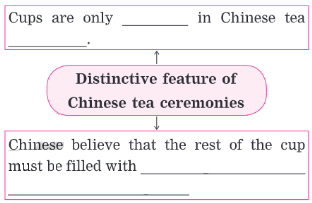
     In most areas of China the tea is made in small clay teapots. At tea ceremonies, 
cups are only half-filled. The Chinese believe that the rest of the cup must be filled with friendship and affection.
      In Russia, tea is made and served in samovars - a special Russian tea kettle, made of metal.
     Vietnam produces special varieties of tea such as lotus tea and jasmine tea.
     In Japan, tea is made using powdered green tea called ‘matcha’. The tea is mixed with boiled water using a bamboo whisk and served in small bowls.And how about India ? A cup of tea is offered to any guest or visitor as a token of hospitality even in the humblest of homes. Most Indians like their tea hot with a good deal of milk and sugar in it. In the rainy season, it is brewed with ginger to give it additional medicinal properties. Others add spices, like cardamom, cloves or mace, to add to its taste and flavour. Tea is a must after a plate of spicy snacks, especially in the morning and evenings.
    Some connoisseurs relish delicately flavoured jasmine tea, green tea, lemon tea and even iced tea ! How about you ? 
   
A2. Complex Factual Activities:
Complete the web using the information from the passage :
Image
A3. Activities based on Vocabulary:
(1) List the things from the passage that are used for making tea.
A4. Activities based on Contextual Grammar:
Read the sentences and fill in the blanks with correct prepositions given in the brackets:
(1) Tea is served ________ a small clay pot. (in, on, with)
(2) The tea is mixed ________ boiled water using cloves. (for, with, at)
(3) They still have tea ceremonies ________ important occasions. (for, to, in)
(4) Some people use mace ________ add to its taste. (for, to, with)
A5. Personal Response:
What is your favourite beverage? Tell your reasons.
A1. Simple Factual Activities:
Write down the relation between the characters given below: 
(1) Sycorax and Caliban - ___________
(2) Alonso and Sebastian - ___________

     Prospero was a great magician, for his life had been devoted to the study of magic. The power of his art enabled him to set free the imprisoned spirits, of whom Ariel was the chief. The spirits were so grateful to Prospero that they promised to be ever obedient to his will.
     In the woods nearby, Prospero found Caliban, a twisted, ugly monster. He was the son of Sycorax, the witch. Caliban became Prospero’s servant. Apart from being hideous and horrible in appearance, he was also vicious and brutal in his habits. No matter how hard he tired, Prospero could not make him change his ways for the better. And so it was Ariel’s job to see that he carried out his tasks properly.
      Time passed, and Miranda grew up to be a sweet and beautiful girl. The spirits of the island were loyal and faithful to Prospero, who ruled them wisely and well.
     Now, it came to pass that Alonso, king of Naples, his brother Sebastian and Antonio, the wicked brother of Prospero were sailing in a ship, close to the enchanted island. The ship was also carrying Prince Ferdinand of Naples, and the old, loyal courtier Gonzalo. The entire party was returning after the marriage celebrations of their Princess in a far-off kingdom.
     Knowing that his enemies were near his island, Prospero raised a great tempest with the power of his magic. The royal ship was turned and tossed on the stormy waves. It seemed as if it would sink any moment, along with all the people on board.

A2. Complex Factual Activity:
What good deed did Prospero do on the enchanted island? 
A3. Activities based on Vocabulary:
(1) disillusioned × ___________
(2) kindhearted × ___________
(3) thankless × ___________
(4) sympathetic × ___________
A4. Activities based on Contextual Grammar:
Identify the tense :
(1) The ship was carrying Prince Ferdinand of Naples.
(2) He had devoted his life to the study of magic.
A5. Personal Response:
Why did Prospero raise a great tempest?