Question
A1. Simple Factual Activities:
Complete the sentences using the information from the passage:
(1) At the end of ten years, they ______________.
(2) How little is needed for one to be ______________
(3) Mathilde played her part ______________.
(4) She came to know the ______________.

      From then on, Madame Loisel knew the horrible life of the very poor. But she played her part heroically. The dreadful debt must be paid. She would pay it. They dismissed their maid; they changed their lodgings; they rented a garret under the roof.
    She came to know the drudgery of housework, the odious labours of the kitchen. She washed the dishes, the dirty linen, she carried the garbage down to the street every morning, and carried up the water, stopping at each landing to catch her breath and dressed like a commoner. She had to bargain at markets, quarrel and face insults over every miserable sou.
      Each month they had to pay some loans, renew others, get more time.
      Her husband worked extra, every evening, doing accounts for a tradesman, and often, late into the night, he sat copying a manuscript at five sous a page.
      And this life lasted ten years. At the end of ten years they had paid off everything, even the interest.
      Madame Loisel looked old now. Often, she brooded over the past - What would have happened if she had not lost that necklace ? How strange life is, how fickle ! How little is needed for one to be ruined or saved !

A2. Complex Factual Activities:
(1) How did life of Mathilde change after the horrible incident? 
A3. Activities based on Vocabulary:
Write from the passage the phrases related to 'housework'.
A4. Activities based on Contextual Grammar:
Change the following sentences in passive voice:
(1) They dismissed their maid.
(2) They rented a garret under the roof.
A5. Personal Response:
Write what you think about the following actions of Mathilde:
(1) Mathilde worked very very hard to pay the debt.
Answer

A1. Simple Factual Activities:
(1) At the end of ten years, they had paid off everything.
(2) How little is needed for one to be ruined or saved!
(3) Mathilde played her part heroically.
(4) She came to know the drudgery of housework.
A2. Complex Factual Activities:
(1) Mathilde's life was completely changed. She dismissed her maid and did extremely unpleasant labours in the kitchen. She washed the dishes, the dirty linen, she carried the garbage down to the street every morning, carried up the water and dressed like a cominon woman. She had to bargain at markets, quarrel and face insults over every miserable sou. She lived the horrible life of the very poor.
A3. Activities based on Vocabulary:
Drudgery of housework, odious labours of the kitchen, washing dishes, washing dirty linen, carry the garbage, carry up the water, bargain at markets.
A4. Activities based on Contextual Grammar:
(1) Their maid was dismissed by them.
(2) A garret under the roof was rented by them.
A5. Personal Response:
(1) Mathilde's action shows that she was a completely transformed woman. She had changed her attitude towards her lifestyle. She forgot her dreams of living a luxurious life. She worked hard and saved money for repaying the debt. She felt duty-bound for coming out of the devastating situation, she was responsible for.

Need a full question paper?

Generate a complete, print-ready paper with questions like this in minutes — across 16+ boards, with answer keys.

Start Generating Free

Similar questions

A1. Simple Factual Activities:
Fill in the blanks with one word:
(1) Prospero took the prince to a cave.
(2) Ferdinand wanted to be the king of Naples.
(3) Many more tricks were played on Prospero's enemies by Ariel.
(4) Antonio wanted to kill king Alonso.

      Miranda begged her father to be kind to the sweet prince; but Prospero took the prince to a cave, where he was made to work, carrying heavy logs. This was only as a trial of his love, for as he watched them from afar, he saw the young people talking to each other, getting to know each other, and very soon, falling in love with each other. 
     “I shall be king of Naples one day,” Ferdinand said to Miranda, “and you shall be my Queen, I promise you !”
     At this, Prospero smiled, and appearing before them, said to Ferdinand, “All your troubles were merely trials of your love; and you have nobly stood the test. Now, I give you my daughter, a priceless gift.”
     In the meanwhile, in another part of the island, the evil and treacherous Antonio was once again plotting a murder. This time he planned to kill king Alonso, so that his brother Sebastian could become the king. The two wicked men were about to kill the sleeping king, when Ariel woke him up, saving his life in the nick of time.
     Many more tricks did Ariel play on Prospero’s enemies. He caused them to wander about; he filled their ears with strange and frightful noises; when they were faint with hunger, he set a huge banquet before them, only to take it away when they touched the food.
     When the men were nearly out of their senses with fear and hunger, Ariel reminded them of their treachery and wickedness in the past.
      King Alonso and the loyal lord Gonzalo were filled with grief, for all the injustice that had been done to Prospero. In this repentant mood, Ariel brought them before Prospero.
      At first, they could hardly recognise the former Duke of Milan, for he was clothed in his magic robe. But Prospero revealed himself to them in his own form. He thanked Gonzalo for his kindness, and reproached the king and Antonio for their treachery.

A2. Complex Factual Activity:
Who said to whom and when?
(1) ... and you shall be my Queen.
(2) "All your troubles were merely trials of your love".
A3. Activities based on Vocabulary:
Match the words in Column 'A' with their meanings in Column 'B':

Column 'A'

Column 'B'

(1) treacherous

(a) a grand dinner party

(2) revealed

(b) very valuable

(3) banquet

(c) showed

(4) priceless

(d) deceitful

A4. Activities based on Contextual Grammar:
(1) Prospero said to Ferdinand, "All your troubles were merely trials of your love and you have nobly stood the test. Now, I give you my daughter, a priceless gift."
(Rewrite the sentence in indirect narration.)
A5. Personal Response:
'Ariel was a faithful spirit' - why do you think so? 

A1. Simple Factual Activities:
Complete the following sentences:
(1) Margie's great grandfather told that in old times all stories ______________. 
(2) According to Margie, 'a real book' means ______________.

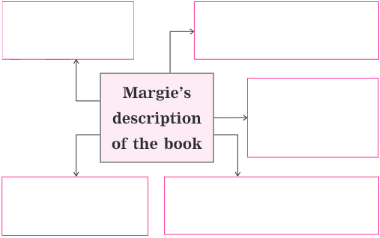
     Margie even wrote about it that night in her diary. On the page headed 17 May 2157, she wrote, "Today Tommy found a real book!'
      It was a very old book. Margie's grandfather once said that when he was a little boy his grandfather told him that there was a time when all stories were printed on paper.
      They turned the pages, which were yellow and crinkly, and it was awfully funny to read words that stood still instead of moving the way they were supposed toon a screen, you know. And then when they turned back to the page before, it had the same words on it that it had when they read it the first time.
      "Gee," said Tommy, "what a waste! When you're through with the book, you just throw it away, I guess. Our television screen must have had a million books on it and it's good for plenty more. I wouldn't throw it away."

A2. Complex Factual Activities:
Complete the following:
Image
A3. Activities based on Vocabulary:

(1) Write at least  ten words related to book:
A4. Activities based on Contextual Grammar:
Underline the verbs and choose the correct options from the brackets:
(1) Margie even wrote about it. (present tense/past tense)
(2) Today Tommy found a new book. (present tense/past tense)
A5. Personal Response:
About what did Tommy say, "What a waste!" Why do you think, did he say so?
A1. Simple Factual Activities:
Complete the following sentences using the information given in the passage:
(1) Most people agree that tea is a ______________.
(2) Emperor Shennong was called the father of ______________.
(3) Bodhidharma found that chewing tea leaves acted as ______________.
(4) Tea got its distinctive flavour by its theanine as well as ______________.

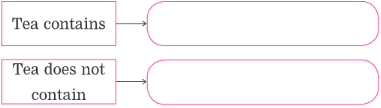
       Most people agree that tea is a refreshing drink. It contains no carbohydrates, fat, or proteins. What gives tea its special and distinctive flavour is theanine as well as caffeine, which give the drink its stimulating quality.
       How and when did people first begin to drink tea? An amusing story has come down to us from Chinese legends. It is said that Emperor Shennong, the father of Chinese agriculture and medicine, was on his travels, when a servant was boiling some water for the emperor to drink. Just then, a few leaves from a nearby tree blew into the boiling water. The water immediately changed colour. On drinking the water, the emperor was amazed by the rich flavour and the refreshing quality of the resulting infusion. Excited by the unknown plant and its amazing flavour, he carried out further investigations, and discovered that tea had many healing and restorative properties and could also be used as an antidote to certain poisons.
       Yet another legend tells us that it was a Buddhist monk named Bodhidharma who was the first to use tea as a drink. He was keen to find a herb or a medicinal plant which would help him stay awake and alert for long periods of time in prayer and meditation. After considerable search and trial, he found that chewing leaves from the tea shrub acted as a stimulant, helping him stay awake. It was he who introduced tea among his disciples in China. It is said that Japanese priests studying under Buddhist teachers in China carried tea seeds and leaves back home with them. Turkish traders also began to bargain for tea on the border of Mongolia. In fact, the story goes that the Chinese Emperor Hui Tsung was so taken up with tea that he set up a research into the best tea- whisking methods and also hosted tea-making and tea-tasting tournaments in the court. So ‘tea minded’ was he, that he failed to notice that Mongolia had actually taken over his empire!

A2. Complex Factual Activities:
(1) Who was Emperor Shennong? Why did he carry out further investigations about tea? 
A3. Activities based on Vocabulary:
Match the words in Column 'A' with their meaning in Column 'B':

Column 'A'Column 'B'
(1) investigation(a) a substance (tea) that helps you to stay awake.
(2) stimulant(b) a drink made by leaving shrubs (leaves), etc. in boiling water.
(3) infusion(c) making you strong and healthy again.
(4) restorative(d) a scientific examination for finding the truth.

A4. Activities based on Contextual Grammar:
Find the subject and the object from the following sentences:
(1) The water immediately changed colour.
(2) He carried out further investigations.
A5. Personal Response:
What is the difference between legends or stories and history?

A1. Simple Factual Activities:
Complete the following sentences using the information given in the passage:
(1) Most people agree that tea is a ______________.
(2) Emperor Shennong was called the father of ______________.
(3) Bodhidharma found that chewing tea leaves acted as ______________.
(4) Tea got its distinctive flavour by its theanine as well as ______________.

       Most people agree that tea is a refreshing drink. It contains no carbohydrates, fat, or proteins. What gives tea its special and distinctive flavour is theanine as well as caffeine, which give the drink its stimulating quality.
       How and when did people first begin to drink tea? An amusing story has come down to us from Chinese legends. It is said that Emperor Shennong, the father of Chinese agriculture and medicine, was on his travels, when a servant was boiling some water for the emperor to drink. Just then, a few leaves from a nearby tree blew into the boiling water. The water immediately changed colour. On drinking the water, the emperor was amazed by the rich flavour and the refreshing quality of the resulting infusion. Excited by the unknown plant and its amazing flavour, he carried out further investigations, and discovered that tea had many healing and restorative properties and could also be used as an antidote to certain poisons.
       Yet another legend tells us that it was a Buddhist monk named Bodhidharma who was the first to use tea as a drink. He was keen to find a herb or a medicinal plant which would help him stay awake and alert for long periods of time in prayer and meditation. After considerable search and trial, he found that chewing leaves from the tea shrub acted as a stimulant, helping him stay awake. It was he who introduced tea among his disciples in China. It is said that Japanese priests studying under Buddhist teachers in China carried tea seeds and leaves back home with them. Turkish traders also began to bargain for tea on the border of Mongolia. In fact, the story goes that the Chinese Emperor Hui Tsung was so taken up with tea that he set up a research into the best tea- whisking methods and also hosted tea-making and tea-tasting tournaments in the court. So ‘tea minded’ was he, that he failed to notice that Mongolia had actually taken over his empire!

A2. Complex Factual Activities:
Image
A3. Activities based on Vocabulary:
Match the words in Column 'A' with their meaning in Column 'B':

Column 'A'Column 'B'
(1) investigation(a) a substance (tea) that helps you to stay awake.
(2) stimulant(b) a drink made by leaving shrubs (leaves), etc. in boiling water.
(3) infusion(c) making you strong and healthy again.
(4) restorative(d) a scientific examination for finding the truth.

A4. Activities based on Contextual Grammar:
Underline the infinitives in the following sentence:
(1) It was funny to read words that stood still.
(2) Do I have to read the book?
(3) Turkish traders began to bargain for tea..
(4) A servant was boiling some water for the king to drink.
A5. Personal Response:
What is the difference between legends or stories and history?

A1. Simple Factual Activities:
Find the following matter in the passage and copy the missing words:
Statements
(1) Faraday's work on electricity is still a subject of study.
(2) Faraday as a child, had a speech defect.
(3) Faraday disliked reading.
(4) The first consistent light bulb was produced by Davy.

     Michael Faraday is regarded as one of the most distinguished scientists and inventors of modern times, and his work on electricity is still a subject of study, in the form of Faraday’s Laws. But few know his inspirational life story, which is all about courage and fighting against the odds.
      Michael Faraday was born into a poverty-stricken family in a dirty London suburb. He suffered from a speech defect as a child. He would pronounce ‘rabbit’ as ‘wabbit’. He could not even say his own name and would call himself ‘Fawaday’. Other children laughed at him and teachers did not help him either. When he was twelve, his mother was forced to take him out of school, thus putting an end to his formal education.
       At thirteen, however, he started working with a bookbinder, binding hundreds of books during the day and staying up all night to read them. Reading thus became his obsession. One day he came across a book on electricity which had been sent to his master for binding. He started reading it and was completely hooked. That was his first introduction to the subject of electricity, which soon became a lifelong fascination. Faraday was still poor at twenty-one. Once, a friend gave him a free ticket to a public lecture and demonstration by the renowned chemist Humphry Davy at London’s Royal Institution. Davy’s work on chemicals and electrical lighting was the subject of conversation among the scientists of that age. Seventy years later, across the Atlantic Ocean in the USA, the same work enabled Thomas Edison to produce the first consistent light bulb.

A2. Complex Factual Activities:
(1) What were the odds against Faraday in his childhood?
A3. Activities based on Vocabulary :
Write two compound words from the passage:
Example: bookbinder
A4. Activities based on Contextual Grammar:
Complete the following sentences using your own words/phrases:
(1) When he was twelve, ______________________.
(2) One day he came across a book on ______________________ .
A5. Personal Response:
(1) Why do you think Faraday's friend gave him a free ticket to Davy's programme?
A1. Simple Factual Activities:
Correct the following sentences using facts from the passage:
(a) Helen escaped with Menelaus.
(b) Troy was attacked because it was a strong rich city.

      The Iliad is the story of Ilium or Troy, a rich trading city in Asia Minor near the narrow sea that leads from the Aegean to the Black Sea. It was well situated, both for commerce and agriculture. In front of the city was the sea over which sailed the ships of Troy, carrying goods and grain. At the back rose the high peak of Mount Ida, from which flowed many rivers and streams. The valleys among the hills were well-watered and fertile, with corn growing in fertile fields and cattle feeding on the rich grass of the meadows while sheep fed on the slopes of the hills.
      Round their city the Trojans had built a strong wall so that no enemy should attack them from the sea. The wall was so broad that people could stand and sit and walk on it. The great gates stood open, and people could go to the seashore outside and come in as they pleased. But in time of war the gates would be closed; and then the city was like a strong fortress, quite safe from all attack, protected by the walls surrounding it, as well as by the hills behind.
      Thus, Troy was a strong city, strongly protected by its walls and strongly defended by its brave soldiers. But all the kings and heroes of Greece had declared war against the Trojans, because Paris, a prince of Troy, had persuaded Helen, wife of a Greek king Menelaus, to elope with him. He had brought her to Troy. The Greeks wanted to take revenge on Troy for the wrong done to Menelaus. They sailed to Troy and laid siege to the city. The Trojans, too, fought hard and the siege continued for ten long years.

A2. Complex Factual Activities:
(1) How did the location of Troy help it to grow into a very rich/prosperous city?
A3. Activities based on Vocabulary:
Match the adjectives in Column 'A' with the nouns in Column 'B':

'A''B'
 (1) high (a) fortress
 (2) brave (b) peak
 (3) fertile (c) fields
 (4) strong (d) soldiers

A4. Activities based on Contextual Grammar:
Underline the infinitives in the sentences
(1) Paris persuaded Helen to elope with him.
(2) The Greeks wanted to take revenge.
A5. Personal Response:
Do you know one of the wars in ancient India which was fought over a woman? Describe it in short.

A1. Simple Factual Activities:
Write down the relation between the characters given below:
(1) Prospero and Miranda - ___________
(2) Prospero and Antonio - ___________

      Prospero was the Duke of Milan, in the kingdom of Naples. He was such a studious and learned scholar that he spent most of his time reading books, while his brother Antonio managed the business of ruling his dukedom.
      Now, Antonio was a treacherous man, and he wanted to become Duke of Milan in his brother place. In fact, Antonio would not have hesitated to kill Prospero - but he knew that the people loved their Duke, and would never forgive his murderer. So Antonio got together with Alonso, the king of Naples who was Prospero’s enemy. They took Prospero to sea, and when they were far away from land, they put Prospero and his baby daughter Miranda into a broken, old boat and sailed away. Prospero and Miranda were left to drift into the wide, open sea Thus Antonio managed to take over the Dukedom of Milan, with all its wealth and power.
      Now, among Prospero’s courtiers was a true and loyal Lord called Gonzalo. Out of love and loyalty for the rightful Duke, Gonzalo had secretly placed in the boat fresh water, food and clothes - and along with them, Prospero’s most valued possessions, his books.
       You can imagine the hardships faced by Prospero cast adrift in an oarless boat, with a baby girl to care for! However, they were fortunate that the boat reached an island, and they landed in safety.
      The island was an enchanted island. For years together, it had come under the spell of an evil witch Sycorax, who had imprisoned all the good spirits she found on the island. She herself had died before Propspero arrived on the island, but the spirits remained trapped in their ‘prisons’ - the trunks of the large trees on the island.

A2. Complex Factual Activity:
What evil deed did Antonio do, to become a Duke himself? 
A3. Activities based on Vocabulary:
Find out adjectives used to describe the following nouns:
(1) ___________ island
(2) ___________ witch
(3) ___________ boat
(4) ___________ water
A4. Activities based on Contextual Grammar:
Make the following sentences exclamatory:
(1) Antonio was a treacherous man.
(2) Gonzalo was a true and loyal courtier.
A5. Personal Response:
What will you do if you are left alone on an isolated island by your friends?
A1. Simple Factual Activities:
State whether the following statements are True or False:
Statements
(1) Folk art conveys a deep thought.
(2) The roots of folk arts lie in women's daily chores.
(3) Designs are not important in Gond style of art.
(4) Special attention is given to the choice of various colours.

     This richness is reflected in the choice of their medium. In the days of past, several things in nature such as soils of different shades, the juice of plants, leaves, tree bark, flowers, fruits and even things like coal and cow-dung were used to prepare colours. The different colours, various textures and patterns were used year after year, lending a simplicity to the art. When we see these pictures, we realise that a picture drawn this way or the other can look equally beautiful. What a deep thought this art conveys - and so easily !
      In the Gond style of art, we see that the outlines may vary a little from artist to artist but the designs that fill it make the whole picture look lively and attractive. The designs include simple textures achieved using dots, straight lines, dotted lines, curvy shapes and circles. Special attention is given to the choice of various colours so that the total effect is amazing and beautiful.
      In today’s age of commercialisation many men have taken up Gond art. But the roots of folk arts probably lie in women’s daily chores like cleaning and decorating the house, dealing with natural colours in the course of cooking and in their leisure time activities.

A2. Complex Factual Activity:
Complete the following sentences:
(1) In the Gond style of art, outlines may vary from artist to artist but ______________________.
(2) The designs in Gond style art contain ______________________.
A3. Activities based on Vocabulary:

(1) Spot the error in the spelling of the following words and rewrite them correctly:
(i) dicided (ii) diffarent
(2) Write related words with 'Artist'.
A4. Activities based on Contextual Grammar:
Do as directed:
(1) What a deep thought this art conveys! (Make it assertive.)
(2) Creating folk art is a very enriching experience. (Make it exclamatory.)
A5. Personal Response:
Why does the author think that the roots of folk art lie in women's chores? 
A1. Simple Factual Activities:
Complete the following sentences using the information from the passage:
(1) The most popular beverage in the world is ______________.
(2) ______________ is an evergreen plant that grows in tropical and sub-tropical climates.
(3) Tea plants require at least ______________ cm of rainfall a year.
(4) The teas we buy are usually classified according to the ______________.

      Let us begin with a question : can you name the most widely consumed beverage in the world, after water?
      Perhaps many of you have guessed the answer : the most popular beverage in the world is tea - the fresh, aromatic brew with which people like to begin their day. It has a refreshing, astringent flavour. It is actually made by brewing, that is by infusing in boiling water, the leaves and shoots of a plant whose botanical name is the Camellia sinensis. The leaves are at first dried, cured and processed before they are packed and sold to us.
      Camellia sinensis is an evergreen plant that grows in tropical and sub-tropical climates. Tea plants require at least 100-125 cm of rainfall a year and prefer acidic soils. Many of the world’s best tea estates are located on hill slopes at elevations of up to 1500 metres : it is said that the tea plants grow slowly and acquire a richer flavour at this height.
      When the plants mature, only the top 1-2 inches of the plant are picked. These buds and leaves are called flushes. A new flush appears on the plant every seven to ten days during the peak growing season. Left to grow on its own, the tea plant may actually grow into a small tree. But in all tea gardens, the plants are pruned and kept at a height of about three feet (waist high) to enable easy plucking of the leaves. The teas we buy are usually classified according to their leaf size. Accordingly we have (1) Assam type of tea, characterised by the largest leaves; (2) China type, characterised by the smallest leaves; and (3) Cambod, characterised by leaves of intermediate size.
      We have three very distinct and different tea growing regions in India. Each of these regions is famous for the special type of tea it produces, which are unique in taste, aroma, strength and flavour. The three regions are : Darjeeling in North-Eastern India, Assam in far North-East India and Nilgiris in South India.

A2. Complex Factual Activities:
(1) Why are tea plants pruned? 
(2) How is tea the beverage made?
A3. Activities based on Vocabulary:
(1) List all the names of geographical places mentioned in the passage:
(2) List the qualities of the special type of tea.
A4. Activities based on Contextual Grammar:
(1) A new flush ______________ on the plant every seven to ten days. (appear/appears)
(2) Tea plants ______________ at least 100-125 cm of rainfall a year. (require/requires)
(3) Each of these regions ______________ famous for the specialtype of tea. (is/are)
(4) It ______________ said that the tea plants grow slowly. (are/is)
A5. Personal Response:
What are botanical names? How are they decided?
A1. Simple Factual Activities:
Answer the following in words:
(1) Mark Twain received a letter from the editor of a small Missouri newspaper.
(2) Finding a spider in a paper is good luck for the reader according to Mark Twain.
(3) Mark Twain's birth was heralded by the return of Halley's comet.
(4) Mark Twain died in November 1835.

      One day during his tenure as the editor of a small Missouri newspaper, Mark Twain received a letter from a reader who had found a spider in his paper. He wondered whether this portended good or bad luck.
       “Finding a spider in your paper,” Twain replied, “is neither good luck nor bad. The spider was merely looking over our paper to see which merchant was not advertising so that he could go to that store, spin his web across the door, and lead a life of undisturbed peace ever afterward.”
      Mark Twain’s birth in November 1835 was heralded by the return of Halley’s comet. Twain, who often remarked upon this curiosity, came to think of himself and the comet as ‘unaccountable freaks,’ cosmically linked: having come in together, he declared, they would go out together.
      In fact, Twain was proven right. On the night of his death in April 1910, Halley’s comet once again blazed through the sky...
Some Quotations
April Fool’s Day - This is the day upon which we are reminded of what we are on the other three hundred and sixty-four.
 A man cannot be comfortable without his own approval.
A person with a new idea is a crank until the idea succeeds.
Age is an issue of mind over matter. If you don’t mind, it doesn’t matter.
All generalizations are false, including this one 
Be careful about reading health books. You may die of a misprint.
Be careless in your dress if you will, but keep a tidy soul.
‘Classic’ - A book which people praise and don’t read. Humour is mankind’s greatest blessing.
I am an old man and have known a great many troubles, but most of them never happened.
I must have a prodigious quantity of mind; it takes me as much as a week sometimes to make it up.
If you tell the truth, you don’t have to remember anything.
 It is better to deserve honours and not have them than to have them and not deserve them.
It is better to keep your mouth closed and let people think you are a fool than to open it and 
remove all doubt.
It’s no wonder that truth is stranger than fiction. Fiction has to make sense.
Whenever you find yourself on the side of the majority, it is time to pause and reflect.
Why is it that we rejoice at a birth and grieve at a funeral? It is because we are not the person 
involved.
Thousands of geniuses live and die undiscovered either by themselves or by others.
Thunder is good, thunder is impressive; but it is lightning that does the work.
When I was younger I could remember anything, whether it happened or not.
When your friends begin to flatter you on how young you look, it’s a sure sign you’re getting old.

A2. Complex Factual Activities:
Which episode shows that Mark Twain did not believe in superstitions? 
A3. Activities based on Vocabulary:
Classify the following words in the given table:
reader, remind, wonder, spider, merchant, return, declare, comet.
A4. Activities based on Contextual Grammar:
Make the sentences affirmative:
(1) Mark Twain received a letter from a reader.
(2) Mark Twain's birth was heralded by the return of Halley's comet.
A5. Personal Response:
(1) Why should we take part in humorous sessions?