Question
A1. Simple Factual Activities:
Complete the following sentences using the information from the passage:
(1) The most popular beverage in the world is ______________.
(2) ______________ is an evergreen plant that grows in tropical and sub-tropical climates.
(3) Tea plants require at least ______________ cm of rainfall a year.
(4) The teas we buy are usually classified according to the ______________

      Let us begin with a question : can you name the most widely consumed beverage in the world, after water?
      Perhaps many of you have guessed the answer : the most popular beverage in the world is tea - the fresh, aromatic brew with which people like to begin their day. It has a refreshing, astringent flavour. It is actually made by brewing, that is by infusing in boiling water, the leaves and shoots of a plant whose botanical name is the Camellia sinensis. The leaves are at first dried, cured and processed before they are packed and sold to us.
      Camellia sinensis is an evergreen plant that grows in tropical and sub-tropical climates. Tea plants require at least 100-125 cm of rainfall a year and prefer acidic soils. Many of the world’s best tea estates are located on hill slopes at elevations of up to 1500 metres : it is said that the tea plants grow slowly and acquire a richer flavour at this height.
      When the plants mature, only the top 1-2 inches of the plant are picked. These buds and leaves are called flushes. A new flush appears on the plant every seven to ten days during the peak growing season. Left to grow on its own, the tea plant may actually grow into a small tree. But in all tea gardens, the plants are pruned and kept at a height of about three feet (waist high) to enable easy plucking of the leaves. The teas we buy are usually classified according to their leaf size. Accordingly we have (1) Assam type of tea, characterised by the largest leaves; (2) China type, characterised by the smallest leaves; and (3) Cambod, characterised by leaves of intermediate size.
      We have three very distinct and different tea growing regions in India. Each of these regions is famous for the special type of tea it produces, which are unique in taste, aroma, strength and flavour. The three regions are : Darjeeling in North-Eastern India, Assam in far North-East India and Nilgiris in South India.

A2. Complex Factual Activities:
(1) Which geographical conditions (features) are required for growing tea plants? 
A3. Activities based on Vocabulary:

Column 'A'

Column 'B'

(1) aromatic

(a) any liquid for drinking

(2) brew

(b) the hot regions of the world

(3) beverage

(c) fragrant

(4) tropical

(d) to make tea etc. by boiling

A4. Activities based on Contextual Grammar:
Underline the adverbs from the following sentences: 
(1) Can you name the most widely consumed beverage in the world, after water?
(2) The tea plants grow slowly.
A5. Personal Response:
What are botanical names? How are they decided?

Answer

A1. Simple Factual Activities:
(1) The arithmetic lesson was on the addition of proper fractions.
(2) And the teachers were people.
(3) The mechanical teacher was flashing on the screen.
(4) Margie inserted yesterday's homework in the slot with a sigh.
A2. Complex Factual Activities:
(1) Tea plants require tropical and sub-tropical climates. They need at least 100-125 cm of rainfall and acidic soils. They grow well on hill slopes at elevations of up to 1500 metres where they acquire a richer flavour at that height.
A3. Activities based on Vocabulary:
(1) aromatic - fragrant.
(2) brew - to make tea etc. by boiling.
(3) beverage - any liquid for drinking.
(4) tropical - the hot regions of the world.
A4. Activities based on Contextual Grammar:
(1) Can you name the most widely consumed beverage in the world, after water?
(2) The tea plants grow slowly.
A5. Personal Response:
     Botanical names are actually scientific names. These names are according to binomial (two words) naming system. The first name tells us the genus (जाती) of a plant and the second name is the species (प्रजाती) of the plant. Throughout the world there should be only one uniform name, that is why the scientific naming system is used.
    They are decided according to their characters and classification to which they belong.

Need a full question paper?

Generate a complete, print-ready paper with questions like this in minutes — across 16+ boards, with answer keys.

Start Generating Free

Similar questions

A1. Simple Factual Activities:
Who said it and to whom:
(1) "I no longer have Madame Forestier's necklace."
(2) "What! ... How!... That's impossible!"

     The day of the party arrived. Madame Loisel was a success. She was prettier than all the other women, elegant, gracious, smiling, and full of joy.
     She danced wildly, with passion, forgetting everything in the triumph of her beauty and success, floating in a cloud of happiness.
     Mathilde and her husband left at about four o’clock in the morning. When they were finally in the street, they could not find a cab. They walked down toward the Seine, till they found one. They were dropped off at their door in the Rue des Martyrs, and sadly, it was all over, for her.
      In front of the mirror, she took a final look at herself in all her glory. But suddenly she uttered a cry. She no longer had the necklace round her neck ! “What is the matter ?” asked her husband.
      She turned towards him, panic-stricken, “I have ... I have ... I no longer have Madame Forestier’s necklace.”
      He stood up, distraught, “What !... How ! …That’s impossible !”

A2. Complex Factual Activities:
Complete the web :
Image
A3. Activities based on Vocabulary:
(1) Write any four adjectives from the passage.
(2) Write any four adverbs with '-ly' from the passage.
A4. Activities based on Contextual Grammar:
Find the determiners from the following sentences and underline them:
(1) They were dropped off at _______ door in _______ Rue des Martyrs.
(2) Forgetting everything in _______ triumph of _______ beauty.
A5. Personal Response:
Write what you think about the following actions of Mathilde :
(1) Mathilde borrowed a diamond necklace from her friend and wore it to the party.
A1. Simple Factual Activities:
Correct the following sentences using facts from the passage:
(a) Troy traded in cattle and grass with other cities.
(b) During war, Trojans jumped over the fort gates.

      The Iliad is the story of Ilium or Troy, a rich trading city in Asia Minor near the narrow sea that leads from the Aegean to the Black Sea. It was well situated, both for commerce and agriculture. In front of the city was the sea over which sailed the ships of Troy, carrying goods and grain. At the back rose the high peak of Mount Ida, from which flowed many rivers and streams. The valleys among the hills were well-watered and fertile, with corn growing in fertile fields and cattle feeding on the rich grass of the meadows while sheep fed on the slopes of the hills.
      Round their city the Trojans had built a strong wall so that no enemy should attack them from the sea. The wall was so broad that people could stand and sit and walk on it. The great gates stood open, and people could go to the seashore outside and come in as they pleased. But in time of war the gates would be closed; and then the city was like a strong fortress, quite safe from all attack, protected by the walls surrounding it, as well as by the hills behind.
      Thus, Troy was a strong city, strongly protected by its walls and strongly defended by its brave soldiers. But all the kings and heroes of Greece had declared war against the Trojans, because Paris, a prince of Troy, had persuaded Helen, wife of a Greek king Menelaus, to elope with him. He had brought her to Troy. The Greeks wanted to take revenge on Troy for the wrong done to Menelaus. They sailed to Troy and laid siege to the city. The Trojans, too, fought hard and the siege continued for ten long years.

A2. Complex Factual Activities:
State the counteraction for the following actions:
(a) Helen eloped with Paris.
(b) The Greeks sailed to Troy and attacked it.
A3. Activities based on Vocabulary:
(1) Write the words related to 'Geography' from the passage.
A4. Activities based on Contextual Grammar:
(1) A prince of Troy had persuaded Helen.
(Begin with Helen had and change the voice.)
Ans. Helen had been persuaded by a prince of Troy.
(2) The city was strongly defended by its brave soldiers.
(Choose the correct option of Active voice.)
(a) Its brave soldiers defended strongly by the city.
(b) Its brave soldiers defended the city strongly.
A5. Personal Response:
Do you know one of the wars in ancient India which was fought over a woman? Describe it in
short.
A1. Simple Factual Activities:
Complete the following sentences:
(1) Margie's great grandfather told that in old times all stories ______________. 
(2) According to Margie, 'a real book' means ______________.

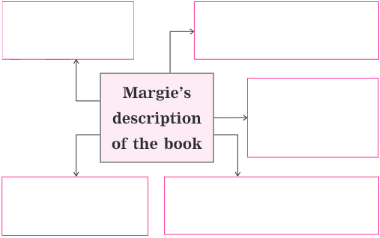
     Margie even wrote about it that night in her diary. On the page headed 17 May 2157, she wrote, "Today Tommy found a real book!'
      It was a very old book. Margie's grandfather once said that when he was a little boy his grandfather told him that there was a time when all stories were printed on paper.
      They turned the pages, which were yellow and crinkly, and it was awfully funny to read words that stood still instead of moving the way they were supposed toon a screen, you know. And then when they turned back to the page before, it had the same words on it that it had when they read it the first time.
      "Gee," said Tommy, "what a waste! When you're through with the book, you just throw it away, I guess. Our television screen must have had a million books on it and it's good for plenty more. I wouldn't throw it away."

A2. Complex Factual Activities:
Complete the following:
Image
A3. Activities based on Vocabulary:

(1) Write at least  ten words related to book:
A4. Activities based on Contextual Grammar:
Underline the verbs and choose the correct options from the brackets:
(1) Margie even wrote about it. (present tense/past tense)
(2) Today Tommy found a new book. (present tense/past tense)
A5. Personal Response:
About what did Tommy say, "What a waste!" Why do you think, did he say so?
A1. Simple Factual Activities:
Complete the following sentences:
(1) The mortar-maker's family comprised of ______________.
(2) According to the mortar-maker excess water poured down into ______________.

King : Summon the mortar-maker at once. He must pay with his life for his thoughtlessness.
(First Guard exits and returns with the mortar-maker who rushes and throws himself before the king.)
Mortar-maker : (wailing loudly) Forgive me, O Merciful King. Please do not hang me to death. I have a wife and two young children. Who will look after them ?
King : Your carelessness has cost a life. You must pay with your life.
Mortar-maker : No... no... no, my Royal Lord. I am not to blame. The pot which I used to pour water into the mortar had an extra-ordinarily large mouth. So excess water poured down into the mortar mixture. I was helpless. It is the potter’s fault for making such a useless pot.
King : Let the potter be brought here at once. He must be executed for moulding such useless pots.
(Fourth Guard leaves and re-enters with the potter.)
Potter : (cowering before the king) Your Majesty, show mercy to this humble potter. I agree the pot I made and sold to the mortar-maker was a defective one. But I am not guilty. As I was moulding that pot, I heard the sweet delicate tinkling of anklets. It was the money-lender’s daughter. She distracted me just as I was shaping the mouth and it became too wide.
King : Bring the money-lender’s daughter here, this very instant. She must be sent to the gallows for disturbing this poor potter at work.
(First Guard leaves and enters with the money-lender and his daughter.)
Money-lender : (in a desperate voice) O Just King ! Spare my daughter. She is my only child and to be wedded next Monday.
Daughter : Oh, do not fret, father. The king will not hang me. (To the king) Your Most Esteemed 
Highness, I rarely step outside the threshold of my home. But as my father said, I am to be married next week and my jewellery is not ready. I had to go to the goldsmith’s shop to urge him to work faster and hand over my ornaments on time ... The potter’s shop is on the way. I could not help it. It is all the goldsmith’s fault. Had he delivered my ornaments on time. I would not have been forced to go past the potter’s shop.
King : Then send for the goldsmith and without any delay, he must be hanged.

A2. Complex Factual Activities:
(1) What is the Mortar-maker's excuse? Is it believable? 
A3. Activities based on Vocabulary:
(1) Find out minimum four infinitives from the passage:
A4. Activities based on Contextual Grammar:
(1) Copy four imperative sentences from the passage:
A5. Personal Response:
Do you think the potter is telling the truth? Why? 
A1. Simple Factual Activities:
Answer the following in words:
(1) Mark Twain received a letter from the editor of a small Missouri newspaper.
(2) Finding a spider in a paper is good luck for the reader according to Mark Twain.
(3) Mark Twain's birth was heralded by the return of Halley's comet.
(4) Mark Twain died in November 1835.

      One day during his tenure as the editor of a small Missouri newspaper, Mark Twain received a letter from a reader who had found a spider in his paper. He wondered whether this portended good or bad luck.
       “Finding a spider in your paper,” Twain replied, “is neither good luck nor bad. The spider was merely looking over our paper to see which merchant was not advertising so that he could go to that store, spin his web across the door, and lead a life of undisturbed peace ever afterward.”
      Mark Twain’s birth in November 1835 was heralded by the return of Halley’s comet. Twain, who often remarked upon this curiosity, came to think of himself and the comet as ‘unaccountable freaks,’ cosmically linked: having come in together, he declared, they would go out together.
      In fact, Twain was proven right. On the night of his death in April 1910, Halley’s comet once again blazed through the sky...
Some Quotations
April Fool’s Day - This is the day upon which we are reminded of what we are on the other three hundred and sixty-four.
 A man cannot be comfortable without his own approval.
A person with a new idea is a crank until the idea succeeds.
Age is an issue of mind over matter. If you don’t mind, it doesn’t matter.
All generalizations are false, including this one 
Be careful about reading health books. You may die of a misprint.
Be careless in your dress if you will, but keep a tidy soul.
‘Classic’ - A book which people praise and don’t read. Humour is mankind’s greatest blessing.
I am an old man and have known a great many troubles, but most of them never happened.
I must have a prodigious quantity of mind; it takes me as much as a week sometimes to make it up.
If you tell the truth, you don’t have to remember anything.
 It is better to deserve honours and not have them than to have them and not deserve them.
It is better to keep your mouth closed and let people think you are a fool than to open it and 
remove all doubt.
It’s no wonder that truth is stranger than fiction. Fiction has to make sense.
Whenever you find yourself on the side of the majority, it is time to pause and reflect.
Why is it that we rejoice at a birth and grieve at a funeral? It is because we are not the person 
involved.
Thousands of geniuses live and die undiscovered either by themselves or by others.
Thunder is good, thunder is impressive; but it is lightning that does the work.
When I was younger I could remember anything, whether it happened or not.
When your friends begin to flatter you on how young you look, it’s a sure sign you’re getting old.

A2. Complex Factual Activities:
Which episode shows that Mark Twain did not believe in superstitions? 
A3. Activities based on Vocabulary:
Read the following and write the two meanings of 'mind' and 'matter'.
Age is an issue of mind over matter. If you don't mind, it doesn't matter.
A4. Activities based on Contextual Grammar:
Frame a wh-question to get the underlined part as an answer in each sentences:
(1) Mark Twain received a letter from a reader.
(2) Mark Twain's birth was heralded by the return of Halley's comet.
A5. Personal Response:
(1) Why should we take part in humorous sessions?
A1. Simple Factual Activities:
Fill in the blanks with one word:
(1) Prospero took the prince to a cave.
(2) Ferdinand wanted to be the king of Naples.
(3) Many more tricks were played on Prospero's enemies by Ariel.
(4) Antonio wanted to kill king Alonso.

      Miranda begged her father to be kind to the sweet prince; but Prospero took the prince to a cave, where he was made to work, carrying heavy logs. This was only as a trial of his love, for as he watched them from afar, he saw the young people talking to each other, getting to know each other, and very soon, falling in love with each other. 
     “I shall be king of Naples one day,” Ferdinand said to Miranda, “and you shall be my Queen, I promise you !”
     At this, Prospero smiled, and appearing before them, said to Ferdinand, “All your troubles were merely trials of your love; and you have nobly stood the test. Now, I give you my daughter, a priceless gift.”
     In the meanwhile, in another part of the island, the evil and treacherous Antonio was once again plotting a murder. This time he planned to kill king Alonso, so that his brother Sebastian could become the king. The two wicked men were about to kill the sleeping king, when Ariel woke him up, saving his life in the nick of time.
     Many more tricks did Ariel play on Prospero’s enemies. He caused them to wander about; he filled their ears with strange and frightful noises; when they were faint with hunger, he set a huge banquet before them, only to take it away when they touched the food.
     When the men were nearly out of their senses with fear and hunger, Ariel reminded them of their treachery and wickedness in the past.
      King Alonso and the loyal lord Gonzalo were filled with grief, for all the injustice that had been done to Prospero. In this repentant mood, Ariel brought them before Prospero.
      At first, they could hardly recognise the former Duke of Milan, for he was clothed in his magic robe. But Prospero revealed himself to them in his own form. He thanked Gonzalo for his kindness, and reproached the king and Antonio for their treachery.

A2. Complex Factual Activity:
(1) What tricks did Ariel play on Prospero's enemies? 
A3. Activities based on Vocabulary:
(1) Find out two words from the passage with suffix 'ness' and write your own two words with suffix 'ness'.
A4. Activities based on Contextual Grammar:
Begin the sentences with the underlined object and rewrite it:
(1) Ariel brought them before Prospero.
(2) He thanked Gonzalo for his kindness.
A5. Personal Response:
'Ariel was a faithful spirit' - why do you think so? 
A1. Simple Factual Activities:
Find the following matter in the passage and copy the missing words:
(1) He went on to prove that ______________________ .
(2) It was Maxwell ______________________ .

      He then took the age - old experiment of sprinkling iron filings on a sheet of paper near a magnet, making circular patterns. He went on to prove that these patterns were not a property of the iron filings; in fact they were due to the invisible magnetic fields that filled the empty space around the magnet and hence disturbed the filings. This is where his lack of formal education went against him. Faraday did not know much about advanced mathematics, so he just copied the iron filing patterns with his hand. He was unable to explain them in the form of mathematical equations. He made hundreds of such drawings but without equations, they were not accepted.
      Fortune favoured the brave Faraday once again when he met James Maxwell, a wealthy, educated physicist well versed in mathematics. He was willing to work with Faraday. It was Maxwell who translated Faraday’s idea into a set of equations that are now called Maxwell’s equations. Their combined work has helped us in many ways. Electronics and communication system today are designed around their discoveries. Some day, we might even be able to communicate with aliens across different galaxies using the products of these discoveries.
     Faraday’s life started with difficulties, but as a great scientist he met each difficulty with perseverance and conviction. He was given impossible tasks, which he undertook as challenges and opportunities. He epitomises what the Walt Disney character Pinocchio said : ‘
When you wish upon a star
It does not matter who you are’.

A2. Complex Factual Activity:
Why were Faraday's drawings not accepted? Does it mean they were wrong?
A3. Activities based on Vocabulary:
Find and write the past tense verbs with '-ed' from the passage:
A4. Activities based on Contextual Grammar:
Do as directed:
(1) He was unable to explain them. (Make it a negative sentence without changing meaning.)
(2) He made hundreds of such drawings. (Choose the correct sentence of passive voice.)
(a) Hundreds of such drawings are made by him.
(b) Hundreds of such drawings will be made by him.
(c) Hundreds of such drawings were made by him.
(d) Hundreds of such drawings have made by him.
A5. Personal Response:
When you wish to achieve some goal, does it matter what you are?
A1. Simple Factual Activities:
State whether the following statements are True or False:
(1) The people of the village gathered in the school to thank M. Hamel.
(2) Franz can neither speak nor write French.
(3) Franz's parents were very much anxious in his studies.
(4) Franz had never listened M. Hamel so carefully before.

      Poor man ! It was in honour of this last lesson that he had put on his fine Sunday clothes; and now I understood why the old men of the village were sitting there in the back of the room. It was because they were sorry, too, that they had not gone to school more. It was their way of thanking our master for his forty years of faithful service and of showing their respect for the country that was theirs no more.
      While I was thinking of all this, I heard my name called. It was my turn to recite. I had not learnt my participles and so I could not say a single word. I heard M. Hamel say to me :
       “I don’t scold you, little Franz, you must feel bad enough. See how it is ! Every day we have said to ourselves : ‘Bah ! I’ve plenty of time. I’ll learn it tomorrow.’ And now you see where we’ve come out. Ah, that’s the great troubles with Alsace; she put off learning tomorrow. Now those fellows out there will have the right to say to you: ‘How is it; you pretend to be Frenchmen, and yet you can neither speak nor write your own language.’ But you are not the worst, poor little Franz. We’ve all a great deal to reproach ourselves with.
       “Your parents were not anxious enough to have you learn. They preferred to put you to work on a farm or at the mills, so as to have a little more money. And I’ve been to blame also. Have I not often sent you to water my flowers instead of making you learn your lessons ?”
      Then, from one thing to another, M. Hamel went on to talk of the French language saying that it was the most beautiful language in the world. We must guard it among us and never forget it, because when a people are enslaved, as long as they hold fast to their language, it is as if they had the key to their prison.Then he opened a grammar and read us our lesson. I was amazed to see how well I understood it. All he said seemed so easy, so easy ! I think, too, that I had never listened so carefully, and that he had never explained everything with so much patience. It seemed almost as if the poor man wanted to give us all he knew before going away, and to put it all into our heads at one stroke.

A2. Complex Factual Activities:
(1) Why does Franz understand his lesson well? 
A3. Activities based on Vocabulary:
Arrange the following words in alphabetical order:
prison, patience, people, poor, participles, plenty, pretend, parents.
A4. Activities based on Contextual Grammar:
Add a question tag :
(1) They had not gone to school, ___________?
(2) Your parents were not anxious enough to have you learn, ___________?
(3) You are not the worst, ___________?
(4) I had never listened so carefully, ___________?
A5. Personal Response:
We should be grateful to our teachers - support your views. 
A1. Simple Factual Activities:
Complete the following sentences using the information given in the passage:
(1) Hidden by an island the Greeks waited for ___________.
(2) The ___________ when the side of the horse opened.
(3) The Trojans were taken ___________.
(4) ___________ had turned Helen's heart away from her home.

     The Greek ships had not sailed far. As soon as they were hidden by an island, they had lowered their sails and dropped anchor and waited for the night. In the darkness the fleet sailed back, and the leading ship, which was Agamemnon’s, bore a red light high on its mast. The Greek, who was watching for the return of the fleet, crept to the wooden horse and gave the signal. The side of the horse opened, the Greeks climbed out and opened the gates. The whole Greek army entered the sleeping city. Immediately the Greeks set fire to houses and towers and palaces, and began to burn and kill.
      Troy was filled with the sight of leaping flames and the sound of shouting and the noise of weapons and the cries of weeping women. The sleeping Trojans sprang out of their beds, but they were taken by surprise. Their enemies were right inside their walls, and many of the Trojans were killed before they could put on their armour and seize their weapons.
      A bright light lit up the night sky as palaces and houses, temples and towers, went up in flames. The Trojans fought as well as they could, but it was all in vain. Old King Priam was killed with all his brave sons. Hector’s wife and his old mother and sister were carried off as slaves by the conquerors. Their fate was in contrast to Helen’s when King Menelaus rushed through the city, looking for her and found her in her palace. She hung her head in shame and sorrow as she faced her former husband. Her voice was choked with emotion and she could not speak. But Menelaus forgave her and she went back with him, for it was only Aphrodite who had turned her heart away from her home and her husband and her child.
      When morning came, nothing was left of the proud, rich city that had resisted attack for ten years.

A2. Complex Factual Activities:
Put the following events in the order in which they took place. Number them accordingly:
(1) The Greeks climbed out of the horse and opened the gates of the city.
(2) Nothing of the proud, rich city of Troy was left behind.
(3) The Greek army entered the city.
(4) Troy was burnt down.
A3. Activities based on Vocabulary:
Write the meaningful sentences from the jumbled words:

Column 'A'

Column 'B'

(1) Agamemnon

(a) wife of King Menelaus

(2) Aphrodite

(b) Old Trojan King

(3) Priam

(c) sailing in the leading ship of Greeks

(4) Helen

(d) a Greek goddess


(e) tunnel

A4. Activities based on Contextual Grammar:
Choose the correct alternative from the brackets and complete the following sentences:
(1) They were killed ___________ their great heroes. (with/for)
(2) They found the car ___________ their own garage. (on/in)
(3) He jumped ___________ the river to save the child. (over/into)
(4) She was gazing ___________ the strange person. (on/at)
A5. Personal Response:

Do you think that the conquerors of war are happy after their victory?

A1. Simple Factual Activities:
Stay whether the following statements are True or False:
Statements
(1) Mathilde was married to a big officer at the Ministry of Education.
(2) Mathilde's former schoolmate was very rich.
(3) Mathilde had rich dresses, jewels and everything that she loved.
(4) Mathilde was happy with the invitation brought by her husband

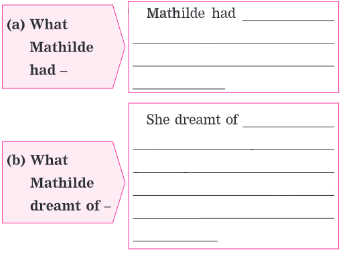
      Mathilde was a pretty and charming girl, born, as if by an error of fate, into a family of clerks. She had no means of becoming known, understood, loved or be wedded to an aristocrat; and so she let herself be married to a minor official at the Ministry of Education.
      She dressed plainly, because she had never been able to afford anything better. She suffered endlessly, feeling she was entitled to all the luxuries of life. She suffered because of her shabby, poorly furnished house. All these things, that another woman of her class would not even have noticed, tormented her and made her resentful. She dreamed of a grand, palatial mansion, with vast rooms and inviting smaller rooms, perfumed for afternoon chats with close friends.
      Yet, she had no rich dresses, no jewels, nothing; and these were the only things she loved. She wanted so much to charm, to be envied, to be sought after.
      She had a rich friend, a former schoolmate at the convent, whom she avoided visiting, because afterwards she would weep with regret, despair and misery.
      One evening her husband came home with an air of triumph, holding a large envelope in his hand. “Look,” he said, “here’s something for you.”
      She tore open the paper and drew out a card, on which was printed the words:
      “The Minister of Education and Mme. Georges Rampouneau request the pleasure of M. and Mme. Loisel’s company at the Ministry, on the evening of Monday, January 18th.”   
      Instead of being delighted, as her husband had hoped, she threw the invitation on the table resentfully, and muttered, “What do you want me to do with that ? And what do you expect me to wear if I go ?”

A2. Complex Factual Activities:
Complete the following:
Image
A3. Activities based on Vocabulary:
Match the words in Column 'A' with their meaning in Column 'B':

Column 'A'

Column 'B'

(1) aristocrat

(a) destiny

(2) fate

(b) great success

(3) shabby

(c) nobleman

(4) triumph

(d) nearly worn out

A4. Activities based on Contextual Grammar:
Find and write the adjectives from the passage for the following nouns:
(1) house (2) girl (3) official (4) mansion.
A5. Personal Response:
Write what you think about the following thoughts and actions of Mathilde :
(1) Mathilde was beautiful, and so she wanted to marry an aristocrat.
(2) Mathilde was sad because she did not get any luxuries.