Question
A1. Simple Factual Activities:
Complete the following sentences using the information given in the passage:
(1) Hidden by an island the Greeks waited for ___________.
(2) The ___________ when the side of the horse opened.
(3) The Trojans were taken ___________.
(4) ___________ had turned Helen's heart away from her home.

     The Greek ships had not sailed far. As soon as they were hidden by an island, they had lowered their sails and dropped anchor and waited for the night. In the darkness the fleet sailed back, and the leading ship, which was Agamemnon’s, bore a red light high on its mast. The Greek, who was watching for the return of the fleet, crept to the wooden horse and gave the signal. The side of the horse opened, the Greeks climbed out and opened the gates. The whole Greek army entered the sleeping city. Immediately the Greeks set fire to houses and towers and palaces, and began to burn and kill.
      Troy was filled with the sight of leaping flames and the sound of shouting and the noise of weapons and the cries of weeping women. The sleeping Trojans sprang out of their beds, but they were taken by surprise. Their enemies were right inside their walls, and many of the Trojans were killed before they could put on their armour and seize their weapons.
      A bright light lit up the night sky as palaces and houses, temples and towers, went up in flames. The Trojans fought as well as they could, but it was all in vain. Old King Priam was killed with all his brave sons. Hector’s wife and his old mother and sister were carried off as slaves by the conquerors. Their fate was in contrast to Helen’s when King Menelaus rushed through the city, looking for her and found her in her palace. She hung her head in shame and sorrow as she faced her former husband. Her voice was choked with emotion and she could not speak. But Menelaus forgave her and she went back with him, for it was only Aphrodite who had turned her heart away from her home and her husband and her child.
      When morning came, nothing was left of the proud, rich city that had resisted attack for ten years.

A2. Complex Factual Activities:
Put the following events in the order in which they took place. Number them accordingly:
(1) The Greeks climbed out of the horse and opened the gates of the city.
(2) Nothing of the proud, rich city of Troy was left behind.
(3) The Greek army entered the city.
(4) Troy was burnt down.
A3. Activities based on Vocabulary:
Write the meaningful sentences from the jumbled words:

Column 'A'

Column 'B'

(1) Agamemnon

(a) wife of King Menelaus

(2) Aphrodite

(b) Old Trojan King

(3) Priam

(c) sailing in the leading ship of Greeks

(4) Helen

(d) a Greek goddess


(e) tunnel

A4. Activities based on Contextual Grammar:
Choose the correct alternative from the brackets and complete the following sentences:
(1) They were killed ___________ their great heroes. (with/for)
(2) They found the car ___________ their own garage. (on/in)
(3) He jumped ___________ the river to save the child. (over/into)
(4) She was gazing ___________ the strange person. (on/at)
A5. Personal Response:

Do you think that the conquerors of war are happy after their victory?
Answer

A1. Simple Factual Activities:
(1) Hidden by an island the Greeks waited for the night.
(2) The Greeks climbed out when the side of the horse opened.
(3) The Trojans were taken by surprise.
(4) Aphrodite had turned Helen's heart away from her home.
A2. Complex Factual Activities:
(1) 1 (2) 4 (3) 2 (4) 3
A3. Activities based on Vocabulary :
(1) Agamemnon - sailing in the leading ship of Greeks
(2) Aphrodite - a Greek goddess
(3) Priam - Old Trojan King -
(4) Helen - wife of King Menelaus
A4. Activities based on Contextual Grammar:
(1) They were killed with their great heroes. (with/for)
(2) They found the car in their own garage. (on/in)
(3) He jumped into the river to save the child. (over/into)
(4) She was gazing at the strange person. (on/at)
A5. Personal Response:
(1) No, I don't think so. Both defeated and victorious countries have to bear the brunt of war. Both have to suffer because of the disastrous consequences they face. Both suffer the loss of lives, money, peace and so many other things. It takes a long time for both to regain their normal life.

Need a full question paper?

Generate a complete, print-ready paper with questions like this in minutes — across 16+ boards, with answer keys.

Start Generating Free

Similar questions

A1. Simple Factual Activities:
Read the sentences and fill in the blanks with correct alternatives:
(1) The County Inspector was a round little man with a red face.
(a) The teacher   (b) The County Inspector
(2) Margie hated most was the slot where she had to put homework and test papers.
(a) the teacher    (b) the slot

    He was a round little man with a red face and a whole box of tools with dials and wires. He smiled at Margie and gave her an apple, then took the teacher apart. Margie had hoped he wouldn’t know how to put it together again, but he knew how all right, and, after an hour or so, there it was again, large and black and ugly, with a big screen on which all the lessons were shown and the questions were asked. That wasn’t so bad. The part Margie hated most was the slot where she had to put homework and test papers. She always had to write them out in a punch code they made her learn when she was six years old, and the mechanical teacher calculated the marks in no time.
    The Inspector had smiled after he was finished and patted Margie’s head. He said to her mother, “It’s not the little girl’s fault, Mrs Jones. I think the geography sector was geared a little too quick. Those things happen sometimes. I’ve slowed it up to an 
average ten-year level. Actually, the overall pattern of her progress is quite satisfactory.” And he patted Margie’s head again.
     Margie was disappointed. She had been hoping they would take the teacher away altogether. They had once taken Tommy’s teacher away for nearly a month because the history sector had blanked out completely.

A2. Complex Factual Activities:
Arrange the following in order of occurrence: 
(1) She wrote them out in a punch code.
(2) All the lessons were shown and questions were asked on the screen.
(3) The County Inspector took the teacher apart and then put it together again.
(4) The mechanical teacher calculated the marks.
A3. Activities based on Vocabulary:
Write what the following sentences would mean today, and what they mean in the context of the story: 
(1) She had been hoping they would take the teacher away altogether.
A4. Activities based on Contextual Grammar:

Rewrite the following using complete words instead of contracted forms:
(1) I've slowed it up.
(2) He wouldn't know.
A5. Personal Response:
Do you like to take tests? Give the reason for your answer.
A1. Simple Factual Activities:
List the profession/occupation of the people mentioned in the passage:
(1) Little Franz: ___________
(2) M. Hamel: ___________
(3) Watcher: ___________
(4) Classmates : ___________

     I started for school very late that morning and was in great dread of a scolding, especially because M. Hamel had said that he would question us on participles, and I did not know the first word about them. For a moment I thought of running away and spending the day out of doors. It was so warm, so bright ! The birds were chirping at the edges of the woods; and in the open field back of the sawmill the Prussian soldiers were drilling.
     When I passed the town hall there was a crowd in front of the bulletin board. For the last two years all our bad news had come from there. I thought myself. “What can be the matter now ?”
     Then, as I hurried by as fast as I could go, the blacksmith, Watcher, who was there with his apprentice, reading the bulletin, called after me :
     “Don’t go so fast, boy; you’ll get to your school in plenty of time !”
     I thought he was making fun of me, and reached M. Hamel’s little garden all out of breath.
     Usually, when school began, there was a great bustle, which could be heard out in the street - the opening and closing of desks, lessons repeated in unison, very loud, and the teacher’s great ruler rapping on the table. But now it was all so still !
     Through the window I saw my classmates, already in their place, and M. Hamel walking up and down with his terrible iron ruler under his arm. I had to open the door and go in before everybody. You can imagine how I blushed and how frightened I was.
     But nothing happened. M. Hamel saw me and said very kindly :"
     “Go to your place quickly, little Franz. We were beginning without you.”

A2. Complex Factual Activities:
(1) Describe the scene usually like when school begins. 
A3. Activities based on Vocabulary:
Choose the correct meaning from the given alternatives:
(1) was in great dread of
(a) was in a great hall
(b) was in great demand
(c) was afraid of
(d) was angry with.
(2) did not know the first word about them
(a) did not know anything about them
(b) did not care about them
(c) knew all the words except the first word
(d) had not learnt them by heart.
A4. Activities based on Contextual Grammar:
Frame a Wh-question to get underlined answer:
(1) The narrator was blushed and frightened.
(2) The morning was warm and bright.
A5. Personal Response:
How do your teachers punish you when you make a mistake in the class? 
A1. Simple Factual Activities:
Who said this to whom:
(1) "I might have needed it."
(2) "Don't sell it for three days."

     In a shop at the Palais Royal, they found a string of diamonds which seemed to be exactly what they were looking for. It was worth forty thousand francs They could have it for thirty-six thousand.
     So they begged the jeweller not to sell it for three days. And they made an arrangement that he would take it back for thirty-four thousand francs if the other necklace was found before the end of February.
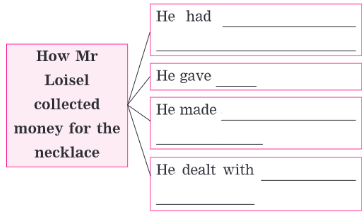
     Loisel had eighteen thousand francs which his father had left him. He would borrow the rest.
And he did borrow. He gave notes, made ruinous agreements, dealt with every type of money-lender Then he went to get the new necklace, and laid down on the jeweller’s counter thirty-six thousand francs.
     When Madame Loisel took the necklace back, Madame Forestier said coldly, “You should have returned it sooner, I might have needed it.”

A2. Complex Factual Activities:
Complete the web: 
Image
A3. Activities based on Vocabulary:
(1) Find and write all the numbers mentioned in the passage:
(2) Write from the passage words related to money matters.
A4. Activities based on Contextual Grammar:
(1) It was worth forty thousand francs.
(Use 'They' in place of 'Itzz' and rewrite the correct sentence.)
(2) He went to get the new necklace.
(Rewrite the sentence using simple present tense for the underlined verb.)
A5. Personal Response:
Write what you think about the following thoughts and actions of Mathilde:
(a) Mathilde returned the diamond necklace to her friend.
A1. Simple Factual Activities:
Complete the following sentences with reference to the passage:
(1) The ___________ became the core of Raza's paintings.
(2) For an artist like Raza, his work, or paintings are an effective ___________.
(3) Raza passed away on ___________.
(4) Raza's wife was ___________.

     Raza was born in a small village in Madhya Pradesh. He began to paint from the age of twelve. He studied art at the ‘Chitrakala Mahavidyalaya’ at Nagpur and then at the J. J. School of Art in Mumbai. Later, he went to France to study Art. After a few years, he decided to settle in France. His wife was French. He won many national and international awards. He was honoured with all the three Padma awards - Padma Shri, Padma Bhushan and Padma Vibhushan. With all the awards and honours, his paintings were exploring a spiritual, metaphysical path. Gradually, the ‘bindu’ or point came to be the core of his paintings. He described his work in these words - My work is my own inner experience and involvement with the mysteries of nature and form which is expressed in colour, line, space and light’.
      Sometimes, an artist’s thoughts appear to be too complex or even complicated when they are expressed through words. For him, the effective medium of communication is his work - his paintings. Raza had great creativity. His paintings are very expressive. This great artist passed away on 23 July 2016 at the age of 94, leaving behind a legacy of sensitive paintings (achieved through extra-ordinary compositions of lines and colours) that depict extra-ordinary compositions.

A2. Complex Factual Activity:

What legacy did Raza leave behind?
A3. Activities based on Vocabulary:
Find out antonyms from the passage for the following words: 
(1) outer ×  
(2) city ×
(3) ordinary × 
(4) international × 
A4. Activities based on Contextual Grammar:
Make the following sentences exclamatory :
(1) His paintings are very expressive.
(2) Raza had a great creativity.
A5. Personal Response:
What are the essential things required to become a good painter?
A1. Simple Factual Activities:
Complete the following sentences using the information from the passage:
(1) The arithmetic lesson was on ______________.
(2) And the teachers were ______________.
(3) ______________ was flashing on the screen.
(4) Margie inserted yesterday's homework in the slot ______________.

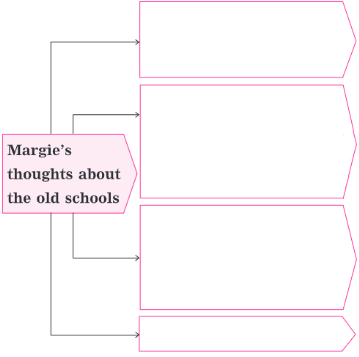
    The screen was lit up, and it said: “Today’s arithmetic lesson is on the addition of proper fractions. Please insert yesterday’s homework in the proper slot.” Margie did so with a sigh. She was thinking about the old schools they had when her grandfather’s 
grandfather was a little boy. All the kids from the whole neighbourhood came, laughing and shouting in the schoolyard, sitting together in the schoolroom, going home together at the end of the day. They learned the same things, so they could help one another with the homework and talk about it.
     And the teachers were people ...
    The mechanical teacher was flashing on the screen : When we add fractions 1/2 and 1/4 ...”
    Margie was thinking about how the kids must have loved it in the old days. She was thinking about the fun they had.

A2. Complex Factual Activities:

Complete the web:
Image
A3. Activities based on Vocabulary:
Write the words from the passage that show actions taken place in the old school.
A4. Activities based on Contextual Grammar:
(1) The kids were laughing and shouting.(Use simple past tense and rewrite the sentence.)
(2) I sing a song. (Change the subject 'T' to 'she' and rewrite the sentence.)
A5. Personal Response:
Would you like to have your own mechanical teacher? why?
A1. Simple Factual Activities:
Choose the correct alternative to answer the following questions:
(1) Who was the old man?
(a) a king (b) a sage (c) a guard (d) a stranger
(2) Who had a wonderful fate in his next life?
(a) the king       (b) the disciple
(c) the sage      (d) the hangmanWho said to whom

Voices and shouts heard from outside. All re-enter in a rush with another elderly man.
King : What ? Why have you all returned with this  stranger alive ? And who is this man ?
First Guard : I beg your pardon, Your highness but we  are confused indeed. This old man rushed towards  us as we were about to hang the young stranger  and begged and pleaded that he should be hanged  instead.
Second Guard : At first we thought the old man had  lost his mental balance. What sane man would  wish to suffer such a drastic death willingly ?
First Guard : But this young man says that he is a  wise and learned sage from the forest yonder and  he himself was this man’s disciple.
Sage : O Noble King, You are most generous. Be kind  and allow me to be hanged in place of my  disciple. I beg of you.
King : What a strange appeal ! And why  does such a wise and holy man wish to  obstruct the course of justice, may I ask ? 
Sage : (showing reluctance to let out his  secret) Your Majesty.... the truth is... no....  no.... I cannot say it.
King : I demand an explanation or I shall  not have you hanged in place of your  disciple.
Sage : You see........ uh........ it has been  predicted by the great prophets..... uh......  no...... no..... I shouldn’t say this.
King : (annoyed) Speak out at once or your disciple  will be hanged.
Sage : The.... the great prophets have foretold that the one who will be hanged on this day, in this kingdom, shall .... shall become the next king and conquer many more nations. I want to become the next great king, Your Majesty, and reign over a greater country ... I will go down in history as a famous royal monarch. The future generations will read about me and my greatness for milleniums to come. I shall never earn that fame if I remain a recluse - a sage. So do grant me this favour, O King, let me die at the gallows today.
King : Humm ...... The next king ? And this kingdom will expand ? Glory for milleniums to come ! Why, no one but I should be entitled to this privilege. Guards ! Take me to the gallows and hang me at once without any delay. Hurry up ! Don’t waste time. What a wonderful fate in my next life - a king once again ! Goodbye, world. See you again.

A2. Complex Factual Activities:
(1) What was the sage's request? Why did he make such a strange request? 
(2) What does the King want to know?
A3. Activities based on Vocabulary:
Match the following words in Column 'A' with their meaning in Column 'B':

'A''B'
 (1) yonder (a) give the right to
 (2) conquer (b) over there
 (3) recluse (c) favouring a solitary life
 (4) entitled (d) capture

A4. Activities based on Contextual Grammar:
Make the following sentences Assertive :
(1) What a strange appeal!
(2) What a wonderful fate in my next life - a king once again!
A5. Personal Response:
What is your opinion about the king? Is he wicked, greedy, stupid or all of these? Which of his actions/words show that?

A1. Simple Factual Activities:
Find the following matter in the passage and copy the missing words:
(1) When he was twelve, his mother was forced to take him out of school.
(2) One day he came across a book on electricity which had been sent to his master for binding.

     Michael Faraday is regarded as one of the most distinguished scientists and inventors of modern times, and his work on electricity is still a subject of study, in the form of Faraday’s Laws. But few know his inspirational life story, which is all about courage and fighting against the odds.
      Michael Faraday was born into a poverty-stricken family in a dirty London suburb. He suffered from a speech defect as a child. He would pronounce ‘rabbit’ as ‘wabbit’. He could not even say his own name and would call himself ‘Fawaday’. Other children laughed at him and teachers did not help him either. When he was twelve, his mother was forced to take him out of school, thus putting an end to his formal education.
       At thirteen, however, he started working with a bookbinder, binding hundreds of books during the day and staying up all night to read them. Reading thus became his obsession. One day he came across a book on electricity which had been sent to his master for binding. He started reading it and was completely hooked. That was his first introduction to the subject of electricity, which soon became a lifelong fascination. Faraday was still poor at twenty-one. Once, a friend gave him a free ticket to a public lecture and demonstration by the renowned chemist Humphry Davy at London’s Royal Institution. Davy’s work on chemicals and electrical lighting was the subject of conversation among the scientists of that age. Seventy years later, across the Atlantic Ocean in the USA, the same work enabled Thomas Edison to produce the first consistent light bulb.

A2. Complex Factual Activities:
(1) What were the odds against Faraday in his childhood?
A3. Activities based on Vocabulary :
What is the meaning of the following sentences:
(1) Reading became his obsession.
(2) Electricity became his lifelong fascination.
A4. Activities based on Contextual Grammar:
Write any four words that begin with 're-' as a prefix;
A5. Personal Response:

(1) Write what is implied in the following sentence: 
But few know his inspirational life story, which is all about courage and fighting against the odds.
(What does it tell you about Faraday's life?)
A1. Simple Factual Activities:
State whether you Agree or Disagree with the following statements:
(1) Miranda had never ever seen any human being except her father.
(2) Prospero was not happy when his daughter saw Ferdinand.
(3) Miranda was the goddess of the island.
(4) Ariel was very faithful to Prospero.

      In reality, Ariel informed Prospero, the ship was  safely anchored in one corner of the island; Ferdinand  was all alone on the beach, and Alonso, Antonio,  Gonzalo and the others were wandering about on the  island, not knowing where to go.
      “Ariel, my joyful spirit,” Said Prospero. “Bring Ferdinand here at once, for my daughter must see him.”
      “Remember, Master, I have served you joyfully all these years. And you promised me that you would set me free one day.”             
      “Obey my commands now,” Prospero said to him “and in two days I shall set you free!”
       Ariel, assuming a form invisible to Ferdinand enchanted the prince with a beautiful song, leading him carefully into the presence of Prospero and Miranda And, all happened exactly as Prospero had planned.
       Miranda, who had never ever seen any human being except her father, looked at the handsome young prince and was thrilled.
      “I might call him a thing divine,” she exclaimed “for nothing natural I ever saw so noble!”
       Ferdinand too, was astonished to see such a beautiful young girl in a desolate place like the island “Most sure, she is the goddess of the island !” he thought to himself.
       As they gazed at each other in wonder, admiration and love, Prospero was secretly pleased. But outwardly he pretended to be angry. He accused the Prince of spying on the island, to capture it for himself. “Follow me,” he said to the Prince, “I shall tie you up, neck and feet together.”
      The brave prince drew his sword to defend himself - but Prospero waved his magic stick, and the prince was forced to stand like a statue, as still as stone.. 

A2. Complex Factual Activity:
Who said to whom and when :
(1) "Remember, Master, I have served you joyfully all these years!"
(2) "Obey my commands now, and in two days I shall set you free!"
(3) Most sure, she is the goddess of the island!
(4) "Follow me, I shall tie you up, neck and feet together."
A3. Activities based on Vocabulary:
writing related words to the given mood:
(1) Happy mood : ___________, ___________
(2) Surprise mood : ___________, ___________
A4. Activities based on Contextual Grammar:
Rewrite the following sentences as per the instructions:
(1) Prospero waved his magic stick.
(Rewrite the sentence in past continuous tense.)
(2) Ariel informed Prospero that the ship was safely anchored in one corner of the island.
(Rewrite the sentence in past perfect tense.)
A5. Personal Response:
Do you think the power of magic can make you successful? Why?
A1. Simple Factual Activities:
Correct the following sentences using facts from the passage:
(1) The Greek armies and heroes always defeated the Trojans. 
(2) Both the enemies were eager to continue fighting.

      The Iliad is the story of Ilium or Troy, a rich trading city in Asia Minor near the narrow sea that leads from the Aegean to the Black Sea. It was well situated, both for commerce and agriculture. In front of the city was the sea over which sailed the ships of Troy, carrying goods and grain. At the back rose the high peak of Mount Ida, from which flowed many rivers and streams. The valleys among the hills were well-watered and fertile, with corn growing in fertile fields and cattle feeding on the rich grass of the meadows while sheep fed on the slopes of the hills.
      Round their city the Trojans had built a strong wall so that no enemy should attack them from the sea. The wall was so broad that people could stand and sit and walk on it. The great gates stood open, and people could go to the seashore outside and come in as they pleased. But in time of war the gates would be closed; and then the city was like a strong fortress, quite safe from all attack, protected by the walls surrounding it, as well as by the hills behind.
      Thus, Troy was a strong city, strongly protected by its walls and strongly defended by its brave soldiers. But all the kings and heroes of Greece had declared war against the Trojans, because Paris, a prince of Troy, had persuaded Helen, wife of a Greek king Menelaus, to elope with him. He had brought her to Troy. The Greeks wanted to take revenge on Troy for the wrong done to Menelaus. They sailed to Troy and laid siege to the city. The Trojans, too, fought hard and the siege continued for ten long years.

A2. Complex Factual Activities:
State the counteraction for the following actions: 
(1) Hector was killed by Achilles.
(2) The siege continued for ten long years.
A3. Activities based on Vocabulary:
Find antonyms of the following from the passage: 
1) offended × ______________
(2) peace × ______________
(3) exposed × ______________
(4) begin × ______________
A4. Activities based on Contextual Grammar:
(1) Greeks could not take the city. (Make the sentence affirmative.)
(2) Every day Greeks came out of their gates. (Rewrite the sentence using past continuous tense.)
A5. Personal Response:

Which of the following are the adverse effects of war? Tick ☑ in the given box:
(1) Many people are killed.   
(2) The country gains fame and glory.   
(3) They lose peace in the land.   
(4) Thousands are wounded.   
A1. Simple Factual Activities:
Choose the correct alternative to answer the following questions:
(1) Who was going to be hanged?
(a) the young stranger  (b) the hangman
(c) the guard                 (d) the sage
(2) According to the sage how was the king?
(a) holy (b) wise (c) generous (d) great

Voices and shouts heard from outside. All re-enter in a rush with another elderly man.
King : What ? Why have you all returned with this  stranger alive ? And who is this man ?
First Guard : I beg your pardon, Your highness but we  are confused indeed. This old man rushed towards  us as we were about to hang the young stranger  and begged and pleaded that he should be hanged  instead.
Second Guard : At first we thought the old man had  lost his mental balance. What sane man would  wish to suffer such a drastic death willingly ?
First Guard : But this young man says that he is a  wise and learned sage from the forest yonder and  he himself was this man’s disciple.
Sage : O Noble King, You are most generous. Be kind  and allow me to be hanged in place of my  disciple. I beg of you.
King : What a strange appeal ! And why  does such a wise and holy man wish to  obstruct the course of justice, may I ask ? 
Sage : (showing reluctance to let out his  secret) Your Majesty.... the truth is... no....  no.... I cannot say it.
King : I demand an explanation or I shall  not have you hanged in place of your  disciple.
Sage : You see........ uh........ it has been  predicted by the great prophets..... uh......  no...... no..... I shouldn’t say this.
King : (annoyed) Speak out at once or your disciple  will be hanged.
Sage : The.... the great prophets have foretold that the one who will be hanged on this day, in this kingdom, shall .... shall become the next king and conquer many more nations. I want to become the next great king, Your Majesty, and reign over a greater country ... I will go down in history as a famous royal monarch. The future generations will read about me and my greatness for milleniums to come. I shall never earn that fame if I remain a recluse - a sage. So do grant me this favour, O King, let me die at the gallows today.
King : Humm ...... The next king ? And this kingdom will expand ? Glory for milleniums to come ! Why, no one but I should be entitled to this privilege. Guards ! Take me to the gallows and hang me at once without any delay. Hurry up ! Don’t waste time. What a wonderful fate in my next life - a king once again ! Goodbye, world. See you again.

A2. Complex Factual Activities:
(1) Why did the King want to die? 
A3. Activities based on Vocabulary:
Write any suitable noun from the passage for the given adjectives to make correct combination!
(1) generous 
(2) wonderful
(3) great
(4) learned
A4. Activities based on Contextual Grammar:
Rewrite using 'as well as':
(1) He is a wise and learned sage from the forest.
(2) The old man begged and pleaded that he should be hanged instead of the young stranger.
A5. Personal Response:
Write any three instances of funny rules and twisted logic used in Andher Nagari.