Question
A1. Simple Factual Activities:
Complete the following sentences using the information from the passage:
(1) The Greek leaders decided to follow the advice of ______________
(2) The Trojans thought that the long siege was ______________.

       At last Troy was taken, not by force but by a  trick. It was the cunning Odysseus who thought of a  plan to obtain the victory.
        “Let us build a great wooden horse”, he said, “big  enough to hold men inside it, and let some of our  best fighters hide in the horse. Then let us burn our  tents and pretend to sail away in our ships. But instead  of sailing away, we will return in the night. When  the Trojans are asleep, we will attack the city and  burn and kill.”
       The Greek leaders decided to follow the advice  of the wise Odysseus. So a great horse of wood was  made by a skilful engineer, and the greatest heroes,  Menelaus, Odysseus himself, and others entered it, the  last man to go in being the architect himself who  knew the secret of opening and shutting the entrance.  That evening the Greeks burned their tents and sailed  away in their ships, but they did not go very far.  Only one man was left behind to persuade the Trojans  to drag the horse into their city.
        Next day the Trojans woke up, expecting to go  out and fight as they had done for the past ten years.  What delight and surprise they felt at the sight they  saw on the seashore outside the walls ! It seemed that  the long siege was over at last. The tents had been  burnt. The shore was deserted. The Greek ships had  all gone.
       “It’s peace at last,” they cried, and opened wide  their gates and came out in large numbers on the  plain, glad to be free again to go where they pleased.  Then they saw on the sands the huge, wooden horse.  They gathered round it in astonishment, for it was  indeed a wonderful piece of work.

A2. Complex Factual Activities:
Put the following events in the order in which they took place. Number them accordingly:
(1) The Greeks burnt their tents and sailed away.
(2) The cunning Odysseus thought of a plan.
(3) The Greeks built a big wooden horse.
(4) The great heroes hid inside the horse.
A3. Activities based on Vocabulary:
Find the nouns for the following adjectives from the passage:
(1) skilful
(2) cunning
(3) wonderful
(4) wooden
A4. Activities based on Contextual Grammar:
Read the following constructions carefully and then use them to express your ideas:
(1) A horse big enough to hold men inside it.
(2) The Greeks were tired of the long war.
A5. Personal Response:
Why, do you think, did the Greeks burn their tents?
Answer

A1. Simple Factual Activities:
(1) The Greek leaders decided to follow the advice of the wise Odysseus.
(2) The Trojans thought that the long siege was over at last.
A2. Complex Factual Activities:
(1) 4 (2) 1 (3) 2 (4) 3
A3. Activities based on Vocabulary :
(1) engineer
(2) Odysseus
(3) piece of work
(4) horse.
A4. Activities based on Contextual Grammar:
(1) A stick long enough to pull mangoes from the tree.
(2) We are tired of the tedious work.
A5. Personal Response:
(1) The Greeks burnt their tents to show the Trojans that they have left for Greece and did not wish to continue the siege any more. They wanted them (Trojans) to be careless and carefree about the Greek attack and their army.

Need a full question paper?

Generate a complete, print-ready paper with questions like this in minutes — across 16+ boards, with answer keys.

Start Generating Free

Similar questions

A1. Simple Factual Activities:
State whether the following statements are True or False:
Statements
(1) Folk art conveys a deep thought.
(2) The roots of folk arts lie in women's daily chores.
(3) Designs are not important in Gond style of art.
(4) Special attention is given to the choice of various colours.

     This richness is reflected in the choice of their medium. In the days of past, several things in nature such as soils of different shades, the juice of plants, leaves, tree bark, flowers, fruits and even things like coal and cow-dung were used to prepare colours. The different colours, various textures and patterns were used year after year, lending a simplicity to the art. When we see these pictures, we realise that a picture drawn this way or the other can look equally beautiful. What a deep thought this art conveys - and so easily !
      In the Gond style of art, we see that the outlines may vary a little from artist to artist but the designs that fill it make the whole picture look lively and attractive. The designs include simple textures achieved using dots, straight lines, dotted lines, curvy shapes and circles. Special attention is given to the choice of various colours so that the total effect is amazing and beautiful.
      In today’s age of commercialisation many men have taken up Gond art. But the roots of folk arts probably lie in women’s daily chores like cleaning and decorating the house, dealing with natural colours in the course of cooking and in their leisure time activities.

A2. Complex Factual Activity:
Complete the following sentences:
(1) In the Gond style of art, outlines may vary from artist to artist but ______________________.
(2) The designs in Gond style art contain ______________________.
A3. Activities based on Vocabulary:

(1) Spot the error in the spelling of the following words and rewrite them correctly:
(i) dicided (ii) diffarent
(2) Write related words with 'Artist'.
A4. Activities based on Contextual Grammar:
Do as directed:
(1) What a deep thought this art conveys! (Make it assertive.)
(2) Creating folk art is a very enriching experience. (Make it exclamatory.)
A5. Personal Response:
Why does the author think that the roots of folk art lie in women's chores? 
A1. Simple Factual Activities:
Complete the following sentences:
(1) The house in which the thief peered through the hole belonged to ______________.
(2) According to the merchant, ______________ had carelessly built the wall of his house.

King : Let the court begin !
Fourth Guard Messenger : The first complainant !
Thief : (rushes forward and wails loudly) Justice ! Oh, Most Great King ! I beg for Justice.
King : And what is your complaint ?
Thief : In this great land of Andher Nagari, my friend and I have been truly hard-working honest thieves. All these years we have been true to our profession. And what is our reward ? Last night, with great efforts, we made a hole in the wall of a merchant’s house, when all his family were away. My friend peered through that hole into the house, when suddenly the wall collapsed (Wails louder).... and .... and my friend was instantly killed. I’ve lost my only friend and partner. O King ! It’s the merchant’s fault for living in a house with such weak walls.
King : Fetch the merchant at once. A life for life ! The merchant must be hanged ! (Third Guard leaves and returns with the merchant who bows before the king.)
Merchant : Mercy, O Noble King ! I had no intention of killing these skilled professionals. It is not my fault that the wall of my house collapsed. My house has been recently built. It is the fault of the bricklayer, who carelessly built such a weak wall.
King : Bring the careless bricklayer immediately. He must hang for his fault.
Bricklayer : O Most Kind Lord and King ! (kneeling to the king) Have mercy. I beg you, don’t send me to the gallows. I agree that I built the wall which collapsed and killed a man. But it was not due to my carelessness. The mortar which I used to lay the bricks was of very poor quality. There was too much of water mixed in it. It is entirely the mortar-maker’s fault.

A2. Complex Factual Activities:
(1) List the characters that have appeared so far in the passage. 
A3. Activities based on Vocabulary:
Pick out the verbs and state their kind:
(1) My friend peered through the hole.
(2) The merchant was living in a house.
A4. Activities based on Contextual Grammar:
(1) There was too much of water mixed in it. (Frame Verbal Questions)
(2) It is the fault of the bricklayer. He carelessly built such a weak wall.
(Combine the sentence with 'who')
A5. Personal Response:
If you had been the merchant, what would you have said? 
A1. Simple Factual Activities:
State whether the following statements are True or False :
(1) The Goldsmith blamed the King for the delay in his work.
(2) The King thought that the Goldsmith had a good reason to delay the Daughter's work.
(3) The Goldsmith was hanged.
(4) The noose did not fit the Goldsmith's neck.

Second Guard exits and returns with the goldsmith.
Goldsmith : (in a cranky tone) O Noble King ! I beg of you ! How can you give me such a harsh  sentence ? I was merely following your orders to  the letter. You commanded me to set aside all  my work and get the Queen’s ornaments ready  before Her Highness’s birthday. So there has been  a delay in making this lady’s bridal ornaments.  In the name of justice, Your Highness, pardon me.  Spare my life. I was just following Your Highness’s  orders.
King : Not another word. Your excuse does not hold  good. (To the guards) Take the goldsmith away  to the gallows and hang him at once.
Goldsmith : Have mercy, O, Generous King, I fall at  thy feet. Please, forgive me, just once, this time.  Let me live. I have....
King : (loudly) None of this anymore. Take him away  at once. Let him hang to death.
(Two guards drag the wailing goldsmith away.  Courtiers and others whisper to one another out  of shock. Soon the guards return with the goldsmith  and the hangman.)
King : (annoyed) What ? Why have you not carried out  my orders ? Hang the goldsmith at this moment  or else you will suffer the same punishment.
Hangman : (holding a noose in his hand) A thousand  apologies, O Great King, but this noose does not  fit the goldsmith’s neck. It is too loose.
King : Then try it around everyone’s neck here (Pointing  to the subjects) and see who it fits. Whosoever  has a neck of the size of the noose must be  hanged.
(Hangman tries the noose on many of the subjects  waiting for justice. They spurn and resist, but the  Hangman with the help of the guards overpowers  them. Finally, the noose fits the disciple.)
Hangman : Ah, Your Highness, It fits..... at last. 
Disciple : But... but.. King : Ah ! Justice at last ! Take him to the gallows without further delay.
(Hangman and guards force the protesting disciple out.)
King : Justice delayed is justice denied. Andher Nagari prides itself on prompt action. Our actions speak louder than words.

A2. Complex Factual Activities:
(1) List the characters that appear for the first time in this part of the play. Write one or two lines about each of them :
A3. Activities based on Vocabulary:
Find out a suitable word from the extract and complete the following sentences:
(1) If you disturb the class, your teacher will give you ______________.
(2) Most of the women are crazy for ______________.
(3) King Shibi was very ______________.
(4) It is our duty to follow our parent's ______________.
A4. Activities based on Contextual Grammar:
List the proverbs and sayings used in the passage:
A5. Personal Response:
Is the Goldsmith telling the truth? Give reasons for your answer. 
A1. Simple Factual Activities:
Complete the sentences using the information from the passage:
(1) At the end of ten years, they ______________.
(2) How little is needed for one to be ______________
(3) Mathilde played her part ______________.
(4) She came to know the ______________.

      From then on, Madame Loisel knew the horrible life of the very poor. But she played her part heroically. The dreadful debt must be paid. She would pay it. They dismissed their maid; they changed their lodgings; they rented a garret under the roof.
    She came to know the drudgery of housework, the odious labours of the kitchen. She washed the dishes, the dirty linen, she carried the garbage down to the street every morning, and carried up the water, stopping at each landing to catch her breath and dressed like a commoner. She had to bargain at markets, quarrel and face insults over every miserable sou.
      Each month they had to pay some loans, renew others, get more time.
      Her husband worked extra, every evening, doing accounts for a tradesman, and often, late into the night, he sat copying a manuscript at five sous a page.
      And this life lasted ten years. At the end of ten years they had paid off everything, even the interest.
      Madame Loisel looked old now. Often, she brooded over the past - What would have happened if she had not lost that necklace ? How strange life is, how fickle ! How little is needed for one to be ruined or saved !

A2. Complex Factual Activities:
(1) How did life of Mathilde change after the horrible incident? 
A3. Activities based on Vocabulary:
Write from the passage the phrases related to 'housework'.
A4. Activities based on Contextual Grammar:
Change the following sentences in passive voice:
(1) They dismissed their maid.
(2) They rented a garret under the roof.
A5. Personal Response:
Write what you think about the following actions of Mathilde:
(1) Mathilde worked very very hard to pay the debt.
A1. Simple Factual Activities:
Complete the following sentences using the information given in the passage:
(1) Faraday succeeded as head of the laboratory ______________________.
(2) ______________________ was Faraday's another revolutionary discovery.

      In 1829, Davy died and Faraday succeeded him as head of the laboratory. He was free to pursue whatever he liked, and he made another revolutionary discovery. He noticed that if he moved a magnet, it could produce electrical current; thus he could now convert motion into electricity. This is how the electrical generator was born, something still used today to generate all kinds of power, like dynamos and other devices.
      Faraday was now a legend. In 1840, he developed memory loss, which continued for the rest of his life. But the disease did not stop him. He persevered, starting a complicated experiment to prove that light was closely related to electricity and magnetism - a novel thought in those times.
     Remember that piece of Bavarian glass Faraday had kept on his shelf ? He was determined to convert the reminder of his first major failure to an instrument of great success. He used the same glass now to show that in the presence of a magnet, light could be isolated into a single wave rather than spreading out randomly in all directions, a concept called polarization.

A2. Complex Factual Activity:
Write the idea behind an electrical generator. 
A3. Activities based on Vocabulary:
Write from the passage all the words related to science:
A4. Activities based on Contextual Grammar:
Do as directed:
Frame wh-question to get the underlined part as answers:
(1) He used the same glass now.
(2) They found the strange object under a bench in the garden.
A5. Personal Response:
Do you agree with Faraday's following quotation? Explain with his own examples:
'In order to succeed, your desire for success should be greater than your fear of failure'.
A1. Simple Factual Activities:
Who said to whom? Complete the table:

DialogueWho saidTo whom
 (1) "Here's something for you."  
 (2) "What do you want me to do with that?"  


      Mathilde was a pretty and charming girl, born, as if by an error of fate, into a family of clerks. She had no means of becoming known, understood, loved or be wedded to an aristocrat; and so she let herself be married to a minor official at the Ministry of Education.
      She dressed plainly, because she had never been able to afford anything better. She suffered endlessly, feeling she was entitled to all the luxuries of life. She suffered because of her shabby, poorly furnished house. All these things, that another woman of her class would not even have noticed, tormented her and made her resentful. She dreamed of a grand, palatial mansion, with vast rooms and inviting smaller rooms, perfumed for afternoon chats with close friends.
      Yet, she had no rich dresses, no jewels, nothing; and these were the only things she loved. She wanted so much to charm, to be envied, to be sought after.
      She had a rich friend, a former schoolmate at the convent, whom she avoided visiting, because afterwards she would weep with regret, despair and misery.
      One evening her husband came home with an air of triumph, holding a large envelope in his hand. “Look,” he said, “here’s something for you.”
      She tore open the paper and drew out a card, on which was printed the words:
      “The Minister of Education and Mme. Georges Rampouneau request the pleasure of M. and Mme. Loisel’s company at the Ministry, on the evening of Monday, January 18th.”   
      Instead of being delighted, as her husband had hoped, she threw the invitation on the table resentfully, and muttered, “What do you want me to do with that ? And what do you expect me to wear if I go ?”

A2. Complex Factual Activities:
(1) Why did Mathilde weep with misery after visiting her schoolmate? 
A3. Activities based on Vocabulary:
(1) Write any four words from the passage that show the feeling of great pain:
(2) Write English terms that stand for the French terms Monsieur and Mme:
A4. Activities based on Contextual Grammar:
Do as directed:
(1) She had no rich dresses. (Make the sentence affirmative without changing the meaning.)
(2) These were the only things she loved. (Make the sentence negative without changing the meaning.)
A5. Personal Response:
Write what you think about the following thoughts and actions of Mathilde :
(1) Mathilde felt that her house was shabby and poorly furnished.
(2) Mathilde wanted other people to envy her.

A1. Simple Factual Activities:
Write who said it and to whom:
(1) "Choose, my dear."
(2) "You have nothing else?"
(3) "But I don't know what you like."
(4) "Would you lend me this, just this?"

     The next day she went to her friend’s house and told her of her distress.
     Madame Forestier went to her mirrored wardrobe, took out a large box, brought it back, opened it, and said to Madame Loisel :
     “Choose, my dear.”
     First Mathilde saw some bracelets, then a pearl necklace. She tried on the jewellery in the mirror. 
     She kept asking, “You have nothing else ?”
     “Why, yes. But I don’t know what you like.” 
     Suddenly she discovered, in a black satin box, a superb diamond necklace, and her heart began to beat with uncontrolled desire. Her hands trembled as she took it. She fastened it around her neck and stood lost in ecstasy as she looked at herself.
      Then she asked anxiously, hesitating, “Would you lend me this, just this ?”
      “Why, yes, of course.”
      She threw her arms around her friend’s neck, rapturously, then fled with her treasure.

A2. Complex Factual Activities:
(1) Which sentences tell us that Mathilde greatly desired the necklace?
A3. Activities based on Vocabulary:
Fill in the blanks with proper letters so as to find the words: "
(1) the objects such as rings, necklaces, etc, that people wear = ______________
(2) a large cupboard for hanging clothes = ______________
A4. Activities based on Contextual Grammar:
(1) She discovered, in a black satin box, a diamond necklace.
(a) What did she discover in a black satin box?
(b) When did she discover a diamond necklace in a black satin box?
(c) Where did she discover a diamond necklace?
(d) Why did she discover a diamond necklace?
(2) Write the following sentence in simple present tense:
She threw her arms around her friend's neck.
A5. Personal Response:
(1) Mathilde asked her friend, "Would you lend me this, just this?"
Why, do you think, did Mathilde say 'just this'?
A1. Simple Factual Activities:
Who said this to whom:
(1) "I might have needed it."
(2) "Don't sell it for three days."

     In a shop at the Palais Royal, they found a string of diamonds which seemed to be exactly what they were looking for. It was worth forty thousand francs They could have it for thirty-six thousand.
     So they begged the jeweller not to sell it for three days. And they made an arrangement that he would take it back for thirty-four thousand francs if the other necklace was found before the end of February.
     Loisel had eighteen thousand francs which his father had left him. He would borrow the rest.
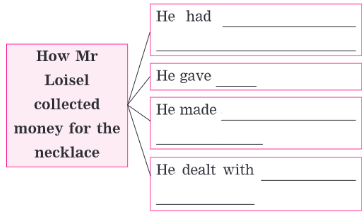
And he did borrow. He gave notes, made ruinous agreements, dealt with every type of money-lender Then he went to get the new necklace, and laid down on the jeweller’s counter thirty-six thousand francs.
     When Madame Loisel took the necklace back, Madame Forestier said coldly, “You should have returned it sooner, I might have needed it.”

A2. Complex Factual Activities:
Complete the web: 
Image
A3. Activities based on Vocabulary:
(1) Find and write all the numbers mentioned in the passage:
(2) Write from the passage words related to money matters.
A4. Activities based on Contextual Grammar:
(1) It was worth forty thousand francs.
(Use 'They' in place of 'Itzz' and rewrite the correct sentence.)
(2) He went to get the new necklace.
(Rewrite the sentence using simple present tense for the underlined verb.)
A5. Personal Response:
Write what you think about the following thoughts and actions of Mathilde:
(a) Mathilde returned the diamond necklace to her friend.
A1. Simple Factual Activities:
Write if the following statements are True or False:
(1) Margie's school was in her house.
(2) In those old days kids went to a special building for learning.
(3) Margie was not interested in reading the old book.
(4) Tommy went home with the book.

    Tommy screamed with laughter. “You don’t know much, Margie. The teachers didn’t live in the house. They had a special building and all the kids went there.”
    “And all the kids learned the same things ?”
    “Sure, if they were the same age.”
    “But my mother says a teacher has to be adjusted to fit the mind of each boy and girl it teaches and that each kid has to be taught differently.” 
    “Just the same they didn’t do it that way then. If you don’t like it, you don’t have to read the book.”
    “I didn’t say I didn’t like it”, Margie said quickly. She wanted to read about those funny schools.
    They weren’t even half finished when Margie’s mother called, “Margie ! School !”
Margie looked up. “Not yet, Mamma.”
   “Now !” said Mrs Jones. “And it’s probably time for Tommy, too.”
    Margie said to Tommy, “Can I read the book some more with you after school ?”
   “May be.” he said nonchalantly. He walked away whistling, the dusty old book tucked beneath his arm. 
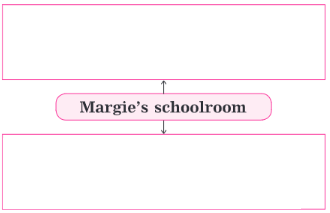
   Margie went into the schoolroom. It was right next to her bedroom, and the mechanical teacher was on and waiting for her. It was always on at the same time every day except Saturday and Sunday, because her mother said little girls learned better if they learned at regular hours.

A2. Complex Factual Activities:

Complete the web :
Image
A3. Activities based on Vocabulary:
Match the similar meaning words:

Column 'A'

Column 'B'

(1) kid

(a) under

(2) same

(b) fast

(3) beneath

(c) similar

(4) quickly

(d) child

A4. Activities based on Contextual Grammar:
Write the following using complete words instead of contracted forms:
(1) They weren't even half finished.
(2) And it's probably time for Tommy, too.
A5. Personal Response:
Would you like your own mechanical teacher? Support your answer.

A1. Simple Factual Activities:
Complete the following sentences with reference to the passage:
(1) The ___________ became the core of Raza's paintings.
(2) For an artist like Raza, his work, or paintings are an effective ___________.
(3) Raza passed away on ___________.
(4) Raza's wife was ___________.

     Raza was born in a small village in Madhya Pradesh. He began to paint from the age of twelve. He studied art at the ‘Chitrakala Mahavidyalaya’ at Nagpur and then at the J. J. School of Art in Mumbai. Later, he went to France to study Art. After a few years, he decided to settle in France. His wife was French. He won many national and international awards. He was honoured with all the three Padma awards - Padma Shri, Padma Bhushan and Padma Vibhushan. With all the awards and honours, his paintings were exploring a spiritual, metaphysical path. Gradually, the ‘bindu’ or point came to be the core of his paintings. He described his work in these words - My work is my own inner experience and involvement with the mysteries of nature and form which is expressed in colour, line, space and light’.
      Sometimes, an artist’s thoughts appear to be too complex or even complicated when they are expressed through words. For him, the effective medium of communication is his work - his paintings. Raza had great creativity. His paintings are very expressive. This great artist passed away on 23 July 2016 at the age of 94, leaving behind a legacy of sensitive paintings (achieved through extra-ordinary compositions of lines and colours) that depict extra-ordinary compositions.

A2. Complex Factual Activity:

What legacy did Raza leave behind?
A3. Activities based on Vocabulary:
Find out antonyms from the passage for the following words: 
(1) outer ×  
(2) city ×
(3) ordinary × 
(4) international × 
A4. Activities based on Contextual Grammar:
Make the following sentences exclamatory :
(1) His paintings are very expressive.
(2) Raza had a great creativity.
A5. Personal Response:
What are the essential things required to become a good painter?