Question
A1. Simple Factual Activities:
Complete the following sentences with reference to the passage:
(1) The ___________ became the core of Raza's paintings.
(2) For an artist like Raza, his work, or paintings are an effective ___________.
(3) Raza passed away on ___________.
(4) Raza's wife was ___________.

     Raza was born in a small village in Madhya Pradesh. He began to paint from the age of twelve. He studied art at the ‘Chitrakala Mahavidyalaya’ at Nagpur and then at the J. J. School of Art in Mumbai. Later, he went to France to study Art. After a few years, he decided to settle in France. His wife was French. He won many national and international awards. He was honoured with all the three Padma awards - Padma Shri, Padma Bhushan and Padma Vibhushan. With all the awards and honours, his paintings were exploring a spiritual, metaphysical path. Gradually, the ‘bindu’ or point came to be the core of his paintings. He described his work in these words - My work is my own inner experience and involvement with the mysteries of nature and form which is expressed in colour, line, space and light’.
      Sometimes, an artist’s thoughts appear to be too complex or even complicated when they are expressed through words. For him, the effective medium of communication is his work - his paintings. Raza had great creativity. His paintings are very expressive. This great artist passed away on 23 July 2016 at the age of 94, leaving behind a legacy of sensitive paintings (achieved through extra-ordinary compositions of lines and colours) that depict extra-ordinary compositions.

A2. Complex Factual Activity:

What legacy did Raza leave behind?
A3. Activities based on Vocabulary:
Find out antonyms from the passage for the following words: 
(1) outer ×  
(2) city ×
(3) ordinary × 
(4) international × 
A4. Activities based on Contextual Grammar:
Make the following sentences exclamatory :
(1) His paintings are very expressive.
(2) Raza had a great creativity.
A5. Personal Response:
What are the essential things required to become a good painter?
Answer

A1. Simple Factual Activities:
(1) The bindu or point became the core of Raza's paintings.
(2) For an artist like Raza, his work, or paintings are an effective medium of communication.
(3) Raza passed away on 23rd July 2016.
(4) Raza's wife was French.
A2. Complex Factual Activities:

Raza left behind a rich legacy of sensitive paintings (achieved through extraordinary compositions of lines and colours) that depict extraordinary compositions.
A3. Activities based on Vocabulary:
(1) outer × inner
(2) city × village
(3) ordinary ×  extraordinary
(4) international ×  national
A4. Activities based on Contextual Grammar:
(1) How expressive his paintings are!
(2) What a great creativity Raza had!
A5. Personal Response:

The essential things that are required to become a good painter are:
(1) interest in painting
(2) a good concentration skill
(3) capacity to sit for a long time at one place
(4) good eyesight
(5) imagination
(6) the knowledge of mixing colours.

Need a full question paper?

Generate a complete, print-ready paper with questions like this in minutes — across 16+ boards, with answer keys.

Start Generating Free

Similar questions

A1. Simple Factual Activities:
Complete the following web-chart :
Image

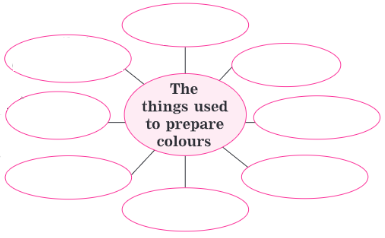
     This richness is reflected in the choice of their medium. In the days of past, several things in nature such as soils of different shades, the juice of plants, leaves, tree bark, flowers, fruits and even things like coal and cow-dung were used to prepare colours. The different colours, various textures and patterns were used year after year, lending a simplicity to the art. When we see these pictures, we realise that a picture drawn this way or the other can look equally beautiful. What a deep thought this art conveys - and so easily !
      In the Gond style of art, we see that the outlines may vary a little from artist to artist but the designs that fill it make the whole picture look lively and attractive. The designs include simple textures achieved using dots, straight lines, dotted lines, curvy shapes and circles. Special attention is given to the choice of various colours so that the total effect is amazing and beautiful.
      In today’s age of commercialisation many men have taken up Gond art. But the roots of folk arts probably lie in women’s daily chores like cleaning and decorating the house, dealing with natural colours in the course of cooking and in their leisure time activities.

A2. Complex Factual Activity:
Write down the special features of the Gond style of art :
A3. Activities based on Vocabulary:
(1) Spot the error in the spelling of the following words and rewrite them correctly:
(i) dicided (ii) diffarent
(2) Write related words with 'Artist'.
A4. Activities based on Contextual Grammar:
Do as directed:
(1) What a deep thought this art conveys! (Make it assertive.)
(2) Creating folk art is a very enriching experience. (Make it exclamatory.)
A5. Personal Response:
Why does the author think that the roots of folk art lie in women's chores?
A1. Simple Factual Activities:
Write if the following statements are True or False:
(1) Margie's school was in her house.
(2) In those old days kids went to a special building for learning.
(3) Margie was not interested in reading the old book.
(4) Tommy went home with the book.

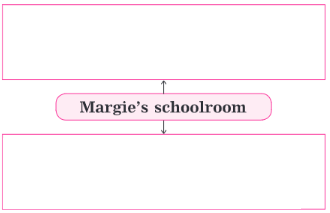
    Tommy screamed with laughter. “You don’t know much, Margie. The teachers didn’t live in the house. They had a special building and all the kids went there.”
    “And all the kids learned the same things ?”
    “Sure, if they were the same age.”
    “But my mother says a teacher has to be adjusted to fit the mind of each boy and girl it teaches and that each kid has to be taught differently.” 
    “Just the same they didn’t do it that way then. If you don’t like it, you don’t have to read the book.”
    “I didn’t say I didn’t like it”, Margie said quickly. She wanted to read about those funny schools.
    They weren’t even half finished when Margie’s mother called, “Margie ! School !”
Margie looked up. “Not yet, Mamma.”
   “Now !” said Mrs Jones. “And it’s probably time for Tommy, too.”
    Margie said to Tommy, “Can I read the book some more with you after school ?”
   “May be.” he said nonchalantly. He walked away whistling, the dusty old book tucked beneath his arm. 
   Margie went into the schoolroom. It was right next to her bedroom, and the mechanical teacher was on and waiting for her. It was always on at the same time every day except Saturday and Sunday, because her mother said little girls learned better if they learned at regular hours.

A2. Complex Factual Activities:

Complete the web :
Image
A3. Activities based on Vocabulary:
Match the similar meaning words:

Column 'A'

Column 'B'

(1) kid

(a) under

(2) same

(b) fast

(3) beneath

(c) similar

(4) quickly

(d) child

A4. Activities based on Contextual Grammar:
Write the following using complete words instead of contracted forms:
(1) They weren't even half finished.
(2) And it's probably time for Tommy, too.
A5. Personal Response:
Would you like your own mechanical teacher? Support your answer.

A1. Simple Factual Activities:
Find the following matter in the passage and copy the missing words:
(1) Faraday decided that ______________________.
(2) Davy never believed ______________________.

      That day in 1812 Faraday was spellbound by Davy’s lecture. He kept taking notes about the ‘mysterious force of electric fluid’. He was so engrossed in the lecture that he forgot to applaud with the rest of the crowd. When he went back, his notes were so comprehensive that he bound them into a book, meaning to gift it to Davy some day. Faraday decided that day that he didn’t just want to sell books, he wanted to be a great scientist - good enough to write his own books. Davy became his role model. But there was a problem. He did not have the social status, money or the education to pursue science. Faraday thought it would be wonderful if Davy became his mentor, but Davy did not agree initially. Faraday was not dejected; he just kept trying.
       Destiny had a strange plan in store for him. A few years later, a chemical explosion happened inside Davy’s lab and he was temporarily blinded. He now needed an assistant with an excellent memory to help him. He was reminded of Faraday and decided to hire him as his secretary. Davy never believed Faraday could do anything in the field of science going by his social status and education. He therefore dismissed Faraday’s aspirations and advised him to stick to bookbinding. But Faraday was relentless. He worked day and night and learnt as much as he could about Davy’s experiments. Soon Faraday became indispensable to Davy, and was promoted to his lab assistant. This was his first step towards a scientific career. Though much of his job now was cleaning labs, at least he got to see some of Davy’s leading experiments.

A2. Complex Factual Activity:
What actions and thoughts of Faraday show that he was inspired by Davy?
A3. Activities based on Vocabulary:
Match the words in Column 'A' with the meaning in Column 'B':

'A'

'B'

(1) pursue

(a) a person that you admire and try to follow him/her

(2) role model

(b) to continue to do or achieve something

(3) mentor

(c) to cheer with claps

(4) applaud

(d) an expert who advises and helps less experienced persons

A4. Activities based on Contextual Grammar:
Do as directed:
(1) He dismissed Faraday's aspirations.
(Begin with Faraday's aspiration-and make the sentence of Passive voice.)
(2) He forgot to applaud with the rest of the crowd.
(Make the sentence negative without changing the meaning.)
A5. Personal Response:
Is it necessary to have social status, money to pursue your goal? Explain why.

A1. Simple Factual Activities:
Complete the sentences using the information given in the passage:
(1) People started telling Davy that ______________________.
(2) He handed him a piece of Bavarian glass, which ______________________.

      Faraday became a celebrity scientist overnight. Nobody now cared about his social status or education; this young man had just created a revolution. One would think, as a teacher Davy was happy at his pupil’s achievement. But in reality he was jealous. People started telling Davy that of all his discoveries, the best was Faraday himself; this made him even more jealous. An angry Davy gave Faraday an impossible task to keep him out of his way. He handed him a piece of Bavarian glass, which was used in the lenses in telescopes and microscopes, and asked him to reverse engineer it. Bavarian glass was manufactured by a secret complicated process and Davy knew that with the equipment available in the lab Faraday would never be able to accomplish the task. This piece of glass became a significant thing in his life.
      Faraday had a never - give - up attitude and he respected Davy. So he accepted the assignment, despite  knowing that it would be very difficult. He toiled for four years, with no help from Davy, and, as expected, failed. Faraday never learned the secret, and this remained his first failure as a scientist. To remind himself of these difficult times, he kept a single glass brick on his shelf as a souvenir. This would inspire him during difficult times.

A2. Complex Factual Activity:
Give one example each to show that -
(1) Davy was not a good mentor.
A3. Activities based on Vocabulary:
Write words using each letter of the following words:
(1) about (2) angry 
A4. Activities based on Contextual Grammar:
Do as directed:
(1) It would be very difficult (Make it a negative sentence.)
(2) He accepted the assignment. (Change the voice.)
A5. Personal Response:
Write what is implied in the following sentence :
People started telling Davy that of all his discoveries, the best was Faraday himself.
(What does it suggest about Davy's work?
A1. Simple Factual Activities:
Complete the following sentences:
(1) The order from Berlin forced on teaching ___________ instead of ___________ in the schools of Alsace and Loraine.
(2) Franz studies ___________, ___________ and ___________ in school.

      I jumped over the bench and sat down at my desk. When I had got a little over my fright, I saw that our teacher had on his beautiful green coat, his frilled shirt, and the little black silk cap, all embroidered, that he never wore except on inspection and prize days. Besides, the whole school seemed so strange and solemn. But the thing that surprised me most was to see, on the back benches, the village people sitting quietly like ourselves; old Hauser, with his three-cornered hat, the former mayor, the former postmaster, and several others besides. Everybody looked sad.
      While I was wondering about it all, M. Hamel mounted his chair, and, in the same grave and gentle tone which he had used to me said :
      “My children, this is the last lesson I shall give you. The order has come from Berlin to teach only German in the schools of Alsace and Loraine. The new master comes tomorrow. This is your last French lesson. I want you to be very attentive.”
      What a thunderclap these words were to me !
      Oh, oh, oh ! that was what they had put up at the town hall !
      My last French lesson ! Why, I hardly knew how to write; I should never learn any more ! I must stop there, then ! Oh, how sorry I was for not learning my lessons, for seeking birds’ eggs, or going sliding on the Saar ! My books, that had seemed such a nuisance a while ago, so heavy to carry, my grammar, and my history of the saints, were old friends now that I couldn’t give up. And M. Hamel, too; the idea that he was going away, that I should never see him again, made me forget all about his ruler and how cranky he was.

A2. Complex Factual Activities:
(1) How did M. Hamel dress up on special occasions? 
(2) Is the school closing down?
A3. Activities based on Vocabulary:
(1) ... got a little over my fright
(a) got very frightened
(b) got something because I was frightened
(c) became little
(d) got less frightened
(2) What a thunderclap these words were to me!
(a) The words came as a shock.
(b) He shouted the words at me.
(c) There was thunder and lightning.
(d) The words were accompanied by claps.
A4. Activities based on Contextual Grammar:
(1) M. Hamel said, "My children, this is the last lesson I shall give you. The order has come from Berlin to teach only German in the schools of Alsace and Loraine." (Rewrite it in indirect narration.)
A5. Personal Response:
Why is it the last lesson?
A1. Simple Factual Activities:
Complete the following sentences:
(1) The writer and her teacher were attracted by ______________.
(2) As the cool stream gushed over Helen's hand, she realised that water meant ______________.

     We walked down the path to the well-house, attracted by the fragrance of the honeysuckle with which it was covered. Someone was drawing water and my teacher placed my hand under the spout. As the cool stream gushed over one hand she spelled into the other the word water, first slowly, then rapidly. I stood still, my whole attention fixed upon the motions of her fingers. Suddenly I felt a misty consciousness as of something forgotten - a thrill of returning thought; and somehow the mystery of language was revealed to me. I knew then that ‘w-a-t-e-r’ meant the wonderful cool something that was flowing over my hand. That living word awakened my soul, gave it light, hope, joy, set it free ! There were barriers still, it is true, but barriers that could in time be swept away.
     I left the well-house eager to learn. Everything had a name, and each name gave birth to a new thought. As we returned to the house, every object that I touched seemed to quiver with life. That was because I saw everything with the strange, new sight that had come to me. On entering the door I remembered the doll I had broken. I felt my way to the hearth and picked up the pieces. I tried vainly to put them together. Then my eyes filled with tears; for I realised what I had done, and for the first time I felt repentance and sorrow.
     I learned a great many new words that day. I do not remember what they all were; but I do know that mother, father, sister, teacher were among them - words that were to make the world blossom for me ‘like Aaron’s rod, with flower.’ It would have been difficult to find a happier child than I was as I lay in my crib at the close of that eventful day and lived over the joys it had brought me, and for the first time longed for a new day to come.
     Helen went on to become a graduate cum laude from Radcliffe. She then devoted the rest of her life to teaching and giving hope to the blind and deaf, as her teacher had done. She and Anne remained friends until  Anne’s death.

A2. Complex Factual Activities:
(1) Why did young Helen feel repentance and sorrow? 
A3. Activities based on Vocabulary:
Find out four compound words from the lesson: 
A4. Activities based on Contextual Grammar:
Rewrite the sentences by using 'As soon as':
On entering the door, I remembered the doll I had broken.
Rewrite the sentences by using 'As soon as':
We walked down the path to the well-house, we got attracted by the fragrance of the honeysuckle.
A5. Personal Response:
Why should we help disabled people?
A1. Simple Factual Activities:
Complete the following:
(1) The two lips are like a fence because ______________________.
(2) Once you have spoken a word you ______________________.

     Man was meant to listen more and talk less. That is why as the great British statesman Benjamin Disraeli said: “Nature has endowed man with two ears and one mouth. If man was meant to talk more and listen less, he would have two mouths and only one ear.” Imagine how we would have looked, how strange with two mouths on the two sides and one ear at the centre.
      And mind you, the ears are like funnels, open all the time. There is no door with which you can close them. Whereas if you have to speak even one single word, that word must pass through two walls - two fences. There is firstly the fence of these two rows of teeth. There is secondly the fence of the two lips. Before a word can be spoken, it has to pass, it has to pierce through these two walls, through these two fences. Therefore we must think at least twice before we utter a word. 
       A very wise man once remarked that of the unspoken word you are a master, of the spoken word, you are a slave. Once you have spoken a word you cannot get it back, do what you will. Therefore you must be very careful about the words that you speak. Once the word has left your lips, you will not be able to get it back.
       What are unspoken words? They are things you want to say, but remain unsaid, as thoughts in your mind. Once you have put the thoughts into words, once the words have left your lips, you cannot change them or control them

A2. Complex Factual Activities:
(1) What were a wise man's thoughts about our spoken word? 
A3. Activities based on Vocabulary :
(1) Write from the passage the words related to our body parts:
(2) Write four words that have 'un-' as prefix:
Example: unspoken
A4. Activities based on Contextual Grammar:
Make two sentences of your own with each of the words given below, using the same word as a noun in one and as a verb in another :
(1) Show :
A5. Personal Response:
(1) Write the biological reasons why man's ears and mouth have developed the way they are now.
A1. Simple Factual Activities:
State whether the following statements are True or False:
Statements
(1) Prospero was the duke of Milan, in the kingdom of Naples.
(2) Prospero's brother Gonzalo was a very treacherous man.
(3) Books were Prospero's most valued possessions.
(4) The king Antonio landed safely on an enchanted island.

      Prospero was the Duke of Milan, in the kingdom of Naples. He was such a studious and learned scholar that he spent most of his time reading books, while his brother Antonio managed the business of ruling his dukedom.
      Now, Antonio was a treacherous man, and he wanted to become Duke of Milan in his brother place. In fact, Antonio would not have hesitated to kill Prospero - but he knew that the people loved their Duke, and would never forgive his murderer. So Antonio got together with Alonso, the king of Naples who was Prospero’s enemy. They took Prospero to sea, and when they were far away from land, they put Prospero and his baby daughter Miranda into a broken, old boat and sailed away. Prospero and Miranda were left to drift into the wide, open sea Thus Antonio managed to take over the Dukedom of Milan, with all its wealth and power.
      Now, among Prospero’s courtiers was a true and loyal Lord called Gonzalo. Out of love and loyalty for the rightful Duke, Gonzalo had secretly placed in the boat fresh water, food and clothes - and along with them, Prospero’s most valued possessions, his books.
       You can imagine the hardships faced by Prospero cast adrift in an oarless boat, with a baby girl to care for! However, they were fortunate that the boat reached an island, and they landed in safety.
      The island was an enchanted island. For years together, it had come under the spell of an evil witch Sycorax, who had imprisoned all the good spirits she found on the island. She herself had died before Propspero arrived on the island, but the spirits remained trapped in their ‘prisons’ - the trunks of the large trees on the island.

A2. Complex Factual Activity:
What had the faithful Lord Gonzalo done to help Prospero? 
A3. Activities based on Vocabulary:
Choose the correct alternative given for the synonym of the words given below:
(1) studious: ___________
(a) outstanding (b) concerned (c) bookish (d) clever
(2) treacherous: ___________
(a) foolish (b) tricky (c) unreliable (d) favourite
A4. Activities based on Contextual Grammar:
Add a question tag:
(1) Prospero was the Duke of Milan, ___________?
(2) Antonio would not have hesitated to kill Prospero, ___________?
A5. Personal Response:
What will you do if you are left alone on an isolated island by your friends?
A1. Simple Factual Activities:
Complete the following sentences:
(1) The mortar-maker's family comprised of ______________.
(2) According to the mortar-maker excess water poured down into ______________.

King : Summon the mortar-maker at once. He must pay with his life for his thoughtlessness.
(First Guard exits and returns with the mortar-maker who rushes and throws himself before the king.)
Mortar-maker : (wailing loudly) Forgive me, O Merciful King. Please do not hang me to death. I have a wife and two young children. Who will look after them ?
King : Your carelessness has cost a life. You must pay with your life.
Mortar-maker : No... no... no, my Royal Lord. I am not to blame. The pot which I used to pour water into the mortar had an extra-ordinarily large mouth. So excess water poured down into the mortar mixture. I was helpless. It is the potter’s fault for making such a useless pot.
King : Let the potter be brought here at once. He must be executed for moulding such useless pots.
(Fourth Guard leaves and re-enters with the potter.)
Potter : (cowering before the king) Your Majesty, show mercy to this humble potter. I agree the pot I made and sold to the mortar-maker was a defective one. But I am not guilty. As I was moulding that pot, I heard the sweet delicate tinkling of anklets. It was the money-lender’s daughter. She distracted me just as I was shaping the mouth and it became too wide.
King : Bring the money-lender’s daughter here, this very instant. She must be sent to the gallows for disturbing this poor potter at work.
(First Guard leaves and enters with the money-lender and his daughter.)
Money-lender : (in a desperate voice) O Just King ! Spare my daughter. She is my only child and to be wedded next Monday.
Daughter : Oh, do not fret, father. The king will not hang me. (To the king) Your Most Esteemed 
Highness, I rarely step outside the threshold of my home. But as my father said, I am to be married next week and my jewellery is not ready. I had to go to the goldsmith’s shop to urge him to work faster and hand over my ornaments on time ... The potter’s shop is on the way. I could not help it. It is all the goldsmith’s fault. Had he delivered my ornaments on time. I would not have been forced to go past the potter’s shop.
King : Then send for the goldsmith and without any delay, he must be hanged.

A2. Complex Factual Activities:
(1) What is the Mortar-maker's excuse? Is it believable? 
A3. Activities based on Vocabulary:
(1) Find out minimum four infinitives from the passage:
A4. Activities based on Contextual Grammar:
(1) Copy four imperative sentences from the passage:
A5. Personal Response:
Do you think the potter is telling the truth? Why? 
A1. Simple Factual Activities:
Say whether the following statements are True or False:
Statements
(1) Anne Mansfield Sullivan was Helen Keller's mother.
(2) The most important day in Helen Keller's life was when her teacher came to her. True
(3) The author compares herself to the great ship that groped her way towards the shore. 
(4) The writer was standing on the porch dumb and expectant on that eventful day.

     (Helen Keller became ill at the age of two and was left blind and deaf. For the next five years she grew up in a world of darkness and emptiness. She was afraid, alone and without any anchor. This is the story of her meeting the teacher who would change her life.)
      The most important day I remember in all my life is the one on which my teacher, Anne Mansfield Sullivan, came to me. I am filled with wonder when I consider the immeasurable contrasts between the two lives which it connects. It was the third of March, 1887, three months before I was seven years old.
      On the afternoon of that eventful day, I stood on the porch, dumb and expectant. I guessed vaguely from my mother’s signs and from the hurrying to and fro in the house that something unusual was about to happen, so I went to the door and waited on the steps. The afternoon sun penetrated the mass of honeysuckle that covered the porch, and fell on my upturned face. My fingers lingered almost unconsciously on the familiar leaves and blossoms which had just come 
forth to greet the sweet Southern spring. I did not know what the future held of marvel or surprise for me. Anger and bitterness had preyed upon me continually for weeks and a deep languor had succeeded this passionate struggle.
      Have you ever been at sea in a dense fog, when it seemed as if a tangible white darkness shut you in, and the great ship, tense and anxious, groped her way toward the shore with plummet and sounding-line, and you waited with beating heart for something to happen ? I was like that ship before my education began, only I was without compass or sounding-line, and had no way of knowing how near the harbour was. “Light! Give me light!” was the wordless cry of my soul, and the light of love shone on me in that very hour.

A2. Complex Factual Activities:
Match the following:

Column 'A'

Column 'B'

(1) The afternoon sun penetrated the mass of honeysuckle ...

(a) when she considered the immeasurable contrasts between the two lives. 

(2) The writer was filled with wonder ...

(b) how near the harbour she was.

(3) The familiar leaves and blossoms came forth...

(c) and fell on the writer's upturned face.

(4) The writer was like compass or sounding- line and no way of knowing....

(d) to greet the sweet southern spring.

A3. Activities based on Vocabulary:
Classify the following into 'one' and 'many':
day, contrast, teacher, lives, months, years, afternoon, porch, signs, face, fingers, leaves, blossoms, anger, bitterness, weeks, struggle, ship, darkness
A4. Activities based on Contextual Grammar:
Add a tail tag to the following sentences:
(3) Helen had no way of knowing how near the harbour was, ______________
(4) The afternoon sun penetrated the mass of honeysuckle, ______________
A5. Personal Response:
Complete the following using your own ideas:
The most important day I remember in all my life is the one on which ............