Question
A1. Simple Factual Activities:
Complete the sentences using the information given in the passage:
(1) People started telling Davy that ______________________.
(2) He handed him a piece of Bavarian glass, which ______________________.

      Faraday became a celebrity scientist overnight. Nobody now cared about his social status or education; this young man had just created a revolution. One would think, as a teacher Davy was happy at his pupil’s achievement. But in reality he was jealous. People started telling Davy that of all his discoveries, the best was Faraday himself; this made him even more jealous. An angry Davy gave Faraday an impossible task to keep him out of his way. He handed him a piece of Bavarian glass, which was used in the lenses in telescopes and microscopes, and asked him to reverse engineer it. Bavarian glass was manufactured by a secret complicated process and Davy knew that with the equipment available in the lab Faraday would never be able to accomplish the task. This piece of glass became a significant thing in his life.
      Faraday had a never - give - up attitude and he respected Davy. So he accepted the assignment, despite  knowing that it would be very difficult. He toiled for four years, with no help from Davy, and, as expected, failed. Faraday never learned the secret, and this remained his first failure as a scientist. To remind himself of these difficult times, he kept a single glass brick on his shelf as a souvenir. This would inspire him during difficult times.

A2. Complex Factual Activity:
Give one example each to show that -
(1) Davy was not a good mentor.
A3. Activities based on Vocabulary:
Write words using each letter of the following words:
(1) about (2) angry 
A4. Activities based on Contextual Grammar:
Do as directed:
(1) It would be very difficult (Make it a negative sentence.)
(2) He accepted the assignment. (Change the voice.)
A5. Personal Response:
Write what is implied in the following sentence :
People started telling Davy that of all his discoveries, the best was Faraday himself.
(What does it suggest about Davy's work?
Answer

A1. Simple Factual Activities:
(1) People started telling Davy that of all his discoveries, the best was Faraday himself, this made him even more jealous.
(2) He handed him a piece of Bavarian glass, which was used in the lenses in telescopes and microscopes, and asked him to reverse engineer it.
A2. Complex Factual Activities:

(1) Davy was jealous of his pupil's achievement and never helped him in his difficulties. He gave Faraday an impossible task to keep him out of his way. He knew that with the equipment available in the lab, Faraday would never be able to accomplish the task. He wanted to enjoy his pupil's failure. This shows that Davy was not a good mentor.
A3. Activities based on Vocabulary:
(1) ant, ball, odd, use, table
(2) and, not, give, ray, yes
A4. Activities based on Contextual Grammar:
(1) It would not be very easy.
(2) The assignment was accepted by him.
A5. Personal Response:
Humphry Davy was a renowned chemist who made many discoveries about chemicals and electrical lighting. Faraday wanted Davy to become his mentor but Davy never believed in Faraday's ability and always tried to keep him away from the experiments he was doing. Davy became jealous of Faraday when he became a celebrity scientist overnight. But Faraday did not receive recognition for his success from Davy. So people started telling Davy that Faraday himself was his best discovery.

Need a full question paper?

Generate a complete, print-ready paper with questions like this in minutes — across 16+ boards, with answer keys.

Start Generating Free

Similar questions

A1. Simple Factual Activities:
Complete the following:
(1) The two lips are like a fence because ______________________.
(2) Once you have spoken a word you ______________________.

     Man was meant to listen more and talk less. That is why as the great British statesman Benjamin Disraeli said: “Nature has endowed man with two ears and one mouth. If man was meant to talk more and listen less, he would have two mouths and only one ear.” Imagine how we would have looked, how strange with two mouths on the two sides and one ear at the centre.
      And mind you, the ears are like funnels, open all the time. There is no door with which you can close them. Whereas if you have to speak even one single word, that word must pass through two walls - two fences. There is firstly the fence of these two rows of teeth. There is secondly the fence of the two lips. Before a word can be spoken, it has to pass, it has to pierce through these two walls, through these two fences. Therefore we must think at least twice before we utter a word. 
       A very wise man once remarked that of the unspoken word you are a master, of the spoken word, you are a slave. Once you have spoken a word you cannot get it back, do what you will. Therefore you must be very careful about the words that you speak. Once the word has left your lips, you will not be able to get it back.
       What are unspoken words? They are things you want to say, but remain unsaid, as thoughts in your mind. Once you have put the thoughts into words, once the words have left your lips, you cannot change them or control them

A2. Complex Factual Activities:
(1) What were a wise man's thoughts about our spoken word? 
A3. Activities based on Vocabulary :
(1) Write from the passage the words related to our body parts:
(2) Write four words that have 'un-' as prefix:
Example: unspoken
A4. Activities based on Contextual Grammar:
Make two sentences of your own with each of the words given below, using the same word as a noun in one and as a verb in another :
(1) Show :
A5. Personal Response:
(1) Write the biological reasons why man's ears and mouth have developed the way they are now.
A1. Simple Factual Activities:
Fill in the blanks with one word:
(1) Prospero took the prince to a ___________.
(2) Ferdinand wanted to be the king of ___________.
(3) Many more tricks were played on Prospero's enemies by ___________.
(4) Antonio wanted to kill king ___________.

      In reality, Ariel informed Prospero, the ship was  safely anchored in one corner of the island; Ferdinand  was all alone on the beach, and Alonso, Antonio,  Gonzalo and the others were wandering about on the  island, not knowing where to go.
      “Ariel, my joyful spirit,” Said Prospero. “Bring Ferdinand here at once, for my daughter must see him.”
      “Remember, Master, I have served you joyfully all these years. And you promised me that you would set me free one day.”             
      “Obey my commands now,” Prospero said to him “and in two days I shall set you free!”
       Ariel, assuming a form invisible to Ferdinand enchanted the prince with a beautiful song, leading him carefully into the presence of Prospero and Miranda And, all happened exactly as Prospero had planned.
       Miranda, who had never ever seen any human being except her father, looked at the handsome young prince and was thrilled.
      “I might call him a thing divine,” she exclaimed “for nothing natural I ever saw so noble!”
       Ferdinand too, was astonished to see such a beautiful young girl in a desolate place like the island “Most sure, she is the goddess of the island !” he thought to himself.
       As they gazed at each other in wonder, admiration and love, Prospero was secretly pleased. But outwardly he pretended to be angry. He accused the Prince of spying on the island, to capture it for himself. “Follow me,” he said to the Prince, “I shall tie you up, neck and feet together.”
      The brave prince drew his sword to defend himself - but Prospero waved his magic stick, and the prince was forced to stand like a statue, as still as stone..

A2. Complex Factual Activity:
How did Ferdinand and Miranda react on seeing each other?
A3. Activities based on Vocabulary:

(1) Write down minimum four infinitives from the passage:
A4. Activities based on Contextual Grammar:
Rewrite the following sentences in polite request in form of question :
(1) Obey my commands now!
(2) Bring Ferdinand here at once.
A5. Personal Response:

Do you think the power of magic can make you successful? Why?
A1. Simple Factual Activities:
State whether the following statements are True or False:
(1) The people of the village gathered in the school to thank M. Hamel.
(2) Franz can neither speak nor write French.
(3) Franz's parents were very much anxious in his studies.
(4) Franz had never listened M. Hamel so carefully before.

      Poor man ! It was in honour of this last lesson that he had put on his fine Sunday clothes; and now I understood why the old men of the village were sitting there in the back of the room. It was because they were sorry, too, that they had not gone to school more. It was their way of thanking our master for his forty years of faithful service and of showing their respect for the country that was theirs no more.
      While I was thinking of all this, I heard my name called. It was my turn to recite. I had not learnt my participles and so I could not say a single word. I heard M. Hamel say to me :
       “I don’t scold you, little Franz, you must feel bad enough. See how it is ! Every day we have said to ourselves : ‘Bah ! I’ve plenty of time. I’ll learn it tomorrow.’ And now you see where we’ve come out. Ah, that’s the great troubles with Alsace; she put off learning tomorrow. Now those fellows out there will have the right to say to you: ‘How is it; you pretend to be Frenchmen, and yet you can neither speak nor write your own language.’ But you are not the worst, poor little Franz. We’ve all a great deal to reproach ourselves with.
       “Your parents were not anxious enough to have you learn. They preferred to put you to work on a farm or at the mills, so as to have a little more money. And I’ve been to blame also. Have I not often sent you to water my flowers instead of making you learn your lessons ?”
      Then, from one thing to another, M. Hamel went on to talk of the French language saying that it was the most beautiful language in the world. We must guard it among us and never forget it, because when a people are enslaved, as long as they hold fast to their language, it is as if they had the key to their prison.Then he opened a grammar and read us our lesson. I was amazed to see how well I understood it. All he said seemed so easy, so easy ! I think, too, that I had never listened so carefully, and that he had never explained everything with so much patience. It seemed almost as if the poor man wanted to give us all he knew before going away, and to put it all into our heads at one stroke.

A2. Complex Factual Activities:
(1) Why does Franz understand his lesson well? 
A3. Activities based on Vocabulary:
Arrange the following words in alphabetical order:
prison, patience, people, poor, participles, plenty, pretend, parents.
A4. Activities based on Contextual Grammar:
Add a question tag :
(1) They had not gone to school, ___________?
(2) Your parents were not anxious enough to have you learn, ___________?
(3) You are not the worst, ___________?
(4) I had never listened so carefully, ___________?
A5. Personal Response:
We should be grateful to our teachers - support your views. 
A1. Simple Factual Activities:
Complete the sentences using the information from the passage:
(1) At the end of ten years, they ______________.
(2) How little is needed for one to be ______________
(3) Mathilde played her part ______________.
(4) She came to know the ______________.

      From then on, Madame Loisel knew the horrible life of the very poor. But she played her part heroically. The dreadful debt must be paid. She would pay it. They dismissed their maid; they changed their lodgings; they rented a garret under the roof.
    She came to know the drudgery of housework, the odious labours of the kitchen. She washed the dishes, the dirty linen, she carried the garbage down to the street every morning, and carried up the water, stopping at each landing to catch her breath and dressed like a commoner. She had to bargain at markets, quarrel and face insults over every miserable sou.
      Each month they had to pay some loans, renew others, get more time.
      Her husband worked extra, every evening, doing accounts for a tradesman, and often, late into the night, he sat copying a manuscript at five sous a page.
      And this life lasted ten years. At the end of ten years they had paid off everything, even the interest.
      Madame Loisel looked old now. Often, she brooded over the past - What would have happened if she had not lost that necklace ? How strange life is, how fickle ! How little is needed for one to be ruined or saved !

A2. Complex Factual Activities:
(1) How did life of Mathilde change after the horrible incident? 
A3. Activities based on Vocabulary:
Write from the passage the phrases related to 'housework'.
A4. Activities based on Contextual Grammar:
Change the following sentences in passive voice:
(1) They dismissed their maid.
(2) They rented a garret under the roof.
A5. Personal Response:
Write what you think about the following actions of Mathilde:
(1) Mathilde worked very very hard to pay the debt.
A1. Simple Factual Activities:
Complete the following sentences using the information from the passage:
(1) The last man who entered the wooden horse was  ______________.
(2) Troy was taken, not by force but  ______________.

       At last Troy was taken, not by force but by a  trick. It was the cunning Odysseus who thought of a  plan to obtain the victory.
        “Let us build a great wooden horse”, he said, “big  enough to hold men inside it, and let some of our  best fighters hide in the horse. Then let us burn our  tents and pretend to sail away in our ships. But instead  of sailing away, we will return in the night. When  the Trojans are asleep, we will attack the city and  burn and kill.”
       The Greek leaders decided to follow the advice  of the wise Odysseus. So a great horse of wood was  made by a skilful engineer, and the greatest heroes,  Menelaus, Odysseus himself, and others entered it, the  last man to go in being the architect himself who  knew the secret of opening and shutting the entrance.  That evening the Greeks burned their tents and sailed  away in their ships, but they did not go very far.  Only one man was left behind to persuade the Trojans  to drag the horse into their city.
        Next day the Trojans woke up, expecting to go  out and fight as they had done for the past ten years.  What delight and surprise they felt at the sight they  saw on the seashore outside the walls ! It seemed that  the long siege was over at last. The tents had been  burnt. The shore was deserted. The Greek ships had  all gone.
       “It’s peace at last,” they cried, and opened wide  their gates and came out in large numbers on the  plain, glad to be free again to go where they pleased.  Then they saw on the sands the huge, wooden horse.  They gathered round it in astonishment, for it was  indeed a wonderful piece of work.

A2. Complex Factual Activities:
How did Odysseus plan to defeat the Trojans? 
A3. Activities based on Vocabulary:
Arrange the letters properly to make a meaningful word:
(1) aagni
(2) bndeih
(3) rohse
(4) seegi.
A4. Activities based on Contextual Grammar:
Read the following constructions carefully and then use them to express your ideas:
(1) A horse big enough to hold men inside it.
(2) The Greeks were tired of the long war.
A5. Personal Response:
Was it enough to use the wooden horse to hide some soldiers? What was done to make the Trojans take it inside the city? 
A1. Simple Factual Activities:
Correct the following sentences using facts from the passage:
(1) The Greek armies and heroes always defeated the Trojans. 
(2) Both the enemies were eager to continue fighting.

      The Iliad is the story of Ilium or Troy, a rich trading city in Asia Minor near the narrow sea that leads from the Aegean to the Black Sea. It was well situated, both for commerce and agriculture. In front of the city was the sea over which sailed the ships of Troy, carrying goods and grain. At the back rose the high peak of Mount Ida, from which flowed many rivers and streams. The valleys among the hills were well-watered and fertile, with corn growing in fertile fields and cattle feeding on the rich grass of the meadows while sheep fed on the slopes of the hills.
      Round their city the Trojans had built a strong wall so that no enemy should attack them from the sea. The wall was so broad that people could stand and sit and walk on it. The great gates stood open, and people could go to the seashore outside and come in as they pleased. But in time of war the gates would be closed; and then the city was like a strong fortress, quite safe from all attack, protected by the walls surrounding it, as well as by the hills behind.
      Thus, Troy was a strong city, strongly protected by its walls and strongly defended by its brave soldiers. But all the kings and heroes of Greece had declared war against the Trojans, because Paris, a prince of Troy, had persuaded Helen, wife of a Greek king Menelaus, to elope with him. He had brought her to Troy. The Greeks wanted to take revenge on Troy for the wrong done to Menelaus. They sailed to Troy and laid siege to the city. The Trojans, too, fought hard and the siege continued for ten long years.

A2. Complex Factual Activities:
State the counteraction for the following actions: 
(1) Hector was killed by Achilles.
(2) The siege continued for ten long years.
A3. Activities based on Vocabulary:
Find antonyms of the following from the passage: 
1) offended × ______________
(2) peace × ______________
(3) exposed × ______________
(4) begin × ______________
A4. Activities based on Contextual Grammar:
(1) Greeks could not take the city. (Make the sentence affirmative.)
(2) Every day Greeks came out of their gates. (Rewrite the sentence using past continuous tense.)
A5. Personal Response:

Which of the following are the adverse effects of war? Tick ☑ in the given box:
(1) Many people are killed.   
(2) The country gains fame and glory.   
(3) They lose peace in the land.   
(4) Thousands are wounded.   
A1. Simple Factual Activities:
Choose the correct alternative to answer the following questions:
(1) Who was going to be hanged?
(a) the young stranger  (b) the hangman
(c) the guard                 (d) the sage
(2) According to the sage how was the king?
(a) holy (b) wise (c) generous (d) great

Voices and shouts heard from outside. All re-enter in a rush with another elderly man.
King : What ? Why have you all returned with this  stranger alive ? And who is this man ?
First Guard : I beg your pardon, Your highness but we  are confused indeed. This old man rushed towards  us as we were about to hang the young stranger  and begged and pleaded that he should be hanged  instead.
Second Guard : At first we thought the old man had  lost his mental balance. What sane man would  wish to suffer such a drastic death willingly ?
First Guard : But this young man says that he is a  wise and learned sage from the forest yonder and  he himself was this man’s disciple.
Sage : O Noble King, You are most generous. Be kind  and allow me to be hanged in place of my  disciple. I beg of you.
King : What a strange appeal ! And why  does such a wise and holy man wish to  obstruct the course of justice, may I ask ? 
Sage : (showing reluctance to let out his  secret) Your Majesty.... the truth is... no....  no.... I cannot say it.
King : I demand an explanation or I shall  not have you hanged in place of your  disciple.
Sage : You see........ uh........ it has been  predicted by the great prophets..... uh......  no...... no..... I shouldn’t say this.
King : (annoyed) Speak out at once or your disciple  will be hanged.
Sage : The.... the great prophets have foretold that the one who will be hanged on this day, in this kingdom, shall .... shall become the next king and conquer many more nations. I want to become the next great king, Your Majesty, and reign over a greater country ... I will go down in history as a famous royal monarch. The future generations will read about me and my greatness for milleniums to come. I shall never earn that fame if I remain a recluse - a sage. So do grant me this favour, O King, let me die at the gallows today.
King : Humm ...... The next king ? And this kingdom will expand ? Glory for milleniums to come ! Why, no one but I should be entitled to this privilege. Guards ! Take me to the gallows and hang me at once without any delay. Hurry up ! Don’t waste time. What a wonderful fate in my next life - a king once again ! Goodbye, world. See you again.

A2. Complex Factual Activities:
(1) Why did the King want to die? 
A3. Activities based on Vocabulary:
Write any suitable noun from the passage for the given adjectives to make correct combination!
(1) generous 
(2) wonderful
(3) great
(4) learned
A4. Activities based on Contextual Grammar:
Rewrite using 'as well as':
(1) He is a wise and learned sage from the forest.
(2) The old man begged and pleaded that he should be hanged instead of the young stranger.
A5. Personal Response:
Write any three instances of funny rules and twisted logic used in Andher Nagari.
A1. Simple Factual Activities:
Say whether the following statements are True or False:
Statements
(1) When young Helen stretched out her hand, her mother took it.
(2) Young Helen learnt to spell many words without understanding them.
(3) Young Helen did not try to put the pieces of doll together.
(4) Young Helen felt sorry that she had broken the doll.

      I felt approaching footsteps. I stretched out my  hand as I supposed it was my mother. Someone took  it, and I was caught up and held close in the arms  of her who had come to reveal all things to me, and,  more than all things else, to love me.
      The morning after my teacher came she led me  into her room and gave me a doll. The little blind  children at Perkins Institution had sent it and Laura  Bridgman had dressed it; but I did not know this until  afterward. When I played with it a little while, Miss  Sullivan slowly spelled into my hand the word “d-o- l-l.” I was at once interested in this finger play and  tried to imitate it. When I finally succeeded in making  the letters correctly I was flushed with childish pleasure  and pride. Running downstairs to my mother I held  up my hand and made the letters for doll. I did not  know that I was spelling a word or even that words  existed; I was simply making my fingers go in  monkey-like imitation. In the days that followed I  learned to spell in this uncomprehending way a great  many words, among them pin, hat, cup, and a few  verbs like sit, stand and walk. But my teacher had  been with me several weeks before I understood that  everything has a name.
      One day, while I was playing with my new doll,  Miss Sullivan put my big rag doll into my lap also,  spelled ‘d-o-l-l’ and tried to make me understand that  ‘d-o-l-l’ applied to both. Earlier in the day we had a  tussle over the words ‘m-u-g’ and ‘w-a-t-e-r’. Miss  Sullivan had tried to impress it upon me that ‘m-u-g’  is mug and that ‘w-a-t-e-r’ is water, but I persisted  in confounding the two. In despair she had dropped  the subject for the time, only to renew it at the first  opportunity. I became impatient at her repeated  attempts and, seizing the new doll, I dashed it upon  the floor. I was keenly delighted when I felt the fragments of the broken doll at my feet. Neither  sorrow nor regret followed my passionate outburst. I  had not loved the doll. In the still, dark world in  which I lived there was no strong sentiment or  tenderness. I felt my teacher sweep the fragments to  one side of the hearth, and I had a sense of satisfaction  that the cause of my discomfort was removed. She  brought me my hat, and I knew I was going out into  the warm sunshine. This thought, if a wordless  sensation may be called a thought, made me hop and  skip with pleasure.

A2. Complex Factual Activities:
(1) Helen learnt many words without understanding them.
(2) Helen learnt the word 'doll' by imitation from her teacher for the very first time.
(3) She realised that everything has a name.
(4) When she was successful in making the letters of 'doll', she showed it to her mother.
A3. Activities based on Vocabulary:
Pick out 4 infinitives from the passage:
A4. Activities based on Contextual Grammar:
(1) Read the following sentences and frame at least two relevant questions on each:
One day I was playing with the new doll.
(2) Rewrite the following sentence using 'Helen Keller/Young Helen' appropriately in place of 'I' and making other necessary changes in the sentence:
The morning after my teacher came she led me into her room and gave me a doll.
A5. Personal Response:
(1) What is the difference between wordless sensation and thought?

A1. Simple Factual Activities:
State whether you Agree or Disagree with the following statements:
(1) Miranda had never ever seen any human being except her father.
(2) Prospero was not happy when his daughter saw Ferdinand.
(3) Miranda was the goddess of the island.
(4) Ariel was very faithful to Prospero.

      In reality, Ariel informed Prospero, the ship was  safely anchored in one corner of the island; Ferdinand  was all alone on the beach, and Alonso, Antonio,  Gonzalo and the others were wandering about on the  island, not knowing where to go.
      “Ariel, my joyful spirit,” Said Prospero. “Bring Ferdinand here at once, for my daughter must see him.”
      “Remember, Master, I have served you joyfully all these years. And you promised me that you would set me free one day.”             
      “Obey my commands now,” Prospero said to him “and in two days I shall set you free!”
       Ariel, assuming a form invisible to Ferdinand enchanted the prince with a beautiful song, leading him carefully into the presence of Prospero and Miranda And, all happened exactly as Prospero had planned.
       Miranda, who had never ever seen any human being except her father, looked at the handsome young prince and was thrilled.
      “I might call him a thing divine,” she exclaimed “for nothing natural I ever saw so noble!”
       Ferdinand too, was astonished to see such a beautiful young girl in a desolate place like the island “Most sure, she is the goddess of the island !” he thought to himself.
       As they gazed at each other in wonder, admiration and love, Prospero was secretly pleased. But outwardly he pretended to be angry. He accused the Prince of spying on the island, to capture it for himself. “Follow me,” he said to the Prince, “I shall tie you up, neck and feet together.”
      The brave prince drew his sword to defend himself - but Prospero waved his magic stick, and the prince was forced to stand like a statue, as still as stone.. 

A2. Complex Factual Activity:
Who said to whom and when :
(1) "Remember, Master, I have served you joyfully all these years!"
(2) "Obey my commands now, and in two days I shall set you free!"
(3) Most sure, she is the goddess of the island!
(4) "Follow me, I shall tie you up, neck and feet together."
A3. Activities based on Vocabulary:
writing related words to the given mood:
(1) Happy mood : ___________, ___________
(2) Surprise mood : ___________, ___________
A4. Activities based on Contextual Grammar:
Rewrite the following sentences as per the instructions:
(1) Prospero waved his magic stick.
(Rewrite the sentence in past continuous tense.)
(2) Ariel informed Prospero that the ship was safely anchored in one corner of the island.
(Rewrite the sentence in past perfect tense.)
A5. Personal Response:
Do you think the power of magic can make you successful? Why?
A1. Simple Factual Activities:
Complete the following sentences using proper words from the passage:
(1) Father knew as much ______________.
(2) How can a man ______________?
(3) They had a teacher, but it wasn't ______________.
(4) Margie wouldn't want ______________ in her house to teach her.

    So she said to Tommy, “Why would anyone write about school ?”
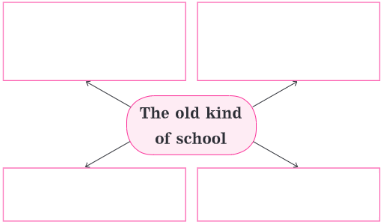
    Tommy looked at her with very superior eyes.“Because it’s not our kind of school, stupid. This is the old kind of school that they had hundreds and hundreds of years ago.” He added loftily, pronouncing the word carefully, “Centuries ago.”
    Margie was hurt. “Well, I don’t know what kind of school they had all that time ago.” She read the book over his shoulder for a while, then said, “Anyway, they had a teacher.”
    “Sure they had a teacher, but it wasn’t a regular teacher. It was a man.”
    “A man ? How could a man be a teacher ?” 
    “Well, he just told the boys and girls things and gave them homework and asked them questions.”
    “A man isn’t smart enough.”
    “Sure he is. My father knows as much as my teacher.”
     “He knows almost as much, I betcha.”
      Margie wasn’t prepared to dispute that. She said, “I wouldn’t want a strange man in my house to teach me.”  

A2. Complex Factual Activities:

Complete the web about the 'Old School', using the information told by Tommy.
Image
A3. Activities based on Vocabulary:
Write what the following sentences would mean today, and what they mean in the context of the story: 

Column 'A'

Column 'B'

(1) betcha

(a) in superior manner

(2) pronouncing

(b) to debate

(3) loftily

(c) expressing the word strongly

(4) dispute

(d) surely, bet you

A4. Activities based on Contextual Grammar:
Rewrite the following using complete words instead of contracted forms:
(1) That wasn't so bad.
(2) It's not the little girl's fault.
A5. Personal Response:
Do you like to take tests? Give the reason for your answer.