Question
A1. Simple Factual Activities:
Write down the relation between the characters given below: 
(1) Sycorax and Caliban - ___________
(2) Alonso and Sebastian - ___________

     Prospero was a great magician, for his life had been devoted to the study of magic. The power of his art enabled him to set free the imprisoned spirits, of whom Ariel was the chief. The spirits were so grateful to Prospero that they promised to be ever obedient to his will.
     In the woods nearby, Prospero found Caliban, a twisted, ugly monster. He was the son of Sycorax, the witch. Caliban became Prospero’s servant. Apart from being hideous and horrible in appearance, he was also vicious and brutal in his habits. No matter how hard he tired, Prospero could not make him change his ways for the better. And so it was Ariel’s job to see that he carried out his tasks properly.
      Time passed, and Miranda grew up to be a sweet and beautiful girl. The spirits of the island were loyal and faithful to Prospero, who ruled them wisely and well.
     Now, it came to pass that Alonso, king of Naples, his brother Sebastian and Antonio, the wicked brother of Prospero were sailing in a ship, close to the enchanted island. The ship was also carrying Prince Ferdinand of Naples, and the old, loyal courtier Gonzalo. The entire party was returning after the marriage celebrations of their Princess in a far-off kingdom.
     Knowing that his enemies were near his island, Prospero raised a great tempest with the power of his magic. The royal ship was turned and tossed on the stormy waves. It seemed as if it would sink any moment, along with all the people on board.

A2. Complex Factual Activity:
What good deed did Prospero do on the enchanted island? 
A3. Activities based on Vocabulary:
(1) disillusioned × ___________
(2) kindhearted × ___________
(3) thankless × ___________
(4) sympathetic × ___________
A4. Activities based on Contextual Grammar:
Identify the tense :
(1) The ship was carrying Prince Ferdinand of Naples.
(2) He had devoted his life to the study of magic.
A5. Personal Response:
Why did Prospero raise a great tempest?
Answer

A1. Simple Factual Activities:
(1) mother and son
(2) brothers
A2. Complex Factual Activities:
The enchanted island was under the spell of Sycorax, a dead witch. Prospero, set free all the imprisoned good spirits on that island and compelled them to follow his orders. Being a good magician, he could do it so all the spirits were grateful and obedient to him.
A3. Activities based on Vocabulary:

(1) disillusioned × enchanted
(2) kindhearted × vicious
(3) thankless × grateful
(4) sympathetic × brutal
A4. Activities based on Contextual Grammar: 
(1) Past Continuous Tense
(2) Past Perfect Tense
A5. Personal Response:
If I am left alone on an isolated island by my friends, first I will try to track the location with my mobile. Then I will send it to my parents and other faithful friends. If they get that location, they will definitely reach where I am and I would come out of that isolated island.

Need a full question paper?

Generate a complete, print-ready paper with questions like this in minutes — across 16+ boards, with answer keys.

Start Generating Free

Similar questions

A1. Simple Factual Activities:
Correct the following sentences using facts from the passage:
(1) The Greek armies and heroes always defeated the Trojans. 
(2) Both the enemies were eager to continue fighting.

     The fighting went on daily, but the siege did not end. On the one hand, the Greeks could not take the city, and on the other hand the Trojans could not force them to sail away. Every day the Trojans came out of their gates, and the Greeks came out of their tents and ships, and the fighting went on. Sometimes there were great battles between the two armies. Sometimes there were single fights between two great heroes. Sometimes the Trojans had the better of it and sometimes the Greeks. But still the fighting went on.
     Great heroes on both sides were killed in the course of the war. After leading the defence of his city for nine years, the brave Hector was at last killed by Achilles, whom none could resist. But Achilles himself was killed later on by a poisoned arrow that entered his heel, the only part of his body where he could be wounded. Still later, Paris himself was killed, also by a poisoned arrow. The Trojans were tired of being shut up in their city, and the Greeks were longing to see their homes again. But still the fighting went on.

A2. Complex Factual Activities:
(1) Who were the brave heroes on either side who were killed in the war? How? 
A3. Activities based on Vocabulary:
(1) Write the words related to war from the passage.
A4. Activities based on Contextual Grammar:
(1) The Trojans, too, fought hard. (Add a question tag.)
(2) Find the gerund from the sentence.
The fighting went on daily. 
A5. Personal Response:

Which of the following are the adverse effects of war? Tick ☑ in the given box:
(1) They lose peace in the land.   
(2) Thousands are wounded.  
(3) Soldiers enjoy fighting.
(4) Those who win the war become rich and famous.
A1. Simple Factual Activities:
Complete the following sentences using the information from the passage:
(1) The most popular beverage in the world is ______________.
(2) ______________ is an evergreen plant that grows in tropical and sub-tropical climates.
(3) Tea plants require at least ______________ cm of rainfall a year.
(4) The teas we buy are usually classified according to the ______________.

      Let us begin with a question : can you name the most widely consumed beverage in the world, after water?
      Perhaps many of you have guessed the answer : the most popular beverage in the world is tea - the fresh, aromatic brew with which people like to begin their day. It has a refreshing, astringent flavour. It is actually made by brewing, that is by infusing in boiling water, the leaves and shoots of a plant whose botanical name is the Camellia sinensis. The leaves are at first dried, cured and processed before they are packed and sold to us.
      Camellia sinensis is an evergreen plant that grows in tropical and sub-tropical climates. Tea plants require at least 100-125 cm of rainfall a year and prefer acidic soils. Many of the world’s best tea estates are located on hill slopes at elevations of up to 1500 metres : it is said that the tea plants grow slowly and acquire a richer flavour at this height.
      When the plants mature, only the top 1-2 inches of the plant are picked. These buds and leaves are called flushes. A new flush appears on the plant every seven to ten days during the peak growing season. Left to grow on its own, the tea plant may actually grow into a small tree. But in all tea gardens, the plants are pruned and kept at a height of about three feet (waist high) to enable easy plucking of the leaves. The teas we buy are usually classified according to their leaf size. Accordingly we have (1) Assam type of tea, characterised by the largest leaves; (2) China type, characterised by the smallest leaves; and (3) Cambod, characterised by leaves of intermediate size.
      We have three very distinct and different tea growing regions in India. Each of these regions is famous for the special type of tea it produces, which are unique in taste, aroma, strength and flavour. The three regions are : Darjeeling in North-Eastern India, Assam in far North-East India and Nilgiris in South India.

A2. Complex Factual Activities:
(1) Why are tea plants pruned? 
(2) How is tea the beverage made?
A3. Activities based on Vocabulary:
(1) List all the names of geographical places mentioned in the passage:
(2) List the qualities of the special type of tea.
A4. Activities based on Contextual Grammar:
(1) A new flush ______________ on the plant every seven to ten days. (appear/appears)
(2) Tea plants ______________ at least 100-125 cm of rainfall a year. (require/requires)
(3) Each of these regions ______________ famous for the specialtype of tea. (is/are)
(4) It ______________ said that the tea plants grow slowly. (are/is)
A5. Personal Response:
What are botanical names? How are they decided?
A1. Simple Factual Activities:
State whether the following statements are True or False:
Statements
(1) The huge wooden horse was an offering to the god of the sea.
(2) The man left by the Greeks told the false story of the horse.
(3) Their wise priest told the Trojans not to make a hole in the wall.
(4) The Greeks were tired of the long war and had sailed away.

     As they were wondering how the horse had been built and why it had been left behind, they found a Greek with his hands tied together lying under it. When the Trojans dragged him out, the man pretended to be very frightened of them. When he was commanded to tell them why the Greeks had gone and why they had left this horse behind, he pretended to tremble very much and refused to speak. When at last they threatened to kill him, he spoke and told them this false tale.
     “The Greeks are tired of the long war and have sailed away in their ships,” he said. “But they are afraid of the long voyage home too, and so they have made this horse and left it as an offering to the god of the sea. They wanted also to kill me and offer me as a sacrifice to the sea-god; but I escaped and hid from them.”
      “But why did the Greeks make such a huge horse ?” some of the Trojans asked. And the cunning Greek made this reply : “If they had made a smaller offering, you might have taken it into your city. Then the luck would have gone to the Trojans and not to the Greeks. That is why they made it too big to go inside your gates.”
     The Trojans were delighted to hear this. “The Greeks have gone,” they said, “and the walls are no longer necessary. Let us make a hole in the wall and drag the horse in.”
     Their wise priest warned them not to do so. “It may be a trick that will ruin us,” he said. “You will bring disaster on the city if you break down the walls.” But they were so excited that they paid no attention to his words. They broke down part of their strong wall in order to drag the horse in.
     All that day the Trojans feasted and drank and celebrated. After all their celebrations, they went to sleep and slept soundly. But that day of rejoicing was soon followed by a night of terror and death.ss

A2. Complex Factual Activities:
Put the following events in the order in which they took place. Number them accordingly:
(1) The priest warned the Trojans not to break the wall.
(2) The Trojans found a Greek man under the big wooden horse.
(3) They broke down a part of the wall and brought the horse in.
(4) The Trojans slept soundly.
A3. Activities based on Vocabulary:
Write the meaningful sentences from the jumbled words:
(1) the Greeks did a large such Why horse make?
(2) wise their them priest warned not so to do.
A4. Activities based on Contextual Grammar:
Read the following constructions carefully and then use them to express your ideas:
(1) They went to sleep. (Write the sentence in past progressive tense.)
(2) Why did the Greeks make such a huge horse? (Rewrite the sentence using past perfect tense.)
A5. Personal Response:
Was the big wooden horse really an offering to the god of the sea? 
A1. Simple Factual Activities:
Read the sentences and fill in the blanks with correct alternatives:
(1) The County Inspector was a round little man with a red face.
(a) The teacher   (b) The County Inspector
(2) Margie hated most was the slot where she had to put homework and test papers.
(a) the teacher    (b) the slot

    He was a round little man with a red face and a whole box of tools with dials and wires. He smiled at Margie and gave her an apple, then took the teacher apart. Margie had hoped he wouldn’t know how to put it together again, but he knew how all right, and, after an hour or so, there it was again, large and black and ugly, with a big screen on which all the lessons were shown and the questions were asked. That wasn’t so bad. The part Margie hated most was the slot where she had to put homework and test papers. She always had to write them out in a punch code they made her learn when she was six years old, and the mechanical teacher calculated the marks in no time.
    The Inspector had smiled after he was finished and patted Margie’s head. He said to her mother, “It’s not the little girl’s fault, Mrs Jones. I think the geography sector was geared a little too quick. Those things happen sometimes. I’ve slowed it up to an 
average ten-year level. Actually, the overall pattern of her progress is quite satisfactory.” And he patted Margie’s head again.
     Margie was disappointed. She had been hoping they would take the teacher away altogether. They had once taken Tommy’s teacher away for nearly a month because the history sector had blanked out completely.

A2. Complex Factual Activities:
Arrange the following in order of occurrence: 
(1) She wrote them out in a punch code.
(2) All the lessons were shown and questions were asked on the screen.
(3) The County Inspector took the teacher apart and then put it together again.
(4) The mechanical teacher calculated the marks.
A3. Activities based on Vocabulary:
Write what the following sentences would mean today, and what they mean in the context of the story: 
(1) She had been hoping they would take the teacher away altogether.
A4. Activities based on Contextual Grammar:

Rewrite the following using complete words instead of contracted forms:
(1) I've slowed it up.
(2) He wouldn't know.
A5. Personal Response:
Do you like to take tests? Give the reason for your answer.
A1. Simple Factual Activities:
Complete the following sentences:
(1) The mortar-maker's family comprised of ______________.
(2) According to the mortar-maker excess water poured down into ______________.

King : Summon the mortar-maker at once. He must pay with his life for his thoughtlessness.
(First Guard exits and returns with the mortar-maker who rushes and throws himself before the king.)
Mortar-maker : (wailing loudly) Forgive me, O Merciful King. Please do not hang me to death. I have a wife and two young children. Who will look after them ?
King : Your carelessness has cost a life. You must pay with your life.
Mortar-maker : No... no... no, my Royal Lord. I am not to blame. The pot which I used to pour water into the mortar had an extra-ordinarily large mouth. So excess water poured down into the mortar mixture. I was helpless. It is the potter’s fault for making such a useless pot.
King : Let the potter be brought here at once. He must be executed for moulding such useless pots.
(Fourth Guard leaves and re-enters with the potter.)
Potter : (cowering before the king) Your Majesty, show mercy to this humble potter. I agree the pot I made and sold to the mortar-maker was a defective one. But I am not guilty. As I was moulding that pot, I heard the sweet delicate tinkling of anklets. It was the money-lender’s daughter. She distracted me just as I was shaping the mouth and it became too wide.
King : Bring the money-lender’s daughter here, this very instant. She must be sent to the gallows for disturbing this poor potter at work.
(First Guard leaves and enters with the money-lender and his daughter.)
Money-lender : (in a desperate voice) O Just King ! Spare my daughter. She is my only child and to be wedded next Monday.
Daughter : Oh, do not fret, father. The king will not hang me. (To the king) Your Most Esteemed 
Highness, I rarely step outside the threshold of my home. But as my father said, I am to be married next week and my jewellery is not ready. I had to go to the goldsmith’s shop to urge him to work faster and hand over my ornaments on time ... The potter’s shop is on the way. I could not help it. It is all the goldsmith’s fault. Had he delivered my ornaments on time. I would not have been forced to go past the potter’s shop.
King : Then send for the goldsmith and without any delay, he must be hanged.

A2. Complex Factual Activities:
(1) Is the Daughter's complaint about the Goldsmith true? 
A3. Activities based on Vocabulary:
(1) Find out minimum four infinitives from the passage:
A4. Activities based on Contextual Grammar:
Read the following sentences and separate the subject and the verb in each:

SentenceSubjectverb
 (1) You are a stranger.  
 (2) I am a visitor here.  

A5. Personal Response:
Why is the daughter so confident that the king will not hang her? Does her prediction come true?

A1. Simple Factual Activities:
Complete the following sentences:
(1) The house in which the thief peered through the hole belonged to ______________.
(2) According to the merchant, ______________ had carelessly built the wall of his house.

King : Let the court begin !
Fourth Guard Messenger : The first complainant !
Thief : (rushes forward and wails loudly) Justice ! Oh, Most Great King ! I beg for Justice.
King : And what is your complaint ?
Thief : In this great land of Andher Nagari, my friend and I have been truly hard-working honest thieves. All these years we have been true to our profession. And what is our reward ? Last night, with great efforts, we made a hole in the wall of a merchant’s house, when all his family were away. My friend peered through that hole into the house, when suddenly the wall collapsed (Wails louder).... and .... and my friend was instantly killed. I’ve lost my only friend and partner. O King ! It’s the merchant’s fault for living in a house with such weak walls.
King : Fetch the merchant at once. A life for life ! The merchant must be hanged ! (Third Guard leaves and returns with the merchant who bows before the king.)
Merchant : Mercy, O Noble King ! I had no intention of killing these skilled professionals. It is not my fault that the wall of my house collapsed. My house has been recently built. It is the fault of the bricklayer, who carelessly built such a weak wall.
King : Bring the careless bricklayer immediately. He must hang for his fault.
Bricklayer : O Most Kind Lord and King ! (kneeling to the king) Have mercy. I beg you, don’t send me to the gallows. I agree that I built the wall which collapsed and killed a man. But it was not due to my carelessness. The mortar which I used to lay the bricks was of very poor quality. There was too much of water mixed in it. It is entirely the mortar-maker’s fault.

A2. Complex Factual Activities:
(1) List the characters that have appeared so far in the passage. 
A3. Activities based on Vocabulary:
Pick out the verbs and state their kind:
(1) My friend peered through the hole.
(2) The merchant was living in a house.
A4. Activities based on Contextual Grammar:
(1) There was too much of water mixed in it. (Frame Verbal Questions)
(2) It is the fault of the bricklayer. He carelessly built such a weak wall.
(Combine the sentence with 'who')
A5. Personal Response:
If you had been the merchant, what would you have said? 
A1. Simple Factual Activity:
Complete the following sentences:
(1) The incident in the story has taken place on ______________.
(2) Their television screen must have had ______________.

      Margie even wrote about it that night in her diary. On the page headed 17 May 2157, she wrote, "Today Tommy found a real book!"
      It was a very old book. Margie's grandfather once said that when he was a little boy his grandfather told him that there was a time when all stories were printed on paper.
      They turned the pages, which were yellow and crinkly, and it was awfully funny to read words that stood still instead of moving the way they were supposed toon a screen, you know. And then when they turned back to the page before, it had the same words on it that it had when they read it the first time.
      "Gee," said Tommy, "what a waste! When you're through with the book, you just throw it away, I guess. Our television screen must have had a million books on it and it's good for plenty more. I wouldn't throw it away."

A2. Complex Factual Activity:
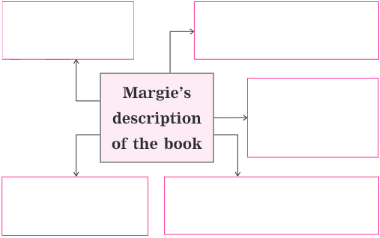
Complete the following web:
Image
A3. Activities based on Vocabulary:
Match the words in Column 'A' with their meaning in Column 'B':

Column 'A'

Column 'B'

(1) real

(a) very amusing

(2) crinkly

(b) exactly the one/ones referred to

(3) same

(c) having a lot of thin folds

(4) awfully funny

(d) genuine and not false

A4. Activities based on Contextual Grammar:
Write the following using complete words instead of contracted forms:
(1) ... when you're through.
(2) ... and it's good for plenty more.
A5. Personal Response:
About what did Tommy say, "What a waste!" Why do you think, did he say so?

A1. Simple Factual Activities:
Complete the sentences using the information given in the passage:
(1) The ___________ spurred a revolution.
(2) Davy and William Wollaston were trying to re-create ___________.

      Even then Davy did not have much hope for Faraday. Then Faraday got another chance to prove himself. One day Davy tried to re-create a famous electromagnetism experiment with fellow chemist William Wollaston, exploring why when an electric current is applied to a wire, it causes that wire to behave like a magnet. Obviously, the forces were connected but nobody had figured out how to make it happen continuously. Davy believed that if he could find out why it happened and controlled it, there could be many practical applications of the force. But he was unable to figure it out and was frustrated. He then teased Faraday, asking him to try his hand at it after he was done cleaning the lab.
       Within a few days, Faraday solved the problem In fact, he went further and the result was the first induction motor, which converted electrical current into continuous mechanical motion.
       The induction motor spurred a revolution. Fans air conditioning, sewing machines, photographs, power tools, cars and even trains and aeroplane engines grew out of this simple device which was born out of mockery directed at Faraday.

A2. Complex Factual Activity:
(1) What happens when an electric current is applied to a wire?
(2) An induction motor is a commonly used electrical machine. What examples of its use are given here? 
A3. Activities based on Vocabulary:
Write the words/phrases related to electricity from the passage.
A4. Activities based on Contextual Grammar:
Do as directed:
(1) Even then Davy did not have much hope for Faraday. (Choose the correct question tag.)
(a), didn't he? (b), have he? (c), does he? (d), did he?
(2) He needed an assistant.
(Frame a Wh-question to get the underlined part of the sentence as an answer.)
A5. Personal Response:
Even then Davy did not have much hope for Faraday.
A1. Simple Factual Activities:
Find the following matter in the passage and copy the missing words:
(1) When he was twelve, his mother was forced to take him out of school.
(2) One day he came across a book on electricity which had been sent to his master for binding.

     Michael Faraday is regarded as one of the most distinguished scientists and inventors of modern times, and his work on electricity is still a subject of study, in the form of Faraday’s Laws. But few know his inspirational life story, which is all about courage and fighting against the odds.
      Michael Faraday was born into a poverty-stricken family in a dirty London suburb. He suffered from a speech defect as a child. He would pronounce ‘rabbit’ as ‘wabbit’. He could not even say his own name and would call himself ‘Fawaday’. Other children laughed at him and teachers did not help him either. When he was twelve, his mother was forced to take him out of school, thus putting an end to his formal education.
       At thirteen, however, he started working with a bookbinder, binding hundreds of books during the day and staying up all night to read them. Reading thus became his obsession. One day he came across a book on electricity which had been sent to his master for binding. He started reading it and was completely hooked. That was his first introduction to the subject of electricity, which soon became a lifelong fascination. Faraday was still poor at twenty-one. Once, a friend gave him a free ticket to a public lecture and demonstration by the renowned chemist Humphry Davy at London’s Royal Institution. Davy’s work on chemicals and electrical lighting was the subject of conversation among the scientists of that age. Seventy years later, across the Atlantic Ocean in the USA, the same work enabled Thomas Edison to produce the first consistent light bulb.

A2. Complex Factual Activities:
(1) What were the odds against Faraday in his childhood?
A3. Activities based on Vocabulary :
What is the meaning of the following sentences:
(1) Reading became his obsession.
(2) Electricity became his lifelong fascination.
A4. Activities based on Contextual Grammar:
Write any four words that begin with 're-' as a prefix;
A5. Personal Response:

(1) Write what is implied in the following sentence: 
But few know his inspirational life story, which is all about courage and fighting against the odds.
(What does it tell you about Faraday's life?)
A1. Simple Factual Activities:
Read the passage on 'Gond Art' carefully. Then complete the following sentences without going back to the passage:
(1) Gond art is a tribal ___________.
(2) The Gondi language is similar to Telugu, a Dravidian ___________.
(3) Originally people used to draw pictures on the earthen walls of their ___________.
(4) In folk arts, you yourself prepare the 'canvas' - the surface on which to draw and the colours with which you ___________.

      Gond art has spread mainly in Central India. Originally, people used to draw  pictures on the earthen walls of their houses. Most folk arts involve natural  techniques of preparing colours and use of several mediums. They are transferred  from generation to generation in a smoothly flowing process. Gond art is no  exception to this. A house decorated with beautiful pictures creates a pleasant  atmosphere. Also, art is a medium of recording and preserving what is seen.
     In folk arts, you yourself prepare the ‘canvas’ - the surface on which to draw and the colours with which you draw. That is why creating folk art is a very enriching experience.

A2. Complex Factual Activity:
Complete the following sentences:
(1) A house decorated with beautiful pictures creates _____________________.
(2) Creating folk art is ______________________.
(3) Gond art is developed and prepared by ______________________.
(4) Gond art has spread mainly in  ______________________.
A3. Activities based on Vocabulary:
Spot the error in the spelling and rewrite them correctly:
(1) mithology (2) tibel (3) midiam (4) erthen. 
A4. Activities based on Contextual Grammar:
Complete the following table with the help of the passage: 
AdjectiveAdverb
large___________
main___________
___________beautifully
___________traditionally
A5. Personal Response:
Write few sentences about your favourite art: