Question
A1. Simple Factual Activities:
State whether the following statements are Right or Wrong:
(1) We should have vision for today not tomorrow.
(2) If we close our eyes and feel the child inside us, we can listen to that child.
(3) Mahatına Gandhi, Nelson Mandela and Martin Luther King are calling on us.
(4) Satyarthi's vision of tomorrow is to see that cobbler's boy sitting with him in his classroom.

     As a child, I had a vision of tomorrow. A vision of that cobbler boy sitting with me in my classroom.
     Now, that tomorrow has become TODAY.
     I am TODAY, and you are TODAY. TODAY it is time for every child to have a right to life, right to freedom, right to health, right to education, right to safety, right to dignity, right to equality, and right to peace.
     TODAY, beyond the darkness, I see the smiling faces of our children in the blinking stars. TODAY, in every wave of every ocean, I see my children are playing and dancing. TODAY, in every plant, in every tree, and mountain, I see our children growing freely with dignity.
     Friends, I want you to see and feel this TODAY inside you.
     My dear sisters and brothers, as I said many interesting things are happening today. May I please request you to put your hand close to your heart - close your eyes and feel the child inside you?
     I am sure you can - Now, listen to that child.Listen please.
     Today, I see thousands of Mahatma Gandhis, Nelson Mandelas and Martin Luther Kings calling on us.
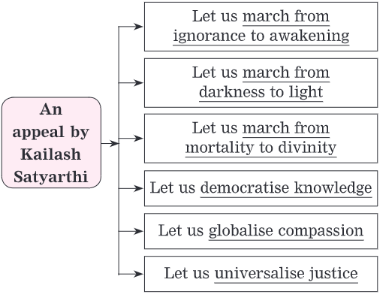
     Let us democratise knowledge. Let us universalise justice. Together, let us globalise compassion!
     I call upon you in this room, and all across the world. I call for a march from exploitation to education, I call for a march from poverty to shared prosperity, a march from slavery to liberty, and a march from violence to peace.
     Let us march from ignorance to awakening. Let us march from darkness to light. Let us march from mortality to divinity.
     Let us march!  

A2. Complex Factual Activities:
Complete the following web-chart :
Image
A3. Activities based on Vocabulary:
Write the infinitive forms of the following and use any two of them in your own sentences:
(1) dancing
(2) playing
(3) growing 
(4) happening 
A4. Activities based on Contextual Grammar:
Make nouns of the following:
(1) universal
(2) global
(3) knowledge
(4) exploitation
A5. Personal Response:
(1) What do you mean by 'Every child has a right to life'? 
Answer

A1. Simple Factual Activities:
(1) Right
(2) Right
(3) Right
(4) Right
A2. Complex Factual Activities:
Image
A3. Activities based on Vocabulary:
(1) dancing - to dance
(2) playing - to play
(3) growing - to grow
(4) happening - to happen
Sentences:
(1) Anish wanted to dance in the procession but his father did not allow him.
(2) It is our duty to grow more and more trees to save the planet Earth.
A4. Activities based on Contextual Grammar:
(1) universal - universalize
(2) global - globalize
(3) knowledge - know
(4) exploitation - exploit
A5. Personal Response:
(1) The right to life is a moral principle based on the belief that a human being has the right to live. Every child has some inherent right to life which is protected by laws. No one shall be arbitrarily deprived of his life. So it is our duty to protect every child and help him/her to live a happy and healthy life.

Need a full question paper?

Generate a complete, print-ready paper with questions like this in minutes — across 16+ boards, with answer keys.

Start Generating Free

Similar questions

A1. Simple Factual Activity:
Complete the following sentences:
(1) The inventory of the State Party is called _______________.
(2) Tentative List is included on the _______________ File.

     BECOMING A WORLD HERITAGE SITE
     There are five steps in becoming a World Heritage Site, the first of which is for a country or State Party to take an inventory of its significant cultural and natural sites. This is called the Tentative List and it is important because nominations to the World Heritage List will not be considered unless the nominated site was first included on the Tentative List. Next, countries are then able to select sites from their Tentative Lists to be included on a Nomination File. The third step is a review of the Nomination File by two Advisory Bodies consisting of the International Council on Monuments and Sites and the World Conservation Union, who then make recommendations to the World Heritage Committee. The World Heritage Committee meets once a year to review these recommendations and decide which sites will be added to the World Heritage List. The final step in becoming a World Heritage Site is determining whether or not a nominated site meets at least one of ten selection criteria. If the site meets these criteria, it can then be inscribed on the World Heritage List. Once a site goes through this process and is chosen, it remains the property of the country on whose territory it sits, but it also becomes considered within the international community.
 
A2. Complex Factual Activity:
Complete the following flow-chart by choosing from the options given below to show how any site of any country can become a World Heritage Site: 
(1) Inclusion of the name of a site from the tentative list to the nomination file.
(2) Name of the site is inscribed on the World Heritage list after meeting the criteria.
(3) Inclusion of the name of site for the nomination in a tentative list after an inventory in the country or the state.
(4) Decision of the World Heritage Committee after the review of the nominated file.
(5) A review of the file included by the advisory bodies.
A3. Activities based on Vocabulary:
Match the words in Column 'A' with their meanings in Column 'B':

 Column 'A' Column 'B'
 (1) inventory (a) fixed basis to judge
 (2) territory (b) suggestions
 (3) criteria (c) region
 (4) recommendations (d) a written list of material

A4. Activities based on Contextual Grammar:
Add a tailtag :
(1) There are five steps in becoming a World. Heritage Site, _______________?
(2) It remains the property of the country, ______________
A5. Personal Response:
(1) Why, do you think, should we preserve the World Heritage Sites?

A1. Simple Factual Activities:
State whether the following statements are Right or Wrong. Correct the wrong ones:
(i) The beggar and the young girl were playing on the road because there was a lot of traffic.
(ii) The scene of the beggar and the girl made Meena peep into her own life. 
(iii) The beggar became Meena's role model.
(iv) It took Meena almost two years to put the change into effect.

     ‘Yes, a beggar,’ she repeated, as if to reassure me. ‘He was old and used to stay in front of my house with his five-year old granddaughter. As you know, I was a chronic pessimist. I used to give my leftovers to this beggar every day. I never spoke to him. Nor did he speak to me. One monsoon day, I looked out of my bedroom window and started cursing the rain. I don’t know why I did that because I wasn’t even getting wet. That day I couldn’t give the beggar and his granddaughter their daily quota of leftovers. They went hungry, I am sure.
     ‘However, what I saw from my window surprised me. The beggar and the young girl were playing on the road because there was no traffic. They were laughing, clapping and screaming joyously, as if they were in paradise. Hunger and rain did not matter.They were totally drenched and totally happy. I envied their zest for life.
     ‘That scene forced me to look at my own life. I realized I had so many comforts, none of which they had. But they had the most important of all assets, one which I lacked. They knew how to be happy with life as it was. I felt ashamed of myself. I even started to make a list of what I had and what I did not have. I found I had more to be grateful for than most people could imagine. That day, I decided to change my attitude towards life, using the beggar as my role model.’
      After a long pause, I asked Meena how long it had taken her to change.
     ‘Once this realization dawned’, she said, ‘it took me almost two years to put the change into effect. Now nothing matters. I am always happy. I find happiness in every small thing, in every situation and in every person.’
     ‘Did you give any gurudakshina to your guru ?’ I asked.
     ‘No. Unfortunately, by the time I understood things, he was dead. But I sponsored his granddaughter to a boarding school as a mark of respect to him.’

A2. Complex Factual Activities:

(1) Meena sponsored the granddaughter of the beggar because _______________.
(a) she was alone in her life after his death.
(b) it was a token of respect to the beggar.
(c) she was rich and so she wanted to help.
(2) _______________ was the most important of all assets, that the beggar and his granddaughter had but the writer was lacking.
(a) Attitude towards life
(b) So many comforts
(c) Hunger. 
A3. Activities based on Vocabulary:
Match the synonyms:

Column 'A'Column 'B'
 (1) paradise (a) enthusiasm
 (2) zest (b) valuable thing
 (3) asset (c) wet
 (4) drenched (d) heaven

A4. Activities based on Contextual Grammar:
(1) Do as directed:
He used to stay in front of my house.
(Rewrite the sentence by using 'would'.)
(2) Change the voice:
That scene forced me to look at my own life.
(Begin the sentence with "I .....)
A5. Personal Response:
(1) According to you, how can we help beggars?

A1. Simple Factual Activity:
Who said to whom?
(1) "The bird has flown!"
(2) "The Pipalnagar Bank is about to collapse."

     ‘What’s that?’ said Kamal Kishore, sitting up suddenly. ‘Which bank?’
     ‘Why the Pipalnagar bank of course. I hear they have stopped paying employees. Don’t tell me you have an account there, Mr. Kishore?’
     ‘No, but my neighbour has!’ he exclaimed; and he called out over the low partition to the keeper of the barber shop next door. ‘Deep Chand, have you heard the latest? The Pipalnagar Bank is about to collapse. You’d better get your money out as soon as you can!’
     Deep Chand who was cutting the hair of an elderly gentleman, was so startled that his hand shook and he nicked his customer’s right ear. The customer yelped with pain and distress: pain, because of the cut and distress because of the awful news he
had just heard. With one side of his neck still unshaven, he sped across the road to the general merchant’s store where there was a telephone. He dialled Seth Govind Ram’s number. The Seth was not at home. Where was he, then? The Seth was holidaying in Kashmir. Oh, was that so? The elderly gentleman did not believe it. He hurried back to the barber’s shop and told Deep Chand: ‘The bird has flown! Seth Govind Ram has left town. Definitely, it means a collapse.’ And then he dashed out of the shop, making a beeline for his office and chequebook.
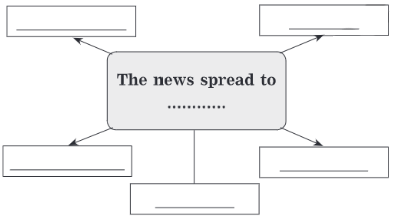
    The news spread through the bazaar with the rapidity of forest fire. From the general merchant’s it travelled to the shop, circulated amongst the customers, and then spread with them in various directions, to the betel-seller, the tailor, the free vendor, the jeweller, the beggar sitting on the pavement.   

A2. Complex Factual Activity:
Complete the web :
Image
A3. Activities based on Vocabulary:
Match the column with their meanings:

WordsMeanings
 (1) beeline (a) state of being upset
 (2) pavement (b) the direct route
 (3) nicked (c) the road for the people to walk
 (4) distress (d) cut slightly

A4. Activities based on Contextual Grammar:
Do as directed:
(1) Mr Kishore said, "Deep Chand, have you heard the latest?" (Change into indirect speech.)
(2) The bird has flown. (Rewrite the sentence using Past Perfect Tense)
A5. Personal Response:
(1) Do you think that rumour spreads faster than fire? Support your answer in two to three lines.

A1. Simple Factual Activity:
Complete the following sentences with the information given in the passage:
(1) The man with crooked leg was _______________.
(2) Someone said that the Seth had hanged himself _______________.

    Old Ganpat the beggar, had a crooked leg. He had been squatting on the pavement for years, calling for alms. In the evening someone would come with a barrow and take him away. He had never been known to walk. But now, on learning that the bank was about to collapse, Ganpat astonished everyone, leaping to his feet and actually running at top speed in the direction of the bank. It soon became known that he had a thousand rupees in savings!
     Men stood in groups at street corners discussing the situation. Pipalnagar seldom had a crisis, seldom or never had floods, earthquakes or drought; and the imminent crash of the Pipalnagar Bank set everyone talking and speculating and rushing about in a frenzy. Some boasted of their farsightedness, congratulating themselves on having already taken out their money, or on never having put any in; others speculated on the reasons for the crash, putting it all down to excesses indulged in by Seth Govind Ram. The Seth had fled the State, said one. He had fled the country, said another. He was hiding in Pipalnagar, said a third. He had hanged himself from the tamarind tree, said a fourth, and had been found that morning by the sweeper-boy.
     By noon the small bank had gone through all; its ready cash, and the harassed manager was in a dilemma. Emergency funds could only be obtained from another bank some thirty miles distant, and he wasn’t sure he could persuade the crowd to wait
until then. And there was no way of contacting Seth Govind Ram on his houseboat in Kashmir. 

A2. Complex Factual Activity:
Complete the following sentences that tell you about Ganpat, the beggar:
(1) Ganpat was an old beggar who had a _______________.
(2) He had been _______________ for years.
A3. Activities based on Vocabulary:
Find the describing words for the following from the passage:
(1) fund (2) leg (3) manager (4) speed
A4. Activities based on Contextual Grammar:
(1) I must know the reason. You are late.
(Join the sentence with the word 'why'.)
(2) He was hiding in Pipalnagar.
(Rewrite the sentence using Simple Present Tense.)
A5. Personal Response:
(1) Have you ever heard a rumour that harmed people? Elaborate it.
A1. Simple Factual Activity:
State whether the following statements are True or False:
(1) The young seagull was not confident about the ability of his wings.
(2) The young seagull's parents guided and improved his siblings in the art of flying.
(3) The wings of the young seagull were not as short as his own.
(4) The whole family of seagulls commended him for his cowardice.

     The young seagull was alone on his ledge. His two brothers and his sister had already flown away the day before. He had been afraid to fly with them. Somehow when he had taken a little run forward to the brink of the ledge and attempted to flap his
wings he became afraid. The great expanse of sea stretched down beneath, and it was such a long way down - miles down. He felt certain that his wings would never support him; so he bent his head and ran away back to the little hole under the ledge where he slept at night. Even when each of his brothers and his little sister, whose wings were far
shorter than his own, ran to the brink, flapped their wings, and flew away, he failed to muster up courage to take that plunge which appeared to him so desperate. His father and mother had come around calling to him shrilly, upbraiding him, threatening to let him starve on his ledge unless he flew away. But for the life of him he could not move.
      That was twenty-four hours ago. Since then nobody had come near him. The day before, all day long, he had watched his parents flying about with his brothers and sister, perfecting them in the art of flight, teaching them how to skim the waves and how to dive for fish. He had, in fact, seen his older brother catch his first herring and devour it, standing on a rock, while his parents circled around raising a proud cackle. And all the morning the whole family had walked about on the big plateau midway down the opposite cliff taunting him for his cowardice.

A2. Complex Factual Activity:

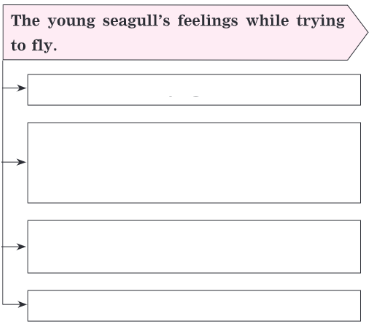
Complete the web describing the young seagull's feelings while trying to fly:
Image
A3. Activities based on Vocabulary:
Guess the meanings of :
(1) muster up courage
(2) eliff
(3) upbraiding
(4) brink
A4. Activities based on Contextual Grammar:
(1) He became afraid.
(2) Since then nobody had come near him.
A5. Personal Response:
(1) Are you afraid of playing any outdoor game? Explain why?
A1. Simple Factual Activities:
Choose the correct alternatives:
(1) What did Mary Kom prefer being called?
(a) Super mom    (b) Super woman
(c) Super being   (d) Super Boxer
(2) What would be a key factor in your conditioning for the Olympics? 
(a) saturated fats
(b) diet and nutrition
(c) trophies and medals

Interviewer :
Do you think interest in boxing in India will ever go beyond the Olympics ?
Mary Kom : Yes, I am sure that in a few years boxing will be very popular among everyone in India, all the year round.
Interviewer : How aware are Indian women of their nutritional requirements ? Diet and nutrition must’ve been a key factor in your conditioning for the Olympics. Do you think nutrition is a neglected area in Indian sports ?
Mary Kom : The awareness is growing now among the female athletes when it comes to nutritional requirements. Nutrition has definitely been a neglected area in Indian sports. I had to gain 3 kgs since I had to fight in the 51kg event instead of the usual 48kgs that I fight in. So I had to focus on what to eat. I gained weight by eating the right kind of healthy food rather than bad saturated fats.
Interviewer : How big a role did OGQ play in shaping the boxing scene in India for the better ?
Mary Kom : OGQ really played an important part in my success. They helped me out whenever I needed something. They took care of everything, which helped me focus on my boxing and kept me stress - free.
Interviewer : What’s your opinion on the future of Indian boxing ?
Mary Kom : The future is very bright and I am sure many more boxers will get medals for us.
Interviewer : Do you find it difficult to convince your children not to fight when they watch you go out and do it in style all the time ?
Mary Kom : Well, I have twins and yes, sometimes it becomes really difficult to keep them under control.
Interviewer : Will you train your kids to become boxers as well ?
Mary Kom : I haven’t really thought about it. As of now, just let their mother box !
Interviewer : You have broken several stereotypes about the women in India by showing that women can compete with men in any field. But how good are you at the ‘traditional’ feminine activities like cooking ?
Mary Kom : Well, I am good at cooking and other household work too.
Interviewer : Would you be interested in coaching Indian women in boxing one day ?
Mary Kom : Let’s see. In the future, may be yes.
Interviewer : What do you prefer being called -Super Mom or Super Boxer ?
Mary Kom : I love being a mom. That’s the best thing that has ever happened to me. 
Awards and recognitions
• Arjuna Award (Boxing) in 2003
• Padma Shree (Sports) in 2006
• Contender for Rajiv Gandhi Khel Ratna Award in 2007
• People of the Year - Limca Book of Records in 2007
• CNN-IBN and Reliance Industries Real Heroes Award in 2008
• Pepsi MTV Youth, AIBA in 2008
• ‘Magnificent Mary’, AIBA in 2008
• Felicitation by Zomi Student’s Federation (ZSF) at New Lamka YPA Hall in 2008
• Rajiv Gandhi Khel Ratna award in 2009
• International Boxing Association’s Ambassador for Women’s Boxing in 2009
• Sportswoman of the year, Sahara Sports Award in 2010.

A2. Complex Factual Activities:
(1) What did OGQ do for Mary Kom? 
A3. Activities based on Vocabulary:
Find out opposite words for the following from the passage.
(1) hated ×
(2) fair ×
(3) Inclusive ×
(4) diffident ×
A4. Activities based on Contextual Grammar:
Underline the subordinate clause and state its kind:
(1) The male boxers were kind enough to practise with me, whenever I required them.
Kind: _______________
(2) I think more and more people should take up sports as a full-time career.
Kind: _______________
A5. Personal Response:
(1) Name some sportswomen you know:
A1. Simple Factual Activity:
Complete the sentences with the help of the information in the passage:
(1) The quality and quantity of energy we put forth, _______________.
(2) _______________ is a walk in the dark.

    Time-bound: Establish time parameters around each goal, as it will help increase focus and accountability. To reduce weight we know how to go about it. But without consistent time - bound action, it never becomes a reality. It may be exercise, diet and stress-free thoughts. All these have to be practised and implemented without hesitation, doubt or indifference, but within a deadline.
    Visions, wishes, intentions and dreams are all valuable. They spark off imagination and encourage us to define where we want to reach. In order to get there, however, we need to bring life images, down to earth and plan to execute our strategies. The quality and quantity of energy we put forth, directly impact the results. Life is something like a trumpet. If we don’t put anything in, we can’t get anything out.
     Success is a walk in the dark. Finding the right footing, precisely mastering the skills and getting to the next place, all depend on how we approach and
tackle the problem. The best way to get from where we are, to where we want to be is to find the footing of our next step. When we take the next step, it should support and hold us without a crack.

A2. Complex Factual Activity:

Pick out examples from the passage that support each of the following facts:
(a) Good results depend upon the quality and quantity of work put in.
(b) A time-limit should be set to achieve goals.
A3. Activities based on Vocabulary:
Classify the following words in their respective columns: 
ah, of, if, and, oh, from, we, but, it, hurrah

PronounPrepositionConjunctionInter- jection
    

A4. Activities based on Contextual Grammar:
(1) We need to bring life images. (Underline the infinitive.) 
(2) The next step should support and hold us without a crack.
(Choose the correct question tag.)
(a) should it? (b) don't it? (c) shouldn't it?
A5. Personal Response:
(1) 'If we don't put anything in, we can't get anything out.' Explain.

A1. Simple Factual Activities:
Make a list of the problems that we are facing and creating violence against children -

     I call upon all the governments, intergovernmental agencies, businesses, faith leaders, workers, teachers and NGOs, and each one of us, to put an end to all forms of violence against children. Slavery, trafficking, child marriages, child labour, sexual abuse, and illiteracy these things have no place in any civilised society.
     Friends, we can do this. Governments must make child - friendly policies, and invest in education and young people. Businesses must be more responsible, accountable and open to innovative partnerships.Intergovernmental agencies must work together to accelerate action. Global civil society must rise above the business-as-usual and fragmented agendas. Faith leaders and institutions, and all of us must stand with our children.
     We must be bold, we must be ambitious, and we must have the will. We must keep our promises. Over fifty years ago, on the first day of my school, I met a cobbler boy, my age sitting outside the gate of my school. I asked my teachers: “Why is he working outside? Why is he not with us in the school?” My teachers had no answer. One day, I
gathered the courage to ask the boys’ father. He said: “Sir, I have never thought about it. We are born to work.”
     His answer made me angry. It still makes me angry.

A2. Complex Factual Activities:
Complete the following sentences :
(1) Government should make _______________.
(2) _______________ and _______________ must stand with our children.
A3. Activities based on Vocabulary:
Find out the describing words used for the following noun and make your own sentences by using any combination:
(1) _______________ agencies
(2) _______________ partnership
A4. Activities based on Contextual Grammar:
Rewrite as indirect speech:
(1) I asked my teachers, "Why is he working outside? Why is he not with us in the school?"
(2) The boy's father said to the writer, "I have never thought about it. We are born to work."
A5. Personal Response:
(1) Why should the government invest in education and young people?
A1. Simple Factual Activities:
Who said to whom-
(1) "Now tell me your name."
(2) "Didn't I tell you? Now take this book."

     When the school bell rang. All the girls scurried out of the classroom. But Bholi dared not leave her corner. Her head still lowered. She kept on sobbing.
    ‘‘Bholi.’’
     The teacher’s voice was so soft and soothing! In all her life she had never been called like that. It touched her heart.
    ‘‘Get up.’’ said the teacher. It was not a command, but just a friendly suggestion. Bholi got up.
    ‘‘Now tell me your name.’’
     Sweat broke out over her whole body. Would her stammering tongue again disgrace her? For the sake  of this kind woman. However she decided to make an effort. She had such a soothing voice : she would not laugh at her.
    ‘‘Bh-Bh-Bho-Bho-,’’ she began to stammer.
    ‘‘Well done, well done.’’ The teacher encouraged her. ‘‘Come on now- the full name?’’
    ‘‘Bh-Bh-Bho-Bholi.’’ At last she was able to say it and felt relieved as if it was a great achievement.
    ‘‘Well done.’’ The teacher patted her affectionately and said. ‘‘Put the fear out of your heart and you will be able to speak like everyone else.’’
     Bholi looked up as if to ask. ‘Really?’
    ‘‘Yes, yes, it will be very easy. You just come to school everyday, will you come?’’
     Bholi nodded.
    ‘‘No. say it aloud.’’
    ‘‘Ye-Ye-Yes.’’ And Bholi herself was astonished that she had been able to say it.
    ‘‘Didn’t I tell you? Now take this book.’’
     The book was full of nice pictures and the pictures were in colour dog, cat, goat, house, parrot, tiger and a cow just like Lakshmi. And with every picture was a word in big black letters.
     ‘‘In one month you will be able to read this book. Then I will give you a bigger book, then a still bigger one. In time you will be more learned than anyone else in the village. Then no one will ever be able to laugh at you. People will listen to you with respect and you will be able to speak without the slightest stammer. Understand? Now go
home, and come back early tomorrow morning”
      Bholi felt as if suddenly all the bells in the village temple were ringing and the trees in front of the school house had blossomed into big red flowers. Her heart was throbbing with a new hope and a new life. 

A2. Complex Factual Activities:
(1) How would you describe the teacher's attitude towards Bholi? Give 3 to 4 points.
A3. Activities based on Vocabulary:
Complete the following sentences using the words given in the brackets:
(scurried, affectionately, a great achievement)
(1) After class, the students _______________ out for their lunch-break.
(2) My father always tries to solve my problem _______________.
A4. Activities based on Contextual Grammar:
Change the voice:
(1) The teacher patted her affectionately. (Begin the sentence with "She....)
(2) The teacher encouraged her. (Begin the sentence with "She....)
A5. Personal Response:
(1) Why does positive encouragement work better than criticism? 
A1. Simple Factual Activities:
Fill in the blanks:
(1) Ramlal had ________ sons and ________ daughters.
(2) All the children except Bholi were ________ and ________.

    Her name was Sulekha but since her childhood everyone had been calling her Bholi the simpleton.
    She was the fourth daughter of Numberdar Ramlal. When she was ten months old, she had fallen off the cot on her head and perhaps it had damaged some part of her brain. That was why she remained a backward child and came to be known
as Bholi, the simpleton.
     At birth the child was very fair and pretty. But when she was two years old, she had an attack of small pox. Only the eyes were saved. But the entire body was permanently disfigured by deep black pockmarks. Little Sulekha could not speak till she was five and when at last she learnt to speak, she stammered. The other children often made fun of
her and mimicked her. As a result, she talked very little.
     Ramlal had seven children, three sons and four daughters and the youngest of them was Bholi. It was a prosperous farmer’s household and there was plenty to eat and drink. All the children except Bholi were healthy and strong. The sons had been sent to
the city to study in schools and later in colleges. Of the daughters Radha, the eldest had already been married. The second daughter Mangla’s marriage had also been settled Ramlal would think of third Champa. They were good looking, healthy girls. And
it was not difficult to find bridegrooms for them.
     But Ramlal was worried about Bholi. She had neither good looks nor intelligence.
     Bholi was seven years old when Mangla was married. The same year a primary school for girls was opened in their village. The Tehsildar sahib came to perform its opening ceremony. He said to Ramlal, ‘‘As a revenue official you are the representative of the government in the village and so you must set an example to the villagers. You
must send your daughter to school.’’
      That night when Ramlal consulted his wife. She cried, ‘‘Are you crazy? If girls go to school, who will marry them?’’
      But Ramlal had not the courage to disobey the Tehsildar. At last his wife said, ‘‘I will tell you what to do. Send Bholi to school. As it is there is little chance of her getting married, with her ugly face and lack of sense. Let the teachers at school worry about her.’’

A2. Complex Factual Activities:
Give reasons:
(1) Little Sulekha used to talk very little because - _______________
A3. Activities based on Vocabulary:
Use the following phrases in the following sentences by making certain changes:
(to shout in terror, to pass on, to hand over)
(1) My sister _______________ a letter of apology to her class teacher.
(2) My father had the day off because he didn't want _______________ his flu to everyone in the office."
A4. Activities based on Contextual Grammar:
Do as directed:
(1) The child was very fair and pretty.
(Choose correct alternative to make it exclamatory.)
(a) What a fair and pretty the child was!
(b) How a fair and pretty the child was!
(c) How fair and pretty the child was!
(2) There was plenty to eat and drink.
(Pick out the infinitive.) 
A5. Personal Response:
(1) How do you feel on the first day of your school?