Question
A1. Simple Factual Activities:
State whether you Agree or Disagree with the following statements:
(1) Mary Kom's coach was allowed to accompany her during her preparation for Olympics
(2) Mary practised with male boxers in Pune
(3) Mary is the first Indian female boxer to win an Olympics medal for India
(4) Dodgy judging was not at all the part of the reason for her loss in the semi-finals.

     In an exclusive interview with Sportskeeda correspondent Taruka Srivastava, Olympic Bronze medalist Mary Kom talked about her preparation for the Olympics and her elation at winning a medal.
Interviewer : First things first- you’re the first Indian female boxer to win an Olympics medal for India. Has the feeling completely sunk in ?
Mary Kom : I am really happy with my achievement and yes it is yet to sink in. I am just so exhilarated.
Interviewer : You were the only female representative from India in boxing. Did that put additional pressure on you?
Mary Kom : No, not at all. I was pretty confident about myself. I knew.
Interviewer : Your coach Charles Atkinson was not allowed to accompany you to the Olympics. How did that affect your preparations ?
Mary Kom : Well I did miss him there but thankfully, we had already done our homework and I was well prepared.
Interviewer : During your preparations for the Olympics, you sparred with the male boxers of the Indian contigent. Who was your favourite sparring partner ?
Mary Kom : (Laughs) Well, I trained hard in Pune and the male boxers were kind enough to practise with me whenever I required them. To name a favourite would be unfair.
Interviewer : You were quoted saying “Adams was very clever, a counter - puncher but, although she carried power, she wasn’t very tactical. I was scoring but the judges were not pressing the buttons.” Do you think dodgy judging was part of the reason for
your loss in the semi - finals?
Mary Kom : Yes, I think some of the decisions were unfortunate and did not work to my benefit.
Interviewer : India managed just 6 medals in the 2012 Olympics even though we are a nation of 1.3 billion people. Where do you think a change is required to help us win medals that are proportionate with our population ?
Mary Kom : I think more and more people should take up sports as a full - time career if we want more gold medals. More corporates should come in and sponsor players so that the players don’t have any financial pressure and can just focus on their games.

A2. Complex Factual Activities:
(1) What can help Indian sportsmen to win more Olympic medals? 
A3. Activities based on Vocabulary:
Find out opposite words for the following from the passage.
(1) hated ×
(2) fair ×
(3) Inclusive ×
(4) diffident ×
A4. Activities based on Contextual Grammar:
Underline the subordinate clause and state its kind:
(1) The male boxers were kind enough to practise with me, whenever I required them.
Kind: _______________
(2) I think more and more people should take up sports as a full-time career.
Kind: _______________
A5. Personal Response:
(1) Name some sportswomen you know:
Answer

A1. Simple Factual Activities:
(1) Disagree
(2) Agree
(3) Agree
(4) Disagree
A2. Complex Factual Activities:
(1) More corporates should come in and sponsor players, so that the players don't have to face financial pressure and can just focus on their game. More and more people should take up sports as a full-time career if we want to win more gold medals. This can help Indian sportsmen to win more Olympic medals.
A3. Activities based on Vocabulary:
(1) hated × adored/admired
(2) fair × unfair
(3) Inclusive × exclusive
(4) diffident × confident
A4. Activities based on Contextual Grammar:
(1) The male boxers were kind enough to practise with me, whenever I required them.
Kind: Adverb clause of time
(2) I think more and more people should take up sports as a full-time career.
Kind: Noun clause.
A5. Personal Response:

(1) Saina Nehwal
(2) P.V. Sindhu
(3) Mithali Raj
(4) Geeta Phogat
(5) Sania Mirza
(6) Anjali Bhagwat

Need a full question paper?

Generate a complete, print-ready paper with questions like this in minutes — across 16+ boards, with answer keys.

Start Generating Free

Similar questions

A1. Simple Factual Activities:
Say whether the following statements are True or False:
(1) The baby langur sensed the presence of his mother.
(2) The mother langur was sitting on the floor of the coop.
(3) The writer cuddled the baby langur tightly in his bosom.
(4) The writer's attention was fixed on the revival of the baby langur.

    My attention was fixed on the revival of the baby langur. Suddenly, I had an uncanny feeling of being watched. I turned away from the coop and looked up. There sat the mother langur on our kitchen roof, watching every move I made. She simply sat there quietly, as if convinced that no harm was being done to her child.
   Meanwhile, the baby sensed the presence of his mother and started to sob and cry a little louder. I retreated from the door of the coop to allow the mother access to her baby.
    Immediately, the mother descended on the floor of the coop and picked up the baby in her arms. She gave the baby a thorough body inspection to check his injuries and then cuddled him tightly in her bosom. The baby found great solace in her caring arms. The mother sat still with the baby in her lap for a few minutes. It was almost as if she was pondering over her options and trying to figure out how she could keep the baby safe from further assault.

A2. Complex Factual Activities:
Complete the following:
(1) Mother langur simply sat quietly because _______________.
(2) The baby langur started to sob and cry because _______________.
 
A3. Activities based on Vocabulary:
Match the words in column 'A' with their meanings in column 'B':

 Column 'A'Column 'B'
 (1) to figure out (a) to find comfort and peace.
 (2) to ponder over (b) the act of checking with complete attention and care.
 (3) to find solace (c) to be able to think until you solve the problem.
 (4) thorough inspection (d) think over something deeply.

A4. Activities based on Contextual Grammar:
Do as directed:
(1) I turned away from the coop and looked up.
(Begin the sentence with - Turning ... and rewrite it.) 
(2) She gave the baby a thorough body inspection.
(Change the sentence into passive voice. Begin with The baby...)
A5. Personal Response:
(1) What is your mother's state of mind during your illness?

A1. Simple Factual Activities:
Complete the following sentences:
(1) Bholi's parents. were eager to accept Bishamber's proposal for marriage because they felt that _______________.
(2) _______________ were envious of her luck.

         Thus the years passed.
    The village became a small town. The little primary school became high school. There were now a cinema under a tin shed and a cotton ginning mill. The mail train began to stop at their railway station.
     One night, after dinner, Ramlal said to his wife, “Then, shall I accept Bishamber’s proposal?”
    “Yes, certainly” his wife said. “Bholi will be lucky to get such a well to do bridegroom. A big shop, a house of his own and I hear several thousands in the bank. Moreover, he is not asking for any dowry”.
    “That’s right, but he is not so young, you know -almost the same age as I am- and he also limps. Moreover, the children from his first wife are quite grown up”.
    “So what does it matter ?” his wife replied. “Forty five or fifty-it is no great age for a man. We are lucky that he is from another village and does not know about her pockmarks and her lack of sense. If we don’t accept this proposal, she may remain
unmarried all her life.”
    “Yes, but I wonder what Bholi will say”.
    “What will that witless one say ? She is like a dumb cow.”
    “May be you are right”, muttered Ramlal. In the other corner of the courtyard, Bholi lay awake on her cot, and listened to her parents’ whispered conversation.
     Bishamber Nath was a well - to - do grocer. He came with a big party of friends and relations with him for the wedding. A brass band playing a popular tune from an Indian film headed the procession, with the bridegroom riding a decorated horse. Ramlal was
overjoyed to see such pomp and splendour. He had never dreamt that his fourth daughter would have such a grand wedding. Bholi’s elder sisters who had come for the occasion were envious of her luck.
     When the auspicious moment came the priest said, “Bring the bride”. Bholi, clad in a red silken bridal dress, was led to bride’s place near the sacred fire.
    “Garland the bride,” one of his friends prompted Bishamber Nath.

A2. Complex Factual Activities:
(1) What were the drawbacks of Bishamber as a bridegroom? 
A3. Activities based on Vocabulary:
Find out synonyms from the passage for the following words: 
(1) fortunate
(2) surely
(3) senseless 
(4) jealous 
A4. Activities based on Contextual Grammar:
Change the following sentences in indirect speech:
(1) "What will that witless one say? She is like a dumb cow". "May be you are right," muttered Ramlal.
(2) "Yes, certainly," his wife said, "Bholi will be lucky to get such a well-to-do bridegroom."
A5. Personal Response:
(1) What is your opinion about Bholi's bridegroom? Should she get married to him?
A1. Simple Factual Activity:
State whether the following statements are Rumours or Facts:
(1) The manager told the customers to go home and come back next day.
(2) Nathu was disgusted to see the broken glass and  stonescluttering the steps.

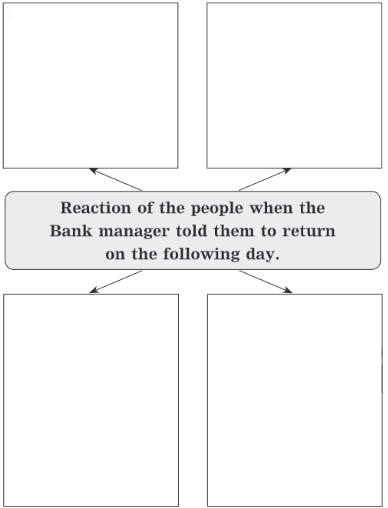
     People were turned back from the counters and told to return the following day. They did not like the sound of that. And so they gathered outside, on the steps of the bank shouting ‘Give us our money or we’ll break in!’ and ‘Fetch the Seth, we know he’s hiding in a safe deposit locker!’ Mischief makers who didn’t have a paisa in the bank, joined the crowd and aggravated their mood. The manager stood at the door and tried to placate them. He declared that the bank had plenty of money but no immediate means of collecting it; he urged them to go home and come back the next day.
    ‘We want it now!’ chanted some of the crowd.‘Now, now, now!’
     And a brick hurtled through the air and crashed through the plate glass window of the Pipalnagar Bank.
    Nathu arrived next morning to sweep the steps of the bank. He saw the refuse and the broken glass and the stones cluttering the steps. Raising his hands in a gesture of horror and disgust he cried: ‘Hooligans! Sons of donkeys! As though it isn’t bad enough to be paid late, it seems my work has also to be increased!’ He smote the steps with his broom scattering the refuse.
    Good morning, Nathu,’ said the washerman’sboy, getting down from his bicycle. ‘Are you ready to take up a new job from the first of next month? You’ll have to I suppose, now that the bank is going out of business.’
    ‘How’s that?’ said Nathu. ‘Haven’t you heard? Well you’d better wait here until half the population of Pipalnagar arrives to claim their money.’ And he waved cheerfully he did not have a bank account and sped away on his cycle.
     Nathu went back to sweeping the steps, muttering to himself. When he had finished his work, he sat down on the highest step, to await the arrival of the manager. He was determined to get his pay. ‘Who would have thought the bank would collapse!’ he said to himself, and looked thoughtfully into the distance. ‘I wonder how it could have happened …

A2. Complex Factual Activity:
Complete the web:
Image
A3. Activities based on Vocabulary:
Write one word for the following:
(1) a person who deliberately causes trouble to people.
(2) a person who washes clothes for other people.
A4. Activities based on Contextual Grammar:
Do as directed :
(1) Nathu raised his hands in a gesture of horror. He cried.
(Join the sentences beginning with the word 'Raising'.)
(2) He was determined to get his pay.
(Change the sentence into exclamatory sentence.)
A5. Personal Response:
(1) How are rumours spread? Are the rumours harmful? Why?/Why not? 
A1. Simple Factual Activities:
Complete the following sentences:
(1) Even though we have made progress in the last couple of decades, we are facing _______________ .
(2) _______________ gives a sense of global citizenship among the youth.

     We have made progress in the last couple of decades. We have reduced the number of out-ofschool children by half. We have reduced the number of child labourers by a third. We have reduced child mortality and malnutrition, and we have prevented millions of child deaths.
     But, let us make no mistake, great challenges still remain.
     Friends! The biggest challenge or biggest crisis knocking on the doors of humankind is fear and intolerance.
     We have utterly failed our children in imparting an education. An education that gives the meaning and objective of life. An education that gives a sense of global citizenship among the youth.
     I am afraid that the day is not very far away when the cumulative result of this failure, will culminate in an unprecedented violence, and that will be suicidal for humankind.
     Rights, security, hope can only be restored through education.
     Young people like Malala ... I’ve started calling her my daughter Malala not just Malala ... So my daughter Malala and other daughters including Kayanat.. in fact.. two Kayanats, and Shazia, and the daughters from Africa, and from all over the world. They are rising up and choosing peace over violence, tolerance over extremism, and courage over fear.
     The solutions are emerging. But these solutions cannot be found in the deliberations in conferences alone, and cannot be found in prescriptions from a distance.
     They lie in small groups and local organisations and individuals, who are confronting with the problem every day. Even if they remain unacknowledged, unrecognised and unknown to the world the solution are with them.

A2. Complex Factual Activities:

(1) What are the children's issues highlighted by Kailash Satyarthi in this passage? 
A3. Activities based on Vocabulary:
Choose the correct option and write in front of the given word:
(1) culminate : _______________
(A) destroy (B) succeed (C) rise to a peak
(2) crisis:  _______________
(A) unstable situation(B) problems (C) difficulty
A4. Activities based on Contextual Grammar:

Complete the following sentences with the help of the sentence given below:
The biggest challenge knocking on the doors of humankind is fear and intolerance.
(1) No other challenge knocking _______________ is as big as _______________.
(2) Fear and intolerance are bigger than  ______________________________.
A5. Personal Response:
(1) What efforts will you take to enrol the out-of-school out-of children? 
A1. Simple Factual Activity:
Complete the following sentences:
(1) The inventory of the State Party is called _______________.
(2) Tentative List is included on the _______________ File.

     BECOMING A WORLD HERITAGE SITE
     There are five steps in becoming a World Heritage Site, the first of which is for a country or State Party to take an inventory of its significant cultural and natural sites. This is called the Tentative List and it is important because nominations to the World Heritage List will not be considered unless the nominated site was first included on the Tentative List. Next, countries are then able to select sites from their Tentative Lists to be included on a Nomination File. The third step is a review of the Nomination File by two Advisory Bodies consisting of the International Council on Monuments and Sites and the World Conservation Union, who then make recommendations to the World Heritage Committee. The World Heritage Committee meets once a year to review these recommendations and decide which sites will be added to the World Heritage List. The final step in becoming a World Heritage Site is determining whether or not a nominated site meets at least one of ten selection criteria. If the site meets these criteria, it can then be inscribed on the World Heritage List. Once a site goes through this process and is chosen, it remains the property of the country on whose territory it sits, but it also becomes considered within the international community.
 
A2. Complex Factual Activity:
Complete the following flow-chart by choosing from the options given below to show how any site of any country can become a World Heritage Site: 
(1) Inclusion of the name of a site from the tentative list to the nomination file.
(2) Name of the site is inscribed on the World Heritage list after meeting the criteria.
(3) Inclusion of the name of site for the nomination in a tentative list after an inventory in the country or the state.
(4) Decision of the World Heritage Committee after the review of the nominated file.
(5) A review of the file included by the advisory bodies.
A3. Activities based on Vocabulary:
Match the words in Column 'A' with their meanings in Column 'B':

 Column 'A' Column 'B'
 (1) inventory (a) fixed basis to judge
 (2) territory (b) suggestions
 (3) criteria (c) region
 (4) recommendations (d) a written list of material

A4. Activities based on Contextual Grammar:
Add a tailtag :
(1) There are five steps in becoming a World. Heritage Site, _______________?
(2) It remains the property of the country, ______________
A5. Personal Response:
(1) Why, do you think, should we preserve the World Heritage Sites?

A1. Simple Factual Activities:
Complete the sentences:
(1) A tiny bird was rushing towards _________.
(2) A heavy fire had broken out in the _________.
(3) The speaker is appealing to globalise _________.
(4) The tiny bird was going to _________.

     We can do it ...
     You may ask that - what can one person do? I would recall a story of my childhood: A heavy fire had broken out in the forest. All the animals were running away, including lion, the king of the forest. Suddenly, then he saw a tiny bird rushing towards the fire. He asked the bird, “What are you doing?” To the lion’s surprise, the bird replied “I am going to extinguish the fire.” The lion laughed and said, “How can you do it keeping just one drop of water, in your beak?” The bird was adamant, and she said, “I am doing my bit.”
     Eighteen years ago, millions of individuals marched across the globe. And demanded a new international law for the abolition of worst form of child labour, and it has happened, we did it, millions of individuals did it.
     Friends! We live in an age of rapid globalisation. We are connected through high-speed Internet. We exchange our goods and services in one single global market. Thousands of flights every day connect us from one corner to another corner of the globe. But there is one serious disconnect and there is a lack of compassion. Let us inculcate and transform these individuals’ compassion into a global compassion.
Let us globalise compassion.
     Mahatma Gandhi said, “If we are to teach real peace in this world... we shall have to begin with the children.” I humbly add, let us unite the world through the compassion for our children.
     I ask - Whose children are they who stitch footballs, yet never played with one?
     Whose children are they who harvest cocoa, yet have never tasted chocolate?
     Whose children are they who are dying of Ebola?
     Whose children are they who are kidnapped and held hostage?
     They are all our children.
     I remember an eight-year-old girl we rescued from intergenerational forced labour from stone quarries. When she was sitting in my car right after her rescue, she asked me: “Why did you not come earlier?”
     Her angry question still shakes me – and has the power to shake the whole world. Her question is for all of us. What are we doing? What are we waiting for? How many girls will we allow to go without rescue?
     Children are questioning our inaction and watching our actions. We need collective actions with a sense of urgency.
     Every single minute matters, every single child matters, every single childhood matters.
     Therefore, I challenge the passivity and pessimism surrounding our children. I challenge this culture of silence and this culture of passivity, this culture of neutrality.

A2. Complex Factual Activities:

Complete the following web:
Image

A3. Activities based on Vocabulary:
(1) Use the word 'stitch' as a Noun and a Verb in separate meaningful sentences.
A4. Activities based on Contextual Grammar:
Add a question tag:
(1) We are connected through high-speed internet.
(2) We exchange our goods and services in one single global market.
A5. Personal Response:
(1) What lesson does the story of the lion and the tiny bird teach us? 
A1. Simple Factual Activities:
Name the following:
(1) Scientist who discovered the properties of uranium -
(2) Two radioactive elements discovered by Curies -
(3) An admirer of the Curies.
(4) A black, very hard and expensive substance.S

      Marie was specially interested in a substance called uranium which was obtained from pitchblende, a black, very hard and very expensive substance. Uranium was known to give off very powerful rays by which men could see through many substances. Now Marie discovered that what was left after obtaining uranium was even more powerful. Later on, Pierre and Marie found that there was not one, but two new substances giving off these rays although they had not yet been able to obtain either of them. They called one of them Polonium, in honour of her country. Poland and the other was called Radium. Radium is the most powerful of the radio-active elements. And radio-active elements can give off rays which can penetrate substances that are opaque to light. There was another French scientist called Henri Becquerel, who in 1896 had discovered that uranium possessed this property. But Polonium and Radium possessed radio-active in much higher degree.
     The Curies now began to work with greater enthusiasm, but they were poor and pitchblende itself was an extremely expensive substance, which they could not afford to buy in large quantity. They, however, sacrificed all the luxuries of life to save money to buy whatever little amount of pitchblende they could. They lived in utter penury, not buying costly food and warm clothes for the extremely cold Parisian winter. Often they could not sleep during the cold nights due to lack of warmth. Overwork seriously affected Madame Curie’s health. Often she was forced to leave the laboratory to take a much needed rest. Her husband begged her to give up the struggle, but she resolutely refused. Marie was driven by a mad determination to discover the mystery of radium. With courage she faced all the miseries of a life of poverty and carried on with her research along with her husband who loved and supported her.
      Luck, however, favoured the Curies and a windfall came to them. It was a gift of a ton of pitchblende from the emperor of Austria, who was an admirer of the Curies. It was the most precious gift the Curies had received and in their shabby laboratory they toiled along, boiled and burnt, overpowered by heat in summer and frozen with cold in winter.

A2. Complex Factual Activities:
(1) Which gift did she receive from the emperor of Austria? Why was it the most precious for them? 
A3. Activities based on Vocabulary:
Find out antonyms for the following from the passage:
(1) economical ×
(2) poverty × 
(3) chill × 
(4) worthless ×
A4. Activities based on Contextual Grammar:
Change the degree:
(1) Pitchblende is one of the most expensive substances.
A5. Personal Response:
(1) Which of the two scientists was greater than the other? Say why.
A1. Simple Factual Activity:
State whether the following statements are True or False:
(1) The young seagull was not confident about the ability of his wings.
(2) The young seagull's parents guided and improved his siblings in the art of flying.
(3) The wings of the young seagull were not as short as his own.
(4) The whole family of seagulls commended him for his cowardice.

     The young seagull was alone on his ledge. His two brothers and his sister had already flown away the day before. He had been afraid to fly with them. Somehow when he had taken a little run forward to the brink of the ledge and attempted to flap his
wings he became afraid. The great expanse of sea stretched down beneath, and it was such a long way down - miles down. He felt certain that his wings would never support him; so he bent his head and ran away back to the little hole under the ledge where he slept at night. Even when each of his brothers and his little sister, whose wings were far
shorter than his own, ran to the brink, flapped their wings, and flew away, he failed to muster up courage to take that plunge which appeared to him so desperate. His father and mother had come around calling to him shrilly, upbraiding him, threatening to let him starve on his ledge unless he flew away. But for the life of him he could not move.
      That was twenty-four hours ago. Since then nobody had come near him. The day before, all day long, he had watched his parents flying about with his brothers and sister, perfecting them in the art of flight, teaching them how to skim the waves and how to dive for fish. He had, in fact, seen his older brother catch his first herring and devour it, standing on a rock, while his parents circled around raising a proud cackle. And all the morning the whole family had walked about on the big plateau midway down the opposite cliff taunting him for his cowardice.

A2. Complex Factual Activity:

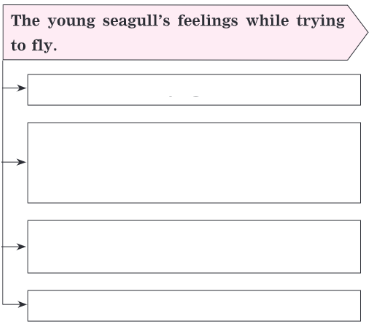
Complete the web describing the young seagull's feelings while trying to fly:
Image
A3. Activities based on Vocabulary:
Guess the meanings of :
(1) muster up courage
(2) eliff
(3) upbraiding
(4) brink
A4. Activities based on Contextual Grammar:
(1) He became afraid.
(2) Since then nobody had come near him.
A5. Personal Response:
(1) Are you afraid of playing any outdoor game? Explain why?
A1. Simple Factual Activity:
Complete the sentences with the help of the information in the passage:
(1) For reducing weight, exercise, diet and stress- free thoughts should be _______________.
(2) Vision, wishes, intentions and dreams spark off imagination and encourage us _______________.

    Time-bound: Establish time parameters around each goal, as it will help increase focus and accountability. To reduce weight we know how to go about it. But without consistent time - bound action, it never becomes a reality. It may be exercise, diet and stress-free thoughts. All these have to be practised and implemented without hesitation, doubt or indifference, but within a deadline.
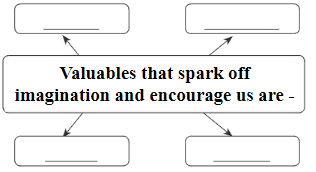
    Visions, wishes, intentions and dreams are all valuable. They spark off imagination and encourage us to define where we want to reach. In order to get there, however, we need to bring life images, down to earth and plan to execute our strategies. The quality and quantity of energy we put forth, directly impact the results. Life is something like a trumpet. If we don’t put anything in, we can’t get anything out.
     Success is a walk in the dark. Finding the right footing, precisely mastering the skills and getting to the next place, all depend on how we approach and
tackle the problem. The best way to get from where we are, to where we want to be is to find the footing of our next step. When we take the next step, it should support and hold us without a crack.

A2. Complex Factual Activity:

Complete the web: 
Image
A3. Activities based on Vocabulary:
Write antonyms for the following words :
(1) wrong ×
(2) decrease × 
(3) discourage × 
(4) light × 
A4. Activities based on Contextual Grammar:
(1) Establish time parameters around each goal. (Rewrite the sentence beginning with 'Let' and change the sentence into passive voice.)
(2) If we don't put anything in, we can't get anything out. (Rewrite the sentence using 'unless' in the beginning.)
A5. Personal Response:
(1) Write any four qualities of a successful person.
A1. Simple Factual Activities:
Answer in one word: 
(1) The motherland of Kailash Satyarthi
(2) The country which Iqbal Masih represents
(3) The place where Nobel Prize distribution programme was held
(4) The ancient texts of wisdom

     My dear children of the world ... Your Majesties, Your Royal Highnesses, Excellencies, distinguished members of the Norwegian Nobel Committee, dear brother Tom Harkin, brothers and sisters, and my dear daughter Malala.
      From this podium of peace and humanity, I am deeply honoured to recite a mantra from the ancient texts of wisdom, Vedas. This mantra carries a prayer, an aspiration and a resolve that has the potential to liberate humanity from all man-made crises.
      Let’s walk together. In the pursuit of global progress, not a single person should be left out or left behind in any corner of the world, from East to West, from South to North. Let’s speak together, let our minds come together! Learning from the experiences of our ancestors, let us together create knowledge for all that benefits all.
      I bow to my late parents, to my motherland India, and to the mother earth.
      With a warm heart I recall how thousands of times, I have been liberated, each time I have freed a child from slavery. In the first smile of freedom on their beautiful faces, I see the Gods smiling.
      I give the biggest credit of this honour to my movement’s Kaalu Kumar, Dhoom Das and Adarsh Kishore from India and Iqbal Masih from Pakistan who made the supreme sacrifice for protecting the freedom and dignity of children. I humbly accept this award on behalf of all such martyrs, my fellow activists across the world and my countrymen.
      My journey from the great land of Lord Buddha, Guru Nanak and Mahatma Gandhi; India to Norway is a connect between the two centres of global peace and brotherhood, ancient and modern.
      Friends, the Nobel Committee has generously invited me to present a “lecture.” Respectfully, I am unable to do that. Because, I am representing here - the sound of silence. The cry of innocence. And, the face of invisibility. I represent millions of those children who are left behind and that’s why I have kept an empty chair here as a reminder.

A2. Complex Factual Activities:
Complete the following sentences:
(1) The writer humbly accepts this award on behalf of all  _______________.
(2) The journey of the writer, that is India to Norway is a _______________.
A3. Activities based on Vocabulary:
Write the describing words for the following nouns from the passage:
(1) credit
(2) sacrifices
(3) chair
(4) pence
A4. Activities based on Contextual Grammar:
Make adjectives of:
(1) honour
(2) create
(3) silence
(4) peace
A5. Personal Response:
(1) Suggest any four ways to establish peace in the world.