Question
A1. Simple Factual Activity:
State whether the following statements are True or False:
(1) The young seagull was not confident about the ability of his wings.
(2) The young seagull's parents guided and improved his siblings in the art of flying.
(3) The wings of the young seagull were not as short as his own.
(4) The whole family of seagulls commended him for his cowardice.

     The young seagull was alone on his ledge. His two brothers and his sister had already flown away the day before. He had been afraid to fly with them. Somehow when he had taken a little run forward to the brink of the ledge and attempted to flap his
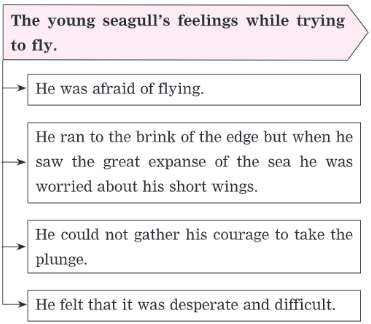
wings he became afraid. The great expanse of sea stretched down beneath, and it was such a long way down - miles down. He felt certain that his wings would never support him; so he bent his head and ran away back to the little hole under the ledge where he slept at night. Even when each of his brothers and his little sister, whose wings were far
shorter than his own, ran to the brink, flapped their wings, and flew away, he failed to muster up courage to take that plunge which appeared to him so desperate. His father and mother had come around calling to him shrilly, upbraiding him, threatening to let him starve on his ledge unless he flew away. But for the life of him he could not move.
      That was twenty-four hours ago. Since then nobody had come near him. The day before, all day long, he had watched his parents flying about with his brothers and sister, perfecting them in the art of flight, teaching them how to skim the waves and how to dive for fish. He had, in fact, seen his older brother catch his first herring and devour it, standing on a rock, while his parents circled around raising a proud cackle. And all the morning the whole family had walked about on the big plateau midway down the opposite cliff taunting him for his cowardice.

A2. Complex Factual Activity:

Complete the web describing the young seagull's feelings while trying to fly:
Image
A3. Activities based on Vocabulary:
Guess the meanings of :
(1) muster up courage
(2) eliff
(3) upbraiding
(4) brink
A4. Activities based on Contextual Grammar:
(1) He became afraid.
(2) Since then nobody had come near him.
A5. Personal Response:
(1) Are you afraid of playing any outdoor game? Explain why?
Answer

A1. Simple Factual Activity:
(1) True
(2) True
(3) False
(4) False
A2. Complex Factual Activities:
Image
A3. Activities based on Vocabulary:
(1) muster up courage -to gather courage
(2) eliff - a high steep face of a rock
(3) upbraiding -scolding
(4) brink -the edge of a steep place
A4. Activities based on Contextual Grammar:
(1) He became afraid. Simple Past Tense
(2) Since then nobody had come near him. Past Perfect Tense
A5. Personal Response:
(1) Yes, I am afraid of playing Kabbadi. It appears to me that it is a very rough and tough game. I am very much afraid of the injuries caused in it. I cannot endure the thought of injury. I believe that it is a game for only strong and hefty people.

Need a full question paper?

Generate a complete, print-ready paper with questions like this in minutes — across 16+ boards, with answer keys.

Start Generating Free

Similar questions

A1. Simple Factual Activities:
Name the following:
(1) Scientist who discovered the properties of uranium -
(2) Two radioactive elements discovered by Curies -
(3) An admirer of the Curies.
(4) A black, very hard and expensive substance.S

      Marie was specially interested in a substance called uranium which was obtained from pitchblende, a black, very hard and very expensive substance. Uranium was known to give off very powerful rays by which men could see through many substances. Now Marie discovered that what was left after obtaining uranium was even more powerful. Later on, Pierre and Marie found that there was not one, but two new substances giving off these rays although they had not yet been able to obtain either of them. They called one of them Polonium, in honour of her country. Poland and the other was called Radium. Radium is the most powerful of the radio-active elements. And radio-active elements can give off rays which can penetrate substances that are opaque to light. There was another French scientist called Henri Becquerel, who in 1896 had discovered that uranium possessed this property. But Polonium and Radium possessed radio-active in much higher degree.
     The Curies now began to work with greater enthusiasm, but they were poor and pitchblende itself was an extremely expensive substance, which they could not afford to buy in large quantity. They, however, sacrificed all the luxuries of life to save money to buy whatever little amount of pitchblende they could. They lived in utter penury, not buying costly food and warm clothes for the extremely cold Parisian winter. Often they could not sleep during the cold nights due to lack of warmth. Overwork seriously affected Madame Curie’s health. Often she was forced to leave the laboratory to take a much needed rest. Her husband begged her to give up the struggle, but she resolutely refused. Marie was driven by a mad determination to discover the mystery of radium. With courage she faced all the miseries of a life of poverty and carried on with her research along with her husband who loved and supported her.
      Luck, however, favoured the Curies and a windfall came to them. It was a gift of a ton of pitchblende from the emperor of Austria, who was an admirer of the Curies. It was the most precious gift the Curies had received and in their shabby laboratory they toiled along, boiled and burnt, overpowered by heat in summer and frozen with cold in winter.

A2. Complex Factual Activities:
(1) Which gift did she receive from the emperor of Austria? Why was it the most precious for them? 
A3. Activities based on Vocabulary:
Find out antonyms for the following from the passage:
(1) economical ×
(2) poverty × 
(3) chill × 
(4) worthless ×
A4. Activities based on Contextual Grammar:
Change the degree:
(1) Pitchblende is one of the most expensive substances.
A5. Personal Response:
(1) Which of the two scientists was greater than the other? Say why.
A1. Simple Factual Activities:
State who/what:
(1) Colours the entire sky.
(2) Takes new shapes with every passing moment,
(3) Makes trees dance.
(4) Changes its forın according to the dictates of the sun and the wind.

     We saw small bits of grass peeping through the small cracks in a concrete pavement. It left us thinking : however impossible things may look, there is always an opening...
     We saw a tree bare of all leaves in the cold winter months. We thought its chapter was over. But three months passed, spring set in and the tree was back to its green majesty once again, full of leaves, flowers, birds and life. What if we too had the conviction that, however difficult things are right now, it will not remain so for ever. Remember, this too shall pass.
     We saw an army of ants lugging a fly which was at least ten times the ant’s size. The ants organized themselves around the fly, lifted it on frail feelers and carried it to quite a distance. Their teamwork and perseverance were impressive. What if we too are consistent, organized, focused...Spider webs are delicate, yet very strong. A rainbow colours the entire sky. Oysters take in a grain of sand they open up with a pearl. Innumerable stars shine across the infinite sky. Clouds take new shapes with every passing moment. The wind makes trees dance with unhindered passion. Water, without hint of ego, changes its form according to the dictates of the sun and the wind. When we see a caterpillar turn into a butterfly, a flower turn into a fruit, we experience the alchemy of nature... we touch it and become gold ourselves.

A2. Complex Factual Activities:
(1) What are the alchemies of nature mentioned in the extract?
A3. Activities based on Vocabulary:
Match the pairs of antonyms:

 WordsAntonyms
 (1) impossible (a) easy
 (2) difficult (b) strong
 (3) delicate (c) forget
 (4) remember (d) possible

A4. Activities based on Contextual Grammar:
Identify the tenses:
(1) We saw an army of ants
(2) We experience the alchemy of nature
A5. Personal Response:
(1) 'Nature is our best teacher'-Explain.

A1. Simple Factual Activity:
State whether the following statements are Rumours or Facts:
(1) The manager told the customers to go home and come back next day.
(2) Nathu was disgusted to see the broken glass and  stonescluttering the steps.

     People were turned back from the counters and told to return the following day. They did not like the sound of that. And so they gathered outside, on the steps of the bank shouting ‘Give us our money or we’ll break in!’ and ‘Fetch the Seth, we know he’s hiding in a safe deposit locker!’ Mischief makers who didn’t have a paisa in the bank, joined the crowd and aggravated their mood. The manager stood at the door and tried to placate them. He declared that the bank had plenty of money but no immediate means of collecting it; he urged them to go home and come back the next day.
    ‘We want it now!’ chanted some of the crowd.‘Now, now, now!’
     And a brick hurtled through the air and crashed through the plate glass window of the Pipalnagar Bank.
    Nathu arrived next morning to sweep the steps of the bank. He saw the refuse and the broken glass and the stones cluttering the steps. Raising his hands in a gesture of horror and disgust he cried: ‘Hooligans! Sons of donkeys! As though it isn’t bad enough to be paid late, it seems my work has also to be increased!’ He smote the steps with his broom scattering the refuse.
    Good morning, Nathu,’ said the washerman’sboy, getting down from his bicycle. ‘Are you ready to take up a new job from the first of next month? You’ll have to I suppose, now that the bank is going out of business.’
    ‘How’s that?’ said Nathu. ‘Haven’t you heard? Well you’d better wait here until half the population of Pipalnagar arrives to claim their money.’ And he waved cheerfully he did not have a bank account and sped away on his cycle.
     Nathu went back to sweeping the steps, muttering to himself. When he had finished his work, he sat down on the highest step, to await the arrival of the manager. He was determined to get his pay. ‘Who would have thought the bank would collapse!’ he said to himself, and looked thoughtfully into the distance. ‘I wonder how it could have happened …

A2. Complex Factual Activity:
Complete the web:
Image
A3. Activities based on Vocabulary:
Write one word for the following:
(1) a person who deliberately causes trouble to people.
(2) a person who washes clothes for other people.
A4. Activities based on Contextual Grammar:
Do as directed :
(1) Nathu raised his hands in a gesture of horror. He cried.
(Join the sentences beginning with the word 'Raising'.)
(2) He was determined to get his pay.
(Change the sentence into exclamatory sentence.)
A5. Personal Response:
(1) How are rumours spread? Are the rumours harmful? Why?/Why not? 
A1. Simple Factual Activities:
Name the following:
(1) Military officer
(2) A peasant girl
(3) The oldest son of the King France
(4) The persons who Joan needed to free Orleans

    The war fought between England and France from 1337 to 1453 has come to be known as the Hundred Years War. Joan was a peasant girl born in eastern
France who led the French army to several victories during this war.
    This play begins at the time when all of northern France and some parts of the south-west were under foreign control. The English controlled some parts and the Burgundians controlled the others. The city of New Orleans, one of the few remaining French cities was held by the English. The year is 1429. Captain Robert de Baudricourt, a military officer is seated at the table. His steward stands facing him.
Robert : I told you to throw the girl out. You have fifty armed soldiers and dozens of strong servants to carry out my orders. Are they afraid of her ?
Steward : No sir, we are afraid of you, but she puts courage in us. She really doesn’t seem to be afraid of anything. Perhaps you could frighten her, sir.
Robert : (grimly) Perhaps, where is she now ?
Steward : Down in the courtyard, sir.
(Robert goes to the window and asks the soldiers to send the girl up)
(The girl enters. She is a well-built, strong country girl of 17 to 18 years. The squire’s glare neither frightens her nor stops her. She speaks confidently.)
Joan : Good morning, captain squire. You are to give me a horse and armour and some soldiers, and send me to the Dauphin.
Robert : This girl is mad. Why didn’t you tell me so, you blockhead ?
Steward : Sir, do not anger her. Give her what she wants.
Robert : I shall send you back to your father with orders to put you under lock and
key.
Joan : You think you will, squire. But it won’t happen that way. You said you would not see me. But here I am.
Robert : So, you are assuming that I’ll give
you what you want.
Joan : Yes, squire. (Continues busily) A horse will cost sixteen francs. It is a big
amount of money. But I can save it on the armour. I don’t need beautiful armour made to my measure. I can find a soldier’s armour that will fit me well enough. I shall not want many soldiers. The Dauphin will give me, all I need, to free Orleans.
Robert : (Shocked) To free Orleans !
Joan : (Simply) Yes, squire. Three men will be enough for you to send with me.
Polly and Jack have promised to come with me.
Robert : You mean Monsieur de Poulengey ?
Joan : Yes, Squire Jack will come willingly. He is a very kind gentleman, and gives me money to give to the poor. I think John Godsave will come, and Dick the Archer, and their servants, John of Honecourt and Julian. There will be no trouble for you, squire. I have arranged it all. You have only to give the order.

A2. Complex Factual Activities:
(1) Why had Joan wanted to meet the Captain Squire? 
A3. Activities based on Vocabulary:
Give one word for the following:
(1) A person of high rank
(2) A stupid person
(3) To take for granted
(4) Military unit consisting of armoured fighting vehicles
A4. Activities based on Contextual Grammar:
(1) He is a very kind gentleman. (Make it exclamatory.)
(2) She is a well-built strong country girl. (Make it exclamatory.)
A5. Personal Response:
(1) Describe any brave lady as Joan of Arc, from India who fought for her nation.
A1. Simple Factual Activities:
Answer in one word: 
(1) The motherland of Kailash Satyarthi
(2) The country which Iqbal Masih represents
(3) The place where Nobel Prize distribution programme was held
(4) The ancient texts of wisdom

     My dear children of the world ... Your Majesties, Your Royal Highnesses, Excellencies, distinguished members of the Norwegian Nobel Committee, dear brother Tom Harkin, brothers and sisters, and my dear daughter Malala.
      From this podium of peace and humanity, I am deeply honoured to recite a mantra from the ancient texts of wisdom, Vedas. This mantra carries a prayer, an aspiration and a resolve that has the potential to liberate humanity from all man-made crises.
      Let’s walk together. In the pursuit of global progress, not a single person should be left out or left behind in any corner of the world, from East to West, from South to North. Let’s speak together, let our minds come together! Learning from the experiences of our ancestors, let us together create knowledge for all that benefits all.
      I bow to my late parents, to my motherland India, and to the mother earth.
      With a warm heart I recall how thousands of times, I have been liberated, each time I have freed a child from slavery. In the first smile of freedom on their beautiful faces, I see the Gods smiling.
      I give the biggest credit of this honour to my movement’s Kaalu Kumar, Dhoom Das and Adarsh Kishore from India and Iqbal Masih from Pakistan who made the supreme sacrifice for protecting the freedom and dignity of children. I humbly accept this award on behalf of all such martyrs, my fellow activists across the world and my countrymen.
      My journey from the great land of Lord Buddha, Guru Nanak and Mahatma Gandhi; India to Norway is a connect between the two centres of global peace and brotherhood, ancient and modern.
      Friends, the Nobel Committee has generously invited me to present a “lecture.” Respectfully, I am unable to do that. Because, I am representing here - the sound of silence. The cry of innocence. And, the face of invisibility. I represent millions of those children who are left behind and that’s why I have kept an empty chair here as a reminder.

A2. Complex Factual Activities:
Complete the following sentences:
(1) The writer humbly accepts this award on behalf of all  _______________.
(2) The journey of the writer, that is India to Norway is a _______________.
A3. Activities based on Vocabulary:
Write the describing words for the following nouns from the passage:
(1) credit
(2) sacrifices
(3) chair
(4) pence
A4. Activities based on Contextual Grammar:
Make adjectives of:
(1) honour
(2) create
(3) silence
(4) peace
A5. Personal Response:
(1) Suggest any four ways to establish peace in the world.
A1. Simple Factual Activity:
Who am I? (Identify the character)
(1) I am the washerman's son. - _______________
(2) I am the sweeper. - _______________

    Nathu grumbled to himself as he swept the steps of the Pipalnagar Bank, owned by Seth Govind Ram. He used the small broom hurriedly and carelessly, and the dust, after rising in a cloud above his head settled down again on the steps. As Nathu was
banging his pan against a dustbin, Sitaram, the washerman’s son, passed by.
    Sitaram was on his delivery round. He had a bundle of freshly pressed clothes balanced on his head.
    ‘Don’t raise such dust!’ he called out to Nathu. ‘Are you annoyed because they are still refusing to pay you an extra two rupees a month?’
    ‘I don’t wish to talk about it,’ complained the sweeper-boy. ‘I haven’t even received my regular pay. And this is the twentieth of the month. Who would think a bank would hold up a poor man’s salary? As soon as I get my money, I’m off! Not another week I work in this place.’ And Nathu banged the pan against the dustbin several times, just
to emphasize his point and giving himself confidence.
    ‘Well, I wish you luck,’ said Sitaram. ‘I’ll keep a lookout for any jobs that might suit you.’ And he plodded barefoot along the road, the big bundle ofclothes hiding most of his head and shoulders.
     At the fourth home he visited, Sitaram heard the lady of the house mention that she was in need of a sweeper. Tying his bundle together, he said; ‘I know of a sweeper boy who’s looking for work. He can start from next month. He’s with the bank just now but they aren’t giving him his pay, and he wants to leave.’
    ‘Is that so?’ said Mrs. Srivastava. ‘Well, tell him to come and see me tomorrow.’ 

A2. Complex Factual Activity:
Arrange the following sentences as per their sequence occurred in the passage:
(1) Nathu complained about his irregular pay.
(2) Nathu used the small broom hurriedly.
(3) Sitaram called out to Nathu.
(4) Nathu grumbled as he swept the steps of the bank.
A3. Activities based on Vocabulary:

Cross out the odd man:
(1) sweeper, hooligan, beggar, declare, locker
(2) hurriedly, carelessly, salary, definitely, suddenly
(3) imminent, latest, pavement, awful, shocking
(4) morning, scattering, raising, collecting, shouting
A4. Activities based on Contextual Grammar:
(1) He called out to Nathu. (Rewrite the sentence in Past Continuous Tense.)
(2) Mrs Srivastava said, "Tell him to come and see me tomorrow." (Change into indirect speech.)
A5. Personal Response:
(1) What qualities do you find in Sitaram?
A1. Simple Factual Activity:
Complete the following sentences:
(1) The inventory of the State Party is called _______________.
(2) Tentative List is included on the _______________ File.

     BECOMING A WORLD HERITAGE SITE
     There are five steps in becoming a World Heritage Site, the first of which is for a country or State Party to take an inventory of its significant cultural and natural sites. This is called the Tentative List and it is important because nominations to the World Heritage List will not be considered unless the nominated site was first included on the Tentative List. Next, countries are then able to select sites from their Tentative Lists to be included on a Nomination File. The third step is a review of the Nomination File by two Advisory Bodies consisting of the International Council on Monuments and Sites and the World Conservation Union, who then make recommendations to the World Heritage Committee. The World Heritage Committee meets once a year to review these recommendations and decide which sites will be added to the World Heritage List. The final step in becoming a World Heritage Site is determining whether or not a nominated site meets at least one of ten selection criteria. If the site meets these criteria, it can then be inscribed on the World Heritage List. Once a site goes through this process and is chosen, it remains the property of the country on whose territory it sits, but it also becomes considered within the international community.
 
A2. Complex Factual Activity:
Complete the following flow-chart by choosing from the options given below to show how any site of any country can become a World Heritage Site: 
(1) Inclusion of the name of a site from the tentative list to the nomination file.
(2) Name of the site is inscribed on the World Heritage list after meeting the criteria.
(3) Inclusion of the name of site for the nomination in a tentative list after an inventory in the country or the state.
(4) Decision of the World Heritage Committee after the review of the nominated file.
(5) A review of the file included by the advisory bodies.
A3. Activities based on Vocabulary:
Match the words in Column 'A' with their meanings in Column 'B':

 Column 'A' Column 'B'
 (1) inventory (a) fixed basis to judge
 (2) territory (b) suggestions
 (3) criteria (c) region
 (4) recommendations (d) a written list of material

A4. Activities based on Contextual Grammar:
Add a tailtag :
(1) There are five steps in becoming a World. Heritage Site, _______________?
(2) It remains the property of the country, ______________
A5. Personal Response:
(1) Why, do you think, should we preserve the World Heritage Sites?

A1. Simple Factual Activity:
State whether you Agree or Disagree with the following statements:
(1) Swami is a close-mouthed little kid.
(2) Swami hated Mathematics even worse.

     A little bit about the book...
     Anything I mention about the book can be mistakenly understood as 'spoilers', so I would rather give a glance into the book without mentioning any events or plots of the story.
     Swami is a mischievous little kid of about 10 years old and living in the era where India was under the British rule... Like most kids of that age, Swami is a kid who cannot stay at one place and absolutely hates school, even worse Mathematics. School is his absolute nightmare. Anyway the story unfolds around the happenings of this kid and how he constantly gets into trouble and gets a good beating from his father.
      Swami is a talkative little kid and thinks that’s his way of facing life, talking himself out of everything. But he does learn the truth the harsh way. As many teens back then, all he wants to do is play under the sun, kick something, climb a tree, break something and harass somebody (unlike kids today!!!). This, in fact, was (and in most parts of India, still is) the life of a typical boy growing up. Technology isn’t big in a kid's life. All they want is to play havoc!!!
       In what ways is Swami a typical boy in his growing years ?
       In this regard, Narayan gets deeply into the workings of Swami’s ten year old mind, explaining exquisitely how he thinks and what his perspective of the world is. The reader does feel like Swami and gets very attached with the character as the story progresses. That's the magic of Narayan.

A2. Complex Factual Activity:
(1) Describe Swami's characteristics in 3-4 sentences. 
A3. Activities based on Vocabulary:
Underline the odd man:
(i) mentioning, happenings, everything, facing
(ii) mischievous, truth, talkative, typical
(iii) give, mention, stay, life
(iv) constantly, absolutely, lovely, deeply
A4. Activities based on Contextual Grammar:
Frame Wh-questions to get the underlined parts as answers:
(1) Narayan gets deeply into the working of Swami's mind.
(2) That's the magic of Narayan.
A5. Personal Response:
(1) Do you think, that even today most of our kids like to live the life Swami was living?
A1. Simple Factual Activity:
Fill in the blanks and complete the sentences:
(1) The number of World Heritage Sites in 2009 were _______________.
(2) _______________ of the World Heritage Sites are considered mixed.

    TYPES OF WORLD HERITAGE SITES
    As of 2009, there are 890 World Heritage Sites that are located in 148 countries (map). 689 of these sites are cultural and include places like the Sydney Opera House in Australia and the Historic Center of Vienna in Austria. 176 are natural and feature such locations as the U.S.'s Yellowstone and Grand Canyon National Parks. 25 of the World Heritage Sites are considered mixed i.e. natural and cultural Peru's Machu Picchu is one of these. Italy has the highest number of World Heritage Sites with 44.
     India has 36 (28 cultural, 7 natural and 1 mixed) World Heritage Sites. The World Heritage Committee has divided the world’s countries into five geographic zones which include (1) Africa, (2) Arab States, (3) Asia Pacific (including Australia and Oceania), (4)
Europe and North America and (5) Latin America and the Caribbean.
     WORLD HERITAGE SITES IN DANGER
     Like many natural and historic cultural sites around the world, many World Heritage Sites are in danger of being destroyed or lost due to war, poaching, natural disasters like earthquakes, uncontrolled urbanization, heavy tourist traffic and environmental factors like air pollution and acid rain. World Heritage Sites that are in danger are inscribed on a separate List of World Heritage Sites in Danger which allows the World Heritage Committee to allocate resources from the World Heritage Fund to that site. In addition, different plans are put into place to protect and/or restore the site. If however, a site loses the characteristics which allowed for it to be originally included on the World Heritage List, the World Heritage Committee can choose to delete the site from the list. To learn more about World Heritage Sites, visit the World Heritage Centre’s website at whc.unesco.org.

A2. Complex Factual Activity:
Complete the following Web by giving reasons why World Heritage sites are in danger :
Image
A3. Activities based on Vocabulary:
Find from the passage the nouns of the following:
(1) locate 
(2) urbanize
(3) pollute
(4) add
A4. Activities based on Contextual Grammar:
Write the following sentences using 'not only... but also' and 'as well as' in two separate sentences:
(1) Opera House in Australia and the Historic Center of Vienna in Austria are cultural sites of the World Heritage.
A5. Personal Response:
(1) What is the role of the 'World Heritage Sites' in promoting tourism in any country?
A1. Simple Factual Activities:
Complete the following sentences:
(1) Meena was a _______________.
(2) The writer was caught in the rain at _______________.

     Meena is a good friend of mine. She is an LIC officer earning a good salary. But there was always something strange about her. She was forever unhappy. Whenever I met her, I would start to feel depressed. It was as though her gloom and cynicism had a way of spreading to others. She never had anything positive to say on any subject or about any person.      
     For instance, I might say to her, ‘Meena, did you know Rakesh has come first in his school ?’     
     Meena’s immediate response would be to belittle the achievement. ‘Naturally, his father is a school teacher’, she would say.      
     If I said, ‘Meena, Shwetha is a very beautiful girl, isn’t she ?’ Meena would be pessimistic. ‘When a pony is young, he looks handsome. It is age that matters. Wait for some time. Shwetha will be uglier than anyone you know.’      
     ‘Meena, it’s a beautiful day. Let’s go for a walk’. 
     ‘No, the sun is too hot and I get tired if I walk too much. Besides, who says walking is good for health ? There’s no proof.’
     That was Meena. She stayed alone in an apartment as her parents lived in Delhi. She was an only child and had the habit of complaining about anything and everything. Naturally, she wasn’t a very pleasant company and nobody wanted to visit her. Then one day, Meena was transferred to Bombay and soon we all forgot about her.
     Many years later, I found myself caught in the rain at Bombay’s Flora Fountain. It was pouring and I didn’t have an umbrella. I was standing near Akbarallys, a popular department store, waiting for the rain to subside. Suddenly, I spotted Meena. My first reaction was to run, even in that pouring rain. I was anxious to avoid being seen by her, having to listen to her never-ending complaints. However, I couldn’t escape. She had already seen me and caught hold of my hand warmly. What’s more, she was very cheerful.
     ‘Hey ! I am really excited. It’s nice to meet old friends. What are you doing here ?’
     I explained that I was in Bombay on an official work.

A2. Complex Factual Activities:
(1) Why would Meena be sad initially? Give reasons. Pick out sentences from the passage which prove that Meena was a pessimist.
A3. Activities based on Vocabulary:
Find antonyms of the following words from the passage:
(1) optimistic × 
(2) new × 
(3) drizzle × 
(4) ugly ×
A4. Activities based on Contextual Grammar:
Change the following sentences into indirect speech:
(1) "Meena, it's a beautiful day." I said.
(2) "Hey! I am really excited. It's nice to meet old friends. What are you doing here?" Meena said to the writer.
A5. Personal Response:
(1) If you have a friend like Meena, what would be your attitude towards her?