Question
A1. Simple Factual Activity:
Choose the correct alternative and complete the sentences: (2)
(1) The poet suggests to listen to _______________. (the sounds of animals/the sounds of life.)
(2) The poet suggests to speak to _______________. (unfamiliar people/parents)

If you do not travel,
If you do not read,
If you do not listen to the sounds of life,
If you do not appreciate yourself.
You start dying slowly...
When you kill your self-esteem;
When you do not let others help you.
You start dying slowly...
If you become a slave of your habits,
Walking everyday on the same paths…
If you do not change your routine,
If you do not wear different colours
Or you do not speak to those you don’t know.
You start dying slowly...

A2. Complex Factual Activity:
(1) What things can lead to slow death?  (2)
A3. Activities based on Poetic Devices:
Give your own rhyming words for the ollowing : (1)
(1) different   (2) same
Answer

A1. Simple Factual Activity:
(1) The poet suggests to listen to the sounds of life.
(2) The poet suggests to speak to unfamiliar people.

A2. Complex Factual Activity:
(1)    Following things can lead one to a slow death. If one ignores travelling, reading, listening to the sounds of life, knowing one's own qualities, keeping your self-respect, telling others to help you, then one can lead to slow death.
      Also, if one becomes a slave of one's habits, does the same things every day without changing the routine, wears the same colours, avoids speaking to strangers, one can lose his/her happy future.

A3. Activities based on Poetic Devices:
(1) different - colour
(2) same - paths

Need a full question paper?

Generate a complete, print-ready paper with questions like this in minutes — across 16+ boards, with answer keys.

Start Generating Free

Similar questions

A1. Simple Factual Activity:
Complete the following sentences : (2)
(1) The poet told the boy to join the others to play but he couldn't hear.
(2) The boy was watching the others play.

Later walking down the street, I saw a child with eyes of blue
He stood and watched the others play; it seemed he knew not what to do
I stopped a moment, then I said, why don’t you join the others dear”
He looked ahead without a word, and then I knew he could not hear
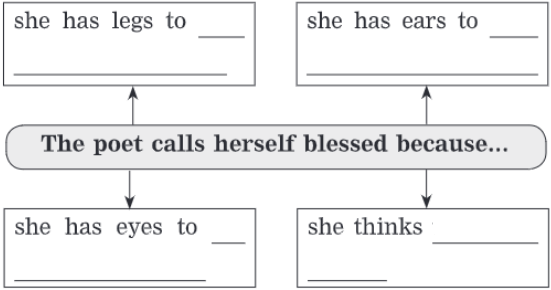
O God forgive me when I whine
I have two ears, the world is mine
With legs to take me where I’ll go
With eyes to see the sunset’s glow
With ears to hear what I would know
O God forgive me when I whine
I’m blessed, indeed, the world is mine

A2. Complex Factual Activity:
Complete the following web : (2)
Image

A3. Activities basedon Poetic Devices:
Write down rhyming pairs from the extract. (1)
A1. Simple Factual Activity:
Fill in the blanks and complete the following sentences: (2)
(1) The Captain lies _______________ on the deck.
(2) When the ship reached its home port he heard _______________ rejoicing and celebrating.

O Captain! My Captain! our fearful trip is done;
The ship has weather’d every rack, the prize we sought is won;
The port is near, the bells I hear, the people all exulting,
While follow eyes the steady keel, the vessel grim and daring:
  But O heart! heart! heart!
    O the bleeding drops of red,
       Where on the deck my Captain lies,
           Fallen cold and dead.

A2. Complex Factual Activity:
(1) Describe the grief that the speaker in the poem feels at the death of his Captain. (2)
A3. Activities basedon Poetic Devices:
Find from the extract one example of each of the following figure of speech : (1)
(1) Exclamation - 
(2) Antithesis - 
A1. Simple Factual Activity:
State whether the following statements are True or False: (2)
(1) The speaker expresses his relief that the ship has reached its home port.
(2) Captain's dead body is lying on the land.

O Captain! My Captain! our fearful trip is done;
The ship has weather’d every rack, the prize we sought is won;
The port is near, the bells I hear, the people all exulting,
While follow eyes the steady keel, the vessel grim and daring:
  But O heart! heart! heart!
    O the bleeding drops of red,
       Where on the deck my Captain lies,
           Fallen cold and dead.

A2. Complex Factual Activity:
(1) Describe the grief that the speaker in the poem feels at the death of his Captain. (2)
A3. Activities basedon Poetic Devices:
Complete the following sentences choosing from the alternatives: (1)
(1) The rhyme scheme of the given extract is _______________. (aabbccdd/abcdede/aabbcded)
(2) The line repeated in every stanza _______________. (O Captain! My Captain!/Fallen cold and dead)
A1. Simple Factual Activity:
Complete the following with the information given in the extract: (2)
(1) The twins were similar to each other in _______________.
(2) The speaker was christened as _______________.

In form and feature, face and limb,
I grew so like my brother,
That folks got taking me for him,
And each for one another.
It puzzled all our kith and kin,
It reached a fearful pitch;
For one of us was born a twin,
Yet not a soul knew which.
One day, to make the matter worse,
Before our names were fixed,
As we were being washed by nurse,
We got completely mixed;
And thus, you see, by fate’s decree,
Or rather nurse’s whim,
My brother John got christened me,
And I got christened him.

A2. Complex Factual Activity:
(1) Write any two lines from the extract that you find humorous. (2)
A3. Activities based on Poetic Devices: 
Write the rhyming words : (1)
(i) limb   (2) brother
A1. Simple Factual Activity:
State whether you agree or disagree with the following statements: (2)
(1) The narrator's brother asked the question fruitlessly - _______________
(2) According to the poet (narrator) he himself died - _______________
(3) The close resembelance between the twins turned the tide of the narrators domestic life - _______________
(4) John was always getting flogged because of the narrator's mistake - _______________

This fatal likeness even dogged
My footsteps, when at school,
And I was always getting flogged,
For John turned out a fool.
I put this question, fruitlessly,
To everyone I knew,
‘What would you do, if you were me,
To prove that you were you?’
Our close resemblance turned the tide
Of my domestic life,
For somehow, my intended bride
Became my brother's wife.
In fact, year after year the same
Absurd mistakes went on,
And when I died, the neighbours came
And buried brother John.

A2. Complex Factual Activity:
(1) Write any two lines from the poem, that you find most humorous. (2)
A3. Activities based on Poetic Devices:
Write the rhyming words for the following from the extract : (1)
(1) knew - _______________
(2) fruitlessly - _______________
A1. Simple Factual Activity:
Say whether the following pieces of advice by the poet are Right or Wrong: (2)
(1) Avoid strong feelings and their unsteady emotions.
(2) When you are not satisfied even then don't change your life.
(3) Go after your dream.
(4) Show the courage to risk something.

If you avoid to feel passion
And their turbulent emotions;
Those which make your eyes glisten
And your heart beat fast.
You start dying slowly...
If you do not change your life
when you are not satisfied with your job,
or with your love,
If you do not risk what is safe, for the uncertain,
If you do not go after a dream,
If you do not allow yourself,
At least once in your lifetime,
To run away from sensible advice…

A2. Complex Factual Activity:
(1) What is it that makes life worth living? Give four points : (2)
A3. Activities based on Poetic Devices:
Give your own rhyming words for : (1)
(1) job    (2) fast
A1. Simple Factual Activity:
(1) When the people around us doubt us, we should trust ourselves.
(2) We can dream but we should not be slave to our dreams.

A2. Complex Factual Activity:
(1)  The lines in the poem begin with 'If you can...' because the poet insistently wants to emphasise the importance of his good advice and attract his son's attention to every piece of advice given by him. The repetition of the lines has a musical effect.

A3. Activities based on Poetic Devices:
(1) Repetition: If you can dream and not make dreams your master.
(2) Metaphor: And stoop and rebuilt them up with worn-out tools.
A1. Simple Factual Activity:
Match the following sentences: (2)

'A''B'
 (1) We should treat two imposters (a) when others doubt us
 (2) We should trust ourselves (b) when others blame us
  (c) just the same

If you can keep your head when all about you
  Are losing theirs and blaming it on you;
If you can trust yourself when all men doubt you,
  But make allowance for their doubting too;
If you can wait and not be tired by waiting,
  Or, being lied about, don’t deal in lies,
Or being hated, don’t give way to hating,
  And yet don’t look too good, nor talk too wise:

If you can dream and not make dreams your master;
  If you can think and not make thoughts, your aim;
If you can meet with Triumph and Disaster
  And treat those two imposters just the same;
If you can bear to hear the truth, you’ve spoken,
  Twisted by knaves to make a trap for fools,
Or watch the things you gave your life to, broken,
  And stoop and build ’em up with worn-out tools:

A2. Complex Factual Activity:
(1) Look at the use of opposite reactions in this extract. For example, "If you can keep your head when all about you are losing theirs". Find four other such opposite reactions from the extract. (2)
A3. Activities based on Poetic Devices:
Identify the figures of speech used in the following lines : (1)
(Apostroph/ Simile/ Repetition/ Alliteration)
(1) "And yet don't look too good, nor talk too wise"
(2) With worn-out tools

A1. Simple Factual Activity:
Complete the following sentences : (2)
(1) The poet told the boy to join the others to play but he couldn't hear.
(2) The boy was watching the others play.

Later walking down the street, I saw a child with eyes of blue
He stood and watched the others play; it seemed he knew not what to do
I stopped a moment, then I said, why don’t you join the others dear”
He looked ahead without a word, and then I knew he could not hear
O God forgive me when I whine
I have two ears, the world is mine
With legs to take me where I’ll go
With eyes to see the sunset’s glow
With ears to hear what I would know
O God forgive me when I whine
I’m blessed, indeed, the world is mine

A2. Complex Factual Activity:

Column 'A'Column 'B'
 (1) The child who was watching the others play.... (a) forgive her.
 (2) The poet requests God to  (b) he was deaf.
  (c) could not hear the poet.

A3. Activities basedon Poetic Devices:
Pick out 2 lines from the extract that contain imagery. (1)