Question
A1. Simple Factual Activity:
State whether the following statements are True or False: (2)
(1) The speaker expresses his relief that the ship has reached its home port.
(2) Captain's dead body is lying on the land.

O Captain! My Captain! our fearful trip is done;
The ship has weather’d every rack, the prize we sought is won;
The port is near, the bells I hear, the people all exulting,
While follow eyes the steady keel, the vessel grim and daring:
  But O heart! heart! heart!
    O the bleeding drops of red,
       Where on the deck my Captain lies,
           Fallen cold and dead.

A2. Complex Factual Activity:
(1) Describe the grief that the speaker in the poem feels at the death of his Captain. (2)
A3. Activities basedon Poetic Devices:
Complete the following sentences choosing from the alternatives: (1)
(1) The rhyme scheme of the given extract is _______________. (aabbccdd/abcdede/aabbcded)
(2) The line repeated in every stanza _______________. (O Captain! My Captain!/Fallen cold and dead)
Answer

A1. Simple Factual Activity:
(1) True
(2) False

A2. Complex Factual Activity:
(1) When the speaker in the poem saw steady keel of the ship that seems serious and bold; his heart is suddenly filled with very strong emotion. He urged his captain to rise up and hear the bells. He told him to rise up because the flag is flung for him. For him the bugle sounds. For him people have brought bouquets and wreaths. People are crowding along the shore to welcome him. He felt very sad and lamented after seeing captain's dead body on the deck.

A3. Activities basedon Poetic Devices:
(1) The rhyme scheme of the given extract is aabbcded.
(2) The line repeated in every stanza fallen cold and dead.

Need a full question paper?

Generate a complete, print-ready paper with questions like this in minutes — across 16+ boards, with answer keys.

Start Generating Free

Similar questions

A1. Simple Factual Activity:
Fill in the blanks: (2)
(1) The poet tells his Captain to rise up and hear _______________.
(2) The Captain does not feel anything The Captain does not feel anything _______________.

O Captain! My Captain! rise up and hear the bells;
Rise up-for you the flag is flung-for you the bugle trills;
For you bouquets and ribbon'd wreaths-for you the shores a-crowding;
For you they call, the swaying mass, their eager faces turning;
 Here Captain! dear father!
   This arm beneath your head;
      It is some dream that on the deck,
         You've fallen cold and dead.
My Captain does not answer, his lips are pale and still;
My father does not feel my arm, he has no pulse nor will;
The ship is anchor'd safe and sound, its voyage closed and done;
From fearful trip, the victor ship, comes in with object won;
  Exult, O shores, and ring, O bells!
     But I, with mournful tread,
        Walk the deck my Captain lies,
           Fallen cold and dead.

A2. Complex Factual Activity:
Complete the following: (2)
(1) Captain does not feel anything because _______________.
(2) The ship is anchored _______________.
A3. Activities basedon Poetic Devices:
Complete the following choosing from the alternatives: (1)
(1) The steady rhythm in the poem consists of a pattern of _______________ beats. (three/four/five)
(2) In the _______________  stanza the speaker does not address the Captain. (first/second/third)
A1. Simple Factual Activity:
Complete the following sentences: (2)
(1) We can bear to hear the truth spoken by _______________.
(2) When all people around us are unable to act in a sensible way, we should _______________.

If you can keep your head when all about you
  Are losing theirs and blaming it on you;
If you can trust yourself when all men doubt you,
  But make allowance for their doubting too;
If you can wait and not be tired by waiting,
  Or, being lied about, don’t deal in lies,
Or being hated, don’t give way to hating,
  And yet don’t look too good, nor talk too wise:

If you can dream and not make dreams your master;
  If you can think and not make thoughts, your aim;
If you can meet with Triumph and Disaster
  And treat those two imposters just the same;
If you can bear to hear the truth, you’ve spoken,
  Twisted by knaves to make a trap for fools,
Or watch the things you gave your life to, broken,
  And stoop and build ’em up with worn-out tools:

A2. Complex Factual Activity:
Complete the following: (2)
(1) Say WHAT ....
the two imposters? 
(2) Say WHO.....
should you trust, when doubted? 

A3. Activities based on Poetic Devices:
Write down all musical pairs from the extract and add your own rhyming word for each of them. (1)

Musical pairsAdded rhyming word
  
  
A1. Simple Factual Activity:
Complete the following with the information given in the extract: (2)
(1) The twins were similar to each other in _______________.
(2) The speaker was christened as _______________.

In form and feature, face and limb,
I grew so like my brother,
That folks got taking me for him,
And each for one another.
It puzzled all our kith and kin,
It reached a fearful pitch;
For one of us was born a twin,
Yet not a soul knew which.
One day, to make the matter worse,
Before our names were fixed,
As we were being washed by nurse,
We got completely mixed;
And thus, you see, by fate’s decree,
Or rather nurse’s whim,
My brother John got christened me,
And I got christened him.

A2. Complex Factual Activity:
(1) Write any two lines from the extract that you find humorous. (2)
A3. Activities based on Poetic Devices: 
Write the rhyming words : (1)
(i) limb   (2) brother
A1. Simple Factual Activities:
Complete the following sentences:
(1) The speaker stops in _______________.
(2) _______________ season of the year is described in the poem.
(3) The time of the day described in the poem is _______________.
(4) The speaker is riding on his _______________.

Whose woods these are I think I know.
His house is in the village, though;
He will not see me stopping here
To watch his woods fill up with snow.
           My little horse must think it queer
           To stop without a farmhouse near
           Between the woods and frozen lake
           The darkest evening of the year.
He gives his harness bells a shake
To ask if there is some mistake.
The only other sound’s the sweep
Of easy wind and downy flake.
           The woods are lovely, dark and deep,
           But I have promises to keep,
           And miles to go before I sleep,
           And miles to go before I sleep.

A2. Complex Factual Activities:
Find out line/lines from the poem as a proof for the following explanation:
(1) There is no one to catch the speaker trespassing.
(2) The little horse draws his master's attention.
A3. Activities based on Vocabulary:
(1) Tell whether the rhyming scheme of the following stanzas is right or wrong. Give the correct rhyme scheme for the wrong one:
A1. Simple Factual Activity:
Complete the following sentences: (2)
(1) We should not lose the common touch even while walking _______________.
(2) _______________, neither foes nor loving friends can hurt us.

If you can talk with crowds and keep your virtue,
Or walk with Kings, nor lose the common touch;
If neither foes nor loving friends can hurt you,
If all men count with you, but none too much;
If you can fill the unforgiving minute
   With sixty seconds’ worth of distance run,
Yours is the Earth and everything that’s in it,
   And which is more you’ll be a Man, my son!

A2. Complex Factual Activity:
Complete the following: (2)
(1) Say WHAT ....
can the unforgiving minute be made up of?
(2) Say WHO.....
can you talk with and walk with?

A3. Activities based on Poetic Devices:
Find and write the rhyming pairs from the extract and add your own rhyming word for each of them : (1)
Rhyming pairsAdded rhyming word
  
  
A1. Simple Factual Activity:
Match the following sentences: (2)

'A''B'
 (1) We should treat two imposters (a) when others doubt us
 (2) We should trust ourselves (b) when others blame us
  (c) just the same

If you can keep your head when all about you
  Are losing theirs and blaming it on you;
If you can trust yourself when all men doubt you,
  But make allowance for their doubting too;
If you can wait and not be tired by waiting,
  Or, being lied about, don’t deal in lies,
Or being hated, don’t give way to hating,
  And yet don’t look too good, nor talk too wise:

If you can dream and not make dreams your master;
  If you can think and not make thoughts, your aim;
If you can meet with Triumph and Disaster
  And treat those two imposters just the same;
If you can bear to hear the truth, you’ve spoken,
  Twisted by knaves to make a trap for fools,
Or watch the things you gave your life to, broken,
  And stoop and build ’em up with worn-out tools:

A2. Complex Factual Activity:
(1) Look at the use of opposite reactions in this extract. For example, "If you can keep your head when all about you are losing theirs". Find four other such opposite reactions from the extract. (2)
A3. Activities based on Poetic Devices:
Identify the figures of speech used in the following lines : (1)
(Apostroph/ Simile/ Repetition/ Alliteration)
(1) "And yet don't look too good, nor talk too wise"
(2) With worn-out tools

A1. Simple Factual Activity:
Choose the correct alternative and complete the sentences: (2)
(1) The poet suggests to listen to _______________. (the sounds of animals/the sounds of life.)
(2) The poet suggests to speak to _______________. (unfamiliar people/parents)

If you do not travel,
If you do not read,
If you do not listen to the sounds of life,
If you do not appreciate yourself.
You start dying slowly...
When you kill your self-esteem;
When you do not let others help you.
You start dying slowly...
If you become a slave of your habits,
Walking everyday on the same paths…
If you do not change your routine,
If you do not wear different colours
Or you do not speak to those you don’t know.
You start dying slowly...

A2. Complex Factual Activity:
(1) What things can lead to slow death?  (2)
A3. Activities based on Poetic Devices:
Give your own rhyming words for the ollowing : (1)
(1) different   (2) same
A1. Simple Factual Activity:
Complete the following sentences : (2)
(1) The poet told the boy to join the others to play but he couldn't hear.
(2) The boy was watching the others play.

Later walking down the street, I saw a child with eyes of blue
He stood and watched the others play; it seemed he knew not what to do
I stopped a moment, then I said, why don’t you join the others dear”
He looked ahead without a word, and then I knew he could not hear
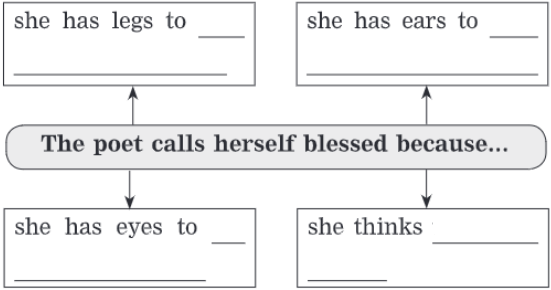
O God forgive me when I whine
I have two ears, the world is mine
With legs to take me where I’ll go
With eyes to see the sunset’s glow
With ears to hear what I would know
O God forgive me when I whine
I’m blessed, indeed, the world is mine

A2. Complex Factual Activity:
Complete the following web : (2)
Image

A3. Activities basedon Poetic Devices:
Write down rhyming pairs from the extract. (1)
A1. Simple Factual Activities:
Choose the correct alternatives: 
(1) The poet has stopped in the _______________. (village/city)
(2) The season of the year is _______________. (winter/summer)
(3) The time of the day is _______________. (evening/morning)
(4) Between the woods and the frozen _______________ is the darkest evening of the year. (lake/river)

Whose woods these are I think I know.
His house is in the village, though;
He will not see me stopping here
To watch his woods fill up with snow.
           My little horse must think it queer
           To stop without a farmhouse near
           Between the woods and frozen lake
           The darkest evening of the year.
He gives his harness bells a shake
To ask if there is some mistake.
The only other sound’s the sweep
Of easy wind and downy flake.
           The woods are lovely, dark and deep,
           But I have promises to keep,
           And miles to go before I sleep,
           And miles to go before I sleep.

A2. Complex Factual Activities:
(1) His horse seems anxious to stop.
(2) The speaker prefers to stay but is forced to move onwards.
A3. Activities based on Vocabulary:
Match the lines of the poem with their figures of speech:
Group 'A'Group 'B'
 (1) Whose woods these are I think I know (a) Alliteration
 (2) The woods are lovely, dark and deep. (b) Personification
 (3) And miles to go before I sleep
      And miles to go before I sleep.
 (c) Inversion
 (4) My little horse must think it queer (d) Repetition
A1. Simple Factual Activity:
Complete the following lines with the help of the poem: (2)
(1) The child wants a basketful of moonlight on _______________.
(2) The child wants to light the dark route so that _______________.

And he goes back early in the morning
while I am sleeping.
O moon
give me a basketful of moonlight
on loan.
I want to light the dark route
so that my father returns early.
I too want to hear fairy tales
and stories from him.
O moon,
give me a basketful of moonlight.
I want to sow seeds of moon
on the sides of the path.

A2. Complex Factual Activity:
Pick out and write the lines from the poem that prove the following: (2)
(1) Eager to hear fairy tales from his father.
(2) Remove darkness and bring light among the darker paths.
A3. Activities based on Poetic Devices:
Give your own rhyming words for the following : (1)
(1) dark    (2) sow