Question
A1. Simple Factual Activity:
Choose the correct alternatives from the given options:
(i) The Lucknow Express had picked up/not picked up speed.
(ii) Hari wanted to/did not want to stay at a hotel.
(iii) On discovering the theft, Anil would feel sad for the loss of his money/the loss of trust.
(iv) Hari had never bought/always bought a ticket in his life.

   When I reached the station I did not stop at the ticket office (I had never bought a ticket in my life.) but dashed straight to the platform. The Lucknow Express was just moving out. The train had still to pick up speed and I should have been able to jump into one of the carriages, but I hesitated — for some reason I can’t explain — and I lost the chance to get away.
   When the train had gone, I found myself standing alone on the deserted platform. I had no idea where to spend the night. I had no friends, believing that friends were more trouble than help. And I did not want to make anyone curious by staying at one of the small hotels near the station. The only person I knew really well was the man I had robbed. Leaving the station, I walked slowly through the bazaar.
    In my short career as a thief, I had made a study of men’s faces when they had lost their goods. The greedy man showed fear; the rich man showed anger; the poor man showed acceptance. But I knew that Anil’s face, when he discovered the theft, would show only a touch of sadness. Not for the loss of money, but for the loss of trust.
    I found myself in the maidan and sat down on a bench. The night was chilly — it was early November — and a light drizzle added to my discomfort. Soon it was raining quite heavily. My shirt and pyjamas stuck to my skin, and a cold wind blew the rain across my
face.
    I went back to the bazaar and sat down in the shelter of the clock tower. The clock showed midnight. I felt for the notes. They were damp from the rain.

A2. Complex Factual Activities:
Give reasons:

(i) Hari hesitated to board the train.
A3. Activities based on Vocabulary:
(1) Find from the passage the collocations for the following:
(i) ticket ...........  (ii) ............ slowly 
(2) Pick out 2 examples of code-mixing from the passage:
A4. Activities based on Contextual Grammar:
Frame Wh-questions to get the underlined answers: 
(i) I had made a study of men's faces.
(ii) The poor man showed acceptance.
A5. Personal Response:

(i) What is face-reading? Can you read faces?

Answer

A1. Simple Factual Activity:
(i) not picked up
(ii) did not want to
(iii) the loss of trust
(iv) never bought
A2. Complex Factual Activities:
Hari unconsciously felt that if he left Anil, he would lose something precious. That is why he hesitated to board the train which would take him away from Anil.
A3. Activities based on Vocabulary:
(1) (i) ticket office (ii) walked slowly
(2) Examples of code-mixing are bazaar, maidan.
A4. Activities based on Contextual Grammar:
(i) What had you made?
(ii) Who showed acceptance?
A5. Personal Response:
(i) Face-reading is observing the expressions and emotions on the faces of people and interpreting them correctly. I am observant and read faces quite well. I am trying to improve this ability.

Need a full question paper?

Generate a complete, print-ready paper with questions like this in minutes — across 16+ boards, with answer keys.

Start Generating Free

Similar questions

A1.Simple Simple l Factual Activities:
Fill in the blanks:
(i) Hawking claimed that he could think in ................ dimensions.
(ii) ................ is the study of the big. ................... is the study of the small.
(iii) .................. is a single unifying theory that can combine cosmology with quantum mechanics.

   Together these three books, along with Hawking’s own research and papers, articulate the physicist’s personal search for science’s Holy Grail: a single unifying theory that can combine cosmology (the study of the big) with quantum mechanics (the study of the small) to explain how the universe began. It’s this kind of ambitious thinking that has allowed Hawking, who claims he can think in 11 dimensions, to lay out some
big possibilities for humankind. He’s convinced that time travel is possible, and that humans may indeed colonize other planets in the future.
   In September 2010, Hawking spoke against the idea that God could have created the universe in his book The Grand Design. Hawking previously argued that belief in a creator could be compatible with modern scientific theories. His new work, however, concluded that the Big Bang was the inevitable consequence of the laws of physics and nothing more. “Because there is a law such as gravity, the universe can and will create itself from nothing,” Hawking said. “Spontaneous creation is the reason there is something rather than nothing, why the universe exists, why we exist.”  

A2. Complex Factual Activity:
(i) What is Hawking convinced of?
A3. Activity based on Vocabulary:
Write words ending in '-ity' using the words given:

(i) unify 
(ii) possible 
(iii) compatible 
(iv) inevitable
A4. Activities based on Contextual Grammar:
State the function of the underlined auxiliaries:
(i) Humans may colonize other planets in the future.
(ii) The universe can create itself from nothing.
A5. Personal Response:
(i) Do you believe that there is a God? Why?
A1.Simple Factual Activities:
Complete the following :
(i) Della had the good habit   ____________ .
(ii) Jim stared at Della   __________ .
(iii) Della took pride in the beauty of her hair __________ .
(iv) Della was a bit apprehensive after she had sold her hair because __________ .

   At 7 o’clock the coffee was made and the fryingpan was on the back of the stove hot and ready to cook the chops.
  Jim was never late. Della doubled the fob chain in her hand and sat on the corner of the table near the door that he always entered. Then she heard his step on the stair away down on the first flight, and she turned white for just a moment. She had a habit of saying little silent prayer about the simplest everyday things, and now she whispered: “Please God, make him think I am still pretty.”
  The door opened and Jim stepped in and closed it. He looked thin and very serious. Poor fellow, he was only twenty-two—and to be burdened with a family! He needed a new overcoat and he was without gloves.
  Jim stopped inside the door, as immovable as a setter at the scent of quail. His eyes were fixed upon Della, and there was an expression in them that she could not read, and it terrified her. It was not anger, nor surprise, nor disapproval, nor horror, nor any of the sentiments that she had been prepared for. He simply stared at her fixedly with that peculiar expression on his face.
   Della wriggled off the table and went for him.
   “Jim,” she cried, “don’t look at me that way. I had my hair cut off and sold because I couldn’t have lived through Christmas without giving you a present. It’ll grow out again—you won’t mind, will you? I just had to do it. My hair grows awfully fast. Say `Merry
Christmas!’ Jim, and let’s be happy. You don’t know what a nice—what a beautiful, nice gift I’ve got for you.”
 
A2. Complex Factual Activity:
Complete the web with words to describe Jim.
Image
A3. Activity based on Vocabulary:
Match the adjectives in column 'A' with the nouns in column 'B' :

'A''B'
 (i) new (a) prayer
 (ii) silent (b) overcoat
 (iii) first (c) expression
 (iv) peculiar (d) flight

A4. Activities based on Contextual Grammar:
(i) Frame a Wh-question to get the underlined part as the answer:
At 7 o'clock the the coffee was made.
(ii) Add appropriate question tags :
I just had to do it, ________?
A5. Personal Response:
(i) Give your opinion: 'It is important to give gifts'.

A1.Simple Factual Activities:
Complete the following sentences using word/words from the passage : (Nov. '2O)
(i) Hemingway's novel is based on ________ .
(ii) The novel was published in ________ .
(iii) During the First World War, Hemingway worked for __________ .
(iv) Hemingway had experience of fishing in __________ .

    An old and experienced Cuban fisherman has a run of terrible bad luck and is unable to catch any fish for eighty-four days. His young and devoted apprentice, Manolin, has been forced by his parents to start working with another fisherman. The old man resolves to sail out farther than all the other fishermen and attempt to catch the really big fish. On the eightyfifth day he succeeds in hooking a marlin with his bait but the marlin is too strong for him and starts pulling the boat. ‘The Old Man and the Sea’ is the story of the old man’s struggle with the marlin and his later battle against sharks.
   Social/Historical context:
   Hemingway’s novel is based on real events and it also draws heavily on his own life. He had experience of fishing in the Cuban waters and like the old man he was also a fan of baseball. He worked for the Red Cross during the First World War and was injured by shrapnel when he was in Italy. Hemingway always talks about the need to struggle against defeat or death and how determination and endurance can help one to win in this struggle. The old man is at the end of the novel very near death, but we know that the story of his suffering and loss will live on in the memories of the people of his village. Ultimately, his story becomes one of triumph because the tales of his life will live on even after his death. The novel was published in 1952, when people were trying to recover from the mass destruction wrought by the two world wars, and this tale of endurance and ultimate triumph immediately struck a chord with the readers.

A2. Complex Factual Activity:
Complete : (Nov. '20)
(i) Two things which Hemingway always talks about :
A3. Activity based on Vocabulary:
(i) Add suffix to make adjectives: (Nov. "20)
(a) injury (b) memory
(ii) Write the synonyms from the passage for the following words : (Nov. 20)
(a) victory (b) tolerance
A4. Activities based on Contextual Grammar:
Do as directed : (Nov, '20)
(i) Ultimately his story becomes one of triumph.
(Rewrite the present perfect tense.)
(ii) He was injured during the First World War.
(Frame a Wh-question to get the underlined part as the answer.)
A5. Personal Response:
(i) Would you prefer reading a book or watching an animated film? Justify you answer. (Nov, 20)
A1. Simple Factual Activities:
Relate the following actions with the king and the hermit: (March '20)Image
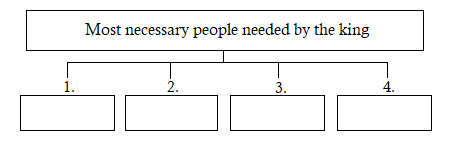
   Equally varied were the answers to the second question. Some said, the people, the king most needed,were his councillors; others the priests; others the doctors while some said the warriors were the most necessary.
  To the third question about what was the most important occupation, some replied that the most important thing in the world was science. Others said     it was skill in warfare; and others, again, that it was religious worship. The king was convinced by none of
these answers and gave the reward to none.
   He decided, instead to go to a hermit who was widely renowned for his wisdom. The hermit lived in a small hut in a forest which he never left. He spoke only to common folk. So the king put on simple clothes and approaching the hermit’s cell, dismounted his horse and left his bodyguard behind.
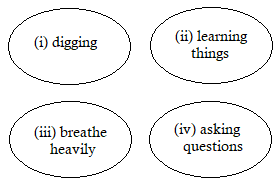
   When the king arrived, the hermit was digging the ground in front of his hut. He greeted the king but went on digging. The hermit was frail and weak, and each time he struck the ground with the spade and turned over a little earth, he breathed heavily. The king went up to him and said, “I have come to you, wise hermit,to ask you to answer three questions-How can I learn to do the right thing at the right time ? Who are the
people I most need, and to whom should I, therefore,pay most attention? And what affairs are the most aimportant and need my first attention?”
    The hermit listened to the king but said nothing. He just spat on his hand and resumed digging. The king watched in silence for a while. 

A2. Complex Factual Activities:
Complete the tree diagrams associated with the happening of this passage.
Image
A3. Activities based on Vocabulary:
Choose the correct answer and fill in the blanks:

(i) The synonym for 'convinced is ................. .
(a) persuaded   (b) happy   (c) unhappy  (d) angry
(ii) "Varied' means ................ .
(a) different       (b) unnecessary
(c) unequal       (d) unimportant
A4. Activities based on Contextual Grammar:
Do as directed: (March 20)
(i) When the king arrived the hermit was digging the ground. (Name and identify the subordinate clause.)
(ii) The hermit listened to the king but said nothing. (Rewrite the sentence beginning Though......)
A5. Personal Response:
(i) The learned people were sometimes divided in their opinions, different people giving quite different answers; at other times, none of them
gave an answer. They all suggested ways to look for an answer. Can you point out one example of each?
A1. Simple Factual Activities:
State whether the following statements are True or False:

(i) The spider's webs are delicate as well as weak.
(ii) The teamwork and perseverance of ants were impressive.

   We went to a rocky beach and saw the spread of the majestic ocean and the rocks alongside, carved,sculpted and shaped by the water. Water is so gentle, rock so hard, yet, as the water flows over it every day, for years, the rock gives in. It takes the shape that the water commands. Our problems are so colossal and we
are so small, yet if we persist... 
   We saw small bits of grass peeping through the small cracks in a concrete pavement. It left us thinking: however impossible things may look, there is always
an opening...
   We saw a tree bare of all leaves in the cold winter months. We thought its chapter was over. But three months passed, spring set in and the tree was back to its green majesty once again, full of leaves, flowers, birds and life. What if we too had the conviction that, however difficult things are right now, it will not remain so for ever. Remember, this too shall pass.
   We saw an army of ants lugging a fly which was at least ten times the ant’s size. The ants organized themselves around the fly, lifted it on frail feelers and carried it to quite a distance. Their teamwork and perseverance were impressive. What if we too are
consistent, organized, focused...Spider webs are delicate,yet very strong. A rainbow colours the entire sky.Oysters take in a grain of sand they open up with a pearl. Innumerable stars shine across the infinite sky. Clouds take new shapes with every passing moment.The wind makes trees dance with unhindered passion. Water, without hint of ego, changes its form according to the dictates of the sun and the wind. When we see a caterpillar turn into a butterfly, a flower turn into a fruit, we experience the alchemy of nature... we touch it and become gold ourselves.

A2. Complex Factual Activities:
Mention what you learn from the following: (Νοv. '20)

(i) Bits of grass peeping through small cracks...
(ii) Tree bare in winter blooms in spring.....
A3. Activity based on Vocabulary:
Match the words with their meanings:

AB
(i) Majestic(a) Huge/massive
(ii) Persist.(b) Grand
(iii) Colossal(c) Firm belief
(iv) Conviction(d) Continue

A4. Activities based on Contextual Grammar:
Do as directed: (Nov. '20)

(i) It takes the shape of water. (Add a question tag.)
(ii) We saw small bits of grass. (Pick out the verb and state whether it is Transitive or Intransitive.)
A5. Personal Response:
(i)  How does nature succeed in its 'Alchemy'?What can it turn a small person into?

A1.Simple Factual Activities:
The following incidents in Stephen Hawking's life are given in jumbled order. Arrange the incidents in proper sequence as per their order of occurrence in Hawking's life:
(i) Hawking was diagnosed with ALS while studying cosmology at the University of Cambridge.
(ii) At college, Hawking was bored with life.
(iii) After the diagnosis. Hawking went on to became a noted scientist.'
(iv) Hawking reflected on the condition of the boy suffering from leukemia.

   Eventually, however, doctors did diagnose Hawking with the early stages of ALS. It was devastating news for him and his family, but a few events prevented him from becoming completely despondent. The first of these came while Hawking was still in the hospital. There, he shared a room with a boy suffering from leukemia. Relative to what his roommate was going through, Hawking later reflected, his situation seemed more tolerable. Not long after he was released from the hospital, Hawking had a dream that he was going to be executed. He said this dream made him realize that there were still things to do with his life.
   In a sense, Hawking’s disease helped him become the noted scientist he is today. Before the diagnosis, Hawking hadn’t always focused on his studies. “Before my condition was diagnosed, I had been very bored with life,” he said. “There had not seemed to be anything worth doing.” With the sudden realization that he might not even live long enough to earn his Ph.D, Hawking poured himself into his work and research. 
   As physical control over his body diminished (he’d be forced to use a wheelchair by 1969), the effects of his disease started to slow down. Over time, however, Hawking’s ever-expanding career was accompanied by an ever-worsening physical state. By the mid-1970s, the Hawking family had taken in one of Hawking’s graduate students to help manage his care and work.He could still feed himself and get out of bed, but virtually everything else required assistance. In addition, his speech had become increasingly slurred, so that only those who knew him well could understand him. In 1985 he lost his voice for good following a tracheotomy. The resulting situation required 24-hour nursing care for the acclaimed physicist.
  It also put in peril Hawking’s ability to do his work.

A2. Complex Factual Activity:
What effect did the incidents mentioned below have on Hawking?
(i) Hawking saw a boy in the same room he was in suffering from leukemia.
(ii) Hawking had a dream that he was going to be executed.
A3. Activity based on Vocabulary:
Write from the passage words that are the opposite of:

(i) allowed
(ii) hopeful
(iii) admitted
(iv) enthusiastic.
A4. Activities based on Contextual Grammar:
(i) A few events prevented him from becoming completely despondent.(Rewrite beginning with 'He was ....'.)
(ii) Only those who knew him well could understand him. (Rewrite using 'no one'.)
A5. Personal Response:
(i) Do you agree or disagree with the following statement? Justify your stand/answer by quoting a line from the passage.
Stephen Hawking was diagnosed with Alzheimer's disease.
A1.Simple Simple l Factual Activities:
The following incidents in Stephen Hawking's life are given in jumbled order. Arrange the incidents in proper sequence as per their order of occurrence in Hawking's life:"
(i) Hawking authored 'A Briefer History of Time' that contained the newest developments.
(ii) Hawking's book 'A Brief History of Time' spent more than four years atop the London Sunday Times'.
(iii) Hawking's book The Universe in a Nutshell' offered an illustrated guide to cosmology's big theories.
(iv) Hawking published the book 'A Brief History of Time that offered an overview of space and time

   Stephen Hawking (born January 8, 1942) is a British scientist, professor and author who has done groundbreaking work in physics and cosmology, and whose books have helped to make science accessible to everyone. At the age of 21, while studying cosmology at the University of Cambridge, he was diagnosed with amyotrophic lateral sclerosis (ALS). Part of his life story was depicted in the 2014 film ‘The Theory of
Everything.’
  Over the years, Stephen Hawking has written or co-written a total of 15 books. A few of the most noteworthy include: The Grand Design, The Universe in a Nutshell, The Theory of Everything.
   In 1988 Hawking catapulted to international prominence with the publication of A Brief History of Time. The short, informative book became an account of cosmology for the masses and offered an overview of space and time, the existence of God and the future.The work was an instant success, spending more than four years atop the ‘London Sunday Times’ bestseller list. Since its publication, it has sold millions of
copies worldwide and been translated into more than 40 languages.
   ‘A Brief History of Time’ also wasn’t as easy to understand as some had hoped. So in 2001, Hawking followed up his book with ‘The Universe in a Nutshell,’ which offered a more illustrated guide to cosmology’s big theories.
   In 2005, Hawking authored the even more accessible ‘A Briefer History of Time,’ which further simplified the original work’s core concepts and touched upon the newest developments in the field like String theory.  

A2. Complex Factual Activity:
Complete the table with relevant information about Hawking:

BooksFilms


A3. Activity based on Vocabulary:
Find out the antonyms from the passage for the following:

(i) worst 
(ii) exclude 
(iii) duplicate 
(iv) oldest
A4. Activities based on Contextual Grammar:
(i) He was diagnosed with amyotrophic lateral sclerosis. (Rewrite using the present perfect tense of the underlined part.)
(ii) It has sold millions of copies worldwide and been translated into more than 40 languages.(Change into a simple sentence)
A5. Personal Response:
(i) Stephen Hawking was a versatile personality. Justify.

A1. Simple Factual Activities:
Choose the correct answer and fill in the blanks:
(i) Many learned people came to the court and gave ....................... .
(a) the same answers  (b) correct answers
(c) different answers    (d) wrong answers.
(ii) The King wanted to know the ............... time to begin everything.
(a) right (b) exact (c) proper  (d) good

   Once a certain king had an idea. If he always knew the right time to begin everything, if he knew who were the right people to listen to and who to avoid the most important thing to do, he would never fail in anything that he would undertake and above all, if he
always knew what was the most undertake. Since he was convinced that he was right in thinking this way, he had a proclamation made in his kingdom. He would give a great reward to anyone who would teach him what the right time was for every action, who the most necessary people were, and how he might know the most important thing to do.
    Many learned people came to the court but they all gave different answers. In reply to the first question,some said that to know the right time for every action,one must draw up in advance a table of days, months and years, and must live strictly according to it. Others declared that it was impossible to decide beforehand the right time for every action; but that, not letting oneself be absorbed in idle pastimes, one should always attend to all that was going on, and then do that which was most essential. Yet others said that it was impossible for one man to decide correctly the right time for every action and that the king should, instead, have a council of wise people, who would help him to fix the proper time for everything.

A2. Complex Factual Activities:
Summarize the following aspect in 4 to 5 lines each in your own words:
(i) The King's problem.
A3. Activities based on Vocabulary:
The following compound words from the passage are spelt in jumbled order. Rearrange the letters to make them meaningful:

(i) a r e e t u k d n
(ii) y o n n a c
(iii) s t a p s i e m
(iv) h e e d a r f o n b
A4. Activities based on Contextual Grammar:
(i) They all gave different answers.(Rewrite using the opposite of 'different'.)
(ii) He was convinced that he was right. (Pick out the clauses and name them.)
A5. Personal Response:
(i) The learned advisers who came to the court confused the king. How do you know?
A1.Simple Simple l Factual Activities:
Choose the correct alternatives from the given statements:
(i) What was most astonishing about the 102-year- old Swamiji?
(a) He was a great speaker and orator.
(b) He was a great scientist.
(c) He was a great admirer of technology.
(d) He looked as steady and alert as any other youngster.
(ii) The year 2009 is significant because of:
(a) The invitation extended to Dr Kalam.
(b) The 102nd birthday celebrations of His Holiness Dr Sri Sri Shivakumara Mahaswamiji.
(c) The establishment of the free residential education system in Dr Sri Sri Shivakumara Mahaswamiji's ashram.
(d) The discourse given by Dr Sri Sri Shivakumara Mahaswamiji.
 
   In April 2009, Dr Kalam was invited to attend  the 102nd birthday celebrations of His Holiness Dr Sri Sri Shivakumara Mahaswamiji in the Tumkur district of Karnataka. Mahaswamiji is a remarkable person, who has dedicated his life to the service of humanity. His greatest contribution is the establishment of a free residential education system for more than nine thousand children in the ashram. The most astonishing
aspect of the entire event of his birthday was that the 102 year old Swamiji stood on his feet without any support! He looked as steady and alert as any other youngster present there. This display of inner strength touched Dr Kalam deeply.
   A couple of days later, we were discussing this unusual birthday party. I said to him, ‘Sir, do you know, only four out of 1 lakh people cross the age of 100 ?’ I had googled the subject beforehand. He replied,‘But how many of these four would be able to stand
tall for half an hour, give a wise discourse, and then go on to feed thousands of children?’ Of course nobody could know the exact answer to his question but the question itself led to many other relevant queries. ‘I wonder what powers Mahaswamiji possesses that keep him so strong at such an advanced age ? Maybe it’s a balanced diet and a healthy lifestyle, or perhaps it’s genetics ?’ I asked.

A2. Complex Factual Activity:
Find evidence from the passage that indicates that Swamiji:
(i) was dedicated
(ii) has inner strength
(iii) contributed to the good of the society
(iv) was younger than the young generation
A3. Activities based on Vocabulary:
Write the opposites of the following words using prefixes (un-, in-, etc.):
(i) invited
(ii) remarkable
(iii) humanity
(iv) wise.
A4. Activities based on Contextual Grammar:
(i) This display of inner strength touched Dr Kalam deeply. (Rewrite beginning 'Dr Kalam......)
(ii) God will shine through us. (Add a question tag.)
A5. Personal Response:
(i) What measures will you take to keep yourself physically and mentally fit?
A1.Simple Simple l Factual Activities:
Name the following from the passage:
(i) The great personalities from India:
(ii) The two centres of global peace and brotherhood:

   My journey from the great land of Lord Buddha, Guru Nanak and Mahatma Gandhi; India to Norway is a connect between the two centres of global peace and brotherhood, ancient and modern.
   Friends, the Nobel Committee has generously invited me to present a “lecture.” Respectfully, I am unable to do that. Because, I am representing here the sound of silence. The cry of innocence. And, the face of invisibility. I represent millions of those
children who are left behind and that’s why I have kept an empty chair here as a reminder.
   I have come here only to share the voices and dreams of our children - because they are all our children - (gesture to everyone in the audience). I have looked into their frightened and exhausted eyes.I have held their injured bodies and felt their broken spirits.
   Twenty years ago, in the foothills of the Himalayas, I met a small, skinny child labourer. He asked me: “Is the world so poor that it cannot give me a toy and a book, instead of forcing me to take a gun or a tool?”
   I met with a Sudanese child-soldier. He was kidnapped by an extremist militia. As his first training lesson, he was forced to kill his friends and family. He asked me: “What is my fault?” 

A2. Complex Factual Activity:

(i) Explain the reason why a chair is kept empty on the podium by Shri Satyarthi.
A3. Activities based on Vocabulary:
 Find the odd man out:
(i) dream, tiny, militia, expenditure
(ii) compassion, liberty, children, pessimism
A4. Activities based on Contextual Grammar:
Pick out the verbs from the following sentences and state their tense:
(i) I met a small, skinny child labourer.
(ii) I am representing here the sound of silence.
A5. Personal Response:
(i) "Write any two efforts that you can make to enrol deprived children/out of school children into a school. One is given for you:
i.c. will persuade parents of such children to send them to school.