Question
A1.Simple Factual Activities:
Complete the following sentences using word/words from the passage : (Nov. '2O)
(i) Hemingway's novel is based on ________ .
(ii) The novel was published in ________ .
(iii) During the First World War, Hemingway worked for __________ .
(iv) Hemingway had experience of fishing in __________ .

    An old and experienced Cuban fisherman has a run of terrible bad luck and is unable to catch any fish for eighty-four days. His young and devoted apprentice, Manolin, has been forced by his parents to start working with another fisherman. The old man resolves to sail out farther than all the other fishermen and attempt to catch the really big fish. On the eightyfifth day he succeeds in hooking a marlin with his bait but the marlin is too strong for him and starts pulling the boat. ‘The Old Man and the Sea’ is the story of the old man’s struggle with the marlin and his later battle against sharks.
   Social/Historical context:
   Hemingway’s novel is based on real events and it also draws heavily on his own life. He had experience of fishing in the Cuban waters and like the old man he was also a fan of baseball. He worked for the Red Cross during the First World War and was injured by shrapnel when he was in Italy. Hemingway always talks about the need to struggle against defeat or death and how determination and endurance can help one to win in this struggle. The old man is at the end of the novel very near death, but we know that the story of his suffering and loss will live on in the memories of the people of his village. Ultimately, his story becomes one of triumph because the tales of his life will live on even after his death. The novel was published in 1952, when people were trying to recover from the mass destruction wrought by the two world wars, and this tale of endurance and ultimate triumph immediately struck a chord with the readers.

A2. Complex Factual Activity:
Complete : (Nov. '20)
(i) Two things which Hemingway always talks about :
A3. Activity based on Vocabulary:
(i) Add suffix to make adjectives: (Nov. "20)
(a) injury (b) memory
(ii) Write the synonyms from the passage for the following words : (Nov. 20)
(a) victory (b) tolerance
A4. Activities based on Contextual Grammar:
Do as directed : (Nov, '20)
(i) Ultimately his story becomes one of triumph.
(Rewrite the present perfect tense.)
(ii) He was injured during the First World War.
(Frame a Wh-question to get the underlined part as the answer.)
A5. Personal Response:
(i) Would you prefer reading a book or watching an animated film? Justify you answer. (Nov, 20)
Answer

A1.Simple Factual Activities:
(i) Hemingway's novel is based on real events.
(ii) The novel was published in 1952.
(iii) During the First World War, Hemingway worked for the Red Cross.
(iv) Hemingway had experience of fishing in the Cuban Waters.
A2. Complex Factual Activity:
(i)
(1) the need to struggle against defeat or death.
(2) how determination and endurance can help one to win in this struggle.
A3. Activity based on Vocabulary:
(i) (a) injurious (b) memorable
(ii) (a) triumph (b) endurance
A4. Activities based on Contextual Grammar:
(i) Ultimately, his story has become one of triumph.
(ii) When was he injured?
A5. Personal Response:
(i) I would prefer reading a book. While reading. I can imagine the events in the book in whatever way I wish to. In an animated film, the answer is given to me, all ready. 1 cannot use my imagination. Besides, watching TV makes my eyes tired, which reading does not.

Need a full question paper?

Generate a complete, print-ready paper with questions like this in minutes — across 16+ boards, with answer keys.

Start Generating Free

Similar questions

A1. Simple Factual Activities:
Name the following:
(i) Former Vice Chief of IAF: 
(ii) Two army generals honoured with the rank of Field Marshal :
(iii) The only officer to attain the highest post of Air Force Marshal :
   
   Air Force Marshal Arjan Singh, an icon of India’s military history, will always be remembered as a war hero who had successfully led a young IAF during the 1965 Indo-Pak war.
   The only officer to attain the highest post of Marshal, the Air Force equivalent to the Army’s five star field marshal, Singh was a fearless and exceptional pilot who had flown more than 60 different types of aircraft.
   He played a major role in transforming the IAF into one of the most potent air forces globally and the fourth biggest in the world. “His contribution to the Indian Air Force is monumental to the least. The IAF grew with him. He was the epitome of military leadership in classical sense and it is, therefore, not surprising that he was honoured with the rank of Air Force Marshal,” former Vice Chief of IAF Kapil Kak
said.
   Singh was honoured with the rank of Marshal on the Republic Day in 2002. Sam Hormusji Framji Jamshedji Manekshaw and K M Cariappa were the only two army generals honoured with the rank of Field Marshal.
   Known as a man of few words, Singh was not only a fearless pilot but also had profound knowledge about air power and applied it in a wide spectrum of areas. Singh had assiduously led the IAF during the 1965 war and denied success to Pakistani Air Force though it was better equipped with American support.“His most outstanding contribution was during that war,” said Kak.

A2. Complex Factual Activities:

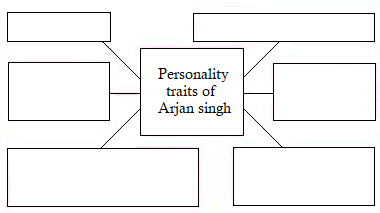
Complete the web with the personality traits of Arjan Singh mentioned in the extract:
Image
A3. Activities based on Vocabulary:
Replace the underlined words/phrases with the appropriate ones, to retain the proper meaning:
(be the epitome of. gear up, a brief stint, play a major role, in recognition of, take over reins)
(i) He contributed notably in bringing up the school.
(ii) Our class monitor is a perfect symbol of duty and discipline.
A4. Activities based on Contextual Grammar:
(i) He was the only officer to attain the highest post of Marshal. (Rewrite using 'no'.)
(ii) He will always be remembered as a war hero. (Rewrite using 'never'.)
A5. Personal Response:
(i) Would you like to be a part of the IAF? Give reasons for your answer.
A1.Simple Factual Activities:
The following incidents in Stephen Hawking's life are given in jumbled order. Arrange the incidents in proper sequence as per their order of occurrence in Hawking's life:

(i) Hawking was rushed to hospital.
(ii) Hawking was unable to attend a conference in Arizona.
(iii) Hawking's predicament caught the attention of a California computer programmer.
(iv) Hawking announced that he was retiring.

   The predicament caught the attention of a California computer programmer, who had developed a speaking program that could be directed by head or eye movement. The invention allowed Hawking to select words on a computer screen that were then passed through a speech synthesizer. At the time of its introduction, Hawking, who still had use of his fingers,selected his words with a handheld clicker. Today, with virtually all control of his body gone, Hawking directs the program through a cheek muscle attached to a
sensor.
   Through the program, and the help of assistants, Stephen Hawking has continued to write at a prolific rate. His work has included numerous scientific papers,of course, but  also information for the non-scientific community.
   Hawking’s health, of course, remains a constant concern - a worry that was heightened in 2009 when he failed to appear at a conference in Arizona because of a chest infection. In April, Hawking, who had already announced he was retiring after 30 years from the post of Lucasian Professor of Mathematics at Cambridge, was rushed to the hospital for being what university officials described as “gravely ill.” It was later announced that he was expected to make a full recovery.

A2. Complex Factual Activity:
(i) Find evidences of Stephen Stephen Hawking's Hawking's special life.
A3. Activity based on Vocabulary:
(i) Write the adjective forms of:(a) infection (b) office.
(ii) Write from the last paragraph phrases that give an indication of Stephen Hawking's health situation.
A4. Activities based on Contextual Grammar:
Pick out the verbs and state the tense.

(i) Stephen Hawking has continued to write at a prolific rate.
(ii) He had already announced he was retiring.
A5. Personal Response:
Do you agree or disagree with the following statement? Justify your stand/answer by quoting a line from the passage.

(i) Though Hawking lost control over his body, he writes at a prolific rate with the help of assistants.

A1.Simple Simple l Factual Activities:
Write True or False for the statements:
(i) The narrator had heard of Bach.
(ii) The narrator's answer displeased Einstein.
(iii) The upper room had a gramophone.
(iv) The narrator liked the kind of music where he could follow the words.

   I knew that I must tell this man the truth. He looked at me as if my answer was very important.
  “I do not know anything about Bach”, I said, “I have never heard any of his music.” He looked surprised.
  “You have never heard of Bach?” he asked.
   He made it sound as if I had said that I had never taken a bath !
   “I’d like to understand music so that I could understand Bach,” I said, “but I’m not able to. I’m tone-deaf.”
  The old man got up.
  “You will come up with me ?” he asked. I just remained seated. “I’m requesting you to come with me”, he said again.
   So I went up with him. He took me to a room which had a gramophone in it and asked, “What kind of music do you like ?”
  “Well,” I answered, “I like songs that have words,and the kind of music where I can follow the tune.”
   He smiled and nodded, obviously pleased. “You can give me an example, perhaps ?” 

A2. Complex Factual Activity:
Who said to whom?

StatementWho saidTo Whom Effect on the listener
(i) "I do not know anything           about Bach."   
(ii) "I like songs that have           words."   

A3. Activities based on Vocabulary:
Pick out words that refer to the following:
(i) They were arranging chairs.
(ii) one who is poor at deciphering musical notes:
A4. Activities based on Contextual Grammar:
State what the underlined modal auxiliaries indicate:

(i) I must tell this man the truth.
(ii) You can give me an example. perhaps?
A5. Personal Response:
(i) What do you learn from Einstein's treatment of the young man?

A1. Simple Factual Activities:
Arrange these incidents in proper sequence:
(i) The bearded man resolved to kill the king.
(ii) The king executed the bearded man's brother.
(iii) The bearded man came out of the ambush.
(iv) The bearded man laid an ambush to kill the king.

    Meanwhile the sun had set and it had become cool. So the king, with the hermit’s help, carried the wounded man into the hut. The man lay there quietly with his eyes closed. By now, the king was so tired after his walk and the work he had done, that he lay down himself and also fell asleep. When he awoke in the morning, it took him some time to remember where he was and who was the strange bearded man lying by his side and gazing intently at him. “Forgive me !” said the bearded man in a weak voice, when he saw that the king was awake and was looking at him.‘‘I do not know you, and I’ve nothing to forgive you for,” said the king. “
   You do not know me, but I know you. I am that enemy of yours who swore to revenge himself on you because you executed his brother and seized his property. I knew you had gone alone to see the hermit, and I resolved to kill you on your way back. But the day passed and you did not return. So I came out of my ambush to find you. Your bodyguards recognised me and wounded me. I escaped from them but would have bled to death had you not dressed my wound. I wished to kill you but you have saved my life. Now if I live, and if you wish it, I’ll serve you all my life.”

A2. Complex Factual Activities:
(i) The king's enemy was repentant. How do you know?
A3. Activities based on Vocabulary:
(i) From the passage, find the collocations for the following:

(a) ............. closed  (b) ............. intently 
(ii) The following compound words from the passage are spelt in jumbled order. Rearrange the letters to make them meaningful:
(a) h e i l n e w a m (b) d a d e b e r 
A4. Activities based on Contextual Grammar:
(i) 'Forgive me,' said the bearded man. (Rewrite in indirect speech.)
(ii) Pick out the finite and non-finite verbs in the sentences:
*Forgive me.
A5. Personal Response:
(i) Whom do you consider your guide when you are in difficulty? Why? (March '20)
A1. Simple Factual Activities :
Write who said to whom:

StatementWhoTo Whom
(a) You'll wake him up.  
(b) "We mustn't miss the chance."  


   One morning in a small apartment in Bombay a girl of about sixteen looked up from the newspaper and said excitedly, ‘Pandit Ravi Shankar is playing tomorrow at the Shanmukhananda auditorium.’
  ‘Sh-sh,’ said her mother pointing to the figure sleeping on the bed. ‘You’ll wake him up. You know he needs all the sleep and rest he can get.’
   But the boy on the bed was not asleep. ‘Pandit Ravi Shankar!’ he said. ‘Pandit Ravi Shankar, the sitar maestro? He raised himself up on his elbows for one second, then fell back. But his eyes were shining. ‘We mustn’t miss the chance,’ he said. ‘I’ve - ‘I’ve –
always wanted to hear him and see him…’
   ‘Lie down son, lie down.’ His mother sprang to his side. ‘He actually raised himself up without help,’ she murmured with a catch in her throat and her eyes turned to the idols on a corner shelf. The prayer, which she uttered endlessly, came unbidden to her lips.
  ‘I must hear him and see him,’ the boy repeated. ‘It’s the chance of a lifetime.’ Then he began to cough and gasp for breath and had to be given oxygen from the cylinder that stood under the bed. But his large eyes were fixed on his sister.
   Smita bit her lip in self-reproach. She had been so excited at seeing the announcement, that she had not remembered that her brother was very ill. She had
seen how the doctors had shaken their heads gravely and spoken words that neither she nor even her parents could understand. But somewhere deep inside Smita had known the frightening truth – that Anant was going to die. The word cancer had hung in the air – her brother 

A2. Complex Factual Activities:
Write which emotions are revealed in these sentences.
(i) Pandit Ravi Shankar's playing tomorrow at Shanmukhananda auditorium."
(ii) 'It's the chance of a lifetime."
A3. Activities based on Vocabulary:
You will find some words describing a particular speciality of the individuals/personalities in the passage. Explain the meaning of the following words given in the table with reference to the particular personality mentioned in the text:

SpecialityPersonalityExplanation
 Maestro  
 Pandit  

A4. Do as directed:
Choose the appropriate Adverb or Adjective form to fill in the gaps:
(i) She spoke in an excited tone. (excited/excitedly)
(ii) I wished the noise would stop. It seemed to go on endlessly. (endless, endlessly)
A5. Personal Response:
(i) Two contradictory pictures are depicted in the passage. Discuss in pairs and describe them in your own words.

A1. Simple Factual Activities:
Complete the following:
(i) The Squire's opinion of miracles was that ....................... .
(ii) Robert accused Poulengey ........................ .

Poulengey : (Slowly) There is something about her. It may be worth trying.
Robert : Oh, come on Polly ! You must be out of your mind !
Poulengey : (Unmoved) What is wrong with it ? The Dauphin is in Chinon, like a rat in a corner, except that he won’t fight. The English will take Orleans. He’ll not be
able to stop them.
Robert : He beat the English the year before last at Montargis. I was with him.
Poulengey : But his men are cowed and now he can’t work miracles. And I tell you that
nothing can save our side now but a miracle.
Robert : Miracles are alright, Polly. The only difficulty about them is that they don’t happen nowadays.
Poulengey : I used to think so. I’m not so sure now.There is something about her. I think the girl herself is a bit of a miracle. Anyhow, this is our last chance.Let’s see what she can do.
Robert : (Wavering) You really think that ?
Poulengey : (Turning) Is there anything else left for us to think? Let’s take a chance. Her words have put fire into me.
Robert : (Giving up) Whew! You’re as mad as she is.
Poulengey : (Obstinately) We want a few mad people now. See where the same ones
have landed us!
Robert : I feel like a fool. Still, if you feel sure... ?
Poulengey : I feel sure enough to take her to Chinon unless you stop me.
Robert : Do you think I ought to have another talk with her ?
Poulengey : (Going to the window) Yes! Joan, come up. (Joan enters)

A2. Complex Factual Activities:
Give reasons:
(i) Poulengey, Jack and Dick had offered to accompany Joan.
A3. Activity based on Vocabulary:
Make sentences of your own using the words/ expressions given below:
(i) worth trying (ii)  out of your mind
A4. Activities based on Contextual Grammar:
Make the following sentences Affirmative without changing the meaning:
(i) I am not so sure, now.
(ii) He will not be able to stop them.
A5. Personal Response:
(i)  After talking to Poulengey what change do you notice in Robert?
A1. Simple Factual Activities:
Say whether the following statements are True or False:
(i) The person the king saved and helped was his enemy.
(ii) The hermit helped the king.
(iii) When he awoke, the king immediately realized where he was.
(iv) The king had gone out for a walk.

    Meanwhile the sun had set and it had become cool. So the king, with the hermit’s help, carried the wounded man into the hut. The man lay there quietly with his eyes closed. By now, the king was so tired after his walk and the work he had done, that he lay down himself and also fell asleep. When he awoke in the morning, it took him some time to remember where he was and who was the strange bearded man lying by his side and gazing intently at him. “Forgive me !” said the bearded man in a weak voice, when he saw that the king was awake and was looking at him.‘‘I do not know you, and I’ve nothing to forgive you for,” said the king. “
   You do not know me, but I know you. I am that enemy of yours who swore to revenge himself on you because you executed his brother and seized his property. I knew you had gone alone to see the hermit, and I resolved to kill you on your way back. But the day passed and you did not return. So I came out of my ambush to find you. Your bodyguards recognised me and wounded me. I escaped from them but would have bled to death had you not dressed my wound. I wished to kill you but you have saved my life. Now if I live, and if you wish it, I’ll serve you all my life.”

A2. Complex Factual Activities:
(i) Summarize the climax in 4 to 5 lines in your own words.
A3. Activities based on Vocabulary:
Match the words with their opposites:

WordsOpposites
 (a) familiar (i) weak
 (b) forget (ii) strange
 (c) firm (iii) nothing
 (d) everything (iv) remember

A4. Activities based on Contextual Grammar:
(i) 'Forgive me,' said the bearded man. (Rewrite in indirect speech.)
(ii) Pick out the finite and non-finite verbs in the sentences:
*Forgive me.
A5. Personal Response:
(i) Whom do you consider your guide when you are in difficulty? Why? (March '20)

A1.Simple Simple l Factual Activities:
Choose the correct alternatives from the given statements:
(i) How can academic brilliance be diminished?
(a) by disturbance and frustration
(b) by going offtrack
(c) by a coating of dust
(d) by losing focus and seriousness
(ii) Who had directly influenced Dr Kalam's beliefs?
(a) Professor Satish Dhawan   (b) Srijan
(c) God                                     (d) countless great minds
 
    A few years later, in the early 1980s, Professor Satish Dhawan, the Director of ISRO, under whom Dr Kalam had made his first unsuccessful launch in 1970 and then a successful one in 1980, had provided him with more soul-shaping wisdom.
    One day in 2012, we were discussing the number of Ph.Ds Dr Kalam had received. He said to me, ‘Srijan, Professor Dhawan had so many master’s degrees- all from the best institutions, no less-so I asked him how one can become so academically accomplished.He responded saying that academic brilliance is no different from the brilliance of a mirror, which can be diminished by a coating of dust. Only when the dust is removed, does the mirror shine and the reflection becomes clear. We can remove the impurities obscuring our souls by living pure and ethical lives, and by serving humanity. And then God will shine through us.’ These words took me back to my meeting with Dr Kalam after my graduation from IIMA, in 2009. At the time, he had advised me to use my degree and gold medal to transform the society I lived in. Back in the present moment, it suddenly struck me that Dr Kalam’s advice had, in fact, directly resonated from Professor Dhawan’s beliefs. The more I lived and worked with Dr Kalam, the more I realized that through his words of wisdom I was getting to learn from countless great
minds. 

A2. Complex Factual Activity:
(i) 1970
(ii) 1980
(iii) 2009 
(iv) 2012 
A3. Activities based on Vocabulary:
Match the words in column 'A' with their their opposites in column 'B':

'A''B'
 (i) asked (a) increased
 (ii) obscure (b) impure
 (iii) diminished (c) clear
 (iv) pure (d) responded

A4. Activities based on Contextual Grammar:
(i) Academic brilliance is no different from the brilliance of a mirror. (Rewrite without 'no'.)
(ii) God will shine through us. (Add a question tag.)
A5. Personal Response:
Write in your own words what the following expressions convey in the context they occur in the text.
(i) Only when the dust is removed, does the mirror shine and the reflection becomes clear.

A1. Write if the following sentences are True or False:
(i) Adams was Mary Kom's friend.
(ii) Charles Atkinson was Mary Kom's coach.
(iii) The judges for Mary Kom's semi-finals at the Olympics were fait
(iv) Charles Atkinson did not go along with Mary Kom for the Olympic finals.

In an exclusive interview with Sportskeeda correspondent Taruka Srivastava, Olympic Bronze medalist Mary Kom talked about her preparation for the Olympics and her elation at winning a medal.
Interviewer : First things first- you’re the first Indian female boxer to win an Olympics medal for India. Has the feeling completely sunk in?
Mary Kom : I am really happy with my achievement and yes it is yet to sink in. I am just so exhilarated.
Interviewer : You were the only female representative from India in boxing. Did that put additional pressure on you?
Mary Kom : No, not at all. I was pretty confident about myself. I knew.
Interviewer : Your coach Charles Atkinson was not allowed to accompany you to the Olympics. How did that affect your preparations ?
Mary Kom : Well, I did miss him there but thankfully, we had already done our homework and I was well prepared.
Interviewer : During your preparations for the Olympics, you sparred with the male boxers of the Indian contingent. Who was your favourite sparring partner ?
Mary Kom : (Laughs) Well, I trained hard in Pune and the male boxers were kind enough to practise with me whenever I required them. To name a favourite
would be unfair.
Interviewer : You were quoted saying “Adams was very clever, a counter- puncher but, although she carried power, she wasn’t very tactical. I was scoring
but the judges were not pressing the buttons.” Do you think dodgy judging was part of the reason for your loss in the semi-finals?
Mary Kom : Yes, I think some of the decisions were unfortunate and did not work to my benefit.  

A2. What prime quality did Mary Kom display during her first attempt in the Olympic games? What was her bad luck?
A3. Find the antonyms of the following words from the passage:
(i) depressed (ii) diffident (iii) float (iv) gain
A4. (i) Although she carried power, she wasn't very tactical.
(Rewrite using a coordinating conjunction.)
(ii) The male boxers kindly practised with me whenever I required them to.
(Underline the subordinate clause and state its kind.)
A5. What, according to you, should a sportsperson do to be successful?
A1.Simple Factual Activities:
Name the food items mentioned in the passage
__________ , __________ , __________ , __________ .

    She ate the caviar and she ate the salmon. She talked gaily of art and literature and music. But I wondered what the bill would come to. When my mutton chop arrived, she took me quite seriously to task.
   “I see that you’re in the habit of eating a heavy luncheon. I’m sure it’s a mistake. Why don’t you follow my example and just eat one thing? I couldn’t possibly eat anything more unless they had some of those giant asparagus. I should be sorry to leave Paris
without having some of them.”
   My heart sank. I had seen them in the shops and I knew that they were horribly expensive. My mouth had often watered at the sight of them.
  “I’m not in the least hungry,” my guest sighed, “but if you insist, I don’t mind having some asparagus.” I ordered them.
  “Aren’t you going to have any?”
  “No, I never eat asparagus.”
   We waited for the asparagus to be cooked. Panic seized me. It was not a question now of how much money I should have left over for the rest of the month,but whether I had enough to pay the bill. It would be mortifying to find myself ten francs short and be
obliged to borrow from my guest. I knew exactly how much I had and if the bill came to more. I made up my mind that I would put my hand in my pocket and with a dramatic cry, start up and say it had been picked. Of course, it would be awkward if she had not
money enough either to pay the bill. Then, the only thing would be to leave my watch and say I would come back and pay later.

A2. Complex Factual Activity:

(i) Explain what the use of the word 'sank' suggests about the narrator's feelings.
A3. Activity based on Vocabulary:
Choose the correct options from the brackets and fill in the blanks :
(quite seriously, gaily, insist, dramatic, morlifying)
(i) Parents always _________ that their children should be all-rounders.
(ii) The _________ turn of events shocked all of us.
(iii) It was _________  to apologise to the bully.
(iv) My mother waved _________ to me as she went for the hike.
A4. Activities based on Contextual Grammar:
(i) She ate the caviar and she ate the salmon.
(Begin the sentence with not only ... but also and rewrite the sentence.)
(ii) Rewrite the following sentence as an affirmative sentence :
I couldn't possibly eat anything more unless they had some of those glant asparagus.
A5. Personal Response:
(i) Which food do you prefer to eat-home food or restaurant food. Why?