Question
A1. Simple Factual Activity:
Complete the following sentences: (2)
(1) We should not lose the common touch even while walking _______________.
(2) _______________, neither foes nor loving friends can hurt us.

If you can talk with crowds and keep your virtue,
Or walk with Kings, nor lose the common touch;
If neither foes nor loving friends can hurt you,
If all men count with you, but none too much;
If you can fill the unforgiving minute
   With sixty seconds’ worth of distance run,
Yours is the Earth and everything that’s in it,
   And which is more you’ll be a Man, my son!

A2. Complex Factual Activity:
Complete the following: (2)
(1) Say WHAT ....
can the unforgiving minute be made up of?
(2) Say WHO.....
can you talk with and walk with?

A3. Activities based on Poetic Devices:
Find and write the rhyming pairs from the extract and add your own rhyming word for each of them : (1)
Rhyming pairsAdded rhyming word


Answer

A1. Simple Factual Activity:
(1) We should not lose the common touch even while walking with the kings.
(2) If we treat everyone equally, neither foes nor loving friends can hurt us.

A2. Complex Factual Activity:
(1) sixty seconds, worth of distance run.
(2) crowd and kings.

A3. Activities basedon Poetic Devices:
Musical pairsAdded rhyming word
 virtue - you too
 touch - much such

Need a full question paper?

Generate a complete, print-ready paper with questions like this in minutes — across 16+ boards, with answer keys.

Start Generating Free

Similar questions

A1. Simple Factual Activity:
Choose the correct alternatives and complete the sentences: (2)
(1) The poet prays to the Lord to help him stand. for what is _______________. (might/ right) 
(2) The poet wants to see that his teenage years have been the _______________ of his life. (worst/ best)

Please open up my eyes, dear Lord,
   That I might clearly see
Help me stand for what is right,
   Bring out the best in me.
Help, Lord, to just say “no”
   When temptation comes my way,
That I might keep my body clean
   And fit for life each day.
When my teenage years are over,
   I know that I will see
That life is lived its very best
   With you walking next to me

A2. Complex Factual Activity:
(1) The What effect does the speaker wish to see in himself at the end of his teens? (1)
(2) In what condition does the poet wish to maintain his body? (1)
A3. Activities based on Poetic Devices:
Write the pairs of rhyming words from the extract: (1)
(1) see - _______________
(2) way - _______________
A1. Simple Factual Activity:
Complete the following lines with the help of the poem: (2)
(1) The poet wants to sow many  _______________.
(2) The whole village goes to the city  _______________.

O moon,
give me moonlight,
basketful or two baskets full,
with seeds of moonlight.
From the city to my village,
on the sides of the path
I want to sow many,
small, small moons of light.
The whole village goes to the city
daily to work.
It becomes dark on its way back
as my village is quite far.
The route is tough and full of
snakes and scorpions.
Neither bus nor cart plies.
When my father returns home
I am asleep.

A2. Complex Factual Activity:
Pick out and write the lines from the poem that prove the following: (2)
(1) Father reaches home late, after dark.
(2) The path from city to village is having many difficulties.
A3. Activities based on Poetic Devices:
Write rhyming words for the following from the extract: (1)
(1) Pack     (2) deeds
A1. Simple Factual Activity:
Complete the following sentences using the information from the extract: (2)
(1) His likeness with his brother dogged poet's _______________.
(2) The narrator's _______________ became his brother's wife. This fatal likeness even dogged
My footsteps, when at school,
And I was always getting flogged,
For John turned out a fool.
I put this question, fruitlessly,
To everyone I knew,
‘What would you do, if you were me,
To prove that you were you?’
Our close resemblance turned the tide
Of my domestic life,
For somehow, my intended bride
Became my brother's wife.
In fact, year after year the same
Absurd mistakes went on,
And when I died, the neighbours came
And buried brother John.

A2. Complex Factual Activity:
Complete the web: (2)
Image
A3. Activities based on Poetic Devices:
Write the rhyming words for the following from the extract : (1)
(1) dogged - _______________
(2) school - _______________
A1. Simple Factual Activity:
State whether the following statements are True or False: (2)
(1) The speaker expresses his relief that the ship has reached its home port.
(2) Captain's dead body is lying on the land.

O Captain! My Captain! our fearful trip is done;
The ship has weather’d every rack, the prize we sought is won;
The port is near, the bells I hear, the people all exulting,
While follow eyes the steady keel, the vessel grim and daring:
  But O heart! heart! heart!
    O the bleeding drops of red,
       Where on the deck my Captain lies,
           Fallen cold and dead.

A2. Complex Factual Activity:
(1) Describe the grief that the speaker in the poem feels at the death of his Captain. (2)
A3. Activities basedon Poetic Devices:
Complete the following sentences choosing from the alternatives: (1)
(1) The rhyme scheme of the given extract is _______________. (aabbccdd/abcdede/aabbcded)
(2) The line repeated in every stanza _______________. (O Captain! My Captain!/Fallen cold and dead)
A1. Simple Factual Activity:
Read the following bits of advice and state whether you Agree or Disagree with them: (2)

AdviceAns.
 (1) Get angry when others commit mistake 
 (2) Run away from troubles. 
 (3) Get angry when others blame us. 
 (4) Reconstruct something we have built with care even if it has been broken by others. 

A2. Complex Factual Activity:
Pick out and enlist the positive and negative qualities in respective columns from the extract: (2)

Positive qualitiesNegative qualities


A3. Activities based on Poetic Devices:
Pick out lines that contain the following figures of speech. (1)
(1) Antithesis (Opposite ideas): 
(2) Personification:

A1. Simple Factual Activity:
Complete the following lines with the help of the poem: (2)
(1) It becomes dark on its way back  _______________.
(2) When the poet's father returns home  _______________.

O moon,
give me moonlight,
basketful or two baskets full,
with seeds of moonlight.
From the city to my village,
on the sides of the path
I want to sow many,
small, small moons of light.
The whole village goes to the city
daily to work.
It becomes dark on its way back
as my village is quite far.
The route is tough and full of
snakes and scorpions.
Neither bus nor cart plies.
When my father returns home
I am asleep.

A2. Complex Factual Activity:
Pick out and write the lines from the poem that prove the following: (2)
(1) Father reaches home late, after dark.
(2) The path from city to village is having many difficulties.
A3. Activities based on Poetic Devices:
Write rhyming words for the following from the extract: (1)
(1) any      (2) pity
A1. Simple Factual Activity:
(1) We should not get angry - when others blame us
(2) We should consider - views and thoughts of others

A2. Complex Factual Activity:
In the first stanza, the poet advises us that :
(1) We should not get angry when others blame us.
(2) We should trust ourselves when others doubt us, but at the same time we should consider other's thoughts and views.
(3) We should not get tired by waiting.
(4) If someone talks lies about us we should not deal in lies.

A3. Activities based on Poetic Devices:
(1) Antithesis
(2) Personification
A1. Simple Factual Activity:
Complete the following sentences : (2)
(1) The poet told the boy to join the others to play but he couldn't hear.
(2) The boy was watching the others play.

Later walking down the street, I saw a child with eyes of blue
He stood and watched the others play; it seemed he knew not what to do
I stopped a moment, then I said, why don’t you join the others dear”
He looked ahead without a word, and then I knew he could not hear
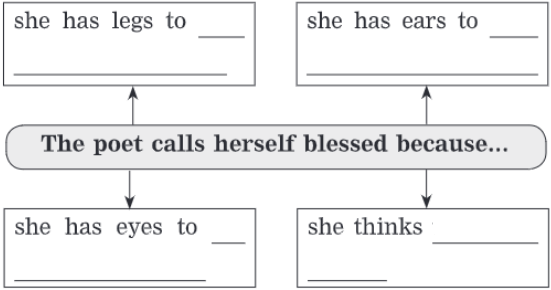
O God forgive me when I whine
I have two ears, the world is mine
With legs to take me where I’ll go
With eyes to see the sunset’s glow
With ears to hear what I would know
O God forgive me when I whine
I’m blessed, indeed, the world is mine

A2. Complex Factual Activity:
Complete the following web : (2)
Image

A3. Activities basedon Poetic Devices:
Write down rhyming pairs from the extract. (1)
A1. Simple Factual Activity:
Say whether the following pieces of advice by the poet are Right or Wrong: (2)
(1) Avoid strong feelings and their unsteady emotions.
(2) When you are not satisfied even then don't change your life.
(3) Go after your dream.
(4) Show the courage to risk something.

If you avoid to feel passion
And their turbulent emotions;
Those which make your eyes glisten
And your heart beat fast.
You start dying slowly...
If you do not change your life
when you are not satisfied with your job,
or with your love,
If you do not risk what is safe, for the uncertain,
If you do not go after a dream,
If you do not allow yourself,
At least once in your lifetime,
To run away from sensible advice…

A2. Complex Factual Activity:
(1) What is it that makes life worth living? Give four points : (2)
A3. Activities based on Poetic Devices:
Give your own rhyming words for : (1)
(1) job    (2) fast