Question
A1. Simple Factual Activity:
State whether the following statements are True or False:
(1) The book is filled with heavy grammar and difficult technical words.
(2) The book circles round the mischief of the kids in a view of the kid.
(3) R. K. Narayan's 'Swami and Friends' is a good read for the kids and teens alike.
(4) Mischievous kids are not as sensitive as other people.

     Significance of the book...
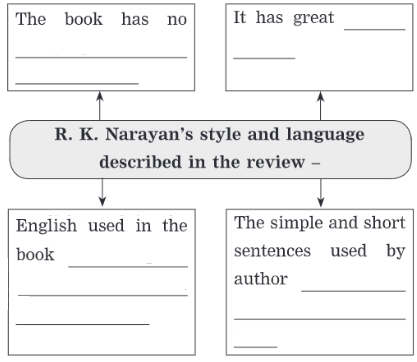
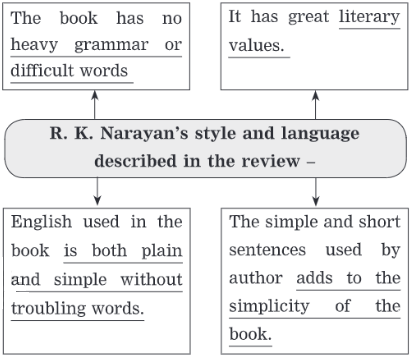
    ‘Swami and Friends’ by R. K. Narayan is not merely an interesting read that could be enjoyed from top to bottom, but the work attributes a lot of literary values even if it is a teen book ‘Swami and Friends’ is a good read for the kids and teens alike. Also the book is widely used in the Asian continent as a study text for the students who study literature as a subject at schools. This does not mean that the book is filled with heavy grammar and technical jargon. Actually the truth is in contrary to this.
     Swami and Friends is written in such simple English it is hard to imagine that it is a work of such a literary genius like R. K. Narayan. The English used in the book is both plain and simple, without any troubling words for the kids. Also the use of simple and short sentences adds to the simplicity of the book.
      It is mentioned in the description that the book is about a mischievous ten year old Indian boy, and some parents may be concerned about the influence this will have on their already mischievous children. But the book is as such, that it encompasses the
mischief of the kids in a view of the kid which is harmless and pure in his perspective. Also amidst all the mischief and naughtiness, we actually find that Swami is a loving and a tender kid who's actually very sensitive. It is also a known fact that mischievous
kids are the most sensitive and loving people of all. And R. K. Narayan does a great job conveying that to all of us.

A2. Complex Factual Activity:
Complete the web:
Image
A3. Activities based on Vocabulary:
Find the following from the passage:
(i) Noun forms of : simple, describe, naughty
(ii) Verb forms of : meaning, attribution imagination, loving
A4. Activities based on Contextual Grammar:
Add question tags:
(1) This does not mean that the book is filled with heavy Grammar.
(2) R. K. Narayan does a great job conveying ving that th to all of us.
A5. Personal Response:
(1) What difference do you find between the children of Swami's days and today's children?
Answer

A1. Simple Factual Activity:
(1) False
(2) True
(3) False
(4) True
A2. Complex Factual Activity:
Image
A3. Activities based on Vocabulary:
(i) simple - simplicity, describe - description, naughty - naughtiness
(ii) meaning mean, attribution attribute, imagination - imagine, loving - love
A4. Activities based on Contextual Grammar:
(1) This does not mean that the book is filled with heavy grammar, does this?
(2) R. K. Narayan does a great job conveying that to all of us, doesn't he?
A5. Personal Response:
(1) I don't think there is any peculiar difference between the children of Swami's days and today's children. Children all over the world and of all the times are the same. The only difference between them, according to me, is that many of today's children keep themselves busy in mobiles, other gadgets and mobile games instead of playing in open space.

Need a full question paper?

Generate a complete, print-ready paper with questions like this in minutes — across 16+ boards, with answer keys.

Start Generating Free

Similar questions

A1. Simple Factual Activities:
Who said to whom:
(1) "Come with me. I will take you to school."
(2) "What is your name, little one?"

     The next day Ramlal caught Bholi by the hand and said. ‘‘Come with me. I will take you to school.’’ Bholi was frightened. She did not know what a school was like. She remembered how a few days ago their old cow. Lakshmi had been turned out of
the house and sold.
     ‘‘N-n-n-n No. no-no-no’’ she shouted in terror and pulled her hand away from her father’s grip.
     ‘‘What’s the matter with you, you fool?’’ shouted Ramlal, ‘‘I am only taking you to school.’’ Then he told his wife. ‘‘Let her wear some decent clothes today. Or else what will the teachers and the other schoolgirls think of us when they see her?’’
      New clothes had never been made for Bholi. The old dresses of her sisters were passed on to her. No one cared to mend or wash her clothes. But today she was lucky to receive a clean dress which had shrunk after many washing and no longer fitted
Champa. She was even bathed and oil was rubbed into her dry and matted hair. Only then did she begin to believe that she was being taken to a place better than her home!
      When they reached the school, the children were already in their classrooms. Ramlal handed over his daughter to the headmistress. Left alone, the poor girl looked about her with fear laden eyes. There were several rooms. And in each room girls like her squatted on mats, reading from books or writing on slates. The headmistress asked        Bholi to sit down in a corner in one of the classrooms. Bholi did not know what exactly a school was like and what happened there. But she was glad to find so many girls almost of her own age present there. She hoped that one of these girls might become her friend.
      The lady teacher who was in the class was saying something to the girls but Bholi could understand nothing. She looked at the pictures on the wall. The colours fascinated her. The horse was brown just like the horse on which the Tehsildar had come to visit their village : the goat was black like the goat of their neighbour: the parrot was green like the parrots she had seen in the mango orchard : and the cow was just like their Lakshmi. And suddenly Bholi noticed that the teacher was standing by her
side, smiling at her.
      “What’s your name. little one?’’
      ‘‘Bh-Bho-Bho.’’ She could stammer no further than that.
       Then she began to cry and tears flowed from her eyes in a helpless flood. She kept her head down as she sat in her corner, not daring to look up at the girls who, she knew were still laughing at her.

A2. Complex Factual Activities:
(1) What shows that Bholi was unwilling to go to school? 
A3. Activities based on Vocabulary:
Complete the following sentences using words given in the brackets:
(disfigured, matted, fascinated)
(1) After the accident Juhi's face was _______________.
(2) It took a long time to straighten the _______________ bundle of wool.
A4. Activities based on Contextual Grammar:
(1) Change into indirect speech:
Ramlal's wife said to him, "I will tell you what to do."
(2) Rewrite as an exclamatory sentence:
The child was very fair and pretty.
A5. Personal Response:
(1) "If girls go to school, who will marry them?"-Why, do you think, that Bholi's mother thought so? 
A1. Simple Factual Activities:
State whether you Agree or Disagree with the following statements: 
Statements
(1) The narrator was fifty-five years old when this incident occurred.
(2) Even today, the narrator cannot forget that look in the mother langur's eyes.

    For a few seconds, the mother langur looked straight into my eyes. Even today, I cannot forget that look in her eyes, showering silent gratitude on me for saving her child. I was overwhelmed by the emotion, the sentiment and the way she said thanks to me. There sat a universal mother holding a stricken child in her lap.
    Then, in a flash, she jumped with her baby clinging to her belly and reached our kitchen roof. She surveyed the area for the vicious male langur and then leapt away in the direction opposite to the place of the violent encounter.
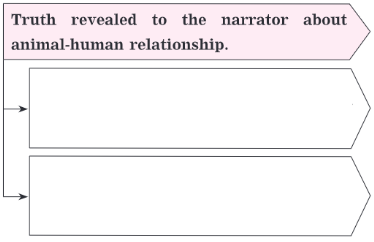
    The brief meeting with the mother and the baby langur convinced me that interspecies communication and mutual trust is indeed a reality and should anyone strike the right chord, the relationship hums into action. The mother langur showed me that food was not the only means of communication between man and animal but that there were other means of establishing a bond through trust, compassion and mutual understanding.
     Fifty-five years have passed since that day. I am now seventy years old. But I still fondly remember that ‘encounter of a special kind’.

A2. Complex Factual Activities:
Complete the web:
Image
 
A3. Activities based on Vocabulary:
Find the words from the passage for the following meanings:
(1) held closely
(2) moved downwards
(3) think very deeply
(4) comfort and peace
A4. Activities based on Contextual Grammar:
Do as directed:
(1) I cannot forget that look in her eyes. (Add a question tag.)
(2) I was overwhelmed by the emotion.
(Write the sentence in Active voice. Begin with The emotion....)
A5. Personal Response:
(1) What opinion do you form about the writer from the story?
A1. Simple Factual Activities:
Complete the following sentences:
(1) The teacher's voice was _______________ and _______________
(2) The teacher did not _______________ Bholi to get up, but it was just a friendly _______________.

     When the school bell rang. All the girls scurried out of the classroom. But Bholi dared not leave her corner. Her head still lowered. She kept on sobbing.
    ‘‘Bholi.’’
     The teacher’s voice was so soft and soothing! In all her life she had never been called like that. It touched her heart.
    ‘‘Get up.’’ said the teacher. It was not a command, but just a friendly suggestion. Bholi got up.
    ‘‘Now tell me your name.’’
     Sweat broke out over her whole body. Would her stammering tongue again disgrace her? For the sake  of this kind woman. However she decided to make an effort. She had such a soothing voice : she would not laugh at her.
    ‘‘Bh-Bh-Bho-Bho-,’’ she began to stammer.
    ‘‘Well done, well done.’’ The teacher encouraged her. ‘‘Come on now- the full name?’’
    ‘‘Bh-Bh-Bho-Bholi.’’ At last she was able to say it and felt relieved as if it was a great achievement.
    ‘‘Well done.’’ The teacher patted her affectionately and said. ‘‘Put the fear out of your heart and you will be able to speak like everyone else.’’
     Bholi looked up as if to ask. ‘Really?’
    ‘‘Yes, yes, it will be very easy. You just come to school everyday, will you come?’’
     Bholi nodded.
    ‘‘No. say it aloud.’’
    ‘‘Ye-Ye-Yes.’’ And Bholi herself was astonished that she had been able to say it.
    ‘‘Didn’t I tell you? Now take this book.’’
     The book was full of nice pictures and the pictures were in colour dog, cat, goat, house, parrot, tiger and a cow just like Lakshmi. And with every picture was a word in big black letters.
     ‘‘In one month you will be able to read this book. Then I will give you a bigger book, then a still bigger one. In time you will be more learned than anyone else in the village. Then no one will ever be able to laugh at you. People will listen to you with respect and you will be able to speak without the slightest stammer. Understand? Now go
home, and come back early tomorrow morning”
      Bholi felt as if suddenly all the bells in the village temple were ringing and the trees in front of the school house had blossomed into big red flowers. Her heart was throbbing with a new hope and a new life. 

A2. Complex Factual Activities:
(1) How did the teacher encourage Bholi to overcome her stammering? 
A3. Activities based on Vocabulary:
Complete the following sentences using the words given in the brackets:
(scurried, a great achievement, astonished )
(1) My mother was  _______________ to see her brother in front of her after so many years.
(2) Overcoming her difficulties was _______________ for Bholi.
A4. Activities based on Contextual Grammar:
(1) Rewrite the following in indirect speech:
"Put the fear out of your heart and you will be able to speak like everyone else."
(2) Change the voice:
The teacher patted her affectionately. (Begin the sentence with "She....)
A5. Personal Response:
(1) Why does positive encouragement work better than criticism?
A1. Simple Factual Activities:
Complete the following sentences:
(1) Soldiers called Joan _______________.
(2) Joan wanted _______________.
(3) The shortest way to save your skin is to _______________.
(4) According to Joan, their soldiers are always beaten because they fight _______________.

Poulengey : (Going to the window) Yes! Joan, come up. (Joan enters.)
Poulengey : (Gravely) Be seated, Joan.
Robert : What is your name ?
Joan : They always called me Jenny, in Lorraine. Here in France, I am Joan. The soldiers call me the Maid.
Robert : How old are you ?
Joan : Seventeen, so they tell me. It might be nineteen. I don’t remember.
Robert : I suppose you think raising a siege is as easy as chasing a cow out of a meadow. You think soldiering is anybody’s job ?
Joan : I don’t think it can be very difficult if God is on your side.
Robert : (Grimly) Have you ever seen English soldiers fighting? Have you ever seen them plundering, burning, turning the countryside into a desert ? Have you heard no tales of their prince who is the devil himself, or of the English king’s father ?
Joan : You do not understand, squire. Our soldiers are always beaten because they are fighting only to save their skins and the shortest way to save your skin is to run away. But I will teach them all to fight for France. Then, they will drive the soldiers before them like sheep. You and Polly will live to see the day when there will not be a single English soldier on the soil of France.
Robert : (To Poulengey) This may all be nonsense, Polly. But the troops might just be inspired by it though nothing that we say seems to put any fire into them. Even the Dauphin might believe it. And if she can put some fire into him, she can put it into anybody.
Robert : (Turning to Joan) Now you, listen to me and don’t cut in before I have time to think. Your orders are that you are to go to Chinon under the escort of this gentleman and three of his friends.
Joan : (Radiant, clasping her hands) Oh, thank you, squire !
Poulengey : How is she to get into the royal presence ?
Robert : I don’t know. How did she get into my presence ? I will send her to Chinon and she can say I sent her. Then, let come what may. I can do no more.
Joan : And the dress ? I may have a soldier’s dress, squire ?
Robert : Take what you please. I wash my hands off it.
Joan : (Wildly excited by her success) Come, Polly. (She dashes out.)
Robert : (Shaking Poulengey’s hand) Goodbye, old man, I am taking a big chance. Few other men would have done it.

A2. Complex Factual Activities:
(1) What shows Joan was a person of immense faith?
A3. Activities based on Vocabulary:
Find out synonyms:
(1) looting - 
(2) seriously - 
(3) following - 
(4) hayfield - 
A4. Activities based on Contextual Grammar:
Rewrite as affirmative sentences:
(1) I don't remember.
(2) YYou do not understand Squire.
A5. Personal Response:
(1) Do you love your country? Why? 
A1. Simple Factual Activity:
Complete the sentences using the information from the passage:
(1) Sitaram was looking out for any job _______________ .
(2) The lady of the house was _______________.

    Nathu grumbled to himself as he swept the steps of the Pipalnagar Bank, owned by Seth Govind Ram. He used the small broom hurriedly and carelessly, and the dust, after rising in a cloud above his head settled down again on the steps. As Nathu was
banging his pan against a dustbin, Sitaram, the washerman’s son, passed by.
    Sitaram was on his delivery round. He had a bundle of freshly pressed clothes balanced on his head.
    ‘Don’t raise such dust!’ he called out to Nathu. ‘Are you annoyed because they are still refusing to pay you an extra two rupees a month?’
    ‘I don’t wish to talk about it,’ complained the sweeper-boy. ‘I haven’t even received my regular pay. And this is the twentieth of the month. Who would think a bank would hold up a poor man’s salary? As soon as I get my money, I’m off! Not another week I work in this place.’ And Nathu banged the pan against the dustbin several times, just
to emphasize his point and giving himself confidence.
    ‘Well, I wish you luck,’ said Sitaram. ‘I’ll keep a lookout for any jobs that might suit you.’ And he plodded barefoot along the road, the big bundle ofclothes hiding most of his head and shoulders.
     At the fourth home he visited, Sitaram heard the lady of the house mention that she was in need of a sweeper. Tying his bundle together, he said; ‘I know of a sweeper boy who’s looking for work. He can start from next month. He’s with the bank just now but they aren’t giving him his pay, and he wants to leave.’
    ‘Is that so?’ said Mrs. Srivastava. ‘Well, tell him to come and see me tomorrow.’ 

A2. Complex Factual Activity:
Write in your own words a few sentences about the following:
(i) Nathu
A3. Activities based on Vocabulary:

Do as directed:
(1) He called out to Nathu. (Rewrite the sentence in Past Continuous Tense.)
(2) Mrs Srivastava said, "Tell him to come and see me tomorrow." (Change into indirect speech.)
A4. Activities based on Contextual Grammar:

Column 'A'Column 'B'
 (1) small (a) man
 (2) pressed (b) pay
 (3) regular (c) clothes
 (4) poor (d) broom

A5. Personal Response:
(1) What makes you angry? What do you do then?

A1. Simple Factual Activities:
Complete the following web: 
Image

To see a world in a grain of sand
     And a heaven in a wild flower,
Hold infinity in the palm of your hand
      And eternity in an hour
    We instinctively turn to outdoor activities and nature as a way of relaxing and enhancing our wellbeing. Nature soothes and nurtures. Nature fulfils and motivates. Nature whispers and commands.
    Are you listening?
    When I do, it leaves me in complete awe.
    We have a hibiscus plant in our garden. Every fortnight a flower blooms on it big, bright and tender. Through the day it smiles with the sun and dances with the wind, but as evening approaches, it starts wilting. The morning after, it withers completely and by evening it falls and becomes one with the earth again. The flower comes to life only for a day, yet it does so in full splendour. What if we too lived our life, however short, to its fullest?
    We went to a rocky beach and saw the spread of the majestic ocean and the rocks alongside, carved, sculpted and shaped by the water. Water is so gentle, rock so hard, yet, as the water flows over it every day, for years, the rock gives in. It takes the shape that the water commands. Our problems are so colossal and we are so small, yet if we persist.... 

A2. Complex Factual Activities:
The writer explains the contrast features of 'water' and 'rock' in the text. Write all the features of both water and rock in the given table: 
A3. Activities based on Vocabulary:
Match the pairs of antonyms.

 Words Antonyms
 (1) gentle (a) small
 (2) colossal (b) long
 (3) short (c) quit
 (4) persist (d) hard

A4. Activities based on Contextual Grammar:
Frame Wh-questions to get the underlined parts as answers:
(1) The flower comes to life only for a day.
(2) We saw the spread of the majestic ocean.
A5. Personal Response:
(1) Explain the line Nature whispers and commands.'

A1. Simple Factual Activity:
State whether the following statements are True or False:
(1) R. K. Narayan's 'Swami and Friends' is a good read for the kids and teens alike.
(2) Mischievous kids are not as sensitive as other people.

     Significance of the book...
    ‘Swami and Friends’ by R. K. Narayan is not merely an interesting read that could be enjoyed from top to bottom, but the work attributes a lot of literary values even if it is a teen book ‘Swami and Friends’ is a good read for the kids and teens alike. Also the book is widely used in the Asian continent as a study text for the students who study literature as a subject at schools. This does not mean that the book is filled with heavy grammar and technical jargon. Actually the truth is in contrary to this.
     Swami and Friends is written in such simple English it is hard to imagine that it is a work of such a literary genius like R. K. Narayan. The English used in the book is both plain and simple, without any troubling words for the kids. Also the use of simple and short sentences adds to the simplicity of the book.
      It is mentioned in the description that the book is about a mischievous ten year old Indian boy, and some parents may be concerned about the influence this will have on their already mischievous children. But the book is as such, that it encompasses the
mischief of the kids in a view of the kid which is harmless and pure in his perspective. Also amidst all the mischief and naughtiness, we actually find that Swami is a loving and a tender kid who's actually very sensitive. It is also a known fact that mischievous
kids are the most sensitive and loving people of all. And R. K. Narayan does a great job conveying that to all of us.

A2. Complex Factual Activity:
Complete the following web:
Image
A3. Activities based on Vocabulary:
Find the following from the passage:
(i) Noun forms of : conclude, rule
(ii) Verb forms of : improvement, inclusion
A4. Activities based on Contextual Grammar:
Do as directed:
(1) The author is one of the greatest authors of all the time.
(Change the sentence into positive degree.)
(2) R. K. Narayan is responsible for many of the outstanding literary works.
(Frame a Wh-question to get the underlined as answer.)
A5. Personal Response:
(1) What difference do you find between the children of Swami's days and today's children?
A1. Simple Factual Activity:
Complete the sentences using the information from the passage:
(1) According to Mrs Bhushan,  _______________.
(2) Mr Bhushan said to his wife, "You go from one shop to another, like  _______________.

      And Sitaram, glad that he had been of service to both a customer and his friend, hoisted his bag on his shoulders and went his way.
      Mrs. Srivastava had to do some shopping. She gave instructions to the ayah about looking after the baby, and told the cook not to be late with the midday meal. Then she set out for the Pipalnagar market place, to make her customary tour of the cloth shops.
      A large shady tamarind tree grew at one end of the bazaar, and it was here that Mrs. Srivastava found her friend Mrs. Bhushan sheltering from the heat. Mrs. Bhushan was fanning herself with a large handkerchief. She complained of the summer, which she affirmed, was definitely the hottest in the history of Pipalnagar. She then showed Mrs. Srivastava a sample of the cloth she was going to buy, and for five minutes they discussed its shade, texture and design. Having exhausted this topic, Mrs. Srivastava
said, ‘Do you know, my dear, that Seth Govind Ram’s bank can’t even pay its employees? Only this morning I heard a complaint from their sweeper, who hasn’t received his wages for over a month!’
     ‘Shocking!’ remarked Mrs. Bhushan. ‘If they can’t pay the sweeper they must be in a bad way. None of the others could be getting paid either.’
     She left Mrs. Srivastava at the tamarind tree and went in search of her husband, who was sitting in front of Kamal Kishore’s photography shop, talking with the owner.
    ‘So there you are!’ cried Mrs. Bhushan. ‘I’ve been looking for you for almost an hour. Where did you disappear ?’
    ‘Nowhere,’ replied Mr. Bhushan. ‘Had you remained stationary in one shop, I might have found you. But you go from one shop to another, like a bee in a flower garden.’
    ‘Don’t start grumbling. The heat is trying enough.I don’t know what’s happening to Pipalnagar. Even the bank’s about to go bankrupt.’   

A2. Complex Factual Activity:
Complete the following web:
Image
A3. Activities based on Vocabulary:
Complete the followinig sentences by using the correct form of the phrases from the bracket:
[to complain of, at the end of, to set out for]
(1) There is an old Shiva's temple at the end of the village.
(2) The travellers set out early in the morning for the tour.
A4. Activities based on Contextual Grammar:
(1) That summer was the hottest in the history of Pipalnagar.
(Change the sentence into Positive Degree.)
(2) I heard a complaint.
(Begin the sentence with 'A complaint.....')
A5. Personal Response:
(1) Do you think, Mr Bhushan was right to compare his wife with a bee in a flower garden? Give your reason.
A1. Simple Factual Activities:
Choose the correct alternatives and complete the following sentences:
(1) In the cold winter month, the tree was _______________ of all leaves.
(a) full (b) withdrew (c) bare (d) short
(2) We find innunerable _______________ in the infinite sky.
(a) clouds (b) crowds (c) stars (d) moons.

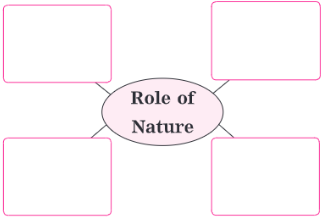
     We saw small bits of grass peeping through the small cracks in a concrete pavement. It left us thinking : however impossible things may look, there is always an opening...
     We saw a tree bare of all leaves in the cold winter months. We thought its chapter was over. But three months passed, spring set in and the tree was back to its green majesty once again, full of leaves, flowers, birds and life. What if we too had the conviction that, however difficult things are right now, it will not remain so for ever. Remember, this too shall pass.
     We saw an army of ants lugging a fly which was at least ten times the ant’s size. The ants organized themselves around the fly, lifted it on frail feelers and carried it to quite a distance. Their teamwork and perseverance were impressive. What if we too are consistent, organized, focused...Spider webs are delicate, yet very strong. A rainbow colours the entire sky. Oysters take in a grain of sand they open up with a pearl. Innumerable stars shine across the infinite sky. Clouds take new shapes with every passing moment. The wind makes trees dance with unhindered passion. Water, without hint of ego, changes its form according to the dictates of the sun and the wind. When we see a caterpillar turn into a butterfly, a flower turn into a fruit, we experience the alchemy of nature... we touch it and become gold ourselves.

A2. Complex Factual Activities:
Complete the following web :
Image
A3. Activities based on Vocabulary:
Find out synonyms from the text for the following words/phrases:
(1) to peer through
(2) easily broken or damaged
(3) mysterious power
(4) drag with great efforts
A4. Activities based on Contextual Grammar:

Do as directed:
(1) We saw an army of ants. (Choose the correct sentence of passive voice.)
(a) An army of ants was seen by us.
(b) An army of ants were seen by us.
(c) An army of ants is seen by us.
(d) An army of ants are seen by us.
(2) We touch it. (Rewrite the sentence in 'Past Perfect Tense.')
A5. Personal Response:
(1) How can learning from nature help human beings?
A1. Simple Factual Activity:
Write whether the following statements are 'true' or 'false":
(1) Writer's father was a medical professional.
(2) After a hearty lunch the narrator settled down with a story book.

     My father was a medical professional working for a private company in Raniganj in West Bengal. The officers of the company were housed in individual bungalows inside a large campus. Our house was in a corner of the campus. The officer’s club was adjacent to the boundary wall of our garden. The compound was luxurious with green grass, colourful flowers and a host of tall and majestic trees. The seasonal vegetables in the kitchen gardens of the households and the magnificent trees constantly attracted squirrels and many species of birds; a group of langurs had even made their den in an aswatha tree nearby. They had all become a part and parcel of our existence and daily life.
     A small incident on a Saturday afternoon left a profound effect on me and unfolded before my eyes a whole new dimension to the wonders of God’s creation. It was a few days into the Puja vacation. Just like for any other child, the holidays provided an opportunity for me to become engrossed in various magazines and storybooks published specially for children in the festive season.
     After a hearty lunch, my parents and my younger sisters lay down for an afternoon nap and I settled down with a storybook. The quiet afternoon presented the perfect backdrop for reading an adventure story. The silence was occasionally broken by the sound of my family snoring, the intermittent chirping of house sparrows, the harsh cawing of a crow the shrill call of a kite flying high above the ground. Minutes ticked by. I became deeply absorbed in the book.

A2. Complex Factual Activities:
Complete the web describing the campus where writer's family lived:
Image
A3. Activities based on Vocabulary:
Match the synonyms:

Column 'A'

Column 'B'

(1) revealed

(a) opportunity

(2) new factor

(b) engrossed in

(3) occupied in

(c) new dimension

(4) chance

(d) unfolded


A4. Activities based on Contextual Grammar: 
(1) The writer's house was in a corner of the ampus.
(Make 'Wh-question' to get underlined part as an answer.) 
(2) I became deeply absorbed in the book.
(Rewrite it in Simple Present Tense)
A5. Personal Response :
(1) Do you like to live in a bungalow? Why?