Question
A1.Simple Factual Activities:
Choose the correct options from the bracket and fill in the blanks:
(younger, eighty, twenty, interval)
(i) I went over during the _______ and sat down beside her.
(ii) None of us are getting any _______ . 
(iii) It was _______ years ago.
(iv) I had _______ francs to last me the rest of the month.

  I caught sight of her at the play and in answer to her call. I went over during the interval and sat down beside her. It was long since I had last seen her and, if someone had not mentioned her name, I hardly think I would have recognised her. She addressd me brightly.
  “Well, it’s many years since we first met. How time does fly ! We’re none of us getting any younger.Do you remember the first time I saw you? You asked me to luncheon.”
   Did I remember ?
   It was twenty years ago and I was living in Paris. I had a tiny apartment and I was earning barely enough money. She had read a book of mine and had written to
me about it. I answered, thanking her, and presently, I received from her another letter saying she was passing through Paris and would like to have a chat with me.But her time was limited and the only free moment she had was on the following Thursday and would I give her a little luncheon at Foyot’s afterwards ? Foyot’s is a restaurant and it was so far beyond my means that I had never even thought of going there. I had
eighty francs (gold francs) to last me the rest of the month and a modest luncheon should not cost more than fifteen. If I cut out coffee for the next two weeks, I could manage well enough.

A2. Complex Factual Activity:
(i)  Who said these words/sentences? Under what circumstances?

Words/
Sentences
Who
said?
Under what circumstances?
 It's many years since   we first met.  

A3. Activity based on Vocabulary:
Find out the 'Synonyms' from the passage for the words:
 
(i) A set of rooms: 
(ii) Acknowledged: 
(iii) Handle: 
(iii) Directed a remark: 
A4. Activities based on Contextual Grammar:
Rewrite the following sentence using the antonym of the underlined word:
(i) We're none of us getting any younger.'
Rewrite the following sentence using 'except':
(ii) The only free moment she had was on the following Thursday.
A5. Personal Response:
(i) If you were in the place of the narrator, how would you have reacted in the given situation?
Answer

A1.Simple Factual Activities:
(i) I went over during the interval and sat down beside her.
(ii) None of us are getting any younger .
(iii) It was eighty years ago.
(iv) I had eighty francs to last me the rest of the month.
A2. Complex Factual Activity:

Words/
Sentences
Who
said?
Under what circumstances?
 It's many years since   we first met. The Guest When she met the writer at   a play and called him over   during the interval to talk to   him.

A3. Activity based on Vocabulary:
(i) Apartment
(ii) Recognized
(iii) Manage
(iv) Addressed
A4. Activities based on Contextual Grammar:
(i) We're all of us getting older.
(ii) She had no free moment except on the following Thursday.
A5. Personal Response:
(i) If I were in the place of the narrator, I would have bluntly told the lady that I was a struggling writer and could not afford to give her a luncheon at Foyot's. I would have suggested some cheaper restaurant that I could afford. I would not try to show off, or spend more than I can afford, just to impress somcone.

Need a full question paper?

Generate a complete, print-ready paper with questions like this in minutes — across 16+ boards, with answer keys.

Start Generating Free

Similar questions

A1. Simple Factual Activities :
Choose the correct alternatives from the given options and rewrite the sentences:
(appealing, casually, flattery, well-otled)
(i) I followed __________.
(ii) Anil talked about the __________ wrestlers.
(iii) I gave him my most __________ smile.
(iv) A little __________ helps in making friends.

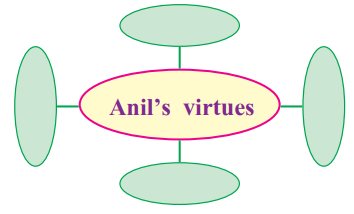
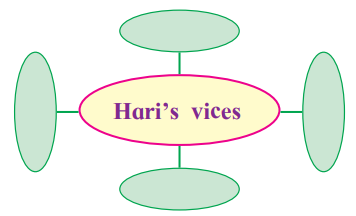
   I was still a thief when I met Anil. And though only only 15. I was an experienced and fairly successful hand.
   Anil was watching a wrestling match when I approached him. He was about 25 a tall, lean fellow - and he looked easy-going, kind and simple enough for my purpose. I hadn't had much luck of late and thought I might be able to get into the young man's confidence.
   "You look a bit of a wrestler yourself." I said. A little flattery helps in making friends.
   "So do you," he replied, which put me off for a moment because at that time I was rather thin.
   "Well," I said modestly, "I do wrestle a bit."
   "What's your name?"
   "Hari Singh," I lied. I took a new name every month. That kept me ahead of the police and my former employers.
    After this introduction, Anil talked about the well-oiled wrestlers who were grunting, lifting and throwing each other about. I didn't have much to say. Anil walked away. I followed casually.
   "Hello again," he said.
    I gave him my most appealing smile. "I want to work for you," I said.
   "But I can't pay you."
    I thought that over for a minute. Perhaps I had misjudged my man.
    I asked, "Can you feed me?"
    "Can you cook?"
    "I can cook." I lied again.
    "If you can cook, then may be I can feed you."

A2. Complex Factual Activities:
Complete the web diagrams:
(i) 

Image
(ii)
Image

A3. Activities based on Vocabulary:
Find similar meanings from the passage for the following:
(i) endearing
(ii) miscalculated
(iii) humbly
(iv) awful
A4. Do as directed:
(i) I can't pay you. (Rewrite making it affirmative.)
(ii) "I want to work for you," I said. (Change into Indirect speech.)
A5. Personal Response:
(i) Why did Anil employ Hari as a cook, even though he could not afford to pay him?

A1.Simple Factual Activities:
Complete the following sentences using word/words from the passage : (Nov. '2O)
(i) Hemingway's novel is based on ________ .
(ii) The novel was published in ________ .
(iii) During the First World War, Hemingway worked for __________ .
(iv) Hemingway had experience of fishing in __________ .

    An old and experienced Cuban fisherman has a run of terrible bad luck and is unable to catch any fish for eighty-four days. His young and devoted apprentice, Manolin, has been forced by his parents to start working with another fisherman. The old man resolves to sail out farther than all the other fishermen and attempt to catch the really big fish. On the eightyfifth day he succeeds in hooking a marlin with his bait but the marlin is too strong for him and starts pulling the boat. ‘The Old Man and the Sea’ is the story of the old man’s struggle with the marlin and his later battle against sharks.
   Social/Historical context:
   Hemingway’s novel is based on real events and it also draws heavily on his own life. He had experience of fishing in the Cuban waters and like the old man he was also a fan of baseball. He worked for the Red Cross during the First World War and was injured by shrapnel when he was in Italy. Hemingway always talks about the need to struggle against defeat or death and how determination and endurance can help one to win in this struggle. The old man is at the end of the novel very near death, but we know that the story of his suffering and loss will live on in the memories of the people of his village. Ultimately, his story becomes one of triumph because the tales of his life will live on even after his death. The novel was published in 1952, when people were trying to recover from the mass destruction wrought by the two world wars, and this tale of endurance and ultimate triumph immediately struck a chord with the readers.

A2. Complex Factual Activity:
Complete : (Nov. '20)
(i) Two things which Hemingway always talks about :
A3. Activity based on Vocabulary:
(i) Add suffix to make adjectives: (Nov. "20)
(a) injury (b) memory
(ii) Write the synonyms from the passage for the following words : (Nov. 20)
(a) victory (b) tolerance
A4. Activities based on Contextual Grammar:
Do as directed : (Nov, '20)
(i) Ultimately his story becomes one of triumph.
(Rewrite the present perfect tense.)
(ii) He was injured during the First World War.
(Frame a Wh-question to get the underlined part as the answer.)
A5. Personal Response:
(i) Would you prefer reading a book or watching an animated film? Justify you answer. (Nov, 20)
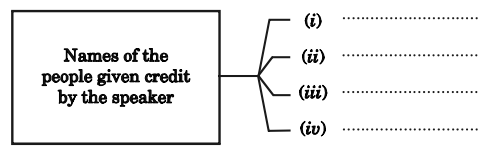
I give the biggest credit of this honour to my movement's Kaalu Kumar, Dhoom Das and Adarsh Kishore from India and Iqbal Masih from Pakistan who made the supreme sacrifice for protecting the freedom and dignity of children. I humbly accept this award on behalf of all such martyrs, my fellow activists across the world and my countrymen.
My journey from the great land of Lord Buddha, Guru Nanak and Mahatma Gandhi, India to Norway is a connect between the two centres of global peace and brotherhood, ancient and modern.
Friends, the Nobel Committee has generously invited me to present a "lecture." Respectfully, I am unable to do that. Because, I am representing here - the sound of silence. The cry of innocence. And, the face of invisibility. I represent millions of those children who are left behind and that's why I have kept an empty chair here as a reminder.
I have come here only to share the voices and dreams of our children - because they are all our children (gesture to everyone in the audience). I have looked into their frightened and exhausted eyes. I have held their injured bodies and felt their broken spirits.

B1. Complete the activity :
Image

B2. Fill up the boxes :
(i) Two centres of global peace:

Image
(ii) The speaker represents :
Image


B3. Write the antonyms of the following words by adding prefixes :
(a) honour × __________
(b) broken × __________
(ii) Give one word for the following from the passage :
(a) a person who works for social change .
(b) a person who sacrifices his/her life for the country.

B4. Do as directed :
(i) I humbly accept this award on behalf of all such martyrs.
(Pick out two determiners)
(ii) I have held their injured bodies and felt their broken spirits.
(Rewrite the sentence by using ‘not only–but also’)

B5. Would you like to be a social worker when you grow up ? Why ?
A1. Simple Factual Activities:
Complete the table:

The words....Who said...To Whom...
(i) This may all be nonsense.  
(ii) I wash my hands of it.  
(iii) How is she to get into the royal presence?  
(iv) And the dress?  

Robert : (To Poulengey) This may all be nonsense, Polly. But the troops might
just be inspired by it though nothing that we say seems to put any fire into
them. Even the Dauphin might believe it. And if she can put some fight into
him, she can put it into anybody.
Robert :
(Turning to Joan) Now you, listen to me and don’t cut in before I have time to think. Your orders are that you are to go to Chinon under the escort of this gentleman and three of his friends.
Joan :
(Radiant, clasping her hands) Oh, thank you, squire !
Poulengey :
How is she to get into the royal presence ?
Robert :
I don’t know. How did she get into my presence ? I will send her to Chinon and she can say I sent her. Then, let come what may. I can do no more.
Joan :
And the dress ? I may have a soldier’s dress, squire ?
Robert :
Take what you please. I wash my hands off it.
Joan :
(Wildly excited by her success) Come, Polly. (She dashes out.)
Robert :
(Shaking Poulengey’s hand) Goodbye, old man, I am taking a big chance. Few other men would have done it. But as you say, there is something about her.
Poulengey :
Yes, there is something about her. Goodbye.

A2. Complex Factual Activities:
Give reasons:
(i) Robert finally agreed to the plan.
A3. Activities based on Vocabulary:
Use the following words in separate sentences, with the words having different meanings:
(i) fire (ii) dress
A4. Activities based on Contextual Grammar:
Rewrite the following as Assertive sentences:  

(i) Make the following sentence Affirmative without changing the meaning:
I can do no more.
(ii) Pick out the modal auxiliary and state its function.
Even the Dauphin might believe it.
A5. Personal Response:
(i)  Do you think that Joan succeeds in her plan?

A1. Simple Factual Activity:
Pick out the statements that are false and write Them correctly:
(i) On the beach, the author found rocks carved and sculpted by the wind.
(ii) The hibiscus flower smiles with the sun and Hances with the wind.
(iii) Rocks take the shape that the water commands.
(iv) Our problems are big and so are we.

To see a world in a grain of sand
And a heaven in a wild flower,
Hold infinity in the palm of your hand
And eternity in an hour

   Something, as tiny as a grain of sand, can spark off an idea or imagination of a huge
significance to the world. One can witness and experience the beauty of Heaven in something as small as wild flower and derive joy forever. Only one should have the eyes and time to see it.
   Infinity is endless space; but your small palm can hold the destiny of earth through your efforts.Eternity is endless time; but just an hour in your life can make a difference to the world forever.
(Great deeds can surpass the limits of time and space. They never die.)
   We instinctively turn to outdoor activities and nature as a way of relaxing and enhancing our well being. Nature soothes and nurtures. Nature fulfils and
motivates. Nature whispers and commands.
    Are you listening?
   When I do, it leaves me in complete awe.
   We have a hibiscus plant in our garden. Every fortnight a flower blooms on it-big, bright and tender. Through the day it smiles with the sun and dances with the wind, but as evening approaches, it starts wilting. The morning after, it withers completely and by evening it falls and becomes one with the earth again. The flower comes to life only for a day, yet it does so in full splendour. What if we too lived our life, however short, to its fullest ?
   We went to a rocky beach and saw the spread of the majestic ocean and the rocks alongside, carved, sculpted and shaped by the water. Water is so gentle, rock so hard, yet, as the water flows over it every day, for years, the rock gives in. It takes the shape that the water commands. Our problems are so colossal and we are so small, yet if we persist...
A2. Complex Factual Activities:
Read the following questions from the passage. What do they imply?
(i) Are you listening?
(ii) What if we too had lived our lives, however short, to the fullest?
A3. Activities based on Vocabulary:
(i) Pick out the examples of concrete nouns from the passage.
Concrete nouns nouns that we can touch or see.
(ii) Pick out the examples of abstract nouns from the passage.
Abstract nouns nouns that we can't touch or see.
A4. Activities based on Contextual Grammar:
Underline the verbs in the sentences below, and say whether they are Transitive (T) or Intransitive (I):
(i) One can witness and experience the beauty of Heaven. 
(ii) It leaves me in complete awe. 
(iii) Nature soothes and nurtures,
(iv) It withers completely. 
A5. Personal Response:
(i) Why does the writer begin by quoting the lines from William Blake's poem 'Auguries of Innocence"?

A1. Simple Factual Activities:
Arrange the following incidents from Steve Jobs' life in proper sequence based on this passage:
(i) Jobs married Laurene.
(ii) Jobs returned to Apple Inc.
(iii) Jobs started Next.
(iv) Jobs got fired.

   My second story is about love and loss. I found what I loved to do early in life. Woz (Steve Wozniak) and I started Apple when I was 20. In 10 years Apple had grown from just the two of us in a garage into a $2 billion company. And then I got fired. It was
devastating.
    But something slowly began to dawn on me - I still loved what I did. And so I decided to start over.
   The heaviness of being successful was replaced by the lightness of being a beginner again. It freed me to enter one of the most creative periods of my life.
    During the next five years, I started a company Next, another company named Pixar, and fell in love with an amazing woman who would become my wife. Pixar is now the world’s most successful animation studio, Apple bought Next. I returned to Apple and
the technology we developed at Next is at the heart of Apple’s current renaissance. And Laurene and I have a wonderful family together.
   Sometimes life hits you in the head with a brick. Don’t lose faith. The only way to do great work is to love what you do. If you haven’t found it yet, keep looking. Don’t settle.

A2. Complex Factual Activities:
Say how:
(i) Jobs reacted later on, after the shock of being fired from Apple.
A3. Activities based on Vocabulary:
Match the words/phrases in column A with their meanings in column B:

(A)(B)
 (i) renaissance (a) causing great destruction
 (ii) to start over (b) lost one's job
 (iii) fired (c) revival
 (iv) devastating (d) to begin again

A4. Activities based on Contextual Grammar:
(i) I started a company. (Rewrite changing to the present continuous tense.)
(ii) Life hits you in the head. (Rewrite in the present perfect continuous tense.)
A5. Personal Response:
(i) What does this second story of Jobs convey to you?

A1.Simple Factual Activities:
Complete the following :
(i) They decided to have luncheon at _________  at _________ on a _________.

  I answered that I would meet my friend at Foyot’s on Thursday at half-past twelve. She was, in appearance,imposing rather than attractive and she gave me the impression of having more teeth, white and large and even, than were necessary for any practical purpose.She was talkative, but since she seemed to want to talk about me, I was prepared to be an attentive listener.
  I was startled when the menu was brought, for the prices were a great deal higher than I had thought. But she reassured me.
  “I never eat anything for luncheon,” she said.
  “Oh, don’t say that!” I answered generously.
   “I never eat more than one thing. I think people eat far too much nowadays. A little fish, perhaps. I wonder if they have any salmon.”
   Well, it was early in the year for salmon and it was not on the menu, but I asked the waiter if there was any. Yes, a beautiful salmon had just come in-it was the first they had had. I ordered it for my guest. The waiter asked her if she would have something while it was being cooked. “No,” she answered, “I never eat more than one thing. Unless you had a little caviar. I never mind caviar.”
   I knew I could not afford caviar, but I could not very well tell her that. For myself, I chose the cheapest dish on the menu and that was a mutton chop. 
   “I think you’re unwise to eat meat,” she said. “I don’t believe in overloading my stomach.” 
A2. Complex Factual Activity:
Who said these words/sentences? Under what circumstances?

Words/
Sentences
Who
said?
Under what circumstances?
 (i) I never eat anything       for luncheon.  
 (ii) I don't belicve in               overloading  my stomach.  

A3. Activity based on Vocabulary:
Choose the correct options from the brackets and fill in the blanks:
(reassured, imposing, generously, unwise)
(i) The crow was _______ to sing. 
(ii) The king decided to distribute his wealth among his subjects ________.
(iii) I was _______ when I saw that I remembered all that I had revised.
(iii) The monument was really very ________ .
A4. Activities based on Contextual Grammar:
Change the voice of the following sentences :
(i) She reassured me.
(ii) I ordered it for my guest.
A5. Personal Response:
(i) Are you careful in your eating habits?

A1. Simple Factual Activities:
Name the following:
(i) The world's most successful animation studio.
(ii) The company that Steve Jobs took ve years to establish.
(iii) The company that bought Next.
(iv) Steve Jobs' wife.

   My second story is about love and loss. I found what I loved to do early in life. Woz (Steve Wozniak) and I started Apple when I was 20. In 10 years Apple had grown from just the two of us in a garage into a $2 billion company. And then I got fired. It was
devastating.
    But something slowly began to dawn on me - I still loved what I did. And so I decided to start over.
   The heaviness of being successful was replaced by the lightness of being a beginner again. It freed me to enter one of the most creative periods of my life.
    During the next five years, I started a company Next, another company named Pixar, and fell in love with an amazing woman who would become my wife. Pixar is now the world’s most successful animation studio, Apple bought Next. I returned to Apple and
the technology we developed at Next is at the heart of Apple’s current renaissance. And Laurene and I have a wonderful family together.
   Sometimes life hits you in the head with a brick. Don’t lose faith. The only way to do great work is to love what you do. If you haven’t found it yet, keep looking. Don’t settle.

A2. Complex Factual Activities:
Say how:
(i) What setback did Jobs suffer when he was thirty?
A3. Activities based on Vocabulary:
(i) When the father learned about his son's misdeeds, it .................. .
(ii) Even if you don't succeed at first, don't .................. in yourself.
(iii) It is corruption in high places that lies ................. of the non-development of this locality.
(iv) On reading exactly the same essays in both answer sheets, it ................ the examiner that the students had cheated during the exams.
A4. Activities based on Contextual Grammar:
(i) You haven't found it. (Name the tense of the verbs underlined to include Time and Aspect.)
(ii) I got fired.(Rewrite changing to the future perfect tense.)
A5. Personal Response:
(i) Which quality of Steve Jobs impresses you the most? How would you apply it in your life?
A1. Simple Factual Activities:
Complete the table given below:

 EventYear
(1) The birth of Arjan Singh ..............
(2) Selected for the Empire Pilot Training Course ..............
(3) Promoted to the rank of Squadron Leader ..............
(4) Retired from service ..............

   Commending his role in the war, Y B Chavan, the then Defence Minister had written: “Air Marshal Arjan Singh is a jewel of a person, quite efficient and firm; unexcitable but a very able leader.”
   In 1944, the Marshal had led a squadron against the Japanese during the Arakan Campaign, flying close air support missions during the crucial Imphal Campaign and later assisted the advance of the Allied Forces to Yangoon (formerly Rangoon).
   In recognition of his feat, he was awarded the Distinguished Flying Cross (DFC) on the spot by the Supreme Allied Commander of South East Asia, the first Indian pilot to have received it. Singh was selected for the Empire Pilot training course at Royal Air Force
(RAF) Cranwell in 1938 when he was 19 years old. He retired from service in 1969.
   Singh was born on April 15, 1919, in Lyalpur (now Faislabad, Pakistan), and completed his education at Montgomery (now Sahiwal, Pakistan). His first assignment on being commissioned was to fly Westland Wapiti biplanes in the North-Western Frontier Province
as a member of the No.1 RIAF Squadron.
   After a brief stint with the newly formed No. 2 RIAF Squadron where the Marshal flew against the tribal forces, he later moved back to No.1 Sqn as a Flying Officer to fly the Hawker Hurricane. He was promoted to the rank of Squadron Leader in 1944.

A2. Complex Factual Activities:
Say what actions preceded the following promotions of Arjan Singh in his career in the IAF:
(i) Selected for Empire Pilot training course at RAF:
(ii) Promoted to Squadron Leader:
A3. Activities based on Vocabulary:
Replace the underlined words/phrases with the appropriate ones, to retain the proper meaning:
(be the epitome of. gear up, a brief stint, play a major role, in recognition of, take over reins)
(i) After a short period of working as a lecturer. Ravi took up an important post in a multinational company.
(ii) Accepting the great value of his research, they awarded him with a Ph.D. (degree)
A4. Activities based on Contextual Grammar: 
(i) In 1944, the Marshal had led a squadron against the Japanese during the Arakan Campaign. (Change the voice.)
(ii) His first assignment on being commissioned was to fly Westland Wapiti biplanes in the North- Y Western Frontier Province.(Rewrite as a complex sentence.)
A5. Personal Response:
(i) Name any four qualities that you think a leader must have.

A1.Simple Simple l Factual Activities:
Fill in the blanks:
(i) Dr Kalam's message made an Impact on the writer because of its .............. and the ............... it posed became his silent motivation.
(ii) The .............. of .............. lies in the answer to the question 'What can I give?'
 
  ‘Turning to me, he asked, ‘What is the reverse of “What can I give ?”
  Circumspectly I replied, ‘What can I...take ?’ ‘Yes,’ he said, ‘and that is the thought which is responsible for all the wrong we see around us. We think that we can take from the environment and destroy it indiscriminately; we think of what we can take from other humans, leading us to corruption and inequity. This attitude of taking and taking even
destroys families. To keep this planet liveable and the human race thriving, we have to replace this attitude of ‘what can I take’ with the goodness of ‘what can I give’.
  The gravity of the message struck me. This challenge became my silent motivation.
  Three years later, in 2012, this idea became a reality as our What Can I Give movement, through which Dr Kalam tried to combat corruption, environmental degradation and social evils.
   It is important that we ask ourselves this question for in the answer lies the truth of humanity. So go ahead and question yourself.
   What can I give ?
   The answers will be astounding.  

A2. Complex Factual Activity:
Rearrange the letters to form sensible words:

(i) To keep this planet liveable and the human race thriving, we have to replace this attitude of 'what can I take with the goodness of 'what can I give.
(ii) Dr Kalam tried to combat corruption, environmental degradation and social evils.
A3. Activities based on Vocabulary:
From the passage write one word for:
(i) without making a difference :
(ii) in a cautious way :
A4. Activities based on Contextual Grammar:
Write what the underlined auxiliaries indicate:

(i) What can I give?
(ii) We have to replace this attitude ....
A5. Personal Response:
(i) Why is there an urgent need to replace 'What can I take' with 'What can I give'