$A\,\,{5\,^o}C$ rise in the temperature is observed in a conductor by passing some current. When the current is doubled, then rise in temperature will be equal to ............. $^oC$
Medium
Download our app for free and get started
(c) Using conservation of energy
Supplied electric energy = absorbed heat energy
$ \Rightarrow $ ${i^2}Rt = mST$
$ \Rightarrow $ $T \propto {i^2}$ ($T$ - change in temperature)
i.e. when $i$ is doubled $T$ will be four times i.e. $5 \times 4 = {20\,^o}C$
Supplied electric energy = absorbed heat energy
$ \Rightarrow $ ${i^2}Rt = mST$
$ \Rightarrow $ $T \propto {i^2}$ ($T$ - change in temperature)
i.e. when $i$ is doubled $T$ will be four times i.e. $5 \times 4 = {20\,^o}C$

Download our appand get started for free
Experience the future of education. Simply download our apps or reach out to us for more information. Let's shape the future of learning together!No signup needed.*
Similar Questions
- 1View SolutionThe relaxation time in conductors
- 2View SolutionWhich of the following is not equal to watt
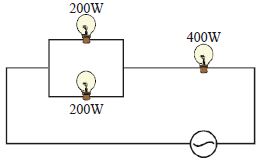
- 3Three electric bulbs of $200\,W,\,\,200\,W$ and $400\,W$ are shown in figure. The resultant power of the combination is ................ $W$View Solution
- 4View SolutionThe reciprocal of resistance is
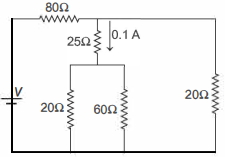
- 5A current of $0.1 \,A$ flows through a $25 \,\Omega$ resistor represented by the circuit diagram. The current in $80 \,\Omega$ resistor is ........... $A$View Solution
- 6$STATEMENT-1$ In a Meter Bridge experiment, null point for an unknown resistance is measured. Now, the unknown resistance is put inside an enclosure maintained at a higher temperature. The null point can be obtained at the same point as before by decreasing the value of the standard resistance. andView Solution
$STATEMENT-2$ Resistance of a metal increases with increase in temperature.
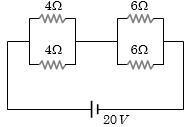
- 7Four resistances are connected in a circuit in the given figure. The electric current flowing through $4\, ohm$ and $6\, ohm$ resistance is respectivelyView Solution
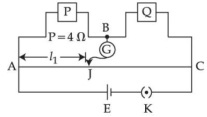
- 8Resistance are connected in a meter bridge circuit as shown in the figure. The balancing length $l_{1}$ is $40\,cm$. Now an unknown resistance $x$ is connected in series with $P$ and new balancing length is found to be $80\,cm$ measured from the same end. Then the value of $x$ will be $.......\Omega$View Solution
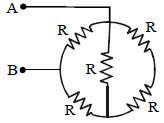
- 9The equivalent resistance between $A$ and $B$ isView Solution
- 10Four wires of the same diameter are connected in turn between two points, maintained at a constant potential difference. Their resistivities are; $\rho $ and $L$ (wire $1$ )., $1.2\,\rho $ and $1.2\,L$ (wire $2$ ), $0.9\,\rho $ and $0.9\,L$ (wire $3$ ) and $\rho $ and $1.5\,L$ (wire $4$ ). Rank the wires according to the rates at which energy is dissipated as heat, greatest firstView Solution