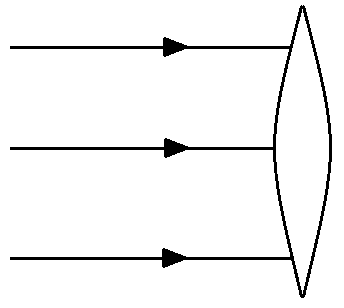
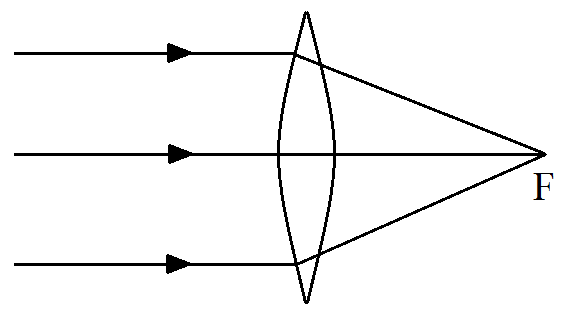
What type of lens is shown in the diagram on the right? What will happen to the parallel rays of light? Show by completing the ray diagram.
Download our app for free and get started
The lens shown in convex. the parallel rays will converge to a point called focus (F).

Download our appand get started for free
Experience the future of education. Simply download our apps or reach out to us for more information. Let's shape the future of learning together!No signup needed.*
Similar Questions
- 1View Solution
Explain how to read the following message which was found on some blotting paper:

- 2View SolutionWhat is meant by:
Draw diagram to show the action of convex mirror on a beam of parallel light rays. Mark on this diagram principal axis, focus F, centre of curvature C, pole P and focal length ƒ, of the convex mirror. - 3View SolutionTo find the image distance for varying object distances in case of a convex lens of focal length 15 cm, a student obtains on a screen a sharp image of a bright object by placing it at 20 cm distance from the lens. After that he gradually moves the object away from the lens and each time focuses the image on the screen.
- In which direction-towards or away from the lens does he move the screen to focus the object?
- How does the size of image change?
- Approximately at what distance does he obtain the image of magnification -1?
- How does the intensity of image change as the object moves farther and farther away from the lens?
- 4View SolutionAn extended object in the form of an arrow pointing upward has been placed in front of plane mirror. Draw a labelled ray-diagram to show the formation of its image.
- 5View SolutionA convex lens is immersed in a liquid of refractive index greater than that of glass. How will the nature of lens change?
- 6View SolutionHow could you find the focal length of a convex lens rapidly but approximately?
- 7View Solution“A concave mirror of focal length ‘f’ can form a magnified erect as well as an inverted image of an object placed in front of it.” Justify this statement stating the position of the object with respect to the mirror in each case for obtaining these images.
- 8View SolutionIt is desired to obtain an erect image of an object, using concave mirror of focal length of 12cm.
Where will the image of this object be, if it is placed 24cm in front of the mirror? Draw ray diagram for this situation also to justify your answer.
Show the positions of pole, principal focus and the centre of curvature in the above ray diagrams. - 9View SolutionWhere must the object be placed for the image formed by a converging lens to be:
- Real, inverted and smaller than the object?
- Real, inverted and same size as the object?
- Real, inverted and larger than the object?
- Virtual, upright and larger than the object?
- 10View SolutionYour eye contains a convex lens. Why is it unwise to look at the sun?