What is the minimum number of rays required for locating the image formed by a concave mirror for an object. Draw a ray diagram to show the formation of a virtual image by a concave mirror.
CBSE DELHI - SET 1 2009
Download our app for free and get started
2 rays are required for the image to be located!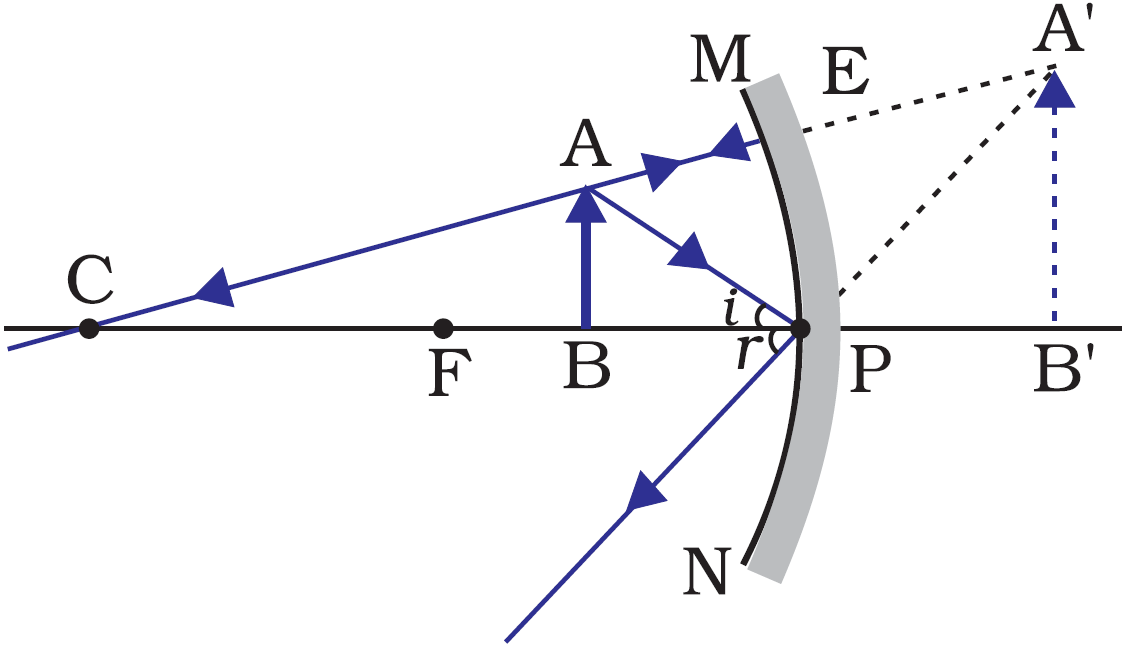

Download our appand get started for free
Experience the future of education. Simply download our apps or reach out to us for more information. Let's shape the future of learning together!No signup needed.*
Similar Questions
- 1View SolutionList four characteristics of the images formed by plane mirrors.
- 2View SolutionWith the help of a labelled diagram, explain how a concave lens diverges a beam of parallel light rays.
- 3View SolutionIf the object is moved further away from the mirror, what changes are there in the position and size of the image?
- 4View SolutionAn object is placed well outside the principal focus of a convex lens. Draw a ray diagram to show how.
- 5View SolutionWhen an object is placed at a distance of 15cm from a concave mirror, its image is formed at 10cm in front of the mirror. Calculate the focal length of the mirror.
- 6View Solution“A concave mirror of focal length ‘f’ can form a magnified erect as well as an inverted image of an object placed in front of it.” Justify this statement stating the position of the object with respect to the mirror in each case for obtaining these images.
- 7View SolutionWrite down the magnification formula for a lens in terms of object distance and image distance. How does this magnification formula for a lens differ from the corresponding formula for a mirror?
- 8View SolutionThe lens A produces a magnification of, -0.6 whereas lens B produces a magnification of +0.6:
- What is the nature of lens A?
- What is the nature of lens B?
- 9View SolutionA convex lens of focal length 25cm and a concave lens of focal length 10cm are placed in close focal contact with each other. Calculate the lens power of this combination.
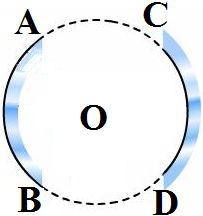
- 10AB and CD, two spherical mirrors, form parts of a hollow spherical ball with its centre at O as shown in the diagram. If arc $\text{AB}=\frac{1}{2}$ arc CD, what is the ratio of their focal lengths? State which of the two mirrors will always form virtual image of an object placed in front of it and why.View Solution