MCQ
$\text{ABC}$ is an equilateral triangle. Charges $+ q$ are placed at each corner. The electric intensity at $O$ will be
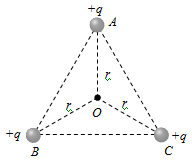
  • A
    $\frac{1}{4 \pi z_0} \frac{q}{r^2}$
  • B
    $\frac{1}{4 \pi \varepsilon_0} \frac{q}{r}$
  • Zero
  • D
    $\frac{1}{4 \pi \varepsilon_0} \frac{3 q}{r^2}$
Answer

Correct option: C.
Zero
Zero

Need a full question paper?

Generate a complete, print-ready paper with questions like this in minutes — across 16+ boards, with answer keys.

Start Generating Free

Similar questions

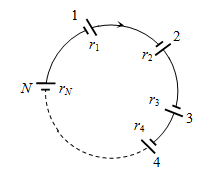
A group of $N$ cells whose emf varies directly with the internal resistance as per the equation $E_N = 1.5 r_N$ are connected as shown in the figure below. The current $I$ in the circuit is
The error in measuring the current with a tangent galvanometer is minimum when the deflection is about
Light of two different frequencies whose photons have energies 1eV and 2.5eV respectively, successively illuminates a metal of work function 0.5eV. The ratio of maximum kinetic energy of the emitted electron will be(a) 1 : 5(b) 1 : 4(c) 1 : 2(d) 1 : 1
       
An electron moving in a circular orbit of radius $r$ makes $n$ rotation per second. The magnetic field produced at the centre has a magnitude of
An $X-$ray has a wavelength of $0.010 \mathring A$ . Its momentum is
Identify the correct statement about the magnetic field lines:
The phenomenon by which stars recedes from each other is explained by:
A closed vessel is half filled with water. There is a hole near the top of the vessel and air is pumped out from this hole.
  1. The water level will rise up in the vessel.
  2. The pressure at the surface of the water will decrease.
  3. The force by the water on the bottom of the vessel will decrease.
  4. The density of the liquid will decrease.
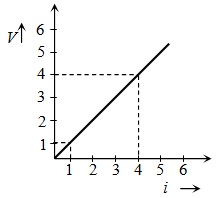
Variation of current and voltage in a conductor has been shown in the diagram below. The resistance of the conductor is
A particle of mass $M$ and charge $Q$ moving with velocity $\overrightarrow{\mathrm{v}}$ describes a circular path of radius $R$ when subjected to a uniform transverse magnetic field of induction $B.$ The work done by the field when the particle completes one full circle is