Question
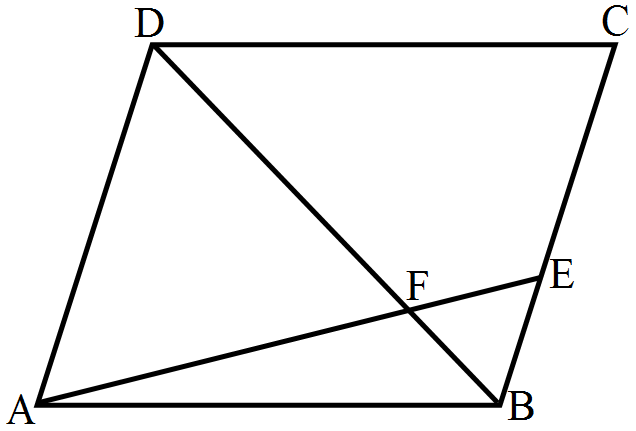
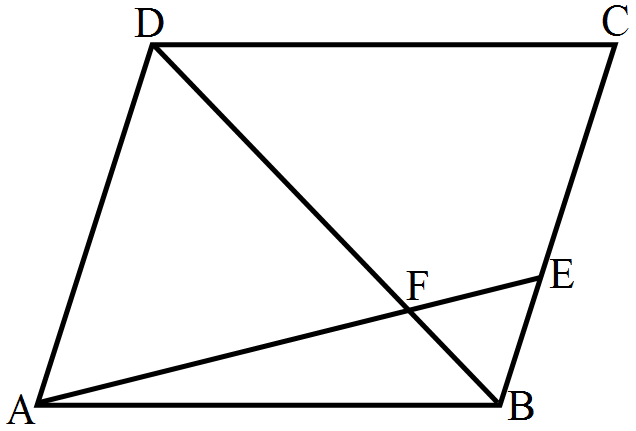
ABCD is a parallelogram and E is a point on BC. If the diagonal BD intersect AE at F, prove that AF × FB = EF × FD.
Answer


Given: ABCD is a parallelogram and E is point on BC. Diagonals DB intersects AE at F.
To Prove: AF × FB = EF × FD
Proof: In $\triangle\text{AFD}$ and $\triangle\text{EFD}$
$\angle\text{AFD}=\angle\text{EFB}$ $($vertically opposite $\angle\text{s})$
$\angle\text{DAF}=\angle\text{BEF}$ $($ Alternate $\angle\text{s})$
$\therefore\triangle\text{AFD}\approx\triangle\text{EFD}$ [By AAA similarity]
$\therefore\frac{\text{AF}}{\text{EF}}=\frac{\text{FD}}{\text{FB}}$
$\text{AF}\times\text{FB}=\text{EF}\times\text{FD}$
Hence proved.

Need a full question paper?

Generate a complete, print-ready paper with questions like this in minutes — across 16+ boards, with answer keys.

Start Generating Free

Similar questions

Find all the zeros of the polynomial $(2x^4 - 11x^3 + 7x^2 + 13x)$, it being given that two if its zeros are $3+\sqrt2$ and $3-\sqrt2.$
Prove that (4, 3), (6, 4) (5, 6) and (3, 5) are the angular points of a square.
The following distribution shows the daily pocket allowance of children of a locality. If the mean pocket allowance is Rs. 18, find the missing frequency f.
Daily pocket allowance (in Rs.)
11-13
13-15
15-17
17-19
19-21
21-23
23-25
Number of children
7
6
9
13
f
5
4
Solve the following system of equations by the method of cross-multiplication:
$\frac{\text{a}^2}{\text{x}}-\frac{\text{b}^2}{\text{y}}=0$
$\frac{\text{a}^2\text{b}}{\text{x}}+\frac{\text{b}^2\text{a}}{\text{y}}=\text{a}+\text{b}$ $\text{x},\text{y}\neq0$
The point A divides the join of P(-5, 1) and Q(3, 5) in the ratio k : 1. Find the two values of k for which the area of ΔABC where B is (1, 5) and C(7, -2) is equal to 2 units.
Find a point which is equidistant from the points A(-5, 4) and B(-1, 6)? How many such points are there?
A solid cone of base radius 10cm is cut into two parts through the midpoint of its height, by a plane parallel to its base. Find the ratio of the volumes of the two parts of the cone.
If (2, p) is the mipoint of the line segment joining the points A(6, -5) and B(-2, 11), find the values of a and p.

Draw the graphs of the equations x – y + 1 = 0 and 3x + 2y – 12 = 0. Determine the coordinates of the vertices of the triangle formed by these lines and the x-axis, and shade the triangular region.

Solve the following systems of equations graphically:
x - 2y = 6
3x - 6y = 0