Question
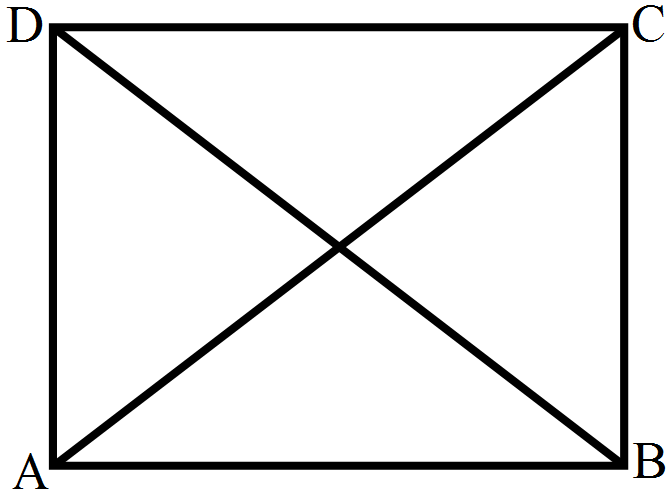
$\text{ABCD}$ is a rectangle in which diagonal $AC$ bisects $\angle\text{A}$ as well as $\angle\text{C}.$ Show that:
$i. \text{ABCD}$ is a square
$ii.$ diagonal $BD$ bisects $\angle\text{B}$ as well as $\angle\text{D}.$
Answer


$i. \text{ABCD}$ is a rectangle in which diagonal $AC $ bisects $\angle\text{A}$ as well as $\angle\text{C}.$
$\Rightarrow\angle\text{BAC}=\angle\text{DAC}...(1)$
And $\angle\text{BCA}=\angle\text{DCA}...(2)$
Since every rectangle is a parallelogram, therefore
$AB\ \|\ DC$ and $AC $ is the transversal.
$\Rightarrow\angle\text{BAC}=\angle\text{DCA}($alternate angles$)$
$\Rightarrow\angle\text{DAC}=\angle\text{DCA} [$from$]$
Thus in $\triangle\text{ADC},$
$\text{AD = CD} ($opposite sides of equal angles are equal$)$
But, $\text{AD = BC}$ and $\text{CD = AB} (\text{ABCD}$ is a rectangle$)$
$\Rightarrow\text{AB = BC = CD = AD}$
Hence, $\text{ABCD}$ is a square.
$ii.$ In $\triangle\text{BAD}$ and $\triangle\text{BCD},$
$\text{AB = CD}$
$\text{AD = BC}$
$\text{BD = BD}$
$\therefore\triangle\text{BAD}\cong\triangle\text{BCD} ($by $\text{SSS}$ congruence criterion$)$
$\Rightarrow\angle\text{ABD}=\angle\text{CBD}$ and $\angle\text{ADB}=\angle\text{CDB}[\text{CP.C.T.}]$
Hence, diagonal $BD$ bisects $\angle\text{B}$ as well as $\angle\text{D}.$
Need a full question paper?

Generate a complete, print-ready paper with questions like this in minutes — across 16+ boards, with answer keys.

Start Generating Free

Similar questions

In the adjoining figure, $X$ and $Y$ are respectively two point on equal sides $AB$ and $AC$ of $\triangle\text{ABC}$ such thet $AX = AY$. Prove that $CX$ $= BY.$
If $p=\frac{3-\sqrt{5}}{3+\sqrt{5}}$ and $q=\frac{3+\sqrt{5}}{3-\sqrt{5}}$, find the value of $p ^2+ q ^2$.
$(x + y)^3 - (x - y)^3$ can be factorized as:
The following table gives the quantity of goods (in crores of rupees)
Year
$1950–51$
$1960–61$
$1965–66$
$1970–71$
$1980–81$
$1982–83$
Quantity of goods (in crore tonnes)
$9$
$16$
$20$
$20$
$22$
$26$
Represent this information with the help of a bar graph.
Using factor theorem, factorize the polynomial : $x^3-6 x^2+3 x+10$
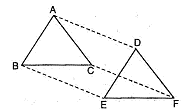
In $\triangle ABC$ and $\triangle DEF, AB = DE, AB \| DE, BC = EF$ and $BC \| EF.$ Vertices $A, B$ and $C$ are joined to vertices $D, E$ and $F$ respectively.

Show that:
$i.$ Quadrilateral $\text{ABED}$ is a parallelogram
$ii.$ Quadrilateral $\text{BECF}$ is a parallelogram
$iii.  AD \| CF$ and $AD = CF$
$iv.$ quadrilateral $\text{ACFD}$ is a parallelogram
$v. AC = DF$
$vi. \triangle ABC \cong \triangle DEF.$
Draw the graphs of the linear equations $4x - 3y + 4 = 0$ and $4x + 3y - 20 = 0.$ Find the area bounded by these lines and $x-$axis.
The factors of $x^2 + 4y^2 + 4y - 4xy - 2x - 8$, are:
Prove: Two distinct lines cannot have more than one point in common.