Abody is placed on a rough inclined plane of inclination $\theta$ .As the angle $\theta$ is increased from $0^o$ to $90^o$ the contact force between the block and the plane
Medium
Download our app for free and get started
contact force, $f=\mu N=\mu m g \cos \theta$
When $\theta=0, f=\mu m g$
If $\theta$ increases $\cos \theta$ will decrease. So $f$ will decrease with increasing $\theta$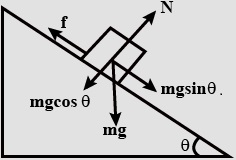

Download our appand get started for free
Experience the future of education. Simply download our apps or reach out to us for more information. Let's shape the future of learning together!No signup needed.*
Similar Questions
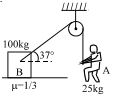
- 1Block $B$ of mass $100 kg$ rests on a rough surface of friction coefficient $\mu = 1/3$. $A$ rope is tied to block $B$ as shown in figure. The maximum acceleration with which boy $A$ of $25 kg$ can climbs on rope without making block move is:View Solution
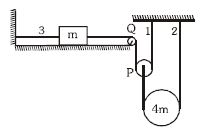
- 2Shown in the diagram is a system of two bodies, a block of mass $m$ and a disc of mass $4\ m$ , held in equilibrium. If the string $3$ is burnt, find the acceleration of the disc. Neglect the masses of the pulleys $P$ and $Q$ . The co-efficient of friction between the block and horizontal surface is $0.5$ and friction between disc and string is zero ........ $m/s^2$View Solution
- 3The time taken by an object to slide down $45^{\circ}$ rough inclined plane is $n$ times as it takes to slide down a perfectly smooth $45^{\circ}$ incline plane. The coefficient of kinetic friction between the object and the incline plane isView Solution
- 4A car of mass $1000\, kg$ negotiates a banked curve of radius $90\, m$ on a frictionless road. If the banking angle is $45^o $, the speed of the car is ....... $ms^{-1}$View Solution
- 5The minimum force required to start pushing a body up a rough (frictional coefficient $\mu$) inclined plane is $F _{1}$ while the minimum force needed to prevent it from sliding down is $F _{2}$. If the inclined plane makes an angle $\theta$ from the horizontal such that $\tan \theta=2 \mu$, then the ratio $\frac{F_{1}}{F_{2}}$ isView Solution
- 6A body starts from rest on a long inclined plane of slope $45^o$ . The coefficient of friction between the body and the plane varies as $\mu = 0.3\,x$ . where $x$ is distance travelled down the plane. The body will have maximum speed ( for $g = 10\,m/s^2$ ) when $x=$ ........ $m$View Solution
- 7View SolutionA metal block is resting on a rough wooden surface. A horizontal force applied to the block is increased uniformly. Which of the following curves correctly represents velocity of the block ?
- 8A heavy box of mass $50 \mathrm{~kg}$ is moving on a horizontal surface. If co-efficient of kinetic friction between the box and horizontal surface is $0.3$ then force of kinetic friction is :View Solution
- 9A block rests on a rough inclined plane making an angle of ${30^o}$ with the horizontal. The coefficient of static friction between the block and the plane is $0.8$. If the frictional force on the block is $10 \,N$, the mass of the block (in kg) is (take $g = 10\,\,m/{s^2})$View Solution
- 10A block of $200\, g$ mass moves with a uniform speed in a horizontal circular groove, with vertical side walls of radius $20\, cm$. If the block takes $40\, s$ to complete one round, the normal force by the side walls of the groove isView Solution