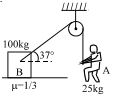
Block $B$ of mass $100 kg$ rests on a rough surface of friction coefficient $\mu = 1/3$. $A$ rope is tied to block $B$ as shown in figure. The maximum acceleration with which boy $A$ of $25 kg$ can climbs on rope without making block move is:
Advanced
Download our app for free and get started
Let $a$ be the maximum acceleration of man.
The block will remain fixed if horizontal component of tension in the rope is equal to the friction force of block against the ground. i.e.
$T \cos 37^{\circ}=f=\mu\left(m_{B} g-T \sin 37^{\circ}\right)$
$\frac{4 T}{5}=\frac{100 g}{3}-\frac{T}{5}$
$\therefore T=\frac{100 g}{3}$
Now, $m_{A} a=T-m_{A} g$
or, $25 a=\frac{100}{3} g-25 g$
or, $a=\frac{4}{3} g-g=\frac{g}{3}$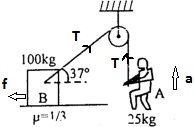

Download our appand get started for free
Experience the future of education. Simply download our apps or reach out to us for more information. Let's shape the future of learning together!No signup needed.*
Similar Questions
- 1A body of mass $1\, kg$ tied to one end of string is revolved in a horizontal circle of radius $0.1\, m$ with a speed of $3$ revolution/sec, assuming the effect of gravity is negligible, then linear velocity, acceleration and tension in the string will beView Solution
- 2A mass is supported on a frictionless horizontal surface. It is attached to a string and rotates about a fixed centre at an angular velocity ${\omega _0}$. If the length of the string and angular velocity are doubled, the tension in the string which was initially ${T_0}$ is nowView Solution
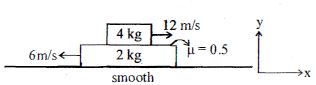
- 3The blocks are given velocity in the direction shown in figure. Co-efficient of friction between two blocks shown in figure is $μ = 0.5$. Take $g = 10\ m/s^2$View Solution
(considering $4\ kg$ block doesn't fall on ground)
Consider the following statements
$(i)$ Time when relative motion between them is stopped is $1.4\ second$.
$(ii)$ Time when relative motion between them is stopped in $1.2\ second$
$(iii)$ The common velocity of the two blocks is $8\ m/s$, towards right.
$(iv)$ The displacement of the $4\, kg$ block when relative motion stopped is$10.8\ m$.
Which of the fstatements is/are correct
- 4A motorcycle is going on an overbridge of radius $R$. The driver maintains a constant speed. As the motorcycle is ascending on the overbridge, the normal forces on it isView Solution
- 5The upper half of an inclined plane of inclination $\theta$ is perfectly smooth while lower half is rough. A block starting from rest at the top of the plane will again come to rest at the bottom, if the coefficient of friction between the block and lower half of the plane is given byView Solution
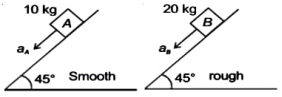
- 6The ratio of acceleration of blocks $A$ placed on smooth incline with block $B$ placed on rough incline is $2: 1$. The coefficient of kinetic friction between block $B$ and incline is .........View Solution
- 7A cyclist is travelling with velocity $v$ on a curved road of radius $R$. The angle $\theta$ through which the cyclist leans inwards is given byView Solution
- 8A mass of $2 \,kg$ is whirled in a horizontal circle by means of a string at an initial speed of $5$ revolutions per minute. Keeping the radius constant the tension in the string is doubled. The new speed is nearly ....... $rpm$View Solution
- 9View SolutionThe limiting friction between two bodies in contact is independent of
- 10$Assertion$ : On a rainy day it is difficult to drive a car or bus at high speed.View Solution
$Reason$ : The value of coefficient of friction is lowered due to wetting of the surface