A block of $200\, g$ mass moves with a uniform speed in a horizontal circular groove, with vertical side walls of radius $20\, cm$. If the block takes $40\, s$ to complete one round, the normal force by the side walls of the groove is
JEE MAIN 2021, Difficult
Download our app for free and get started
$N = m \omega^{2} R$
$N = m \left[\frac{4 \pi^{2}}{ T ^{2}}\right] R$
Given $m =0.2 kg , T =40 S , R =0.2 m$
$N =9.859 \times 10^{-4} N$

Download our appand get started for free
Experience the future of education. Simply download our apps or reach out to us for more information. Let's shape the future of learning together!No signup needed.*
Similar Questions
- 1A hemispherical bowl of radius $r$ is set rotating about its axis of symmetry in vertical. A small block kept in the bowl rotates with bowl without slipping on its surface. If the surface of the bowl is smooth and the angle made by the radius through the block with the vertical is $\theta$, then find the angular speed at which the ball is rotating.View Solution
- 2A body of mass $5\, kg$ is moving in a circle of radius $1\,m$ with an angular velocity of $2$ radian/sec. The centripetal force is ......... $N$View Solution
- 3A car is moving on a circular path and takes a turn. If ${R_1}$ and ${R_2}$ be the reactions on the inner and outer wheels respectively, thenView Solution
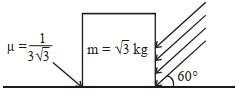
- 4As shown in the figure, a block of mass $\sqrt{3}\, kg$ is kept on a horizontal rough surface of coefficient of friction $\frac{1}{3 \sqrt{3}}$. The critical force to be applied on the vertical surface as shown at an angle $60^{\circ}$ with horizontal such that it does not move, will be $3 x$. The value of $3x$ will beView Solution
$\left[ g =10 m / s ^{2} ; \sin 60^{\circ}=\frac{\sqrt{3}}{2} ; \cos 60^{\circ}=\frac{1}{2}\right]$
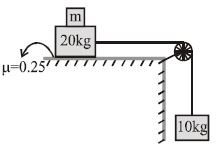
- 5Find the minimum value of $m$ that should placed on $20\, kg$, so that system remain at rest ........ $kg$View Solution
- 6A block is placed on a rough horizontal plane. A time dependent horizontal force $F = Kt$ acts on the block. Here $K$ is a positive constant. Acceleration-time graph of the block isView Solution
- 7A block is moving on an inclined plane making an angle $45^{\circ}$ with the horizontal and the coefficient of friction is $\mu$. The force required to just push it up the inclined plane is $3$ times the force required to just prevent it from sliding down. If we define $N=10 \ \mu$, then $N$ isView Solution
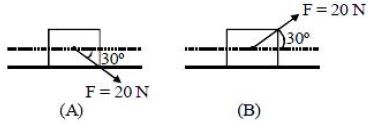
- 8A block of mass $5\, kg$ is $(i)$ pushed in case $(A)$ and $(ii)$ pulled in case $(B)$, by a force $F = 20\, N$, making an angle of $30^o$ with the horizontal, as shown in the figures. The coefficient of friction between the block and floor is $\mu = 0.2$. The difference between the accelerations of the block, in case $(B)$ and case $(A)$ will be $....... ms^{-2}$ .$(g = 10\, ms^{-2})$View Solution
- 9$Assertion$ : On a rainy day it is difficult to drive a car or bus at high speed.View Solution
$Reason$ : The value of coefficient of friction is lowered due to wetting of the surface - 10A block of mass $0.1 \,kg$ is held against a wall by applying a horizontal force of $5\, N$ on the block. If the coefficient of friction between the block and the wall is $0.5$, the magnitude of the frictional force acting on the block is ........ $N$View Solution