Question
Accepting the relation $\frac{v_s}{v_p}=\frac{ N _s}{N_s}$ for ideal transformer, and using thé formula of power; derive $\frac{I_p}{I_s}=\frac{v_s}{v_p}=\frac{N_s}{ N _p}$ and from that explain the types of the transformers.

Answer

$\rightarrow$ If the transformer is assumed to be $100 \%$ efficient $($no energy losses$),$ the input power is equal to the output power,
$\therefore I _p U _p= I _s U _s$
$\therefore \frac{ U _s}{ v _p}=\frac{ I _p}{ I _s}$
But $\frac{ U _s}{ v _p}=\frac{ N _s}{N_p}$
$\rightarrow $ But $\frac{v_s}{v_p}=\frac{ N _s}{N_p}$
we get $\frac{v_s}{v_p}=\frac{ N _s}{N_p}=\frac{ I _p}{ I _s}$.
$\rightarrow$ From this equation
$\frac{v_s}{v_p}=\frac{ N _s}{N_p} \frac{ N _s}{N_p}=\frac{ I _p}{ I _s}$
$\therefore v _s=\left(\frac{ N _s}{N_p}\right) \cdot v _p \ldots(2) $
$\therefore I _s=\frac{ N _p}{N_s} \cdot I _p \cdots$
$\rightarrow$ From eq. $(2)$ and $(3)$
$(i)$ If $N _s> N _p$ then $v_s>v_p$ which means the voltage is stepped up.
Such a transformer is called step up transformer.
$(ii) $ If $N _s< N _p$ then $v _s< v _p$ which means the voltage reduces $($or voltage is stepped down$)$.
Such a transformer is called step down transformer.

Need a full question paper?

Generate a complete, print-ready paper with questions like this in minutes — across 16+ boards, with answer keys.

Start Generating Free

Similar questions

A person standing on a platform finds that a train moving with velocity 0.6c takes one second to pass by him. Find:
  1. The length of the train as seen by the person and.
  2. The rest length of the train.
An electron microscope uses electrons accelerated by a voltage of $50\ kV$. Determine the de Broglie wavelength associated with the electrons. If other factors $($such as numerical aperture, etc.$)$ are taken to be roughly the same, how does the resolving power of an electron microscope compare with that of an optical microscope which uses yellow light?
A charged metallic sphere A is suspended by a nylon thread. Another charged metallic sphere B held by an insulating
Image
handle is brought close to A such that the distance between their centres is 10 cm, as shown in Fig. 1.4(a). The resulting repulsion of A is noted (for example, by shining a beam of light and measuring the deflection of its shadow on a screen). Spheres A and B are touched by uncharged spheres C and D respectively, as shown in Fig. 1.4(b). C and D are then removed and B is brought closer to A to a distance of 5.0 cm between their centres, as shown in Fig. 1.4(c). What is the expected repulsion of A on the basis of Coulomb’s law? Spheres A and C and spheres B and D have identical sizes. Ignore the sizes of A and B in comparison to the separation between their centres.
$\text{ }^{197}_{80}\text{Hg}$ decay to $\text{ }^{197}_{79}\text{Au}$ through electron capture with a decay constant of 0.257 per day.
  1. What other particle or particles are emitted in the decay?
  2. Assume that the electron is captured from the K shell. Use Moseley's law $\sqrt{\text{v}}=\text{a(Z}-\text{b})$ with $\text{a}=4.95\times10^7\text{s}^{-\frac{1}{2}}$ and b = 1 to find the wavelength of the $\text{K}_{\alpha}$ X-ray emitted following the electron capture.
Two particles $A$ and $B$ having charges of $+2.00 \times 10^{-6}C$ and of $-4.00 \times 10^{-6}C$ respectively are held fixed at a separation of $20.0\ cm.$ Locate the point$(s)$ on the line $AB$ where
  1. The electric field is zero.
  2. The electric potential is zero.
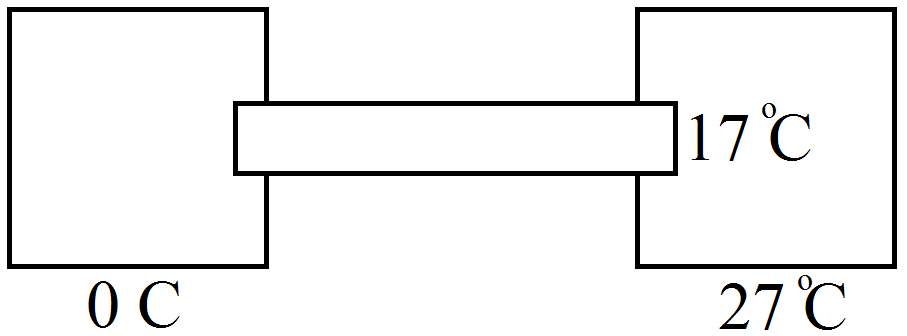
A cylindrical rod of length $50\ cm$ and cross sectional area $1\ cm^2$ is fitted between a large ice chamber at $0^\circ C$ and an evacuated chamber maintained at $27^\circ C$ as shown in figure. Only small portions of the rod are inside the chambers and the rest is thermally insulated from the surrounding. The cross section going into the evacuated chamber is blackened so that it completely absorbs any radiation falling on it. The temperature of the blackened end is $17^\circ C$ when steady state is reached. Stefan constant $\sigma=6\times10^{-8}\text{W/m}^{-2}\text{K}^{-4}.$ Find the thermal conductivity of the material of the rod.
The density of water at $0^\circ C$ is $0.998g \ cm^{-3}$ and at $4^\circ C$ is $1000g \ cm^{-3}.$Calculate the average coefficient of volume expansion of water in the temperature range $0$ to $4^\circ C.$
A string of length 40cm and weighing 10g is attached to a spring at one end and to a fixed wall at the other end. The spring has a spring constant of 160N/m and is stretched by 1.0cm. If a wave pulse is produced on the string near the wall, how much time will it take to reach the spring?
Which of the following will describe the smallest circle when projected with the same velocity perpendicular to the magnetic field B (i) $\alpha$-particle and (ii) $\beta$-particle?
The luminous flux of a 1W sodium vapour lamp is more than that of a 10kW source of ultraviolet radiation. Comment.