MCQ
According to Hess's law, the heat of reaction depends upon :
  • A
    Initial condition of reactants
  • Initial and final conditions of reactants
  • C
    Intermediate path of the reaction
  • D
    End conditions of reactants

Answer

Correct option: B.
Initial and final conditions of reactants
According to Hess's law, the heat of reaction depends upon Initial and final conditions of reactants. The the heat of reaction is independant of the intermediate path of the reaction.
For example, the heat of the reaction for the reaction $\ce{A \rightarrow D}$ is equal to the sum of the heats of the reactions $\ce{A \rightarrow B, B \rightarrow C, C \rightarrow D}.$

Need a full question paper?

Generate a complete, print-ready paper with questions like this in minutes — across 16+ boards, with answer keys.

Start Generating Free

Similar questions

Assertion : Sigma $(\sigma )$ is a strong bond, while pi $(\pi )$ is a weak bond.
Reason : Atoms rotate freely about pi $(\pi )$ bond.
$STATEMENT-1$: For every chemical reaction at equilibrium, standard Gibbs energy of reaction is zero. and $STATEMENT-2$: At constant temperature and pressure, chemical reactions are spontaneous in the direction of decreasing Gibbs energy.
${H_3}B{O_3} + {H_2}O_2 \to {H_2}O + 'X' {\xrightarrow{{NAOH}} }{'Y'}$

Which of the following statements is $/$ are Correct for $'Y'$

$Image$

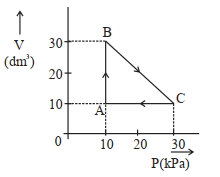
An ideal gas undergoes a cyclic transformation starting from the point $\mathrm{A}$ and coming back to the same point by tracing the path $\mathrm{A} \rightarrow \mathrm{B} \rightarrow \mathrm{C} \rightarrow \mathrm{A}$ as shown in the diagram. The total work done in the process is____ $J$.
Assign $A, B, C, D$ from given type of reaction. $NaI + Mn{O_2} + {H_2}S{O_4}\left( {conc.} \right) \to MnS{O_4} + {I_2} \uparrow $
Given below are two statements:

Statement-$I$: Since fluorine is more electronegative than nitrogen, the net dipole moment of $\mathrm{NF}_3$ is greater than $\mathrm{NH}_3$.

Statement-$II$: In $\mathrm{NH}_3$, the orbital dipole due to lone pair and the dipole moment of $\mathrm{NH}$ bonds are in opposite direction, but in $\mathrm{NF}_3$ the orbital dipole due to lone pair and dipole moments of $N-F$ bonds are in same direction.  In the light of the above statements. Choose the most appropriate from the options given below.

The close resemblance between the properties of an element of $2^{nd}$ period with those of the element of $3^{rd}$ period belonging to the next group is called:
A buffer solution with $pH$$=9$ is to be prepared by mixing $N{H_4}Cl$ and $N{H_4}OH$. Calculate the number of moles of $N{H_4}Cl$ that should be added to one litre of $1.0\,M\;N{H_4}OH.\,$ $[{K_b} = 1.8 \times {10^{ - 5}}]$
Acetylene gas when passed through the $20\%$ ${H_2}S{O_4}{\rm{ \,at\, }}\,{80\,^o }C$ gives acetaldehyde. The catalyst required for this conversion is
Product obtained after nitration of nitrobenzene is