MCQ 11 Mark
$\Delta_\text{f}\text{U}^\ominus$ of formation of $\text{CH}_4\ (\text{g})$ at certain temperature is $-393\ \text{kJ}\ \text{mol}^{-1}.$ The value of $\Delta_\text{f}\text{H}^\ominus$ is:
- A
- ✓
$<\Delta_\text{f}\text{U}^\ominus$
- C
$>\Delta_\text{f}\text{U}^\ominus$
- D
Equal to $\Delta_\text{f}\text{U}^\ominus$
AnswerCorrect option: B. $<\Delta_\text{f}\text{U}^\ominus$
$\Delta_\text{f}\text{H}^\ominus=\Delta_\text{f}\text{U}^\ominus+\Delta\text{n}_\text{g}\text{RT}$
For the reaction,
$\text{C}(\text{s})+2\text{H}_2(\text{g})\rightarrow\text{CH}_4$
$\therefore\ \Delta\text{n}_\text{g}=1-2=-1$
$\therefore\ \Delta_\text{f}\text{H}^\ominus= \Delta_\text{f}\text{U}^\ominus-1\text{RT}$
or$\ \Delta_\text{f}\text{U}^\ominus=\Delta_\text{f}\text{H}^\ominus+\text{RT}$
or$\ \Delta_\text{f}\text{H}^\ominus<\Delta_\text{f}\text{U}^\ominus$
View full question & answer→MCQ 21 Mark
Which of the following can be calculated from Born $-$ Haber cycle for $\mathrm{Al}_2 \mathrm{O}_3?$
- A
Lattice energy of $\mathrm{Al}_2 \mathrm{O}_3$
- B
Electron affinity of $O-$ atom
- C
Ionisation energy of $\ce{Al}$
- ✓
AnswerThe Born $-$ Haber Cycle can be applied to determine the lattice energy of an ionic solid; ionization energy, electron affinity, dissociation energy, sublimation energy, heat of formation, and Hess's Law.
View full question & answer→MCQ 31 Mark
The internal energy of a piece of lead when beaten by a hammer will :
- ✓
- B
- C
- D
Sometimes increases and sometimes decreases
AnswerWhen beaten by a hammer the material heats up due to the impact.
As the work done by this heat is zero there is a net increase in internal energy.
View full question & answer→MCQ 41 Mark
A liquid boils at such a temperature at which the saturated vapour pressure, as compared to atmospheric pressure, is :
AnswerThe vapor pressure at which a liquid boils is equal to the atmospheric pressure.
View full question & answer→MCQ 51 Mark
Which of the following is not a thermodynamic coordinate?
- ✓
Gas constant $(R)$
- B
Pressure $(P)$
- C
Volume $(V)$
- D
Temperature $(T)$
AnswerCorrect option: A. Gas constant $(R)$
$R$ is a constant and is not a thermodynamic constant.
View full question & answer→MCQ 61 Mark
The mathematical expression of first law of thermodynamics is :
- A
$\Delta\text{U}=\text{q}$
- B
$\Delta\text{U}=\text{W}$
- ✓
$\Delta\text{U}=\text{q}+\text{W}$
- D
$\Delta\text{U}=\text{W}_\text{ad}$
AnswerCorrect option: C. $\Delta\text{U}=\text{q}+\text{W}$
View full question & answer→MCQ 71 Mark
For an ideal solution containing two liquid components $A$ and $B,$ the Gibbs free energy of mixing is minimum, when the molar ratio of the liquids is :
- ✓
$1 : 1$
- B
$1 : 2$
- C
$1 :10$
- D
$1 : 1000$
AnswerCorrect option: A. $1 : 1$
View full question & answer→MCQ 81 Mark
For the process to occur under adiabatic conditions, the correct condition is :
- A
$\Delta\text{T}=0$
- B
$\Delta\text{p}=0$
- ✓
$\text{q}=0$
- D
$\text{w}=0$
AnswerCorrect option: C. $\text{q}=0$
View full question & answer→MCQ 91 Mark
Which specific process has negative value of specific heat?
AnswerIn case of saturated vapors, when a certain quantity of heat is removed, the temperature increases.
Hence, the specific heat is negative for saturated vapors.
View full question & answer→MCQ 101 Mark
In a thermodynamic system working subtance is ideal gas, its internal energy is in the from of :
- ✓
- B
Kinetic and potential energy
- C
- D
AnswerInternal energy is associated with the atoms or molecules of the gas.
In an ideal gas the energy is in the form of Kinetic energy only.
View full question & answer→MCQ 111 Mark
For both reversible and irreversible expansion of an ideal gas, under isothermal condition,
- ✓
$\Delta\text{U}=0,\Delta\text{S}_\text{total}\neq0$
- B
$\Delta\text{U}\neq0,\Delta\text{S}_\text{total}=0$
- C
$\Delta\text{U}=0,\Delta\text{S}_\text{total}\neq0$
- D
$\Delta\text{U}\neq0,\Delta\text{S}_\text{total}\neq0$
AnswerCorrect option: A. $\Delta\text{U}=0,\Delta\text{S}_\text{total}\neq0$
View full question & answer→MCQ 121 Mark
Which of the following endothermic processes are spontaneous?
AnswerCorrect option: D. Both $(a)$ and $(b)$
The reaction of baking soda with other acids, like hydrochloric acid, is also endothermic.
Melting of ice and Evaporation of water is show endothermic process.
View full question & answer→MCQ 131 Mark
The internal energy of a perfect gas depends on :
AnswerAccording to the assumptions of Kinetic Theory of Gases, the molecules do not occupy any volume and attractive forces are absent between molecules of an ideal gas.
Thus, other parameters such as volume, pressure etc do not play a significant role in the internal energy of an ideal gas and is a function of temperature only.
For an ideal gas, $\ce{U = U(T)}$
where, $U$ is the internal energy of the ideal gas.
$T$ is the temperature of the ideal gas.
View full question & answer→MCQ 141 Mark
The internal energy of a compressed real gas, as compared to that of the normal gas at the same temperature, is :
- ✓
- B
- C
Sometimes less, sometimes more
- D
AnswerThe internal energy wil be less due to the short range repulsive forces present between the molecules of the real gas.
View full question & answer→MCQ 151 Mark
What will be the value of logarithm of equilibrium constant $\ce{K_P}$ if the standard free energy change of a reaction is $\Delta\text{G}^\circ=-115\text{kJ}$ at $298K$ will be :
- A
$2.303$
- B
$13.83$
- C
$2.015$
- ✓
$20.15$
AnswerCorrect option: D. $20.15$
$\Delta\text{G}^\circ=-115\times10^3\text{J}$
$\text{T}=298\text{K, R}=8.314\text{JK}^{-1}\text{mol}^{-1}$
$-\Delta\text{G}^\circ=2.303\text{RT}\log_{10}\text{K}_\text{p}$
$-(-115\times10^3)=2.303\times8.314$
$\times298\log_{10}\text{K}_\text{p}$
$\log_{10}\text{K}_\text{p}=\frac{115000}{2.303\times8.314\times298}=20.15$
View full question & answer→MCQ 161 Mark
The standard enthalpies of formation of $\mathrm{CO}_2(\mathrm{~g}), \mathrm{H}_2 \mathrm{O}(\mathrm{l}) , (l)$ and glucose $(s)$ at $25^\circ C$ are $-400\text{ kJ/ mol}, -300\text{ kJ/ mol}$ and $-1300\text{ kJ/ mol}^{-1}$ respectively. The standard enthalpy of combustion per gram of glucose of $25^\circ C$ is:
- A
$+\ 2900kJ$
- B
$-\ 2900kJ$
- ✓
$-\ 16.11kJ$
- D
$+\ 16.15kJ$
AnswerCorrect option: C. $-\ 16.11kJ$
$\text{C}_6\text{H}_{12}\text{O}_6(\text{s})+6\text{O}_2(\text{g})\overrightarrow{\ \ \ \ \ \ \ }\ 6\text{CO}_2(\text{g})+6\text{H}_2\text{O(l)}$
$[$Molar mass of$\mathrm{C}_6 \mathrm{H}_{12} \mathrm{O}_6=180 \mathrm{~g} \mathrm{~mol}^{-1}]$
$\Delta\text{H}=6\Delta\text{HgCO}_2+6\Delta\text{HgH}_2\text{O}-\Delta\text{HgC}_6\text{H}_{12}\text{O}_6$
$=6\times(-400)+6\times(-300)-(-1300\text{kJ})$
$\Delta\text{H}=-2400-1800+1300$
$=-4200+1300=-2900\text{kJ/ 180}$
$=-16.11\text{kJ/ g}$
View full question & answer→MCQ 171 Mark
The heat measured for a reaction in bomb calorimeter is :
- A
$\triangle G$
- B
$\triangle H$
- ✓
$\triangle U$
- D
$P\triangle V$
AnswerCorrect option: C. $\triangle U$
A bomb calorimeter is a type of constant $-$ volume calorimeter used in measuring the heat of combustion of a particular reaction.
Hence, the heat measured for a reaction in bomb calorimeter is $\triangle U.$
View full question & answer→MCQ 181 Mark
The internal energy of a perfect gas is :
- ✓
- B
- C
Sum of potential and kinetic energy of the molecules
- D
Difference of kinetic and potential energy of the molecules
AnswerIn a perfect gas or an ideal gas, the atoms of molecules collide in a perfectly elastic manner. That is the intermolecular attractive forces are absent and thus the internal energy is completely kinetic.
View full question & answer→MCQ 191 Mark
Which of the following statements is not correct?
AnswerCorrect option: C. A spontaneous process is reversible in nature.
Spontaneous processes are irreversible because they can be reversed only by taking a different path to get back to their original state. A reversible process can take the same path to return to its original state. An irreversible process must take a different path to get back to its original state.
View full question & answer→MCQ 201 Mark
The reaction $\ce{2A(g)\rightarrow A2(g)},$ will be spontaneous :
View full question & answer→MCQ 211 Mark
Internal energy does not include :
- A
- B
- ✓
Energy arising by gravitational pull
- D
AnswerCorrect option: C. Energy arising by gravitational pull
Energy arising by gravitational pull is not included in internal energy. Its external energy.
View full question & answer→MCQ 221 Mark
Maximum entropy will be in which of the following?
MCQ 231 Mark
The sign of $\Delta\text{G}$ for a spontaneous and non $-$ spontaneous process respectively are :
Answergives a criteria for spontaneity at constant pressure and temperature.
- If $\Delta\text{G}$ is negative $(< 0),$ the process is spontaneous.
- If $\Delta\text{G}$ is positive $(> 0),$ the process is non$-$spontaneous.
View full question & answer→MCQ 241 Mark
No work is done on the system, but $q$ amount of heat is taken out from the system and given to the surrounding. The change in internal energy of a system is :
- ✓
$\Delta\text{U}=-\text{q}$
- B
$\Delta\text{U}=+\text{q}$
- C
$\Delta\text{U}=\text{W}_\text{ad}$
- D
$\Delta\text{U}=\text{q}-\text{W}$
AnswerCorrect option: A. $\Delta\text{U}=-\text{q}$
View full question & answer→MCQ 251 Mark
Which one of the following reaction has $\Delta\text{S}^\circ$ greater than zero?
- A
$\text{CaO}+\text{CO}_2(\text{g})\rightleftharpoons \text{CaCO}_3(\text{s})$
- B
$\text{NaCl(aq)}\rightleftharpoons \text{NaCl(s)}$
- ✓
$\text{NaNO}_3(\text{s})\rightleftharpoons \text{Na}^+(\text{aq})+\text{NO}_3^-(\text{sq})$
- D
$\text{N}_2(\text{g})+3\text{H}_2(\text{g})\rightleftharpoons 2\text{NH}_3(\text{g})$
AnswerCorrect option: C. $\text{NaNO}_3(\text{s})\rightleftharpoons \text{Na}^+(\text{aq})+\text{NO}_3^-(\text{sq})$
$\text{NaNO}_3(\text{s})\rightleftharpoons \text{Na}^+(\text{aq})+\text{NO}_3^-(\text{sq})$
Reaction has $\Delta\text{S}^\circ > 0.$ This is because, in this reaction the compound breaks up into its respective ions resulting in increase in randomness and thus entropy.
View full question & answer→MCQ 261 Mark
Thermodynamics is the branch of science concerned with $ ........ $ and $ ......... $ and their relation to energy and work :
AnswerThermodynamics is the branch of physics concerned with heat and temperature and their relation to energy and work.
In thermodynamics, we study about the concepts of heat, temperature and relation between heat energy and mechanical energy.
View full question & answer→MCQ 271 Mark
What is the characteristic of a material which undergo spontaneous combustion?
Answerpontaneous combustion is a byproduct of spontaneous heating, which occurs when a material increases in temperature without drawing heat from its surroundings. Such materials have a low ignition temperature. If the material reaches its ignition temperature, spontaneous ignition or combustion occurs.
Examples of materials that are prone to spontaneous combustion include oily rags, hay, and other agricultural products.
View full question & answer→MCQ 281 Mark
According to Hess's law, the heat of reaction depends upon :
- A
Initial condition of reactants
- ✓
Initial and final conditions of reactants
- C
Intermediate path of the reaction
- D
End conditions of reactants
AnswerCorrect option: B. Initial and final conditions of reactants
According to Hess's law, the heat of reaction depends upon Initial and final conditions of reactants. The the heat of reaction is independant of the intermediate path of the reaction.
For example, the heat of the reaction for the reaction $\ce{A \rightarrow D}$ is equal to the sum of the heats of the reactions $\ce{A \rightarrow B, B \rightarrow C, C \rightarrow D}.$
View full question & answer→MCQ 291 Mark
Which of the following is most likely to produce a spontaneous reaction?
- A
- B
- C
- ✓
Negative Enthalpy and positive Entropy
AnswerCorrect option: D. Negative Enthalpy and positive Entropy
Explanation: (D) Negative Enthalpy and positive Entropy
For the spontaneous reaction, the negative enthalpy and positive entropy is most likely.
As for spontaneous reaction the value of ΔG must be negative.
Hence, as per formula, ΔG = ΔH − TΔS, So, if ΔH and ΔS are negative and positive respectively then the value of the ΔG must be negative whatever the temperature.
View full question & answer→MCQ 301 Mark
When we take acetone in a test tube it feels cold. Which reaction occurs in the process?
AnswerAcetone is a very volatile solvent, it evaporates quickly.
The heat is absorbed from the surface.
This process is called a endothermic reaction.
View full question & answer→MCQ 311 Mark
Based on knowledge of solid compounds and bond strengths, which of the following reactions is considered non $-$ spontaneous due to the extremely high activation energy but once started becomes extremely spontaneous?
AnswerCorrect option: A. Dissolution of sodium hydroxide.
Dissolution of $\ce{NaOH}$ required high activation energy but once started becomes extremely spontaneous.
View full question & answer→MCQ 321 Mark
The total heat content of a system is :
AnswerEnthalpy $(H)$ is the sum of the internal energy $(U)$ and the product of pressure and volume $\ce{(PV)}$ given by the equation : $\text{H = U + PV}.$
View full question & answer→MCQ 331 Mark
Which of the following, is correct when decrease in entropy has been taken place?
- A
Temperature of a crystalline solid is raised from $0K$ to $115K.$
- ✓
A liquid crystallises into a solid.
- C
$2\text{NaHCO}_3(\text{s})\xrightarrow{\Delta}\text{Na}_2\text{CO}_3(\text{s})+\text{CO}_2(\text{g})+\text{H}_2\text{O(g)}$
- D
$\ce{H_2(g) \rightarrow 2H(g)}$
AnswerCorrect option: B. A liquid crystallises into a solid.
View full question & answer→MCQ 341 Mark
For the process, $\ce{H_2O(l) \rightarrow H_2O(g) }$ at $T = 100^\circ C$ and $1$ atm, the correct choice is :
- A
$\Delta\text{S}_\text{System} > 0$ and $\Delta\text{S}_\text{Surr} < 0$
- ✓
$\Delta\text{S}_\text{System} > 0,\ \Delta\text{S}_\text{Surr} > 0$
- C
$\Delta\text{S}_\text{System} < 0$ and $\Delta\text{S}_\text{Surr} > 0$
- D
$\Delta\text{S}_\text{System} < 0,\ \Delta\text{S}_\text{Surr} < 0$
AnswerCorrect option: B. $\Delta\text{S}_\text{System} > 0,\ \Delta\text{S}_\text{Surr} > 0$
Entropy of system is increasing and of surroundings decreasing.
View full question & answer→MCQ 351 Mark
The laws of thermodynamics speak about :
- A
Rates of chemical changes
- ✓
Feasibility and energy transformations of a Process
- C
Both the rate and energy changes of a process
- D
Energy changes in chemical reactions only
AnswerCorrect option: B. Feasibility and energy transformations of a Process
Thermodynamics laws are about energy transformation of a process and feasibility of a process.
View full question & answer→MCQ 361 Mark
Hess's law is applicable for the determination of heat of :
AnswerHess's law of constant heat summation deals with the enthalpy change for a chemical reaction. The chemical reaction can involve any chemical change. It may include formation or transition.
View full question & answer→MCQ 371 Mark
Enthalpy of sublimation of a substance is equal to :
AnswerCorrect option: A. Enthalpy of fusion $+$ enthalpy of vaporisation.
View full question & answer→MCQ 381 Mark
Thermodynamics is not concerned about $ .........$
- A
Energy changes involved in a chemical reaction.
- B
The extent to which a chemical reaction proceeds.
- ✓
The rate at which a reaction proceeds.
- D
The feasibility of a chemical reaction.
AnswerCorrect option: C. The rate at which a reaction proceeds.
Thermodynamics is not concerned with rate at which a reaction proceeds. The rate of reaction is dealt by kinetics.
View full question & answer→MCQ 391 Mark
You are given a lump of an unknown metal. You perform an experiment and figure out the specific heat is close to 0.89 J/g oC. What could be the identity of the metal?
AnswerExplanation: (D) None of the above
Specific heat of aluminium is close to $0.89J/ g^\circ$C.
View full question & answer→MCQ 401 Mark
At the boiling point of water the saturated vapour pressure will be $($in $mm$ of $\ce{Hg}) :$
AnswerThe boiling point of water is defined as the temperature at which the partial pressures of the water and steam are equal and thus equal to $760\ mm$ of $\ce{Hg}.$
View full question & answer→MCQ 411 Mark
A quantity that cannot be directly measured is :
AnswerCorrect option: B. Heat of formation of $\ce{CH_4(g)}$
View full question & answer→MCQ 421 Mark
If there were no atmosphere, the average temperature on earth surface would be :
AnswerWithout atmosphere, earth will turn into a ball of ice.
It’s temperature will decrease due to absence of green house gases which trap the sun’s heat and keep the planet warm.
View full question & answer→MCQ 431 Mark
Calculate the difference between $\ce{C_P}$ and $\ce{C_V}$ for $10$ moles of an ideal gas.
- ✓
$83.14J$
- B
$8.314J$
- C
$831.4J$
- D
$0.831J$
AnswerCorrect option: A. $83.14J$
View full question & answer→MCQ 441 Mark
In a cyclic process, the change in the internal energy of a system over one complete cycle :
AnswerIn cyclic process, the change in internal energy of a system over one complete cycle is always zero.
View full question & answer→MCQ 451 Mark
Which of the following parameters does not charaterize the thermodynamic state of matter?
AnswerFrom the above options Work depends on the shift from one state to another.
View full question & answer→MCQ 461 Mark
Which of the following expression is correct for a reversible process in a state of equilibrium?
- A
$\Delta\text{G}=-2.30\text{RT}\log\text{K}$
- B
$\Delta\text{G}=2.30\text{RT}\log\text{K}$
- ✓
$\Delta\text{G}^\circ=-2.303\text{RT}\log\text{K}$
- D
$\Delta\text{G}^\circ=2.303\text{RT}\log\text{K}$
AnswerCorrect option: C. $\Delta\text{G}^\circ=-2.303\text{RT}\log\text{K}$
The correct expression for a reversible process in a state of equilibrium can be given as $\Delta\text{G}=\Delta\text{G}^\circ+2.303\text{RT}\log\text{Q}$
At equilibrium when $\Delta\text{G}=0$ and $Q = K$
then, $\Delta\text{G}=\Delta\text{G}^\circ+2.303\text{RT}\log\text{K}=0$
$\Delta\text{G}^\circ=-2.303\text{RT}\log\text{K}$
View full question & answer→MCQ 471 Mark
The most abundant element in the universe is thought to be :
AnswerHydrogen is the most abundant element in the universe followed by Helium.
View full question & answer→MCQ 481 Mark
Which of the following conditions is$/$ are applied for the measurement made in calorimeter?
- A
Constant volume, $\ce{q_v}$
- B
Constant pressure, $\ce{q_p}$
- C
Constant temperature, $\ce{q_T}$
- ✓
Both $(a)$ or $(b)$
AnswerCorrect option: D. Both $(a)$ or $(b)$
In calorimetry, vessel called calorimeter is immersed in a known volume of a liquid. Measurements are made under two different conditions.
- At constant volume, $\ce{q_v}$
- At constant pressure, $\ce{q_p}$
View full question & answer→MCQ 491 Mark
The above diagram represents :
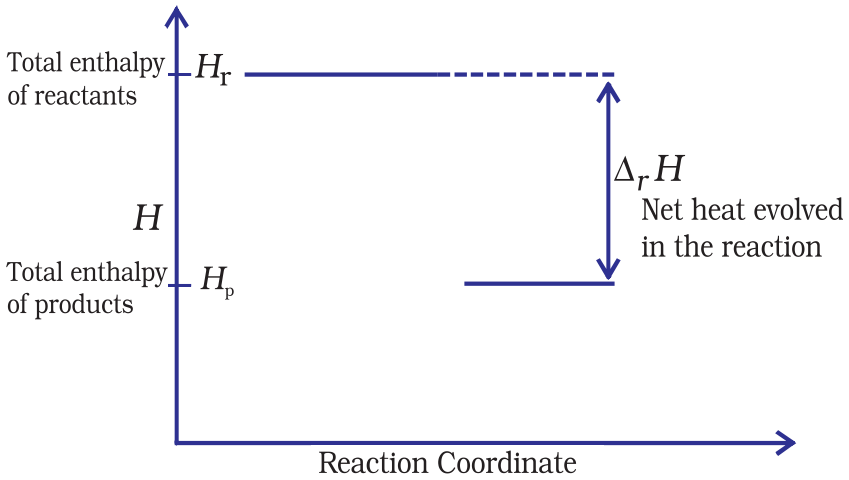
- ✓
Enthalpy for exothermic reactions.
- B
Enthalpy for endothermic reactions.
- C
Entropy for exothermic reactions.
- D
Entropy for endothermic reactions.
AnswerCorrect option: A. Enthalpy for exothermic reactions.
In an exothermic reaction, there is the decrease in enthalpy on passing from reactants to products.
View full question & answer→MCQ 501 Mark
A gas is allowed to ospand in a well insulated container against a cemstant eternal pressure of $2.5$ atm from an initial volume of $2.50L$ to a final volume of $4.50L$ The change in internal energy in Joule's will he :
- A
$-\ 500J$
- ✓
$-\ 506J$
- C
$+\ 505J$
- D
$1136.25J$
AnswerCorrect option: B. $-\ 506J$
$\Delta\text{U}=\text{q}+\text{w}$
For adiabatic process $q = 0$
$\therefore\Delta\text{U}=\text{w}=-\text{P}\Delta\text{V}$
$=-2.5\text{ atm}(4.5-2.5\text{L})$
$=-2.5\times2.0\text{ atm}=-5\text{L atm}$
$\Delta\text{U}=-5\times101.3\text{J}=-506.5\text{J}$
View full question & answer→MCQ 511 Mark
If the bond energies of $\ce{H-H, Br-Br}$ and $\ce{H-Br}$ are $433, 192$ and $364 \text{ kJ mol}^{-1}$, respectively, then $\Delta\text{H}^\circ$ for the reaction. $\ce{H_2(g) + Br(g) \rightarrow 2HBr(g)}$ is :
- A
$-\ 261kJ$
- ✓
$-\ 103kJ$
- C
$+\ 261kJ$
- D
$-\ 1031kJ$
AnswerCorrect option: B. $-\ 103kJ$
$\Delta\text{H}=\text{B}_{\text{H}-\text{H}}+\text{B}_{\text{Br}-\text{Br}}-2\text{B}_{\text{H}-\text{Br}}$
$=433+192-2\times364$
$=625-728$
$=-103\text{kJ}$
View full question & answer→MCQ 521 Mark
The temperature at the bottom of a high water fall is higher than that at the top because :
- A
by itself heat flows from higher to lower temperature
- B
the difference in height causes a difference in pressure
- C
thermal energy is transformed into mechanical energy
- ✓
mechanical energy is transformed into thermal energy
AnswerCorrect option: D. mechanical energy is transformed into thermal energy
The water at the top of the waterfall, falls and gains velocity.
The potential energy it has converts into kinetic energy.
When the water lands at the bottom, the kinetic energy converts into heat and hence the water is warmer at the bottom.
View full question & answer→MCQ 531 Mark
Which heat is produced throughout the conducting wire?
AnswerAs the heat produced in the conductor by following Joule's law of heating or cooling. $Sp,$ the produced heat is Joule heat.
View full question & answer→MCQ 541 Mark
Hess law of heat summation includes :
- A
- ✓
Initial reactants and final products
- C
- D
AnswerCorrect option: B. Initial reactants and final products
Hess law includes initial reactants and final products.
View full question & answer→MCQ 551 Mark
Which of the following is an endothermic process?
- A
$2\text{H}_2+\text{O}_2\rightarrow2\text{H}_2\text{O};\ \Delta\text{H}=-\text{q}\text{ kJ}$
- ✓
$\text{N}_2+\text{O}_2\rightarrow2\text{NO}-\text{Y kJ}$
- C
$\text{CH}_4+2\text{O}_2\rightarrow\text{CO}_2+2\text{H}_2\text{O};$
$\Delta\text{H}=-\text{X kJ mol}^{-1}$
- D
$\text{NaOH}+\text{HCl}\rightarrow\text{NaCl}+\text{H}_2\text{O}+\text{Z kJ}$
AnswerCorrect option: B. $\text{N}_2+\text{O}_2\rightarrow2\text{NO}-\text{Y kJ}$
It is an endothermic process as heat is being absorbed.
View full question & answer→MCQ 561 Mark
The enthalpies of all elements in their standard states are :
- A
- ✓
- C
$< 0.$
- D
Different for each element.
AnswerThe enthalpies of all elements in their standard states are zero.
View full question & answer→MCQ 571 Mark
$\Delta\text{S}(\text{A}\rightarrow\text{C})=50\text{ev},$$\Delta\text{S}(\text{C}\rightarrow\text{D})=30\text{ev},$
$\Delta\text{S}(\text{B}\rightarrow\text{D})=20\text{ev}$
$\text{A}\rightarrow\text{B}$
$\downarrow\ \ \ \ \ \uparrow$
$\text{C}\rightarrow\text{D}$
The entropy change for $A \rightarrow B$ would be :
- A
$100ev$
- ✓
$60ev$
- C
$-\ 60ev$
- D
$-\ 100ev$
AnswerCorrect option: B. $60ev$
$\Delta\text{S}(\text{A}\rightarrow\text{B})=\Delta\text{S}(\text{A}\rightarrow\text{C})$
$+\Delta\text{S}(\text{C}\rightarrow\text{D})+\Delta\text{S}(\text{D}\rightarrow\text{B})$
$=50+30-\Delta\text{S}(\text{D}\rightarrow\text{B})$
$=50+30-20=60\text{ev}$
View full question & answer→MCQ 581 Mark
AnswerCombustion is an oxidation reaction and during this reaction, heat is produced.
In this type of reaction, bonds are broken first and then new bonds may be created results in new material formation.
So, it is always an exothermic reaction.
View full question & answer→MCQ 591 Mark
Which of the following statements is correct?
- A
The presence of reacting species in a covered beaker is an example of open system.
- B
There is an exchange of energy as well as matter between the system and the surroundings in a closed system.
- ✓
The presence of reactants in a closed vessel made up of copper is an example of a closed system.
- D
The presence of reactants in a thermos flask or any other closed insulated vessel is an example of a closed system.
AnswerCorrect option: C. The presence of reactants in a closed vessel made up of copper is an example of a closed system.
If a closed reaction vessel is made of copper, it will work as closed system because in such system heat will be exchanged with the surroundings but no matter will exchange.
View full question & answer→MCQ 601 Mark
A bomb calorimeter is used to measure the value of heat of reaction at a constant :
AnswerFor combustion reactions, we often enclose all reactants in an explosive-proof steel container, called the bomb whose volume does not change during a reaction. The bomb is then submerged in water or other liquid that absorbs the heat of reaction. The heat capacitor of the bomb plus other things is then measured using the same technique as other calorimeters. Such an instrument is called a bomb calorimeter, and its application is called the bomb calorimetry. For combustion reactions, we often enclose all reactants in an explosive $-$ proof steel container, called the bomb whose volume does not change during a reaction. The bomb is then submerged in water or other liquid that absorbs the heat of reaction.
View full question & answer→MCQ 611 Mark
The resultant heat change in a reaction is the same whether it takes place in one or several stages. This statement is called:
AnswerThe enthalpy change for the overall process is the sum of the enthalpy change of the steps in the process.
View full question & answer→MCQ 621 Mark
The statement "The change of enthalpy of a chemical reaction is same whether the reaction takes place in one or several steps" is :
- A
- B
- C
first law of thermodynamics
- ✓
AnswerThe statement "The change of enthalpy of a chemical reaction is same whether the reaction takes place in one or several steps" is Hess’s law of constant heat summation.
View full question & answer→MCQ 631 Mark
Specific heat may be defined as :
AnswerCorrect option: D. Heat capacity $g^{-1}$
The amount of heat required to raise the temperature of a unit mass of a substance by one $-$ degree celsius is known as specific heat. Heat capacity is the amount of heat added to a substance to raise its temperature by one kelvin.
Thus, specific heat may be defined as heat capacity per gram.
View full question & answer→MCQ 641 Mark
In the given reaction, $\ce{H_2(g) \rightarrow 2H(g)}; \Delta\text{H}=435.0\text{kJ mol}^{-1}$ The enthalpy change is known as :
- A
- ✓
- C
Bond dissociation enthalpy.
- D
Both $(b)$ and $(c).$
Answer$\ce{H_2(g) \rightarrow 2H(g)}; \Delta_\text{a}\text{H}^\circ=435\text{kJ mol}^{-1}$
$H-$ atoms are formed by breaking $H-H$ bond in dihydrogen.
The enthalpy change in this process is known as enthalpy of atomisation $,\Delta_\text{a}\text{H}^\circ.$
View full question & answer→MCQ 651 Mark
A spontaneous reaction occurs:
- A
- B
- C
with outside intervention and slowly
- ✓
by itself but it has now effect on how fast the reaction takes
AnswerCorrect option: D. by itself but it has now effect on how fast the reaction takes
Explanation: (D) by itself but it has now effect on how fast the reaction takes
A spontaneous reaction occurs by itself but it has no effect on how fast the reaction takes.
A spontaneous reaction may be very fast but another spontaneous reaction may be very slow.
View full question & answer→MCQ 661 Mark
The state of gas can be described by quoting the relationship between,
- A
Pressure, volume, temperature.
- B
Temperature, amount, pressure.
- C
Amount, volume, temperature.
- ✓
Pressure, volume, temperature, amount.
AnswerCorrect option: D. Pressure, volume, temperature, amount.
State of a system can be described by state functions or state variables which are pressure, volume, temperature and amount of the gas $\text{(PV = nRT)}.$
View full question & answer→MCQ 671 Mark
Two substances $P$ and $Q$ when brought together, form substance $R$ with the evolution of heat. The properties of $R$ are different from both $P$ and $Q$. What is substance $R\ ?$
AnswerSince the substance $R$ is a mixture of two substances, it may either be a mixture or a compound.
In a mixture the constituents retain their properties while in a compound, they lose their properties.
Since the question mentions that $R$ has different property from both $P$ and $Q,$ hence it must be a compound.
View full question & answer→MCQ 681 Mark
Which heat depends on the direction of current?
AnswerIn Peltier effect, heat loss and heat gain depends upon the direction of current.
A typical Peltier heat pump involves multiple junction in series in which direction of current is important.
View full question & answer→MCQ 691 Mark
The enthalpies of elements in their standard states are taken as zero.The enthalpy of formation of a compound.
- A
- B
- ✓
May be positive or negative.
- D
AnswerCorrect option: C. May be positive or negative.
Heat of formation of a compound may be positive or negative, e.g.,
$\text{C}(\text{s})+\text{O}_2(\text{g})\rightarrow\text{CO}_2(\text{g});$
$\Delta\text{H}^\circ=-393.5\text{kJ}\ \text{mol}^{-1}$
$\text{N}_2(\text{g})\frac{1}{2}\text{O}_2(\text{g})\rightarrow\text{N}_2\text{O}(\text{g});$$\Delta\text{H}^\circ=+92\text{kJ}\ \text{mol}^{-1}$
View full question & answer→MCQ 701 Mark
Choose the correct answer. A thermodynamic state function is a quantity :
- A
Used to determine heat changes.
- ✓
Whose value is independent of path.
- C
Used to determine pressure volume work.
- D
Whose value depends on temperature only.
AnswerCorrect option: B. Whose value is independent of path.
View full question & answer→MCQ 711 Mark
Actual flame temperature is always lower than the adiabatic flame temperature, because there is $ .......... :$
- A
no possibility of obtaining complete combustion at high temperature.
- B
always loss of heat from the flame.
- ✓
both $(a)$ and $(b).$
- D
neither $(a)$ nor $(b).$
AnswerCorrect option: C. both $(a)$ and $(b).$
The constant volume adiabatic flame temperature is the temperature that results from a complete combustion process that occurs without any work, heat transfer or changes in kinetic or potential energy. The constant pressure adiabatic flame temperature is the temperature that results from a complete combustion process that occurs without any heat transfer or changes in kinetic or potential energy. Its temperature is lower than the constant volume process because some of the energy is utilized to change the volume of the system $($i.e., generate work$).$
View full question & answer→MCQ 721 Mark
What is the free energy change $\triangle G,$ when $1.0$ mole of water at $100^\circ C$ and $1$ atm pressure is converted steam at $100^\circ C$ and $1$ atm pressure : $-$
- A
$+\ 540 \text{ cal}$
- B
$-\ 9800 \text{ cal}$
- C
$+\ 9800 \text{ cal}$
- ✓
$0 \text{ cal}$
AnswerCorrect option: D. $0 \text{ cal}$
As we know that $\triangle G$ at equilibrium is always $0.$
So, here also is equilibrium; so $\triangle G = 0$
View full question & answer→MCQ 731 Mark
Which of the following is not correct?
- A
$\Delta\text{G}$ is zero for a reversible reactio.
- ✓
$\Delta\text{G}$ is positive for a spontaneous reactio.
- C
$\Delta\text{G}$ is negative for a spontaneous reaction.
- D
$\Delta\text{G}$ is positive for a non $-$ spontaneous reaction.
AnswerCorrect option: B. $\Delta\text{G}$ is positive for a spontaneous reactio.
$\Delta\text{G}$ gives a criterion for spontaneity at constant pressure and temperature.
- If $\Delta\text{G}$ is negative $(< 0)$. The process is spontaneous.
- If $\Delta\text{G}$ is positive $(> 0)$. The process is non-spontaneous.
- If $\Delta\text{G}$ is zero then reaction is at equilibrium.
View full question & answer→MCQ 741 Mark
The reverse of a spontaneous reaction is $....... :$
- A
- ✓
- C
- D
There is no way of telling
AnswerThe revere of a spontaneous reaction is always non $-$ spontaneous.
According to the second law of thermodynamics, a reaction is spontaneous if the overall entropy or disorder increases.
If we go back to our cleaning the house analogy, when our home becomes messy, then the entropy increases.
The mess that accumulates is a spontaneous reaction, and as a result, the entropy increases.
View full question & answer→MCQ 751 Mark
For the reaction, $\text{N}_2(\text{g})+3\text{H}_2(\text{g})\rightleftharpoons2\text{NH}_3(\text{g});\ \Delta\text{H}$ is :
- ✓
$\Delta\text{U}-2\text{RT}$
- B
$\Delta\text{U}-\text{RT}$
- C
$\Delta\text{U}+\text{RT}$
- D
$\Delta\text{U}+2\text{RT}$
AnswerCorrect option: A. $\Delta\text{U}-2\text{RT}$
View full question & answer→MCQ 761 Mark
The entropy change can be calculated by using the expression $\Delta\text{S}=\frac{\text{q}_\text{rev}}{\text{T}}\ .$ When water freezes in a glass beaker, choose the correct statement amongst the following :
- A
$\Delta\text{S}_\text{(system)}$ decreases but $\Delta\text{S}_\text{(surrounding)}$ remains the same.
- B
$\Delta\text{S}_\text{(system)}$ increases but $\Delta\text{S}_\text{(surrounding)}$ decreases.
- ✓
$\Delta\text{S}_\text{(system)}$ decreases but $\Delta\text{S}_\text{(surrounding)}$ increases.
- D
$\Delta\text{S}_\text{(system)}$ decreases but $\Delta\text{S}_\text{(surrounding)}$ also decreases.
AnswerCorrect option: C. $\Delta\text{S}_\text{(system)}$ decreases but $\Delta\text{S}_\text{(surrounding)}$ increases.
When water freezes, the heat is transferred from system to the surroundings, thus entropy of system decreases but entropy of surroundings increases.
View full question & answer→MCQ 771 Mark
Energy hidden in a definite quantity of substance is :
AnswerInternal energy is the hidden energy in a definite quantity of substance.
View full question & answer→MCQ 781 Mark
Which of the following properties is the measure of the degree of randomness or disorder in the system?
MCQ 791 Mark
The volume of gas is reduced to half from its original volume. The specific heat will be $ .........$
AnswerThe specific heat of a substance is the heat required to raise the temperature of $1$ gram of a substance by one degree $(1K$ or $1^\circ C)$. It is an intensive property and is independent of the volume of the substance.
View full question & answer→MCQ 801 Mark
All natural processes are :
AnswerA spontaneous process is one that occurs on its own, without any energy used from the outside.
For example, a ball will roll down an incline; water will flow downhill; ice will melt into water; radioisotopes will decay; and iron will rust.
So all natural process are spontaneous.
View full question & answer→MCQ 811 Mark
- A
Law of conservation of mass.
- ✓
Law of conservation of energy.
- C
- D
Both $(a)$ and $(b).$
AnswerCorrect option: B. Law of conservation of energy.
Hess's law is based on law of conservation of energy.
View full question & answer→MCQ 821 Mark
On the basis of thermochemical equations $(a), (b)$ and $(c),$ find out which of the algebric relationships given in options $(i)$ to $(iv)$ is correct.
- $\text{C}(\text{graphite})+\text{O}_2(\text{g})\rightarrow\text{CO}_2(\text{g});\Delta_\text{r}\text{H}=\text{x}\text{kJ}\ \text{mol}^{-1}$
- $\text{C}(\text{graphite})+\frac{1}{2}\text{O}_2(\text{g})\rightarrow\text{CO}(\text{g});\Delta_\text{r}\text{H}=\text{y} \text{kJ}\ \text{mol}^{-1}$
- $\text{CO}(\text{g})+\frac{1}{2}\text{O}_2(\text{g})\rightarrow\text{CO}_2(\text{g});\Delta_\text{r}\text{H}=\text{z}\text{kJ}\ \text{mol}^{-1}$
- A
$z = x + y $
- B
$x = y \ – z$
- ✓
$x = y + z$
- D
$y = 2z\ – x$
AnswerCorrect option: C. $x = y + z$
$\text{CO}(\text{g})+\frac{1}{2}\text{O}_2(\text{g})\rightarrow\text{CO}_2(\text{g})$
Adding the reaction $2$ and reaction $3,$ we get $1^\text{st}$ reaction,
$\text{C}+\frac{1}{2}\text{O}_2+\text{CO}+\frac{1}{2}\text{O}_2\rightarrow\text{CO}+\text{CO}_2$
$\text{C}+\text{O}_2\rightarrow\text{CO}_2\ $$\Delta\text{H}=\text{y+z}$
Hence $\text{X = Y + Z}$
View full question & answer→MCQ 831 Mark
For a given reaction, $\Delta\text{H}=35.5\text{kJ mol}^{-1}$ and $\Delta\text{S}=83.6\text{Jk}^{-1}\text{mol}^{-1}.$ The reaction is spontaneous at $($assume that $\Delta\text{H}$ and $\Delta\text{S}$ do not vary with temperature$)$
- A
$T > 425K$
- ✓
- C
$T > 298K$
- D
$T < 425K$
Answer$\Delta\text{G}=\Delta\text{H}-\text{T}\Delta\text{S}$
$=0=35.5\times1000\text{J}-\text{T}\times83.6\text{Jk}^{-1}\text{mol}^{-1}$
$\Rightarrow\text{T}=\frac{35500}{83.6}=425\text{K}$
Above $425K, \Delta\text{G}=-\text{ve},$ therefore process will be spontaneous above $425K.$
View full question & answer→MCQ 841 Mark
Consider the reactions given below. On the basis of these reactions find out which of the algebric relations given in options $(i)$ to $(iv)$ is correct?
- $\text{C}(\text{g})+4\text{H}(\text{g})\rightarrow\text{CH}_4(\text{g});\Delta_\text{r}\text{H}=\text{x}\text{kJ}\ \text{mol}^{-1}$
- $\text{C}(\text{graphite,s})+2\text{H}_2(\text{g})\rightarrow\text{CH}_4(\text{g});\Delta_\text{r}\text{H}=\text{y}\text{kJ}\ \text{mol}^{-1}$
- A
$\text{x}=\text{y}$
- B
$\text{x}=2\text{y}$
- ✓
$\text{x} > \text{y}$
- D
$\text{x} < \text{y}$
AnswerCorrect option: C. $\text{x} > \text{y}$
$x > y$ because same bonds are formed in reactions $(i)$ and $(ii)$ but bonds between reactant molecules are broken only in reaction $(ii)$. As energy is absorbed when bonds are broken, energy released in reaction $(i)$ is greater than that in reaction $(ii).$
View full question & answer→MCQ 851 Mark
Two samples of $\text{DNA, A }$ and $B$ have melting points $340K$ and $350K$ respectively. This is because :
- ✓
$B$ has more $GC$ content than $A$
- B
$A $ has more $GC$ content than $B$
- C
$B$ has more $AT$ cotent than $A$
- D
both have same $AT$ content
AnswerCorrect option: A. $B$ has more $GC$ content than $A$
The $B$ sample of $\text{DNA}$ having higher melting point must be having more $GC$ content as comppared to sample $A$.
Since $GC$ base pair having $3$ hydrogen bonds as compare to $AT$ base pair having only $2$ hydrogen bonds, results in stronger bonding.
View full question & answer→MCQ 861 Mark
For the reaction, $\text{X}_2\text{O}_4(\text{l})\rightleftharpoons2\text{XO}_2(\text{g})$
$\Delta\text{U}=2.1\text{K cal}, \ \Delta\text{S}=20\text{cal K}^{-1}$ at $300K,$ Hence $\Delta\text{G}$ is : $[h = 2 \text{cal}]$
- A
$2.7\text{K cal}$
- ✓
$-2.7\text{K cal}$
- C
$9.3\text{K cal}$
- D
$-9.3\text{K cal}$
AnswerCorrect option: B. $-2.7\text{K cal}$
$\Delta\text{H}=\Delta\text{U}+\Delta\text{n}\text{RT}$
$\Delta\text{H}=2100\text{cal}+2\times2\times300$
$=2100\text{cal}+1200\text{cal}=330\text{cal}$
$\Delta\text{G}=\Delta\text{H}-\text{T}\Delta\text{S}$
$=3300\text{cal}-20\times300$
$=3300\text{cal}-6000\text{cal}$
$=-2700\text{cal}=-2.7\text{K cal}$
View full question & answer→MCQ 871 Mark
AnswerTherm is a non $\text{SI}$ unit of heat energy equal to $\text{ICCF}$ of natural gas and $10000\ B + u$ British thermal units.
View full question & answer→MCQ 881 Mark
Enthalpy of sublimation of a substance is equal to,
AnswerCorrect option: A. Enthalpy of fusion $+$ enthalpy of vapourisatio.
Enthalpy of sublimation of a substance is equal to enthalpy of fusion $+$ enthalpy of vapourisation.
Sublimation is direct conversion of solid to vapour, i.e., solid $\rightarrow $ vapour.
Writing in two steps, we have solid $\rightarrow $ liquid $\rightarrow $ vapour.
Solid $\rightarrow $ liquid requires enthalpy of fusion.
Liquid $\rightarrow $ vapour requires enthalpy of vapourisation.
View full question & answer→MCQ 891 Mark
Which of the following property is not a thermodynamic property of the system?
AnswerA thermodynamic property is that, which is measurable and whose value describes the state of system. Out of the given quantities, heat doesn't describe the state of a system so it is not a thermodynamic property because a system doesn't contain heat but only can transfer heat.
View full question & answer→MCQ 901 Mark
View full question & answer→MCQ 911 Mark
Free energy change for the process $\ce{A(s)\leftrightarrow B(l)}$ will be :
AnswerIn the given process, $A$ and $B$ are in equilibrium, and we know that the free energy change for equilibrium reaction is zero.
View full question & answer→MCQ 921 Mark
- ✓
Heat changes in a chemical reaction.
- B
- C
- D
Influence of pressure on volume of a gas
AnswerCorrect option: A. Heat changes in a chemical reaction.
Hess law deals with the heat changes in a chemical reaction.
View full question & answer→MCQ 931 Mark
Name the apparatus used to measure the heat absorbed or released by a reaction :
AnswerCalorimeter is used to measure the heat absorbed or released by a reaction.
Centrifuge is used to separate precipitate from solution.
Barometer is used to measure pressure.
Balance is used to measure weight of a substance.
Battery is used to provide electricity.
View full question & answer→MCQ 941 Mark
For the reaction $,\mathrm{NaCl}(\mathrm{s}) \rightarrow \mathrm{Na}^{+}(\mathrm{g})+\mathrm{Cl}^{-}(\mathrm{g})$ Identify the enthalpy involved in the above reaction :
- A
- ✓
- C
- D
Enthalpy of dissociation.
AnswerLattice enthalpy of an ionic compound is the enthalpy change which occurs, when one mole of an ionic compound dissociate into its ions in gaseous state.
$\mathrm{NaCl}(\mathrm{s}) \rightarrow \mathrm{Na}^{+}(\mathrm{g})+\mathrm{Cl}^{-}(\mathrm{g})$;
$\Delta_\text{lattice}\text{H}^-=+788\text{ kJ mol}^{-1}$
View full question & answer→MCQ 951 Mark
The enthalpy change when one mole of solute dissolves in a specified amount of solvent is called :
- A
- ✓
- C
- D
Enthalpy of dissociation.
AnswerEnthalpy of solution is the enthalpy change when one mole of solute dissolved in a specified amount of solvent.
View full question & answer→MCQ 961 Mark
Which of the following drives spontaneous reactions?
- ✓
Low enthalpy values and high entropy values.
- B
Low enthalpy values and low entropy values.
- C
High enthalpy values and low entropy values.
- D
High temperatures and low pressures.
AnswerCorrect option: A. Low enthalpy values and high entropy values.
Low enthalpy and high entropy drives spontaneous reactions.
These leads to negative value of Gibbs free energy change.
$\triangle G = \triangle H − T\triangle S$
View full question & answer→MCQ 971 Mark
Which of the following process is non-spontaneous?
- A
Heat flow from hot end to cool end.
- B
Water flow from higher level to lower level.
- ✓
Gas flow from lower pressure region to higher pressure region.
- D
Gas flow from higher pressure region to lower pressure region.
AnswerCorrect option: C. Gas flow from lower pressure region to higher pressure region.
Gas flowing from higher pressure region to lower pressure region is a natural process. Similarly, option $A$ and $B$ are natural.
Natural processes are spontaneous. Therefore, flow of gas from lower pressure to higher pressure region is non $-$ spontaneous.
View full question & answer→MCQ 981 Mark
A reaction, $\text{A + B + C + D + q}$ is found to have a positive entorpy change. The reaction will be :
- A
Possible at high temperature.
- B
Possible only at low temperature.
- C
Not possible at any temperature.
- ✓
Possible at any temperature.
AnswerCorrect option: D. Possible at any temperature.
View full question & answer→MCQ 991 Mark
Regarding a thermochemical equation, wrong statement is :
AnswerCorrect option: D. It tells whether the reaction is possible or not
A thermochemical equation cannot tell whether the reaction is feasible or not. Free energy data is required to determine whether the reaction is feasible or not.
View full question & answer→MCQ 1001 Mark
Whether a reaction is endothermic or exothermic can be indicated by :
AnswerWhether a reaction is endothermic or exothermic can be indicated by enthalpy change.
Enthalpy change is the difference in the enthalpy of products and the enthalpy of reactants.
A positive value of enthalpy change indicates endothermic reaction as the enthalpy of products is more than the enthalpy of reactants.
A negative value of enthalpy change indicates exothermic reaction as the enthalpy of products is less than the enthalpy of reactants.
View full question & answer→MCQ 1011 Mark
Which of the following is not true about a reversible reaction?
- A
The reaction does not proceed to completion
- B
It cannot be influenced by a catalyst
- ✓
Number of moles of reactants and products is always equal
- D
It can be attained only in a closed container
AnswerCorrect option: C. Number of moles of reactants and products is always equal
View full question & answer→MCQ 1021 Mark
The value of $\Delta_\text{r}\text{G}^\circ$ is equal to :
- A
$-2.303\text{RT}\log\text{K}$
- B
$+2.303\text{RT}\log\text{K}$
- C
$\Delta_\text{r}\text{H}^\circ-\text{T}\Delta_\text{r}\text{S}^\circ$
- ✓
Both $(a)$ and $(c)$
AnswerCorrect option: D. Both $(a)$ and $(c)$
View full question & answer→MCQ 1031 Mark
Lattice enthalpies are determined by :
- ✓
Born $-$ Haber cycle.
- B
- C
- D
AnswerCorrect option: A. Born $-$ Haber cycle.
View full question & answer→MCQ 1041 Mark
How many joules of heat are absorbed when $70.0g$ of water is completely vaporised at its boiling point?
$[$Take : $LV = 2260 \text{ kJ/ kg}]$
- A
$22,352$
- B
$52,460$
- C
$22,344$
- ✓
$1,58,200$
AnswerCorrect option: D. $1,58,200$
View full question & answer→MCQ 1051 Mark
For a reaction to be spontaneous, the sign on delta $G$ should be :
Answer$\triangle G =$ negative for spontaneous reaction.
$\triangle G =$ Positive for non $-$ spontaneous reaction.
$\triangle G = 0$ for equilibrium.
View full question & answer→MCQ 1061 Mark
The spontaneity of a reaction is indicated by :
AnswerThe spontaneity of a reaction is indicated by gibbs free energy change.
A negative value of gibbs free energy change indicates the reaction is spontaneous.
A positive value of gibbs free energy change indicates the reaction is non spontaneous.
Zero value of gibbs free energy change indicates the reaction is at equilibrium.
View full question & answer→MCQ 1071 Mark
The important considerations in deciding if a reaction will be spontaneous are :
- A
Stability state of reactants
- B
Energy gained heat evolved
- ✓
Exothermic energy randomness of the products
- D
Endothermic energy structure of the products
AnswerCorrect option: C. Exothermic energy randomness of the products
$\triangle G = \triangle H - T\triangle S,$ for a reaction to be spontaneous $\triangle G,$ should be negative.
it is guaranteed only if both terms in $\text{RHS}$ is negative.
therefore $\triangle H$ should be negative and $\triangle S$ should be positive.
Negative $\triangle H$ implies exothermic energy and positive $\triangle S$ implies randomness of the product.
View full question & answer→MCQ 1081 Mark
What can be used in combination with a calorimeter to compare the specific heats of two substances?
AnswerThermometer can be used in combination with a calorimeter to compare the specific heats of two substances.
Thermometer will measure the temperature.
View full question & answer→MCQ 1091 Mark
The enthalpy of vapourisation of a liquid is $30 \text{ kJ mol}^{-1}$ and enthalpy of vapourisation is $75 \text{ J mol}^{-1}$. The boiling point of the liquid at $1$ atm is :
- A
$250K$
- ✓
$400K$
- C
$450K$
- D
$600K$
AnswerCorrect option: B. $400K$
$\Delta\text{S}=\frac{\Delta\text{H}}{\text{T}}$
$\Rightarrow\frac{30\times1000\text{J}}{\text{T}}=75\text{J}$
$\Rightarrow\ \text{T}=\frac{30000}{75}=400\text{K}$
View full question & answer→MCQ 1101 Mark
Which of the following processes is a nonspontaneous process?
- A
Dissolution of salt or sugar in water
- B
Mixing of different gases through diffusion
- C
Precipitation of copper when zinc rod is dipped in aqueous solution of copper sulphate
- ✓
Flow of heat from a cold body to a hot body in contact of these
AnswerCorrect option: D. Flow of heat from a cold body to a hot body in contact of these
View full question & answer→MCQ 1111 Mark
Internal energy per mole of gas depends on
AnswerIn a isochoric process, the volume of the system is kept constant. In the isochoric process, the heat energy supplied is absorbed as internal energy and does not cause a change in the work done by the system. The other terms used for isochoric process are iso $-$ volumetric or isometric process.
Example : Gas heated in a tight container such as keeping a closed tin with air into fire.
View full question & answer→MCQ 1121 Mark
Which statement about reactions that produce heat is not correct?
- A
Burning magnesium produces hear energy
- B
The overall reaction is exothermic
- ✓
The products have more energy than the reactants
- D
The temperature of the surroundings increases
AnswerCorrect option: C. The products have more energy than the reactants
In a exothermic reaction heat is released for stability of product with less energy.
View full question & answer→MCQ 1131 Mark
"The change of enthalpy of a chemical reaction is the same whether the reaction takes place in one step or in several steps". This law was presented by :
AnswerAccording to Hess's law of constant heat summation, even if a chemical reaction takes place by several different routes, the change in enthalpy of the reaction will be same for all the routes.
View full question & answer→MCQ 1141 Mark
For a spontaneous process :
- A
enthalpy change of the system must be negative
- B
entropy change of the system must be positive
- C
entropy change of the surrounding must be positive
- ✓
entropy change of the system plus surrounding must be positive
AnswerCorrect option: D. entropy change of the system plus surrounding must be positive
For a spontaneous process the randomness of the molecules in the system increases so the entropy change of the system and surroundings must be positive.
View full question & answer→MCQ 1151 Mark
Hess's law of constant heat summation in based on :
- A
$\text{E = mc}^2$
- B
- ✓
First law of thermodynamics
- D
AnswerCorrect option: C. First law of thermodynamics
Hess’s law is an application of first law of thermodynamics.
View full question & answer→MCQ 1161 Mark
For a thermodynamics process to be reversible, the temperature difference between hot body and the working substance should be :
AnswerIn thermodynamics, a reversible process is a process whose direction can be "reversed" by inducing infinitesimal changes to some property of the system via its surroundings, while not increasing entropy. Throughout the entire reversible process, the system is in thermodynamic equilibrium with its surroundings, which means that the hot body and surroundings are at same temperature.
View full question & answer→MCQ 1171 Mark
In the given reaction, $\ce{Na(s) \rightarrow Na(g)}$ The enthalpy of atomisation is same as the :
- A
Enthalpy of dissociation.
- ✓
- C
- D
Enthalpy of vaporisation.
View full question & answer→MCQ 1181 Mark
If the sublimation energy and enthalpy of fusion of $\ce{I_2}$ are $57.3 \text{kJ mol}^{-1}$ and $15.5\ \text{kJ mol}^{-1}$, respectively then, calculate the enthalpy of vaporisation of $\ce{I_2}$.
- A
$-72.8\ \text{kJ mol}^{-1}$
- B
$72.8 \ \text{kJ mol}^{-1}$
- C
$-41.8\ \text{kJ mol}^{-1}$
- ✓
$+41.8\ \text{kJ mol}^{-1}$
AnswerCorrect option: D. $+41.8\ \text{kJ mol}^{-1}$
- $I_2(s) \rightarrow I_2(g); \Delta\text{H}_1=+57.3\text{kJ mol}^{-1}$
- $I_2(s) \rightarrow I_2(l); \Delta\text{H}_2=+15.5\text{kJ mol}^{-1}$
- $I_2(l) \rightarrow I_2(g); \Delta\text{H}=?$
$\text{(iii) = (i) - (ii)}$
Now, $\Delta\text{H}=57.3-15.5=+41.8\text{kJ mol}^{-1}$ View full question & answer→MCQ 1191 Mark
Which of the following statement is correct for the reaction ? $\ce{CaO(s) + CO_2(g) \rightarrow CaCO_3(s)}; \Delta_\text{r}\text{H}^\circ=-178.3\text{ kJ mol}^{-1}$
- A
$\Delta_\text{r}\text{H}^\circ$ is the enthalpy of formation of $\ce{CaCO_3}$
- ✓
$\Delta_\text{r}\text{H}^\circ$ is not the enthalpy of formation of $\ce{CaCO_3}$
- C
$\Delta_\text{r}\text{H}^\circ$ is the enthalpy of combustion of $\ce{CaCO_3}$
- D
AnswerCorrect option: B. $\Delta_\text{r}\text{H}^\circ$ is not the enthalpy of formation of $\ce{CaCO_3}$
View full question & answer→MCQ 1201 Mark
The pressure-volume work for an ideal gas can be calculated by using the expression $\text{w}=-\int\limits^{\text{V}_\text{f}}_{\text{V}_\text{t}}\text{p}_\text{ex}\text{dV}\ .$The work can also be calculated from the $PV–$ plot by using the area under the curve within the specified limits. When an ideal gas is compressed $(a)$ reversibly or $(b)$ irreversibly from volume $V_i$ to $V_f$ . choose the correct option.
- A
$w ($reversible$) = w ($irreversible$)$
- ✓
$w ($reversible$) < w ($irreversible$)$
- C
$w ($reversible$) > w ($irreversible$)$
- D
$w($reversible$) = w ($irreversible$)\ + \text{p}_\text{ex}.\Delta\text{V}$
AnswerCorrect option: B. $w ($reversible$) < w ($irreversible$)$
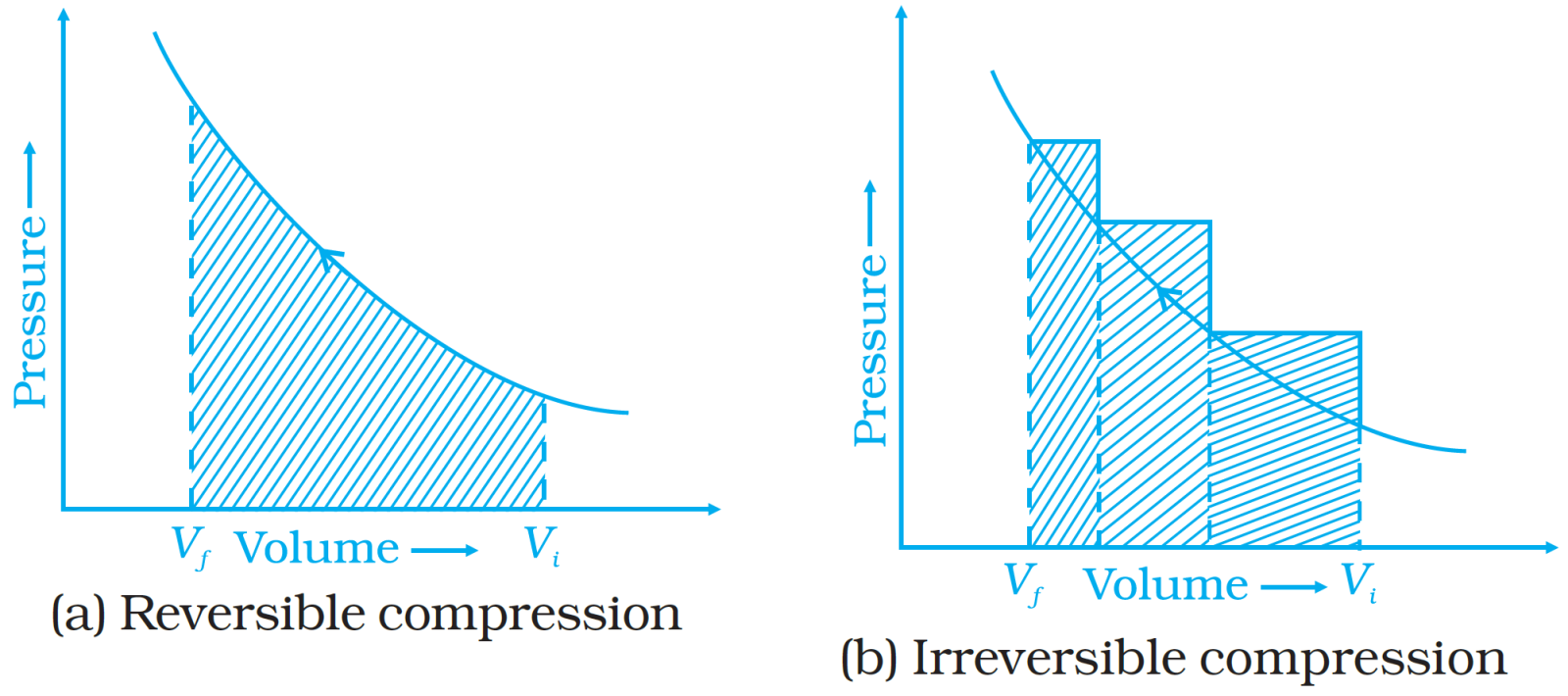
Area under the curve is greater in irreversible compression than that of reversible compression.
View full question & answer→MCQ 1211 Mark
The heat released when the requisite amount of ions in the gaseous state combine to give $1$ mol of crystal lattice is known as :
AnswerThe lattice energy of a crystalline solid is usually defined as the energy of formation of the crystal from infinitely $-$ separated ions, molecules, or atoms.
The heat energy released when new bonds are made between the ions and water molecules is known as the hydration enthalpy.
The standard enthalpy of formation of a compound is the change of enthalpy from the formation of $1$ mole of the compound from its constituent elements.
View full question & answer→MCQ 1221 Mark
Mixture of ice and water is form a :
AnswerMixture of ice and water is a heterogeneous system because their chemical compositions are same but the physical properties are completely different.
View full question & answer→MCQ 1231 Mark
In which of the processes, does the internal energy of the system remain constant?
AnswerFor an ideal gas, in an isothermal process the change in internal energy is $0$ as internal energy is function of temperate,but temperature remains constant.
View full question & answer→MCQ 1241 Mark
Enthalpy change for the reaction, $4H(g) \rightarrow 2H_2(g)$ is $-869.6\ kJ$ The dissociation energy of $H-H$ bond is:
- A
$-869.6\ kJ$
- ✓
$+434.8\ kJ$
- C
$+217.4\ kJ$
- D
$-434.8\ kJ$
AnswerCorrect option: B. $+434.8\ kJ$
$\ce{4H(g) \rightarrow 2H_2(g); \Delta\text{H}=-869.6\text{kJ}}$
$\ce{2H_2(g) \rightarrow 4H(g); \Delta\text{H}=+869.6\text{kJ}}$
$\therefore \ce{H_2(g) \rightarrow 2H(g)}$
Dissociation energy of $\ce{H-H}$ bond $=\frac{869.6}{2}=434.8\text{kJ}$
View full question & answer→MCQ 1251 Mark
The correct thermodynamic conditions for the spontaneous reaction at all temperature is:
- A
$\Delta\text{H}<0$ and $\Delta\text{S}>0$
- ✓
$\Delta\text{H}<0$ and $\Delta\text{S}<0$
- C
$\Delta\text{H}<0$ and $\Delta\text{S}=0$
- D
$\Delta\text{H}>0$ and $\Delta\text{S}<0$
AnswerCorrect option: B. $\Delta\text{H}<0$ and $\Delta\text{S}<0$
In exothermic process, if entropy increases, $AG$ will be $-ve$ at all temperatures and spontaneous at all temperatures.
View full question & answer→MCQ 1261 Mark
Select the incorrect expression from the following.
- A
$\Delta\text{S}_\text{total}=\Delta\text{S}_\text{system}+\Delta\text{S}_\text{surr}$
- B
$\Delta\text{S}_\text{surr}=\frac{\Delta\text{H}_\text{surr}}{\text{T}}=-\frac{\Delta\text{H}_\text{sys}}{\text{T}}$
- ✓
$\Delta\text{S}_\text{total} < 0\ ($spontaneous process$)$
- D
$\Delta\text{G}=\Delta\text{H}-\text{T}\Delta\text{S}$
AnswerCorrect option: C. $\Delta\text{S}_\text{total} < 0\ ($spontaneous process$)$
For spontaneous process, $\Delta\text{S}_\text{total} > 0$
$\text{T}\Delta\text{S}_\text{system}-\Delta\text{H}_\text{system} > 0$
$-(\Delta\text{H}_\text{system}-\text{T}\Delta\text{S}_\text{system}) > 0$
View full question & answer→MCQ 1271 Mark
What is multiplied by temperature in the equation that calculates free energy?
AnswerExplanation:(D) Positive ΔS
Formula for Gibbs Free Energy is ΔG = ΔH − TΔS
Hence, Positive ΔS is multiplied by temperature in the equation that calculates free energy.
ΔS is entropy change.
ΔG is Gibbs Free Energy change.
ΔH is enthalpy change.
View full question & answer→MCQ 1281 Mark
Which of the following is an extensive property?
AnswerGibbs free energy is an extensive propety.
View full question & answer→MCQ 1291 Mark
The bond dissociation energies of $\ce{H_2, Cl_2},$ and $\ce{HCl}$ are $104, 58$ and $103 \text{ k cal mol}^{-1}$ respectively. The enthalpy of formation of $\text{HCl}$ would be :
- ✓
$-22 \text{ k cal mol}^{-1}$
- B
$-44\text{ k cal mol}^{-1}$
- C
$+44\text{ k cal mol}^{-1}$
- D
$+22\text{ k cal mol}^{-1}$
AnswerCorrect option: A. $-22 \text{ k cal mol}^{-1}$
View full question & answer→MCQ 1301 Mark
Which of the following are state functions?
AnswerBecause these depend upon initial and final state and not on path.
View full question & answer→MCQ 1311 Mark
nternal energy of an ideal gas depends on:
AnswerThe relation between the internal energy and enthalpy, it can be derived that the internal energy of the gas is independent of the volume and pressure whereas it is only temperature$-$dependent.
View full question & answer→MCQ 1321 Mark
A thermochemical equation :
- A
Includes only the balanced chemical reaction
- ✓
Includes the balanced chemical reaction and change in enthalpy value
- C
Includes only the change in enthalpy value
- D
Includes the unbalanced chemical reaction and change in enthalpy value
AnswerCorrect option: B. Includes the balanced chemical reaction and change in enthalpy value
A thermochemical equation includes the balanced chemical reaction and change in enthalpy value.
A thermochemical equation is a balanced chemical equation in which the exact value of enthalpy change, physical states and number of moles of reactants and products are specified. Following is the example of thermochemical equation between methane and oxygen.
$\mathrm{CH}_4(\mathrm{~g})+2 \mathrm{O}_2(\mathrm{~g}) \rightarrow \mathrm{CO}_2(\mathrm{~g})+2 \mathrm{H}_2 \mathrm{O}(\mathrm{I}) \Delta \mathrm{Ho}=-890 \mathrm{~kJ}$
View full question & answer→MCQ 1331 Mark
Which one of the following process is non $-$ spontaneous?
AnswerCorrect option: D. Flow of electric current from low potential to high potential
The physical or chemical processes which do not proceed by its own in a particular direction and requires outside help is called a non $-$ spontaneous process. Therefore, flow of heat from a cold body to a hot body is a non $-$ spontaneous process as it requires external work as per Clausius.
View full question & answer→MCQ 1341 Mark
During complete combustion of one mole of butane, $2658kJ$ of heat is released. The thermochemical reaction for above change is :
- A
$2\text{C}_4\text{H}_{10}(\text{g})+130_2(\text{g})\rightarrow $$ 8\text{CO}_2({\text{g})}+10\text{H}_2\text{O}(\text{l})\Delta_\text{c}\text{H}=-2658.0\text{kJ}\ \text{mol}^{-1}$
- B
$\text{C}_4\text{H}_{10}(\text{g})+\frac{13}{2}\text{O}_2(\text{g})\rightarrow $$ 4\text{CO}_2(\text{g})+5\text{H}_2\text{O}(\text{g})\Delta_\text{c}\text{H}=-1329.0\text{kJ}\ \text{mol}^{-1}$
- ✓
$\text{C}_4\text{H}_{10}+\frac{13}{2}\text{O}_2(\text{g})\rightarrow4 $$ \text{CO}_2(\text{g})+5\text{H}_2\text{O}\text{}(\text{l})\Delta_\text{c}\text{H}=-2658.0\text{kJ}\ \text{mol}^{-1}$
- D
$\text{C}_4\text{H}_{10}(\text{g})\frac{13}{2}\text{O}_2(\text{g})\rightarrow $$ 4\text{CO}_2(\text{g})+5\text{H}_2\text{O}(\text{l})\Delta_\text{c}=+2658.0\text{kJ}\ \text{mol}^{-1}$
AnswerCorrect option: C. $\text{C}_4\text{H}_{10}+\frac{13}{2}\text{O}_2(\text{g})\rightarrow4 $$ \text{CO}_2(\text{g})+5\text{H}_2\text{O}\text{}(\text{l})\Delta_\text{c}\text{H}=-2658.0\text{kJ}\ \text{mol}^{-1}$
Standard enthalpy of combustion is defiend as the enthalpy change per mole $($or per unit amount$)$ of a substance, when it undergoes combustion and all the reactants and products being in their standard states at the specified tempreature.
View full question & answer→MCQ 1351 Mark
The internal energy $U$ is a unique function of any state because change in $U:$
- ✓
Does not depends upon path
- B
- C
Corresponds to adiabatic process
- D
Corresponds to an isothermal process
AnswerCorrect option: A. Does not depends upon path
Internal energy of a body depends upon the final and initial temperature of the body.
It does not depend upon the path an the process the body has undergoes.
View full question & answer→MCQ 1361 Mark
What is the change in the energy of system if $500\text{ cal}$ of heat energy are added to a system and system does $350 \text{ cal}$ of work on the surroundings?
- A
$-150 \text{ cal}$
- ✓
$+150 \text{ cal}$
- C
$+850\text{ cal}$
- D
$-850\text{ cal}$
AnswerCorrect option: B. $+150 \text{ cal}$
According to the first law of thermodynamics,
$\Delta\text{E}=\text{q}+\text{W}=500+(-350)=+150\text{ cal}$
View full question & answer→MCQ 1371 Mark
Magnitude of Seebeck $emf$ between the junctions does not depend on:
- ✓
- B
Temperature of cold junction
- C
Temperature of hot function
- D
AnswerThe Seeback effect is the direct conversion of heat into electricity in which potential difference is needed to calculate the current density so the potential of two junctions must be known.
It has nothing to do with neutral temperature.
View full question & answer→MCQ 1381 Mark
Which of the following is slow process :
AnswerIsothermal processes are necessarily slow as they require heat transfer to remain at the same temperature which is done by being in thermal equilibrium with some reservoir.
A process will be isothermal only if it happens on timescales larger than the timescale required for effective heat transfer.
View full question & answer→MCQ 1391 Mark
Hess's law is used to calculate :
AnswerHint : Hess’s law states that, if an overall reaction takes place in several steps, its standard reaction enthalpy is the sum of the standard enthalpies of the intermediate reactions, at the same temperature.
View full question & answer→MCQ 1401 Mark
For which of the following processes $\Delta\text{S}$ is negative?
- A
$ \mathrm{H}_2(\mathrm{~g}) \rightarrow 2 \mathrm{H}(\mathrm{g}) $
- ✓
$ \mathrm{N}_2(\mathrm{~g}, 1 \mathrm{~atm}) \rightarrow \mathrm{N}_2(\mathrm{~g}, 5 \mathrm{~atm}) $
- C
$2 \mathrm{SO}_3(\mathrm{~g}) \rightarrow 2 \mathrm{SO}_2(\mathrm{~g})+\mathrm{O}_2(\mathrm{~g})$
- D
$\ce{C(diamond) \rightarrow C(graphite)}$
AnswerCorrect option: B. $ \mathrm{N}_2(\mathrm{~g}, 1 \mathrm{~atm}) \rightarrow \mathrm{N}_2(\mathrm{~g}, 5 \mathrm{~atm}) $
At higher pressure $\ce{N_2(g)}$ will have less entropy, i.e. $\Delta\text{S}$ will be $- \ce{ve}$ because molecules will be less free to move at high pressure.
View full question & answer→MCQ 1411 Mark
Two moles of an ideal gas is expanded isothermally and reversibly from $1L$ to $10L$ at $300K$. The enthalpy change $($in $kJ)$ for the process is :
- A
$11.4kJ$
- ✓
$-11.4kJ$
- C
$0kJ$
- D
$4.8kJ$
AnswerCorrect option: B. $-11.4kJ$
$\text{w}=+2.303\text{nRT}\log\frac{\text{V}_2}{\text{V}_1}$
$=2.303\times2\times8.314\times300=11.48\text{kJ}$
$\Delta\text{U}=\text{q}+\text{w},\ \Delta\text{U}=0,\ \text{q}=-11.48\text{kJ}$
$\Delta\text{H}=\text{q}_\text{p}=-11.48\text{kJ mol}^{-1}$
View full question & answer→MCQ 1421 Mark
Which of the following is technique used to measure the heat of a reaction?
AnswerCalorimetry is used to determine heat of the reaction.
View full question & answer→MCQ 1431 Mark
The heat required to raise the temperature of a body by $1K$ is called :
AnswerThe heat required to raise the temperature of a body by $1K$ is called thermal capacity.
In other words, when $q$ is the heat supplied to the body and the temperature raises by $1K,$ then the thermal capacity of body is $q.$
View full question & answer→MCQ 1441 Mark
The thermal motion means :
- A
Motion due to heat engine
- B
Disorderly motion of the body as a whole
- C
Motion of the body that generates heat
- ✓
Random motion of molecules
AnswerCorrect option: D. Random motion of molecules
Whenever a system absorbs heat from the surroundings or when we supply thermal energy to a system, the internal energy of the system increases.
The heat absorbed increases the kinetic energy of the molecules causing them to move randomly.
View full question & answer→MCQ 1451 Mark
- A
Law of conservation of mass
- ✓
Law of conservation of energy
- C
Enthalpy is a state function
- D
AnswerCorrect option: B. Law of conservation of energy
The enthalpy change for the overall process is the sum of the enthalpy change of the steps in the process.
This law is conservation of energy.
View full question & answer→MCQ 1461 Mark
Name the type of wall used in the above figure.
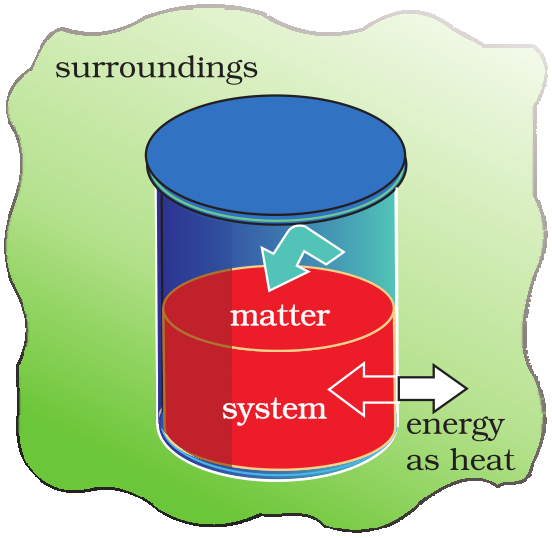
- A
- B
Thermally insulating walls.
- ✓
Thermally conducting walls.
- D
AnswerCorrect option: C. Thermally conducting walls.
View full question & answer→MCQ 1471 Mark
Hess's law is related to :
- ✓
Change in heat during a reaction
- B
- C
- D
Influence of pressure on volume of a gas
AnswerCorrect option: A. Change in heat during a reaction
Hess's law is related to change in heat during a reaction.
It states that the total change in heat enthalpy during the complete course of reaction is same whether the change is brought in one step or in several steps by one method or other method.
View full question & answer→MCQ 1481 Mark
The energy of a system available to do work is called as :
- ✓
- B
- C
Heinsenberg uncertainty principle
- D
AnswerThe energy of a system available to do work is called as Gibbs free energy.
Heat required to rise one unit mass of a substance by $1$ degree Celsius is known as Specific heat.
Heat absorbed or released during production of a substance from elements in their standard states is known as Heat of formation.
Heinsenberg uncertainty principle states that, "It is not possible to determine simultaneously the position and momentum of a moving microsopic particle $($electron$)$ with absolute accuracy".
Heat required to vaporize unit mass of a substance without changing its temperature at constant pressure is called Heat of vaporization.
View full question & answer→MCQ 1491 Mark
In an adiabatic process, no transfer of heat takes place between system and surroundings. Choose the correct option for free expansion of an ideal gas under adiabatic condition from the following.
- A
$\text{q}=0,\ \Delta\text{T}\neq0,\ \text{w}=0$
- B
$\text{q}\neq0,\ \Delta\text{T} < 0,\ \text{w}=0$
- ✓
$\text{q}=0,\ \Delta\text{T}=0,\ \text{w}=0$
- D
$\text{q}=0,\ \Delta\text{T} < 0,\ \text{w}\neq0$
AnswerCorrect option: C. $\text{q}=0,\ \Delta\text{T}=0,\ \text{w}=0$
For, free expansion $,w = 0$ for, adiabatic process $,q = 0$ from first law of thermodynamics : $\Delta\text{U}=\text{q}+\text{w}=0+0=0$ since, there is no change of internal energy hence temperature will also remain constant, i.e., $\Delta\text{T}=0$
View full question & answer→MCQ 1501 Mark
The amount of heat required to raise the temperature of a substance through $1^\circ C$ is called :
AnswerEnergy required to raise the temperature of an object by $1^\circ C$ is called heat capacity.
View full question & answer→MCQ 1511 Mark
What describes a spontaneous reaction?
- A
Positive $\triangle H$
- B
Negative $\triangle H$
- C
Positive $\triangle G$
- ✓
Negative $\triangle G$
AnswerCorrect option: D. Negative $\triangle G$
For a reaction to be spontaneous, the value of $\triangle G$ should be Negative.
View full question & answer→MCQ 1521 Mark
If a $\triangle Go$ for a given reaction is known one may determine all the following except the :
AnswerCorrect option: A. Direction of Spontaneoun change at the standard condition
View full question & answer→