According to Hook’s law of elasticity, if stress is increased, the ratio of stress to strain
AIIMS 2001, Easy


Download our appand get started for free
Experience the future of education. Simply download our apps or reach out to us for more information. Let's shape the future of learning together!No signup needed.*
Similar Questions
- 1View SolutionThe dimensions of four wires of the same material are given below. In which wire the increase in length will be maximum when the same tension is applied
- 2The upper end of a wire of radius $4\, mm$ and length $100\, cm$ is clamped and its other end is twisted through an angle of $30°$. Then angle of shear is ..... $^o$View Solution
- 3View SolutionTwo identical wires of rubber and iron are stretched by the same weight, then the number of atoms in the iron wire will be
- 4The ratio of two specific heats of gas ${C_p}/{C_v}$ for argon is $1.6$ and for hydrogen is $1.4$. Adiabatic elasticity of argon at pressure $P$ is $E.$ Adiabatic elasticity of hydrogen will also be equal to $E$ at the pressureView Solution
- 5A rod of length $l$ and area of cross-section $A$ is heated from $0°C$ to $100°C$. The rod is so placed that it is not allowed to increase in length, then the force developed is proportional toView Solution
- 6The stress-strain curves are drawn for two different materials $X$ and $Y$. It is observed that the ultimate strength point and the fracture point are close to each other for material $X$ but are far apart for material $Y$. We can say that materials $X$ and $Y$ are likely to be (respectively)View Solution
- 7View SolutionWhich of the following affects the elasticity of a substance
- 8The strain energy stored in a body of volume $V$ due to shear strain $\phi$ is (shear modulus is $\eta$ )View Solution
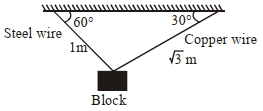
- 9A block of weight $100 N$ is suspended by copper and steel wires of same cross sectional area $0.5 cm ^2$ and, length $\sqrt{3} m$ and $1 m$, respectively. Their other ends are fixed on a ceiling as shown in figure. The angles subtended by copper and steel wires with ceiling are $30^{\circ}$ and $60^{\circ}$, respectively. If elongation in copper wire is $\left(\Delta \ell_{ C }\right)$ and elongation in steel wire is $\left(\Delta \ell_{ s }\right)$, then the ratio $\frac{\Delta \ell_{ C }}{\Delta \ell_{ S }}$ is. . . . . .View Solution
[Young's modulus for copper and steel are $1 \times 10^{11} N / m ^2$ and $2 \times 10^{11} N / m ^2$ respectively]
- 10A $0.1 \mathrm{~kg}$ mass is suspended from a wire of negligible mass. The length of the wire is $1 \mathrm{~m}$ and its crosssectional area is $4.9 \times 10^{-7} \mathrm{~m}^2$. If the mass is pulled a little in the vertically downward direction and released, it performs simple harmonic motion of angular frequency $140 \ \mathrm{rad} \mathrm{s}^{-1}$. If the Young's modulus of the material of the wire is $\mathrm{n} \times 10^9 \mathrm{Nm}^{-2}$, the value of $\mathrm{n}$ isView Solution