Two identical wires of rubber and iron are stretched by the same weight, then the number of atoms in the iron wire will be
Easy


Download our appand get started for free
Experience the future of education. Simply download our apps or reach out to us for more information. Let's shape the future of learning together!No signup needed.*
Similar Questions
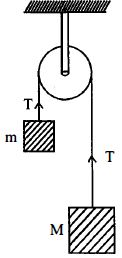
- 1Two blocks of masses $m$ and $M$ are connected by means of a metal wire of cross-sectional area $A$ passing over a frictionless fixed pulley as shown in the figure. The system is then released. If $M = 2\, m$, then the stress produced in the wire isView Solution
- 2View SolutionThe breaking stress of a wire depends upon
- 3View SolutionThe longitudinal strain is only possible in
- 4A $0.1 \mathrm{~kg}$ mass is suspended from a wire of negligible mass. The length of the wire is $1 \mathrm{~m}$ and its crosssectional area is $4.9 \times 10^{-7} \mathrm{~m}^2$. If the mass is pulled a little in the vertically downward direction and released, it performs simple harmonic motion of angular frequency $140 \ \mathrm{rad} \mathrm{s}^{-1}$. If the Young's modulus of the material of the wire is $\mathrm{n} \times 10^9 \mathrm{Nm}^{-2}$, the value of $\mathrm{n}$ isView Solution
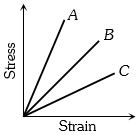
- 5The stress-strain curves for brass, steel and rubber are shown in the figure. The lines $A, B$ and $C$ are forView Solution
- 6Two wires $‘A’$ and $‘B’$ of the same material have radii in the ratio $2 : 1$ and lengths in the ratio $4 : 1$. The ratio of the normal forces required to produce the same change in the lengths of these two wires isView Solution
- 7A stone of mass $20\, {g}$ is projected from a rubber catapult of length $0.1\, {m}$ and area of cross section $10^{-6} \,{m}^{2}$ stretched by an amount $0.04\, {m}$. The velocity of the projected stone is $....\,m\,/s.$ (Young's modulus of rubber $=0.5 \times 10^{9}\, {N} / {m}^{2}$ )View Solution
- 8A pan with set of weights is attached with a light spring. When disturbed, the mass-spring system oscillates with a time period of $0.6$ $s.$ When some additional weights are added then time period is $0.7s.$ The extension caused by the additional weights is approximately given by ......... $cm$View Solution
- 9The compressibility of water is $4 \times {10^{ - 5}}$ per unit atmospheric pressure. The decrease in volume of $100$ cubic centimeter of water under a pressure of $100$ atmosphere will be ......... $cc$View Solution
- 10Given : $\sigma$ is the compressibility of water, $\rho$ is the density of water and $K$ is the bulk modulus of water. What is the energy density of water at the bottom of a lake $‘h’$ metre deep ?View Solution