Question
According to Newton's third law each team pulls the opposite team with equal force in a tug of war. Why then one team wins and the other loses?

Answer

The forces on the rope must be equal and opposite, according to Newton’s third law. But not all the forces acting on each team are equal. The friction between one team and the ground does not depend on the other team and can be larger on one side than on the other. In addition, the grips on the rope need not be equal and opposite. Thus, the net force acting on each team from all sources need not be equal.

Need a full question paper?

Generate a complete, print-ready paper with questions like this in minutes — across 16+ boards, with answer keys.
Start Generating Free

Similar questions

A (i) series (ii) parallel combination of two given resistors is connected, one by one, across a cell. In which case will the terminal potential difference, across the cell have a higher value?
If a charge is placed at rest in an electric field, will its path be along a line of force? Discuss the situation when the lines of force are straight and when they are curved.
Find the binding energy per nucleon of $\text{ }^{197}_{79}\text{Au}$ if its atomic mass is $196.96u.$
Monochromatic light of wavelength 589 nm is incident from air on a water surface. What are the wavelength, frequency and speed of (a) reflected, and (b) refracted light? Refractive index of water is 1.33.
A heating element using nichrome connected to a 230 V supply draws an initial current of 3.2 A which settles after a few seconds to a steady value of 2.8 A. What is the steady temperature of the heating element if the room temperature is 27${ }^{\circ} C$ ? Temperature coefficient of resistance of nichrome averaged over the temperature range involved is $1.70 \times 10^{-4}{ }^{\circ} C ^{-1}$.
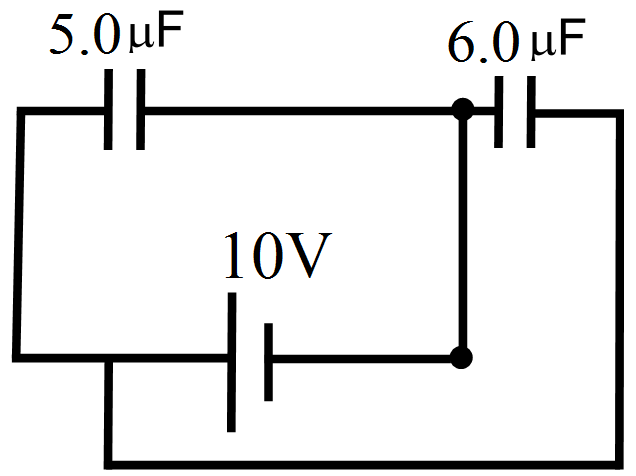
Find the charge supplied by the battery in the arrangement shown in figure.
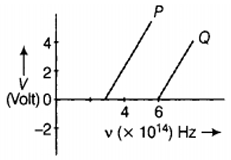
In the study of a photoelectric effect, the graph between the stopping potential $V$ and frequency of the incident radiation on two different metals $P$ and $Q$ is shown below.
Image
$i$. Which one of the two metals has higher threshold frequency?
$ii.$ Determine the work function of the metal which has greater value.
Estimate the proportion of boron impurity whieh will increase the conductivity of a pure silicon sample by a factor of $100.$ Assume that each boron atom creates a hole and the concentration of holes in pure silicon at the same temperature is $7 \times 10^{15}$ holes per cubic metre. Density of silicon is $5 \times 10^{21}$ atoms per cubic metre.
An electric bulb is marked $220 V, 100 W$. Calculate : (i) resistance of the bulb (ii) peak voltage of the source (iii) rms current flowing through the bulb.
Find the energy liberated in the reaction:
$^{223}Ra \rightarrow \ ^{209}Pb +\ ^{14}C.$
The atomic masses needed are as follows.
$^{223}Ra$ $^{209}Pb$ $^{14}C$
$22.018u$ $208.981u$ $14.003u$