Question
Account for the following observations:
Though fluorine is more electronegative than chlorine yet $\mathrm{BF}_3$ is a weaker Lewis acid than $\mathrm{BCl}_3$
Answer

In boron halides, there exists certain degree of pi bonding involving halogen lone pairs and empty $2 p$ orbital of boron. This bonding is strongest in case of $\mathrm{BF}_3$ and when a boron halide accepts electrons from a donor molecule, this bonding is lost. Due to this, $\mathrm{BF}_3$ resists this change most strongly followed by other halides and thus the acceptor strength increases in the order $\mathrm{BF}_3<\mathrm{BCl}_3<\mathrm{BBr}_3<\mathrm{Bl}_3$.
Due to this, $\mathrm{Bl}_3$ a stronger Lewis acid than $\mathrm{BCl}_3$ and $\mathrm{BF}_3$.

Need a full question paper?

Generate a complete, print-ready paper with questions like this in minutes — across 16+ boards, with answer keys.

Start Generating Free

Similar questions

i. What will be the minimum pressure required to compress $500 dm ^3$ of air at 1 bar to $200 dm ^3$ at $30^{\circ} C$.
ii. Critical temperature for $CO _2$ and $CH _4$ are $31.1^{\circ} C$ and $-81.9^{\circ} C$ respectively. Which of these has stronger intermolecular forces and why?
The amount of energy released when $1 \times 10^{10}$ atoms of chlorine in vapour state are converted to $Cl ^{-}$ions according to the equation,
$Cl(g)+e^{-} \rightarrow Cl^{-}(g) \text { is } 57.86 \times 10^{-10} J$
Calculate the electron gain enthalpy of chlorine atom in terms of $kJ mol ^{-1}$ and eV per atom.
  1. State as to why
  1. alkali metals are prepared by electrolysis of their fused chlorides?
  2. sodium is found to be more useful than potassium?
  1. Explain what happens when fused sodium metal reacts with ammonia?
i. Write the resonance structures for $\mathrm{CO}_2$.
ii. Draw Lewis structure of $\mathrm{H}_2 \mathrm{SO}_4$.
iii. Why $\mathrm{KHF}_2$ exist but $\mathrm{KHCl}_2$ does not?
Why is nitric acid added to sodium extract before adding silver nitrate for testing halogens?
Calculate the volume of 02 at STP liberated by heating 12.25 g of $\mathrm{KClO}_3$ (At. wt. of $\mathrm{K}=39, \mathrm{Cl}=35.5,0=16 \mathrm{u}$ )
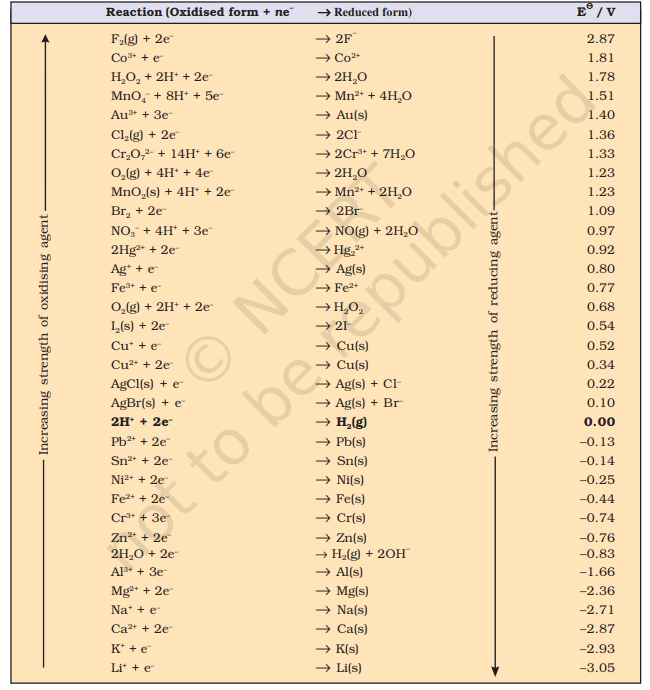
Using the standard electrode potentials given in the Table, predict if the reaction between the following is feasible:

$\mathrm{Br}_2(\mathrm{aq})$ and $\mathrm{Fe}^{2+}(\mathrm{aq})$
Why does benzene undergo electrophilic substitution reactions easily and nucleophilic substitutions with difficulty?
  1. Calculate e.m.f. of following cells
  1. $\text{Zn}|\text{Zn}^{2+}(1\text{M})||\text{CO}^{2+}(1\text{M})|\text{Co}$
$\text{E}^0_\frac{\text{Zn}^{2+}}{\text{Zn}}=-0.76\text{V}$

$\text{E}^0_\frac{\text{CO}^{2+}}{\text{Cu}}=-0.28\text{V}$
  1. $\text{Zn}|\text{Zn}^{2+}(1\text{M})||\text{Ag}+(1\text{M})|\text{Ag}$
$\text{E}^0_\frac{\text{Ag}+}{\text{Ag}}=+0.80\text{V}$
  1. What is meant by negative $\text{E}^\circ$ value and positive $\text{E}^\circ$ value of redox couple?
What properties of water make it useful as a solvent? What types of compound can it:
  1. Dissolve, and
  2. Hydrolyse?