Question
Using the standard electrode potentials given in the Table, predict if the reaction between the following is feasible:
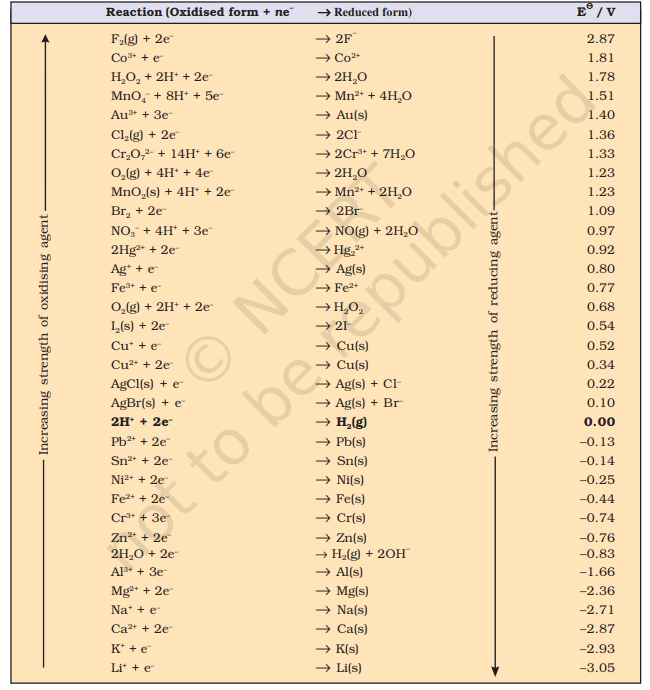
$\mathrm{Br}_2(\mathrm{aq})$ and $\mathrm{Fe}^{2+}(\mathrm{aq})$

Answer

The possible reaction between $\mathrm{Br}_2(\mathrm{aq})$ and $\mathrm{Fe}^{2+}(\mathrm{aq})$ is given by, $\text{Br}_{2(\text{s})}+2\text{Fe}^{2+}_{(\text{aq})}\rightarrow2\text{Br}^-_{(\text{aq})}+2\text{Fe}^{3+}_{(\text{aq})}$ $\text{Oxidation half equation:}\ \ \ \ \ \ \ \text{Fe}^{2+}_{(\text{aq})}\xrightarrow{\ \ \ \ \ \ }\text{Fe}^{3+}_{(\text{aq})}+\text{e}^-]\times2\ \ ;\text{E}^\circ=-0.77\text{V}\\\text{Reduction half equation:}\ \ \text{Br}^{}_{2(\text{aq})}+2\text{e}^-\xrightarrow{\ \ \ \ \ }2\text{Br}^{-}_{(\text{aq})}\ \ \ \ \ \ \ \ \ ; \text{E}^\circ=+1.09\text{V}\\\overline{\ \ \ \ \ \ \ \ \ \ \ \ \ \ \ \ \ \ \ \ \ \ \ \ \ \ \ \ \ \ \ \ \ \ \ \ \ \ \ \ \ \ \ \ \ \ \ \ \ \ \ \ \ \ \ \ \ \ \ \ \ \ \ \ \ \ \ \ \ \ \ \ \ \ \ \ \ \ \ \ \ \ \ \ \ \ \ \ \ \ \ \ \ \ \ \ \ \ \ \ \ \ \ \ \ \ \ \ \ \ \ \ \ \ \ \ \ \ \ \ \ }\\\ \ \ \ \ \ \ \ \ \ \ \ \ \ \ \ \ \ \ \ \ \ \ \ \ \ \text{Br}^{}_{2(\text{aq})}+2\text{Fe}^{2+}_{(\text{aq})}\xrightarrow{\ \ \ \ \ }2\text{Br}^{-}_{(\text{aq})}+2\text{Fe}^{3+}_{(\text{aq})}\ \ \ \ \ ;\text{E}^\circ=-0.32\text{V}$Here, E° for the overall reaction is positive. Hence, the reaction between $\mathrm{Br}_2(\mathrm{aq})$ and $\mathrm{Fe}^{2+}(\mathrm{aq})$ is feasible.

Need a full question paper?

Generate a complete, print-ready paper with questions like this in minutes — across 16+ boards, with answer keys.

Start Generating Free

Similar questions

2 Arrange the following set of compounds in order of their decreasing relative reactivity with an electrophile, $\mathrm{E}^{+}$.
Toluene, $\mathrm{p}-\mathrm{H}_3 \mathrm{C}-\mathrm{C}_6 \mathrm{H}_4-\mathrm{NO}_2, \mathrm{p}-\mathrm{O}_2 \mathrm{~N}-\mathrm{C}_6 \mathrm{H}_4-\mathrm{NO}_2$.
Is demineralised or distilled water useful for drinking purposes? If not, how can it be made useful?
1. Define intensive properties.
2. One mole of acetone requires less heat to vaporise than 1 mole of water. Which of the two liquids has the higher enthalpy of vaporisation?
3. Define standard enthalpy.
The first $\left(\mathrm{IE}_1\right)$ and second $\left(\mathrm{IE}_2\right)$ ionisation enthalpies $\left(\mathrm{kJ} \mathrm{~mol}^{-1}\right)$ of three elements $\mathrm{I}, \mathrm{II}$ and III are given below:
Element
$\mathrm{IE}_1$
$\mathrm{IE}_2$
I
403
2640
II
549
1060
III
1142
2080
Identify the element which is likely to be:
  1. Non-metal.
  2. An alkali metal.
  3. An alkaline earth metal.
An alkyl halide ' A ' of formula $\mathrm{C}_6 \mathrm{H}_{13} \mathrm{Cl}$ on treatment with alcoholic KOH gives two isomeric alkenes ' B ' and ' C ' with molecular formula $\mathrm{C}_6 \mathrm{H}_{12}$. Both alkenes on hydrogenation give 2, 3-dimethyl butane. Predict the structure of 'A', 'B' and ' C '.
An unknown alkene ‘A’ on reductive ozonolysis gives two isomeric carbonyl compounds 'B' and 'C' having molecular formula $\mathrm{C}_3 \mathrm{H}_6 \mathrm{O}$. Write the structures of A, B and C.
A transluscent white waxy solid (A) on heating in inert atmosphere is converted into its allotropic form ' B '. Allotrope ' A ', on reaction with very dilute aqueous solution of KOH liberates highly poisonous gas (C) having rotten fish smell. With excess of chlorine (C) forms (D) which hydrolyse to a compound 'E'. Identify A to E giving chemical equations.
Compare the alkali metals and alkaline earth metals with respect to (i) Ionisation enthalpy (ii) Basicity of oxides and (iii) Solubility of hydroxides.
A 5L vessel contains 1.4g of nitrogen. When heated to 1800K, 30% of molecules are dissociated into atoms. Calculate the pressure of the gas at 1800K.
When electromagnetic radiation of wavelength 300 nm falls on the surface of sodium, electrons are emitted with a kinetic energy of $1.68 \times 10^5 \mathrm{~J} \mathrm{~mol}^{-1}$. What is the minimum energy needed to remove an electron from sodium? What is the maximum wavelength that will cause a photo-electron to be emitted?
$\left(\mathrm{h}=6.626 \times 10^{-34} \mathrm{~J} \mathrm{~s}\right)$