Questions

3 Marks Question

Take a timed test

53 questions · self-marked practice — reveal the answer and mark yourself.

Question 13 Marks
How can you explain higher stability of $\mathrm{BCl}_3$ as compared to $\mathrm{TICl}_3$ ?
Answer
Boron and thallium belong to group 13 of the periodic table. In this group, the +1 oxidation state becomes more stable on moving down the group. $\mathrm{BCl}_3$ is more stable than $\mathrm{TICl}_3$ because the +3 oxidation state of B is more stable than the +3 oxidation state of TI . In TI , the +3 state is highly oxidizing and it reverts back to the more stable +1 state.
View full question & answer
Question 23 Marks
Explain the following reactions:
Silicon dioxide is treated with hydrogen fluoride.
Answer
When silicon dioxide ($SiO_2$​​​​​​​) is heated with hydrogen fluoride (HF), it forms silicon tetrafluoride ($SiF_4$​​​​​​​). Usually, the Si-O bond is a strong bond and it resists any attack by halogens and most acids, even at a high temperature. However, it is attacked by HF.
$\text{SiO}_4+4\text{HF}\rightarrow \text{SiF}_4+2\text{H}_2\text{O}$
The $SiF_4$​​​​​​​ formed in this reaction can further react with HF to form hydrofluorosilicic acid.
$\text{SiF}_4+2\text{HF} \rightarrow \text{H}_2\text{SiF}_6$
View full question & answer
Question 33 Marks
How is excessive content of $\text{CO}_2$ responsible for global warming?
Answer
Carbon dioxide is a very essential gas for our survival. However, an increased content of $\text{CO}_2$ in the atmosphere poses a serious threat. An increment in the combustion of fossil fuels, decomposition of limestone, and a decrease in the number of trees has led to greater levels of carbon dioxide. Carbon dioxide has the property of trapping the heat provided by sunrays. Higher the level of carbon dioxide, higher is the amount of heat trapped. This results in an increase in the atmospheric temperature, thereby causing global warming.
View full question & answer
Question 43 Marks
What do you understand by,
  1. Inert pair effect.
  2. Allotropy.
  3. Catenation.
Answer
  1. Inert pair effect: The reluctance of $\text{ns}^2$ pair in p-block elements having higher atomic number to take part in bond formation is called inert pair effect.
  2. Allotropy: The existence of an element in more than one form having different physical properties but same or slightly different chemical properties is called allotropy.
  3. Catenation: The property by virtue of which a large number of atoms of the same element get linked together through covalent bonds resulting in the formation of long chains, branched chains and rings of different sizes is called catenation.
View full question & answer
Question 53 Marks
Write reactions to justify amphoteric nature of aluminium.
Answer
A substance is called amphoteric if it displays characteristics of both acids and bases. Aluminium dissolves in both acids and bases, showing amphoteric behavior.
  1. $2\text{Al}_{(\text{S})}+6\text{HCl}_{(\text{aq})}\rightarrow2\text{Al}^{3+}_{(\text{aq})}+3\text{H}_{2(\text{g})}$
  2. $2\text{Al}_{\text{(s)}}+2\text{NaOH}_{(\text{aq})}+6\text{H}_2\text{O}_{\text{(l)}}\rightarrow 2\text{Na}^{+}\big[\text{Al(OH)_4}\big]^{-}_\text{(aq)}+3\text{H}_{2\text{(g)}}$
View full question & answer
Question 63 Marks
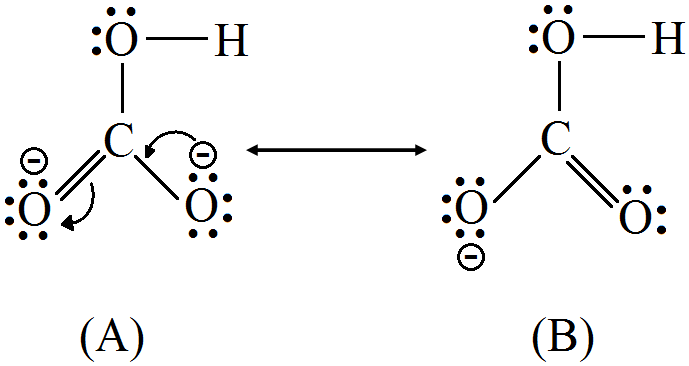
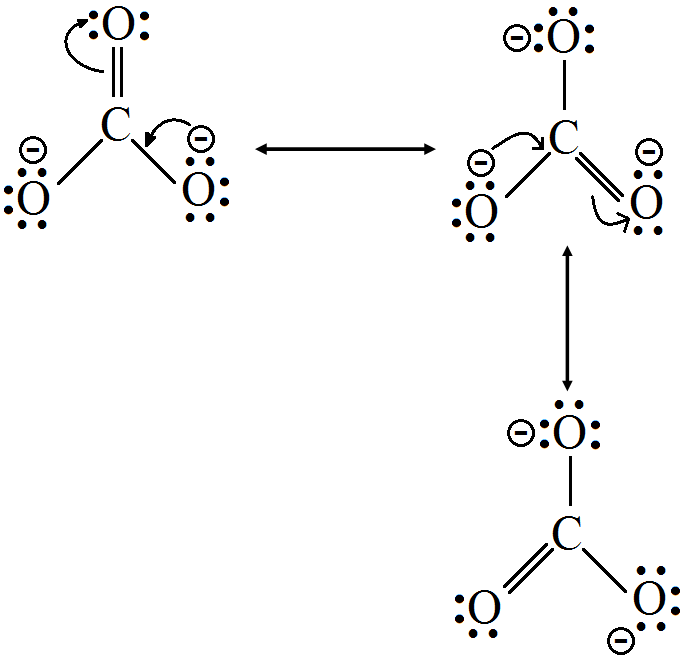
Write the resonance structures of $\text{CO}_3^{2-}$ and $\text{HCO}_3^-.$
Answer
  1. $\text{CO}_3^{2-}$
  1. $\text{HCO}^{-}_3\text{ ion}$


There are only two resonating structures for the bicarbonate ion.
View full question & answer
Question 73 Marks
In some of the reactions thallium resembles aluminium, whereas in others it resembles with group I metals. Support this statement by giving some evidences.
Answer
Thallium belongs to group 13 of the periodic table. The most common oxidation state for this group is +3 . However, heavier members of this group also display the +1 oxidation state. This happens because of the inert pair effect. Aluminium displays the +3 oxidation state and alkali metals display the +1 oxidation state. Thallium displays both the oxidation states. Therefore, it resembles both aluminium and alkali metals.
Thallium, like aluminium, forms compounds such as $\mathrm{TICl}_3$ and $\mathrm{Tl}_2 \mathrm{O}_3$. It resembles alkali metals in compounds $\mathrm{Tl}_2 \mathrm{O}$ and TICl.
View full question & answer
Question 83 Marks
Suggest a reason as to why CO is poisonous.
Answer
Carbon monoxide is a colourless, odourless gas which has a tendency to bind to hemoglobin (the oxygen carrying molecule in blood), forming a complex called carboxyhemoglobin. This complex is 300 times more stable than oxyhemoglobin complex and therefore, if once, formed can seriously hamper the oxygen supply to different organs and ultimately can cause death. This is why CO is said to be so dangerous.
View full question & answer
Question 93 Marks
Write balanced equation for:
  1. $\text{BF}_3$ is reacted with ammonia.
  2. Al is treated with dilute NaOH.
  3. CO(g) is heated with ZnO.
Answer
  1. $\text{BF}_3+\text{NH}_3\xrightarrow{\ \ \ \ \ \ }\text{H}_3\text{N}\xrightarrow{\ \ \ \ \ }\text{BF}_3$
  2. $2\text{Al}+2\text{NaOH}+6\text{H}_2\text{O}\xrightarrow{\ \ \ \ \ }2\text{Na[Al(OH})_4]+3\text{H}_2$
  3. $\text{ZnO(s)}+\text{CO(g)}\xrightarrow{\ \ \ \ \Delta\ \ \ \ }\text{Zn(s)}+\text{CO}_2\text{(g)}$
View full question & answer
Question 103 Marks
i. Out of $CO _2, SiO _2, GeO _2, SnO _2$, and $PbO _2$, which is best oxidising agent and why?
ii. $SnCl _4$ is liquid, $SnCl _2$ is solid, why?
iii. Name the hydride of group 15 which has lowest boiling point.
Answer
i. $PbO _2$ is best oxidising agent because $Pb ^{4+}$ can gain 2 electrons to form $Pb ^{2+}$ which is more stable due to inert pair effect.
ii. $SnCl _4$ is covalent compound, has weak Vander waal's forces of attraction between molecules. That is why it is liquid. $SnCl _2$ is ionic compound, it is solid due to strong forces of attraction between ions.
iii. $PH _3$ has lowest boiling point due to less surface area and less van der Waal's forces of attraction.
View full question & answer
Question 113 Marks
What happens when:
  1. Aluminium is treated with dilute NaOH.
  2. Boric acid is added to water.
  3. Diborane is reacted with $\text{H}_2\text{O}$.
Answer
  1. $2\text{Al}+\text{NaOH}+2\text{H}_2\text{O}\xrightarrow{\ \ \ \ \ \ \ }2\text{NaAlO}_2+3\text{H}_2$
  2. $\text{B(OH})_3+2\text{H}_2\text{O}\xrightarrow{\ \ \ \ \ }\text{B(OH})^-_4+\text{H}_3\text{O}^+$
  3. $\text{B}_2\text{H}_6+6\text{H}_2\text{O}\xrightarrow{\ \ \ \ \ \ \ \ \ \ }2\text{H}_3\text{BO}_3+6\text{H}_2\\ \ \ \ \ \ \ \ \ \ \ \ \ \ \ \ \ \ \ \ \ \ \ \ \ \ \ \ \ \ \ \ \ \ \ \ \ ^\text{Orthoboric}\\ \ \ \ \ \ \ \ \ \ \ \ \ \ \ \ \ \ \ \ \ \ \ \ \ \ \ \ \ \ \ \ \ \ \ \ \ \ \ \ \ ^\text{acid}$
View full question & answer
Question 123 Marks
Describe the general trends in the following properties of the elements in Groups 13 and 14.
Atomic size.
Answer
Group 13Atomic size: On moving down the group the size of atom increases becaouse for each successive member of the group one extra shell of electrons is added but in some cases deviations is seen. The size of Ga is less than that of Al duo to the poor shieldeng effect of 10 electrons present in d orbital.
Group 14
Atomic size: In group 14 atomic radius is referred as covalent radius. There is a considrable increase in covalent radius from C to Si, thereafter from Si to a small increase in radius is observed. Thise is due to the presence of completely filled d and f orbitals in heavier members due to screening effect.
View full question & answer
Question 133 Marks
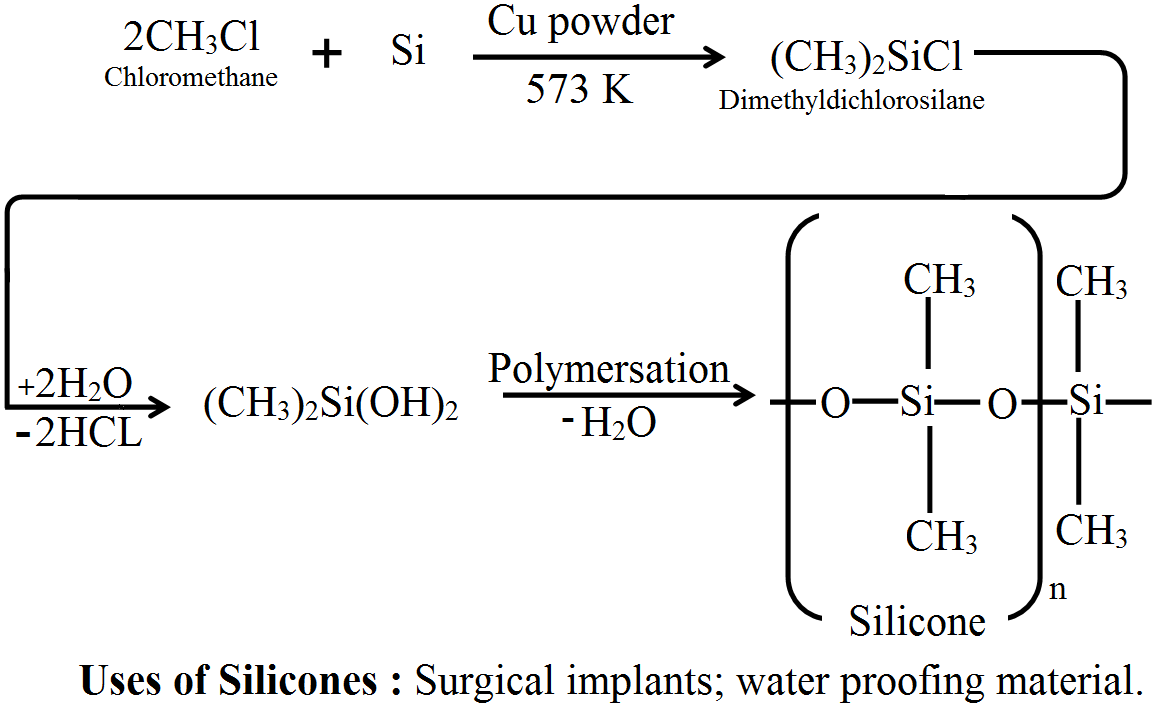
What are silicones? State the uses of silicones.
Answer
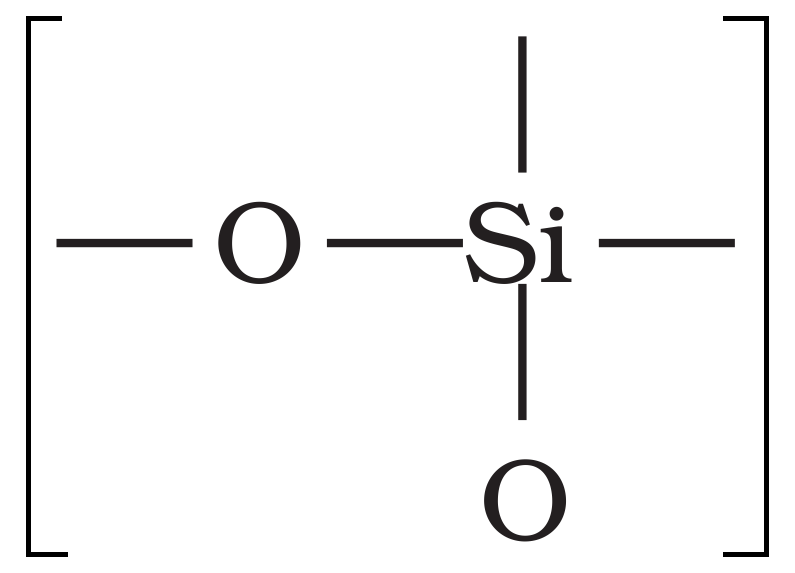
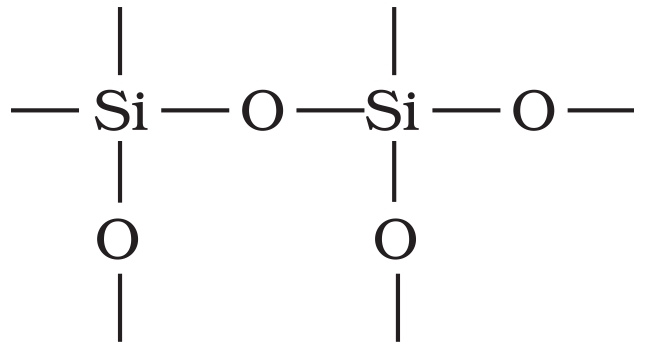
Silicones are organosilicon polymers containing Si? O? Si linkages. They contain repeated units. Silicones are non-toxic, stable towards heat and are hydrophobic (water repellent) in nature.Uses:
  1. Silicones are used in making waterproof cloth, paper, wool, wood, etc. By exposing them to silicone vapour.
  2. Silicone oils are used as lubricants at high as well as low temperatures.
  3. These are used as insulating materials for electric motors and other electrical appliances.
  4. Silicone rubbers are useful as they retain their elasticity over a range of temperatures.
  5. These are mixed with paints and enamels to make them resistant to the effect of high temperature, sunlight and damp.
View full question & answer
Question 143 Marks
  1. Why does water transported through lead pipes become poisonous?
  2. When formic acid reacts with conc $\text{H}_2\text{SO}_2$, what will happen? Write chemical equation?
  3. Name the allotrope of carbon which is isomorphous (same structure) with crystalline silicon.
Answer
  1. It is due to formation of lead hydroxide which makes the water poisonous.
  2. Carbon monoxide is formed.
$\text{HCOOH}\xrightarrow{\ \ \ \ \text{conc. H}_2\text{SO}_4\ \ \ \ }\text{H}_2\text{O}+\text{CO}$
  1. Silicon crystals have same octahedral structure as diamond in which each 'C' is linked to four carbon like silicon.
View full question & answer
Question 153 Marks
What are boranes? Give chemical equation for the preparation of diborane.
Answer
Boron forms a number of hydrides. These are called boranes. Boranes can be grouped into two series:
  1. $\mathrm{B}_n \mathrm{H}_{n+4}: \mathrm{B}_2 \mathrm{H}_6, \mathrm{~B}_5 \mathrm{H}_9, \mathrm{~B}_{10} \mathrm{H}_{14}$, etc.
  2. $\mathrm{B}_n \mathrm{H}_{n+6}: \mathrm{B}_4 \mathrm{H}_{10}, \mathrm{~B}_5 \mathrm{H}_{11}, \mathrm{~B}_9 \mathrm{H}_{15}$, etc.
The simplest boron hydride, $BH_3$ is unknown. The most important hydride is diborane, $B_2H_6$. It is prepared by the action of $LiAlH_4$ on boron trichloride in presence of ether. $4\text{BCl}_3+3\text{LiAlH}\rightarrow2\text{B}_2\text{H}_6+3\text{LiCl}+3\text{AlCl}_3$
View full question & answer
Question 163 Marks
  1. Give reasons:
  1. Graphite is used as a good lubricant.
  2. A mixture of dilute NaOH and aluminium pieces is used to open a drain.
  1. Write balanced equations for the following reactions:
  1. $\text{NaH}+\text{B}_2\text{H}_6\xrightarrow{\ \ \ \ \ \ \ }$
  2. $\text{H}_3\text{BO}_3\xrightarrow{\Delta}$
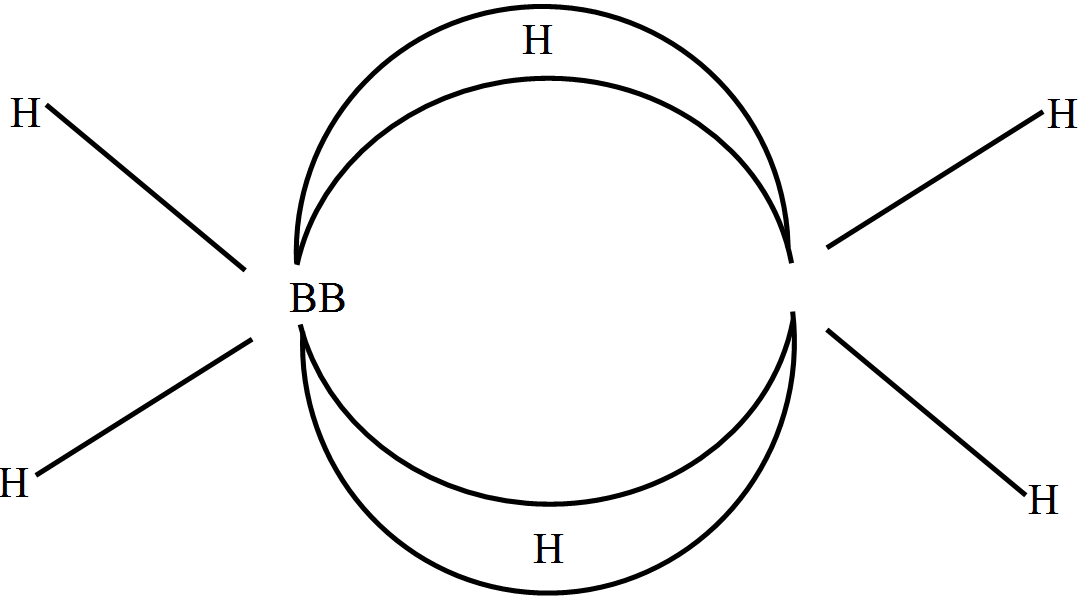
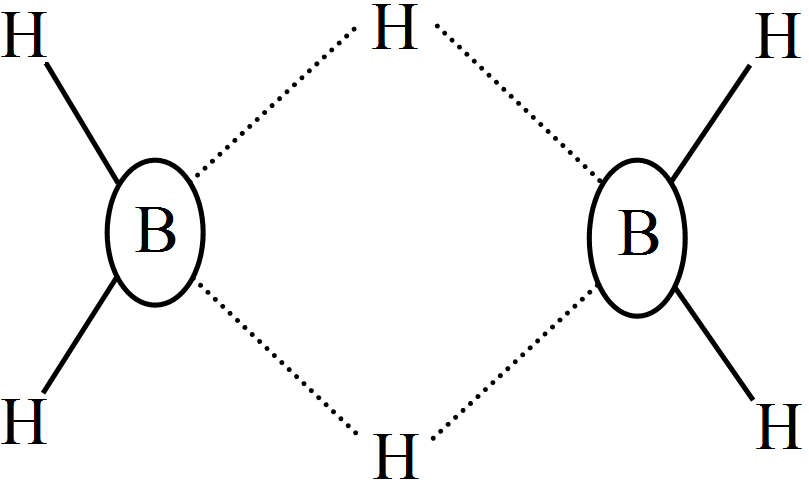
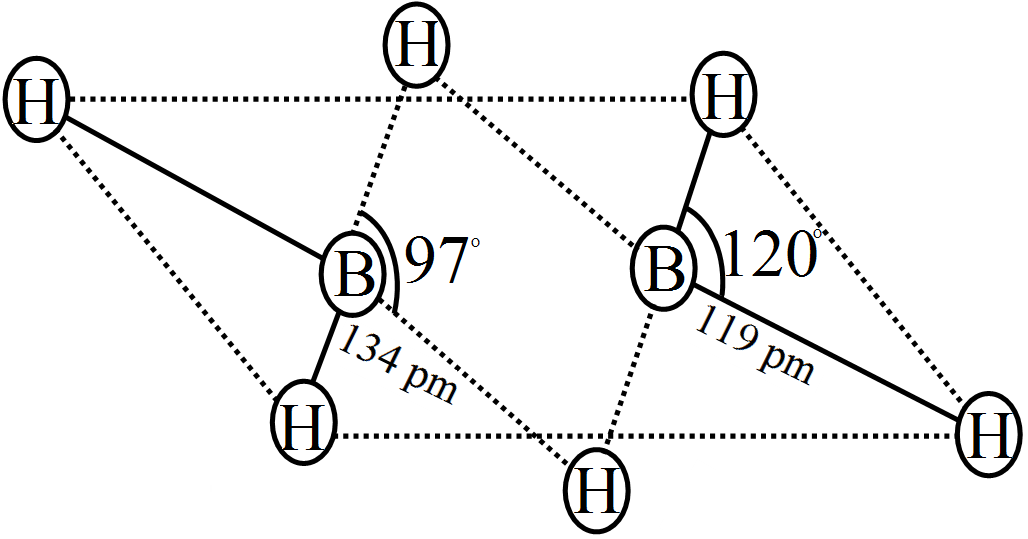
  1. Draw the shape of $B_2H_6$ molecule.
Answer
  1.  
  1. Two successive layers of graphite are held together by weak forces of attraction, so layers can slide over each other. This makes graphite a good lubricant.
  2. NaOH reacts with aluminium to evolve dihydrogen whose pressure can be used to open clogged drains.
$2\text{Al}+2\text{NaOH}+2\text{H}_2\text{O}\xrightarrow{\ \ \ \ \ \ \ }2\text{NaAlO}_2+3\text{H}_2$
  1.  
  1. $2\text{NaH}+\text{B}_2\text{H}_6\xrightarrow{\ \ \ \ \ \ \ }2\text{Na}^+[\text{BH}_4]^-$
  2. $\text{H}_3\text{BO}_3\xrightarrow[\text{}\Delta]{370\text{K}}4\text{HBO}_2\xrightarrow{410\text{K}}\text{H}_2\text{B}_4\text{O}_7\\\xrightarrow[\text{Hot}]{\text{Red}}2\text{B}_2\text{O}_3+\text{H}_2\text{O}$
Step - I : $\text{H}_3\text{BO}_3\rightleftharpoons\text{HBO}_2+\text{H}_2\text{O}$
Step - II: $4\text{HBO}_2\xrightarrow[\text{-H}_2\text{O}]{\Delta}\text{H} _2\text{B}_4\text{O}_7\xrightarrow{\Delta}2\text{B}_2\text{O}_3+\text{H}_2\text{O}$
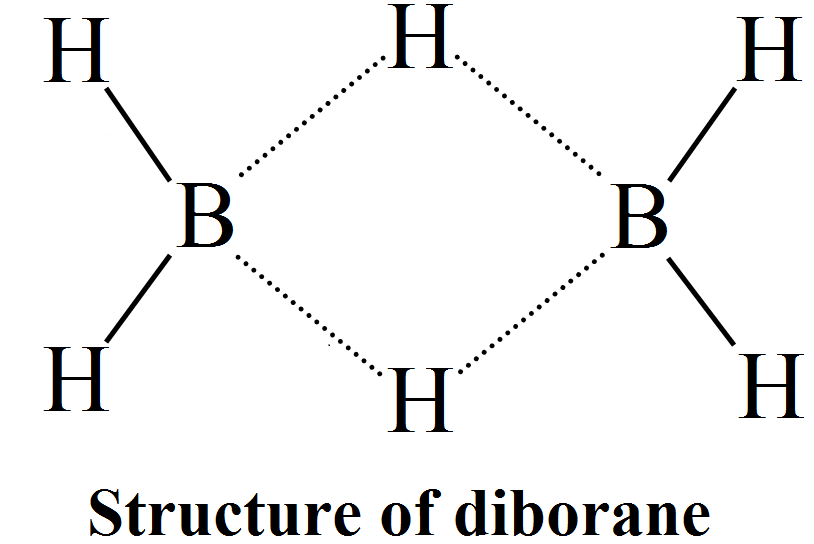
  1. Shape of $B_2H_6$ molecure:

View full question & answer
Question 173 Marks
Account for the following observations:
Though fluorine is more electronegative than chlorine yet $\mathrm{BF}_3$ is a weaker Lewis acid than $\mathrm{BCl}_3$
Answer
In boron halides, there exists certain degree of pi bonding involving halogen lone pairs and empty $2 p$ orbital of boron. This bonding is strongest in case of $\mathrm{BF}_3$ and when a boron halide accepts electrons from a donor molecule, this bonding is lost. Due to this, $\mathrm{BF}_3$ resists this change most strongly followed by other halides and thus the acceptor strength increases in the order $\mathrm{BF}_3<\mathrm{BCl}_3<\mathrm{BBr}_3<\mathrm{Bl}_3$.
Due to this, $\mathrm{Bl}_3$ a stronger Lewis acid than $\mathrm{BCl}_3$ and $\mathrm{BF}_3$.
View full question & answer
Question 183 Marks
Explain the following:
$Pb^{4+}$ acts as an oxidising agent but $Sn^{2+}$ acts as a reducing agent.
Answer
Inert pair effect is less prominent in Sn than in Pb . Therefore, +2 oxidation of Sn is less stable than its +4 oxidation state. In other words, $\mathrm{Sn}^{2+}$ can easily lose two electrons to form $\mathrm{Sn}^{4+}$ and hence $\mathrm{Sn}^{2+}$ acts as a reducing agent.
$\mathrm{Sn}^{2+} \rightarrow \mathrm{Sn}^{4+}+2 \mathrm{e}$.
In contrast, the inert pair effect is' more prominent in Pb than in Sn . Therefore, +2 oxidation state of Pb is more stable than its +4 oxidation state. In other words, $\mathrm{Pb}^{4+}$ can easily lose two electrons to form $\mathrm{Pb}^{2+}$ and hence $\mathrm{Pb}^{4+}$ acts as an oxidising agent.
$\mathrm{Pb}^{4+}+2 \mathrm{e}^{-} \rightarrow-\mathrm{Pb}^{2+} .$
View full question & answer
Question 193 Marks
Describe the general trends in the following properties of the elements in Groups 13 and 14.
Metallic character.
Answer
Group 13Metallic character: Boron is nonmetallic and all other elements are metalic. Metallic character increases from B to Al to Tl it decreases due to poor shielding effect of d-electrons and f-electrons.
Group 14
Metallic character: In group 14, on moving down the metallic character increases. Carbone is non-metal, Si and Ge are metalloid and Sn and Pb are metals.
View full question & answer
Question 203 Marks
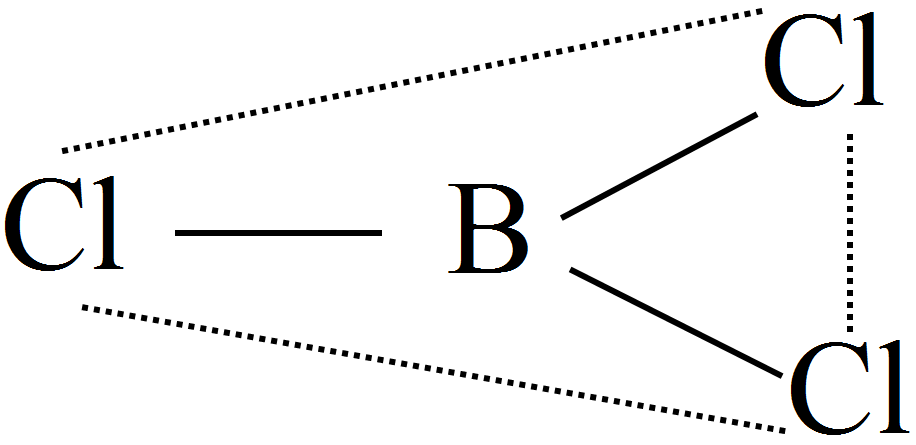
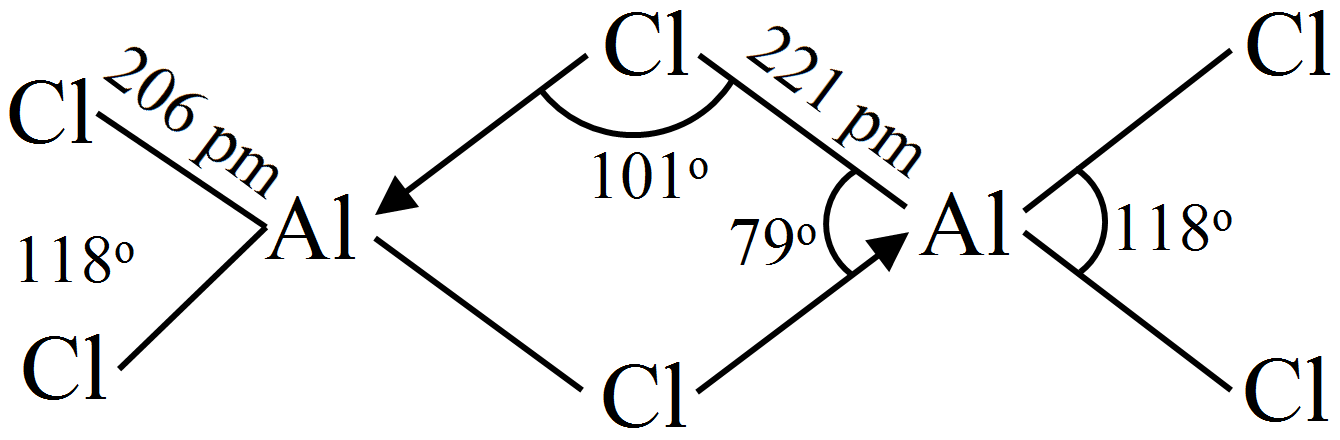
$BCl _3$ is trigonal planar while $AlCl _3$ is tetrahedral in dimeric state. Explain.
OR
$BCl _3$ exists as monomer whereas $AlCl _3$ is dimerised through halogen bridging. Give reason. Explain the structure of the dimer of $AlCl _3$ also.
Answer
Both $BCl _3$ and $AlCl _3$ are electron deficient molecules having six electrons in the valence shell of their respective central atoms. To complete their octets, the central atom in each case can accept a pair of electrons from the chlorine atom of another molecule forming dimeric structures. However, because of small size of B , it cannot accommodate four big sized Cl atoms around it. Therefore, $BCl _3$ prefers to exist as a monomeric planar molecule in which B atom is $sp ^2$-hybridised.

On the other hand, Al because of its bigger size can easily accommodate four Cl atoms around it. As a result, $AlCl_3$ exists as a dimer. In this dimer, since the covalency of Al has increased to 4.
Therefore, Al is $sp^3$​​​​​​​-hybridised and the four Cl atoms are held tetrahedrally around it.
View full question & answer
Question 213 Marks
  1. Name an element which has higher melting point in group 13.
  2. Which element is best reducing agent in group 14.
  3. Why is $\text{CO}_2$ an oxidising agent?
Answer
  1. Boron has highest melting point due to strong cavalent bonds.
  2. Sn is best reducing agent due to lowest standard reduction potential.
  3. In $\text{CO}_2$, 'C' has highest oxidation state, it can gain electron, therefore acts as oxidising agent.
View full question & answer
Question 223 Marks
Explain the following reactions:
  1. Silicon dioxide is treated with hydrogen fluoride.
  2. Carbon is heated with ZnO.
  3. Hydrated Alumina is treated with aqueous NaOH solution.
Answer
  1. $\text{SiO}_2+6\text{HF}\xrightarrow{\ \ \ \ \ }\text{H}_2\text{SiF}_6+2\text{H}_2\text{O}\\ \ \ \ \ \ \ \ \ \ \ \ \ \ \ \ \ \ \ \ \ \ \ \ \ \ \ \ \ \ ^\text{Fluosilicic}\\ \ \ \ \ \ \ \ \ \ \ \ \ \ \ \ \ \ \ \ \ \ \ \ \ \ \ \ \ \ \ \ \ ^\text{acid}$
  2. $\text{ZnO}+\text{C}\xrightarrow{\ \ \ \ \ \ \ }\text{Zn}+\text{CO}$
  3. $\text{Al}_2\text{O}_3.2\text{H}_2\text{O}+2\text{NaOH}+\text{H}_2\text{O}\xrightarrow{\ \ \ \ \ \ \ }\\2\text{Na[Al(OH})_4]$
View full question & answer
Question 233 Marks
  1. Draw the shape of $B_2H_6$ molecule.
  2. Give suitable reasons for the following:
  1. $[\text{SiF}_6]^{2-}$ is known whereas $[\text{SiCl}_6]^{2-}$ not
  2. Diamond is covalent, yet it has high melting point.
  1. Complete the reactions:
  1. $\text{Na}_2\text{B}_4\text{O}_7+7\text{H}_2\text{O}\xrightarrow{\ \ \ \ \ \ \ }$
  2. $\text{B}_2\text{H}_6+3\text{O}_2\xrightarrow{\ \ \ \ \ \ \ \ }$
Answer
  1.  
  1.  
  1. $\text{SiF}^{2-}_6$ is known but $\text{SiCl}_6^{2-}$
Not because six large chloride ions cannot be accommodated around silicon.
  1. Diamond has a 3-D network structure in which each carbon is tetrahedrally linked to four neighbouring carbon atoms through C—C bond. The structure is rigid and so its melting point is high.
  1.  
  1. $\text{Na}\text{B}_4\text{O}_7+7\text{H}_2\text{O}\xrightarrow{\ \ \ \ \ }2\text{NaOH}+4\text{H}_3\text{BO}_3$
  2. $\text{B}_2\text{H}_6+3\text{O}_2\xrightarrow{\ \ \ \ \ \ }\text{B}_2\text{O}_3+3\text{H}_2\text{O}$
View full question & answer
Question 243 Marks
  1. Account for the following:
  1. Boron halides do not dimerise like $BH_3$.
  2. Carbon shows catenation remarkably.
  3. $PbCl_4$ is a good oxidising agent.
  1. Complete the following reactions:
  1. $\text{Na}_{2}\text{B}_{4}\text{O}_{7} + 2\text{HCl} + \text{5H}_{2}\text{O} \xrightarrow{\ \ \ \ \ \ \ \ }$
  2. $\text{B}_{2}\text{H}_{6} + 6\text{NH}_{3} \xrightarrow[\ \ \ \ \ \ ]{\Delta}$
Answer
  1.  
  1. Due to larger size of halogens in comparison to H; boron halides cannot dimerise but $BH_3$ can. And two small boron atoms can't accommodate large sized halogen atoms around them.
  2. Carbon shows remarkably catenation property due to small size and high strength of carbon carbon bond.
  3. Stability of +4 oxidation state decreases down the group and that of +2 oxidation state increases down the group due to inert pair effect. Hence, $Pb^{4+}$ easily changes to $Pb^{2+}$ acting as good oxidising agent.
  1.  
  1. $\text{B}_2\text{B}_6+3\text{O}_2\xrightarrow{\ \ \ \ \ \ }\text{B}_2\text{O}_3+3\text{H}_2\text{O}$
  2. $2\text{BF}_3+6\text{NaH}\xrightarrow{450\text{K}}\text{B}_2\text{H}_6+6\text{NaF}$
View full question & answer
Question 253 Marks
Give reasons for the following:
Carbon has a strong tendency for catenation compared to silicon.
Answer
The bond dissociation energy decreases rapidly as the atomic size increases. Since the atomic size of carbon is much smaller ( 77 pm ) as compared to that of silicon ( 118 pm ), therefore, carbon-carbon bond dissociation energy is much higher ( $348 \mathrm{~kJ} \mathrm{~mol}^{-1}$ ) than that of silicon-silicon bond $\left(297 \mathrm{~kJ} \mathrm{~mol}^{-1}\right)$. Hence, because $\mathrm{C}-\mathrm{C}$ bonds are much stronger as compared to Si -Si bonds, carbon has a much higher tendency for catenation than silicon.
View full question & answer
Question 263 Marks
When aqueous solution of borax is acidified with hydrochloric acid, a white crystalline solid is formed which is soapy to touch. Is this solid acidic or basic in nature? Explain.
Answer
When aqueous solution of borax is acidified with HCl, a crystalline solid which is soapy to touch is formed. This is orthoboric acid. It is a Lewis acid as it combines with $OH^−$ ion of water to form $[B(OH)_4]^−$ ion with release of $H^+$ ion.
$\text{Na}_2\text{B}_4\text{O}_7+2\text{HCl}+5\text{H}_2\text{O}\rightarrow4\text{H}_3\text{BO}_3+2\text{NaCl}\\ \ \ \ ^\text{Borax}\ \ \ \ \ \ \ \ \ \ \ \ \ \ \ \ \ \ \ \ \ \ \ \ \ \ \ \ \ \ \ \ \ \ \ \ \ \ \ \ \ \ ^\text{Boric acid}$
$\text{H}_3\text{BO}_3+\text{H}_2\text{O}\rightarrow\text{[B(OH)}_4]^-+\text{H}^+\xrightarrow{\text{H}_2\text{O}}\text{H}_3\text{O}^+$
View full question & answer
Question 273 Marks
If a trivalent atom replaces a few silicon atoms in three dimensional network of silicon dioxide, what would be the type of charge on overall structure?
Answer
If a few tetrahedral Si atoms in a three dimensional network structure of $\mathrm{SiO}_2$ are replaced by an equal number of trivalent atoms, then one valence electron of each Si atom will become free. As a result, each substitution of Si atom by a trivalent atom introduces one unit negative charge into the three dimensional network structure of $\mathrm{SiO}_2$. Hence, $\mathrm{SiO}_2$ becomes negatively charged.
View full question & answer
Question 283 Marks
A compound (A) of boron reacts with $NMe_3$ to give an adduct (B) which on hydrolysis gives a compound (C) and hydrogen gas. Compound (C) is an acid. Identify the compounds A, B and C. Give the reactions involved.
Answer
Compound $[A]$ of boron reacts with $\mathrm{NMe}_3$ and gives an adduct $[B]$ thus compound $[A]$ is Lewis acid. Since $[B]$ on hydrolysis gives an acid $[C]$ and $\mathrm{H}_2$ gas, therefore $[A]$ is $\mathrm{B}_2 \mathrm{H}_6$, $[B]$ is an adduct $2 \mathrm{BH}_3 \mathrm{NMe}_3$ and $[C]$ is boric acid. Reactions are as follows:
$\text{B}_2\text{H}_6(\text{A})+2\text{NMe}_3\rightarrow2\text{BH}_3\text{NMe}_3\text{(B)}$
$\text{BH}_3\text{NMe}_3+3\text{H}_2\text{O}\rightarrow\text{H}_3\text{BO}_3\text{(C)}+\text{NMe}_3+6\text{H}_2$
View full question & answer
Question 293 Marks
Carbon and silicon both belong to the group 14, but inspite of the stoichiometric similarity, the dioxides, (i.e., carbon dioxide and silicon dioxide), differ in their structures. Comment.
Answer
Carbon, the first member of group 14 possesses a pronounced ability to form stable p-p multiple bonds with itself and with other first row elements such as nitrogen and oxygen. In $CO_2$ , both the oxygen atoms are linked with carbon atom by double bonds.
$ \ \ \ \ \ _{\sigma}\ \ \ \ \ \ _{\sigma}\\\text{O}=\text{C}=\text{O}\\ \ \ \ \ \ ^{\pi}\ \ \ \ \ \ ^{\pi}$
However, silicon shows its reluctance in forming p-p multiple bonding due to large atomic size. Thus, in $SiO_2$​​​​​​​, oxygen atoms are linked to silicon atom by single covalent bonds giving three dimensional networks.
View full question & answer
Question 303 Marks
A nonmetallic element of group 13, used in making bullet proof vests is extremely hard solid of black colour. It can exist in many allotropic forms and has unusually high melting point. Its trifluoride acts as Lewis acid towards ammonia. The element exihibits maximum covalency of four. Identify the element and write the reaction of its trifluoride with ammonia. Explain why does the trifluoride act as a Lewis acid.
Answer
Non-metallic element of group 13 is boron. It is grey-black and very hard in nature. It has a high melting point,$2300^∘C$. It exists in two allotropic forms:
  1. Crystalline solid.
  2. Amorphous powder. It forms trifluoride, $BF_3.BF_3$ acts as a Lewis acid as it is an electron deficient compound.
$\text{BH}_3+:\text{NH}_3\rightarrow\text{H}_3\text{N}\rightarrow\text{BF}_3\\ \ \ \ \ \ \ \ \ \ \ \ \ \ \ \ \ \ \ \ \ \ \ \ \ \ \ \ \ ^\text{Adduct}$
$NH_3$ donates an electron pair which is accepted by boron to saturate its outer shell. Maximum covalency of boron is four as its valency shell contains only four orbitals.
View full question & answer
Question 313 Marks
Explain:
  1. Boron is unable to form $\text{BF}^{3-}_6$ ion.
  2. $[\text{SiF}_6]^{2-}$ is known whereas $[\text{SiCl}_6]^{2-}$ is not known.
  3. Conc. $\mathrm{HNO}_3$ can be stored in aluminium container.
Answer
  1. Due to non-availability of d orbitals, boron is unable to form $\text{BF}^{3-}_6$ ion.
  2. Due to small size of F; six fluorine atoms can be accomodated around silicon but six chlorine atoms cannot.
  3. Conc. $\mathrm{HNO}_3$ can be stored in aluminium container because of the formation of protective layer of oxide which prevents subsequent layers from undergoing reaction with nitric acid.
View full question & answer
Question 323 Marks
Explain the following:
$\mathrm{BF}_3$ does not hydrolyse.
Answer
Unlike other boron halides, $\mathrm{BF}_3$ does not hydrolyse completely. Instead, it hydrolyses incompletely to form boric acid and fluoroboric acid. This is because the HF first formed reacts with $\mathrm{H}_3 \mathrm{BO}_3$.
$\text{BF}_3+3\text{H}_2\text{O}\rightarrow\text{H}_3\text{BO}_3+3\text{HF}\ ]\times4$
$\frac{\text{H}_3\text{BO}_3+4\text{HF}\rightarrow\text{H}^++[\text{BF}_4]^-+3\text{H}_2\text{O]}\times3}{4\text{BF}_3+3\text{H}_2\text{O}\rightarrow\text{H}_3\text{BO}_3+3[\text{BF}_4]^-+3\text{H}^+}$
View full question & answer
Question 333 Marks
How are silicones prepared? Write its two uses.
Answer
Preparation of Silicones:
Methyl chloride (or any other alkyl or aryl chloride) reacts with silicon in presence of copper catalyst at 573K, methyl substituted chlorosilanes are produced. Hydrolysis of dialkyl chlorosilanes, followed by condensation polymerisation yields silicones.
View full question & answer
Question 343 Marks
i. Which one is more soluble in diethyl ether, anhydrous $\mathrm{AlCl}_3$ or hydrated $\mathrm{AlCl}_3$ ? Explain in terms of bonding?
ii. Unlike ordinary fire, thermite reaction can not be stopped by pouring water. Explain.
iii. What happens when $\mathrm{B}_2 \mathrm{O}_3$ is heated with Mg ?
Answer
i. Anhydrous $\mathrm{AlCl}_3$ is an electron deficient compound, therefore, more soluble in diethyl ether which donates a pair of electron whereas hydrated $\mathrm{AlCl}_3 \mathrm{AlCl}_3$ is not electron deficient due to donation of lone pair of electron by $\mathrm{H}_2 \mathrm{O}$.
ii. In therimate reaction $\mathrm{Fe}_2 \mathrm{O}_3$ supplies oxygen needed for reaction, therefore, cutting off supply of oxygen by water is not possible. At high temperature, 'Al' reacts with steam to form $\mathrm{H}_2$ which helps to spread fire.
iii. Boron metal is formed and MgO will be formed.
$\text{B}_2\text{O}_3\ +\ 3\text{Mg}\ \xrightarrow{\ \ \ \text{Heat}\ \ \ }\ 3\text{Mg}\ +\ 2\text{ B}$
View full question & answer
Question 353 Marks
A tetravalent element forms monoxide and dioxide with oxygen. When air is passed over heated element (1273 K), producer gas is obtained. Monoxide of the element is a powerful reducing agent and reduces ferric oxide to iron. Identify the element and write formulas of its monoxide and dioxide. Write chemical equations for the formation of producer gas and reduction of ferric oxide with the monoxide.
Answer
Producer gas is a mixture of CO and $\mathrm{N}_2$, therefore, the tetravalent element is carbon and its monoxide and dioxide are CO and $\mathrm{CO}_2$ respectively.
$2\text{C(s)}+\text{O}_2\text{(s)}+4\text{N}_2\text{(g)}\xrightarrow{1273\text{K}}2\text{CO(g)}+4\text{N}_2\text{(g)}$
The carbon monoxide is a strong reducing agent and reduces ferric oxide to iron.
$\text{Fe}_2\text{O}_3\text{(s)}+3\text{CO(g)}\xrightarrow{\triangle}2\text{Fe(s)}+3\text{CO}_2\text{(g)}$
View full question & answer
Question 363 Marks
Describe the general trends in the following properties of the elements in Groups 13 and 14.
Ionisation enthalpy.
Answer
Groups 13Ionization enthalpy: The ionization enthalpy values as expected from the general trends do not decrease smoothly down the group. The decrease from B to Al is associated with increased in size. The observed discontinuty in the ionization enthalpy values between Al and Ga and between in and Tl are due to inability of d- and f-electrons, which have low screening effect, to compensate the increase in nuclear charge.
Group 14
Ionization enthalpy: The first ionization enthalpy of group 14 members is higher than the corresponding members of group 13. The influence of inner core electrons is visible here also. In general, the ionization enthalpy decreases down the group. Small decrease in $\mathrm{D}_{\mathrm{i}} \mathrm{H}$ from Si to Ge to Sn and slight increase in $\mathrm{D}_{\mathrm{i}} \mathrm{H}$ from Sn to Pb is the consequence of poor shielding effect of intervening d and f orbitals and increase in size of the atome.
View full question & answer
Question 373 Marks
Describe the general trends in the following properties of the elements in Groups $13$ and $14.$
Answer
Group 130xidation states: All elements show +3 oxidation state but on moving down the group due to inert pair effect +3 oxidation state decreases and +1 oxidation state progressively increases in the order of $Al < Ga < In$
Group 14
Oxidation states: The common oxidation states exhibited by these elements are +4 and +2 . Carbone also exhibits negative oxidation states. Since, the sum of the first four ionization enthalpies is very high, compounds in +4 oxidation state are generally covalent in nature. In heavier members, the tendency to show +2 oxidation state increases in the sequence $Ge < Sn < Pb$.
It is due to the inability of $ns ^2$ electrons of valence shall to participate in bonding. The relative stabilities of these two oxidation states very down the group. Carbon and silicon mostly show +4 oxidation states. Germanium froms stable compounds in +4 state and only few compounds in +2 state.
View full question & answer
Question 383 Marks
Three pairs of compounds are given below. Identify that compound in each of the pairs which has group 13 element in more stable oxidation state. Give reason for your choice. State the nature of bonding also.
i. $\mathrm{TICl}_3, \mathrm{TICl}$.
ii. $\mathrm{AlCl}_3, \mathrm{AlCl}_3$.
iii. $\mathrm{InCl}_3, \mathrm{InCl}$.
Answer
  1. TlCl is more stable then $\mathrm{TICl}_3$ because moving down the group lower oxidation state is more stable due to inert pair effect.
  2. $\mathrm{AlCl}_3$ is more stable because it does not show inert pair effect. It is a covalent compound and acts as a lewis acid.
  3. InCl is more stable due to inert pair effect and lower oxidation state +1 is more stable. In shows both the oxidation states +3 and +1.
View full question & answer
Question 393 Marks
i. Account for the following:
a. Boron trihalides $\left( BX _3\right)$ act as Lewis acids.
b. $PbCl _4$ is a powerful oxidising agent.
c. Graphite acts as a good lubricant.
ii. Complete the following reactions:
  1. $\text{NA}_2\text{B}_4\text{O}_7+2\text{HCl}+5\text{H}_2\text{O}\xrightarrow{\ \ \ \ \ \ \ }$
  2. $\text{B}_2\text{H}_6+6\text{NH}_3\xrightarrow{\Delta\ \ }$
Answer
a. $BX _3$ is a suboctet species i.e. has 6 electrons around B . The octet of boron is not complete and hence it acts as a Lewis acid (electron seeking species).
b. $In PbCl _4$ the oxidation state of Pb is +4 . Due to inert pair effect, $Pb ^{+2}$ is more stable than $Pb ^{+4}$. Hence $Pb ^{+4}$ is easily reduced to $Pb ^{+2}$ ?; thereby acting as a good oxidising agent.
c. Graphite has layered structure in which the different layers are held together by weak van der Waals' forces and hence can easily slip over one another. Therefore graphite acts as lubricant.
  1. $\text{Na}_2\text{B}_4\text{O}_7+2\text{HCl}+5\text{H}_2\text{O}\xrightarrow{\ \ }2\text{NaCl}+4\text{B(OH})_3$
  2. $3\text{B}_2\text{H}_6+6\text{NH}_3\xrightarrow{\Delta}2\text{B}_3\text{N}_3\text{H}_6+12\text{H}_2$
View full question & answer
Question 403 Marks
  1. What happens when magnesium is heated with Boron?
  2. What happens when lithium borohydride is treated with iodine?
  3. What is formula of meta boric acid?
Answer
  1. A Magnesium boride is formed.
$3\text{Mg}+2\text{B}\xrightarrow{\ \ \ \ \ \ \ \ \ \ }\text{Mg}_3\text{B}_2$
  1. $\mathrm{B}_2 \mathrm{H}_6$ is formed.
$2\text{LiBH}_4+\text{I}_2\xrightarrow{\ \ \ \ \ \ \ }2\text{LiI}+\text{B}_2\text{H}_6+\text{H}_2$
  1. $\mathrm{HBO}_2$ is meta boric acide.
View full question & answer
Question 413 Marks
Complete the following reactions:
  1. $8\text{LiH}+\text{AlCl}_6\xrightarrow{\ \ \ \ \ \ \ \ \ }$
  2. $2\text{LiH}+\text{B}_2\text{H}_6\xrightarrow{\ \ \ \ \ \ \ \ \ }$
  3. $2\text{NaH}+\text{B}_2\text{H}_6\xrightarrow{\ \ \ \ \ \ \ \ \ }$
Answer
  1. $8\text{LiH}+\text{AlCl}_6\xrightarrow{\ \ \ \ \ \ \ \ \ }2\text{LiAlH}_4+6\text{LiCl}$
  2. $2\text{LiH}+\text{B}_2\text{H}_6\xrightarrow{\ \ \ \ \ \ \ \ \ }2\text{LiBH}_4$
  3. $2\text{NaH}+\text{B}_2\text{H}_6\xrightarrow{\ \ \ \ \ \ \ \ \ }2\text{NaBH}_4$
View full question & answer
Question 423 Marks
Account for the following.
  1. CO is used in the extraction of metals.
  2. CO is poisonous.
  3. $\mathrm{CO}_2$ is used in referigeration.
Answer
  1. CO being a good reducing agent, reduces several metal oxides (except alkali and alkaline earth metal oxides) into crude metal. That's why it is used in the extraction of metals.
  2. CO forms carboxy-haemoglobin complex with haemoglobin (the red pigment which carries oxygen) of blood which is about 300 times more stable than oxygen-haemoglobin complex and thus, it stops the supply of oxygen and hence, leads to death of the person.
  3. Solid $\mathrm{CO}_2$, produce cooling and sublimes directly into vapour state. That's why it is used for refrigeration.
View full question & answer
Question 433 Marks
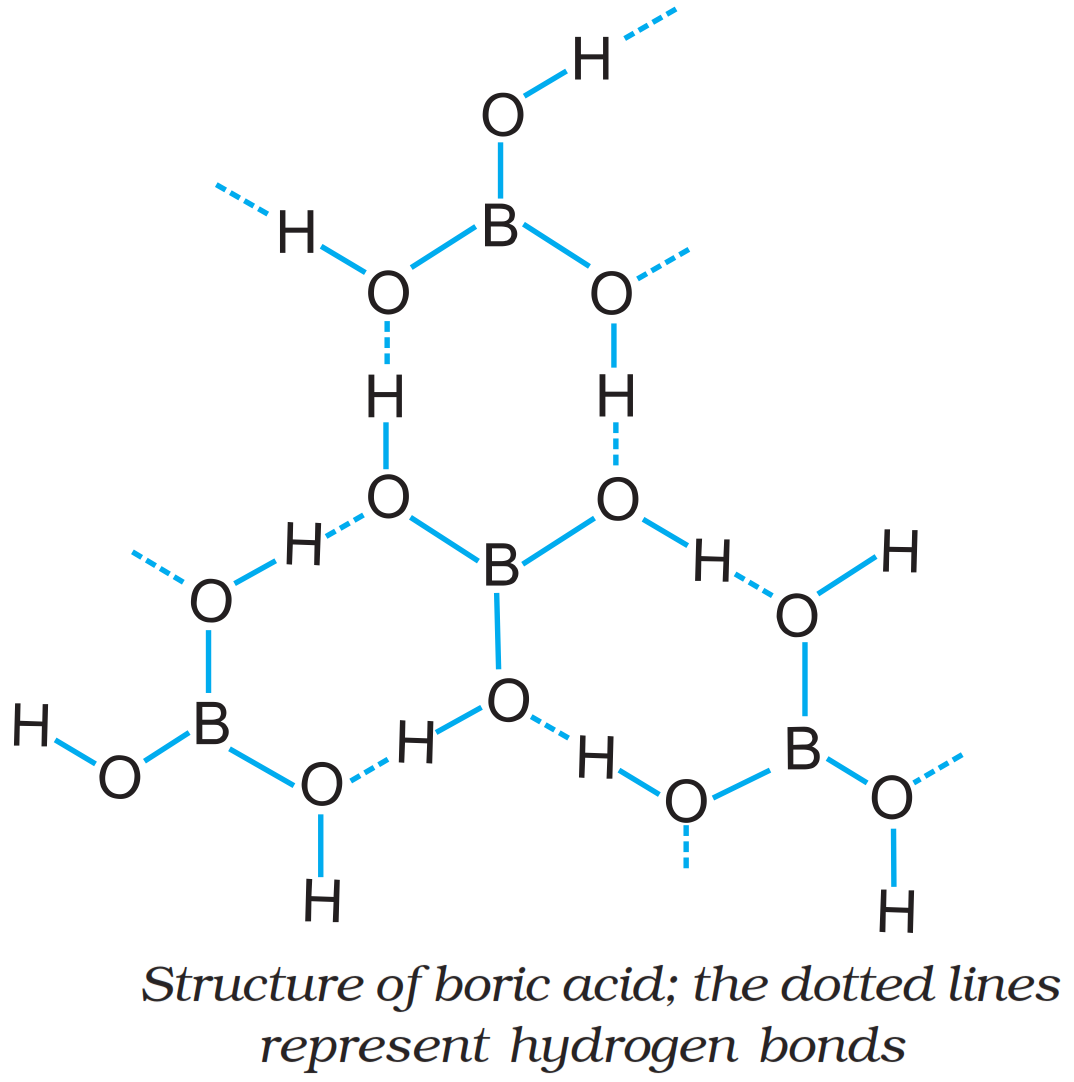
Draw the structure of boric acid showing hydrogen bonding. Which species is present in water? What is the hybridisation of boron in this species?
Answer
It has a layer structure in which planar H3BO3 unit are joined by hydrogen bonds forming hexagonal rings. Boric acid is a weak monobasic acid. It is not a protonic acid but acts as a Lewis acid by accepting electrons from a hydroxyl ion. In water, boric acid is present in the form of $[\text{B(OH)}_4]^-$species. The hybridizations of boron in this species is $\mathrm{sp}^3$.
$\text{B(OH)}_3+2\text{HOH}\rightarrow[\text{B(OH)}_4]^-+\text{H}_3\text{O}^+$
View full question & answer
Question 443 Marks
A transluscent white waxy solid (A) on heating in inert atmosphere is converted into its allotropic form ' B '. Allotrope ' A ', on reaction with very dilute aqueous solution of KOH liberates highly poisonous gas (C) having rotten fish smell. With excess of chlorine (C) forms (D) which hydrolyse to a compound 'E'. Identify A to E giving chemical equations.
Answer
- 'A' is white phosphorus, 'B' is red phosphorus.
'C' is phosphine, ' D ' is $PCl _5$, E ' is $H _3 PO _4$
.$\text{PH}_3+5\text{Cl}_2\xrightarrow{\\ \ \ \ \ \ \ \ }\text{PCl}_5+5\text{HCl}\\ \ \ \ \ \ \ \ \ \ \ \ \ \ \text{'C'}\ \ \ \ \ \ \ \ \ \ \ \ \ \ \ \text{'D'} $
$\text{P}_4+3\text{KOH}+3\text{H}_2\text{O}\xrightarrow{\text{Heat}}3\text{KH}_2\text{PO}_2+\text{PH}_3(\text{g})\\\ \ \ \ \ \ \ \ \ \ \ \ \ \ \ (\text{White phosphorus})\ \ \ \ \ \ \ \text{'C'}$
$\text{PCl}_5(\text{s})+4\text{H}_2\text{O}(\text{l})+\text{H}_3\text{PO}_4+5\text{HCl}\\ \ \ \ \ \ \ \ \ \ \ \ \ \ \ \ \ \ \ \ \ \ \ \ \ \text{'D'}\ \ \ \ \ \ \ \ \ \ \ \text{'E'}$
View full question & answer
Question 453 Marks
  1. What is used of $^{10}_5\text{B}$ in nuclear reactor?
  2. Name the elements with atomic number $113$ and $114$.
  3. Name the element having lowest melting point in group $14$.
  4. Why is $NH_3$ liquid whereas $CH_4$ gas?
  5. Why does carbon form large number of compounds?
Answer
a. ${ }_5^{10} \mathrm{~B}$ absorbs neutron in nuclear reactor and controls fission reaction.
b. Nihonium (Nh) is element with atomic no 113 and flerovium ( FI ) is element with atomic number 114.
c. Tin has lowest melting point in group 14.
d. It is because $\mathrm{NH}_3$ molecules are associated with intermolecular H -bonding whereas $\mathrm{CH}_4$ does not.
e. It is due to property of catenation and tetravalency, it can form large number of compounds, open chain, branched and closed chain compounds.
View full question & answer
Question 463 Marks
Give reasons of the following statements:
  1. Boron is unable to form $\text{BF}^{3-}_6.$
  2. Stability of +1 oxidation state progressively increases for the heavier elements of Group 13.
  3. Graphite is used as a dry lubricant in machines running at high temperature.
Answer
  1. It is because 'B' does not have d-orbitals.
  2. It is due to inert pair effect.
  3. It is because it is soft and slippery and has high melting point.
View full question & answer
Question 473 Marks
  1. Name the metal used in photoelectric cells.
  2. Why diamond is used as an abrasive?
  3. What are allotropes?
Answer
  1. Cesium is used in photo-electric cells.
  2. It is because diamond is $\mathrm{sp}^3$ hybridised which means carbon atom is bonded to four other carbon atoms with the help of strong covalent bond giving it a rigid 3-D structure which make it hard.
  3. Allotropes are forms of same element which differ in physical properties but have same chemical properties, e.g. diamond and graphite are allotropes of carbon.
View full question & answer
Question 483 Marks
  1. How is diborane prepared in the laboratory? Draw its structure.
  2. Explain why $\mathrm{CO}_2$ is a gas whereas $\mathrm{SiO}_2$ is a solid.
Answer
  1. $2\text{naBH}_4+\text{I}_2\xrightarrow{\ \ \ \ \ \ \ }\text{B}_2\text{H}_6+2\text{NaI}+\text{H}_2$
  1. $\mathrm{CO}_2$ exists as descrete molecules which are held together by weak van der Waals' forces of attraction whereas $\mathrm{SiO}_2$​​​​​​​ is three dimensional covalent solid.
View full question & answer
Question 493 Marks
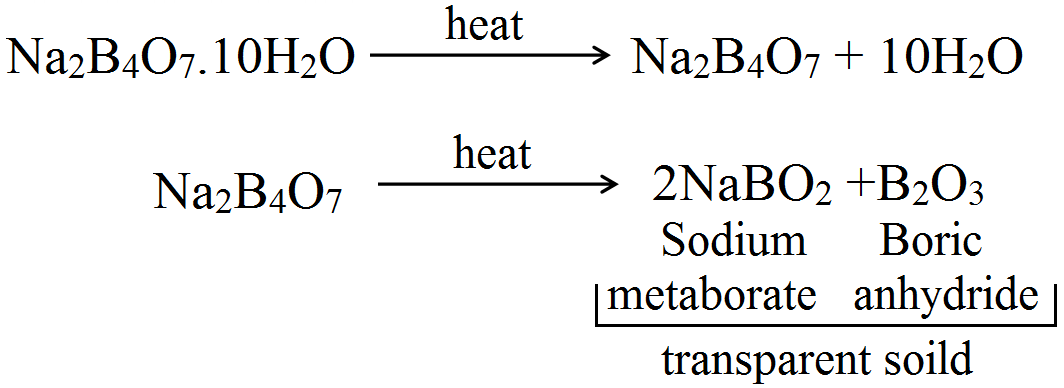
State with equations what happens when borax is heated on a platinum wire loop and the resulting transparent mass is heated with CoO in Bunsen burner.
Answer
On heating borax on a platinum loop, borax first loses its water of crystallisation and swells upto form a puffy mass. On heating further, it melts to a transparent liquid which solidifies to a transparent mass.

This transparent solid is called borax bead. Whenever a coloured salt of $Co^{2+}, Cu^{2+}, Ni^{2+}$ etc. is heated with borax bead, the salt decomposes to form the corresponding metal oxide which combines with $B_2O_3$ present in the bead to form coloured metaborates e.g.,
$\text{CoO}\ \ +\ \ \text{B}_2\text{O}_3\ \xrightarrow{\ \ \ \text{heat}\ \ \ }\ \text{Co(BO}_2)_2\\ ^\text{Cobalt oxide} \ \ \ \ \ \ \ \ \ \ \ \ \ \ \ \ \ \ \ \ \ ^\text{Cobalt metaborate (blue)}$
View full question & answer
Question 503 Marks
Name the following:
  1. The crystalline form of silica used in modern radio and T.V. broad casting and mobile radio communication.
  2. The oxides of carbon which form a complex with haemoglobin 300 times more faster than oxygen.
  3. Allotropes of carbon which has $\Delta_\text{f}\text{H}^\ominus=0$
  4. A type of polymer is semiorganic in nature.
  5. Two man-made silicate.
Answer
  1. Quartz is used in modern radio and T.V. broadcasting and mobile communication.
  2. Carbon monoxide forms complex with haemoglobin.
  3. Graphite has $\Delta_\text{f}\text{H}^\text{o}=0$
  4. Silicone is semi organic polymer.
  5. Cement and glass are man-made silicate.
View full question & answer
Question 513 Marks
Describe the general trends in the following properties of the elements in Groups $13$ and $14.$
Nature of halides.
Answer
Groups 13 Nature of Halides: These elements react with halogens to from trihalides (except $TII _3$ ).
$2 E(s)+3 X_2(g) \rightarrow 2 EX_3(s)(X=F, Cl, Br, I)$
Halides of boron and Aluminum are electron deficient and act as Lewis acidic character of halides of boron decreases in the following order:
$BF_3<BCl_3<BBr_3<BI_3$
Groups 14
Nature of Halides: These elements can form halides of formula $MX _2$ and $MX _4( X = F , Cl , Br , I )$. Except carbon, all other members react directly with halogen under suitable conditions to make halides, most of the compounds $\left( MX _4\right)$ are covalent in nature.
The central metal atom in these halides undergoes $sp ^3$ hybridization and the molecule is tetrahedral in shape. Exceptions are $SnF _4$ and $PbF _1$, which are ionic in nature. $Pbl _4$ does not exist because Pb -I bond initially formed during the reaction does not release enough energy to unpair $6 s^2$ electrons and excite one of them to higher orbital to have four unpaird electrons around lead atom. Heavier members Ge to Pb are able to make halides of formula $MX _2$.
View full question & answer
Question 523 Marks
Explain the following:
Carbon shows catenation property but lead does not.
Answer
Property of catenation depends upon the strength of element-element bond which, in turn, depends upon the size of the element. Since the atomic size of carbon is much smaller than that of lead, therefore, carbon-carbon bond strength is much higher than that of lead-lead bond. Due to stronger C-C than Pb-Pb bonds, carbon has a much higher tendency for catenation than lead.
View full question & answer
Question 533 Marks
Aluminium dissolves in mineral acids and aqueous alkalies and thus shows amphoteric character. A piece of aluminium foil is treated with dilute hydrochloric acid or dilute sodium hydroxide solution in a test tube and on bringing a burning matchstick near the mouth of the test tube, a pop sound indicates the evolution of hydrogen gas. The same activity when performed with concentrated nitric acid, reaction doesn’t proceed. Explain the reason.
Answer
Aluminum is amphoteric in nature, it reacts with acid and base to give salt and $\mathrm{H}_2$ gas. It burn with pop sound. $2\text{Al}+6\text{HCL}\rightarrow2\text{AlCl}_3+3\text{H}_2(\text{g})$ $2\text{Al}+2\text{NaOH}+2\text{H}_2\text{O}\rightarrow2\text{NaAlO}_2+3\text{H}_2(\text{g})$When Al reacts with conc. $\mathrm{HNO}_3$, athin layer of $\mathrm{Al}_2 \mathrm{O}_3$ on the surface of Al metal which protect further reaction. This layer is called protective layer.
$2\text{Al}+6\text{HNO}_3\text{conc.}\rightarrow\text{Al}_2\text{O}_3+6\text{NO}_2+3\text{H}_2\text{O}$
View full question & answer