Question
Account for the following:
i. Which is smaller $\mathrm{Fe}^{2+}$ or $\mathrm{Fe}^{3+}$, why?
ii. Chlorine (Cl) have more negative electron gain enthalpy than Fluorine (F).
[Atomic no.: $\mathrm{F}=9, \mathrm{Cl}=17]$
iii. Anions are bigger in size than their parent atom.
Answer

i. $\mathrm{Fe}^{3+}$ ion is smaller than $\mathrm{Fe}^{2+}$ due to greater effective nuclear charge. In $\mathrm{Fe}^{3+}, 26$ protons attract 23 electrons more strongly than $\mathrm{Fe}^{2+}$ in which 26 protons attract 24 electrons.
ii. It is due to less inter electronic repulsion in 'Cl' than F as ' F ' is smaller in size than Cl .
iii. Anions are formed when a neutral atom gains one or more electrons. Since, the number of electrons increases and the number of protons remains same, the effective nuclear charge decreases which results in decrease in ionic radii.

Need a full question paper?

Generate a complete, print-ready paper with questions like this in minutes — across 16+ boards, with answer keys.

Start Generating Free

Similar questions

Write the molecular orbital configuration of $\text{N}_2$.Calculate its bond order and predict its magnetic behaviour.
Given$\text{N}_2(\text{g}) + 3\text{H}_2(\text{g}) \xrightarrow{ \ \ \ \ \ \ }2\text{NH}_3(\text{g}) ; \Delta_{\text{r}}\text{H}^\ominus= –92.4\text{kJ} \ \text{mol}^{–1}$
What is the standard enthalpy of formation of $\text{NH}_{3}$ gas?
  1. In the following redox reactions, identify the oxidation and reducing agents:
  1. $\text{H}_3\text{PO}\text{(aq)}+2\text{HgCl}_2+2\text{H}_2\text{O}\text{(aq)}\\ \xrightarrow{ \ \ \ \ }\text{H}_3\text{PO}_4\text{(aq)}+2\text{Hg(l)}+4\text{HCl(aq)}$
  2. $\text{O}_2\text{(g)}+\text{PtF}_6\text{g}\xrightarrow{ \ \ \ \ }\text{O}_2^+[\text{PtF}_6]^\ominus\text{(s)}$
  1. Why does $H_2S$ acts as reducing agent only whereas $SO_2$​​​​​​​ acts as bot oxidant as wells as rductant?
56 kg of $\mathrm{N}_2(\mathrm{~g})$ and 10 kg of $\mathrm{H}_2(\mathrm{~g})$ are mixed to produce $\mathrm{NH}_3(\mathrm{~g})$. Calculate the number of moles of ammonia gas formed.
(Atomic mass/ $\mathrm{g} \mathrm{mol}^{-1} \mathrm{~N}=14, \mathrm{H}=1$ )
The two $\text{O}-\text{O}$ bond distances in ozone molecule are equal. Justify.
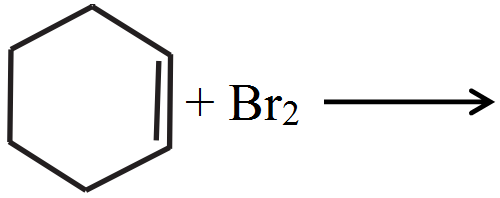
For the following reactions, complete and Identify the type of reactions:
  1. $\text{CH}_3-\text{CH}_2-\text{CH}_2\text{Br}+\text{KOH(alc.)}\overrightarrow{\ \ \ \ \ \ }$
  2. $\text{CH}_3-\text{CH}-\text{CH}_3+\text{KOH(aq)}\overrightarrow{ \ \ \ \ \ \ }\\ \ \ \ \ \ \ \ \ \ \ \ \ \ |\\ \ \ \ \ \ \ \ \ \ \ \ \ \text{Br}$
  3.  
A 25watt bulb emits monochromatic yellow light of wavelength of 0.57µm. Calculate the rate of emission of quanta per second.
Give the relationship between $\Delta U$ and $\Delta H$ for gases.
Elements X, Y and Z have 4, 5 and 7 valence electrons respectively:
  1. Write the molecular formula of the compounds formed by these elements individually with hydrogen.
  2. Which of there compound will have the highest dipole moment?
Identify the type of reactions:
  1. $\text{CH}_4+\text{Cl}_2\xrightarrow{\text{sunlight}}\text{CH}_3\text{Cl}+\text{HCl}$
  2. $\text{C}_6\text{H}_6+(\text{conc.})\text{HNO}_36\xrightarrow{\text{conc.}\text{H}_2\text{SO}_4}\text{C}_6\text{H}_5\text{NO}_2+\text{H}_2\text{O}$
  3. $ \ \ \ \ \ \ \ \ \ \ \ \ \ \ \ \ \ \ \ \ \ \ \ \ \ \ \ \ \ \ \ \ \ \ \ \ \ \ \ \ \ \ \ \ \ \ \ \ \ \ \ \ \ \ \ \ \ \ \ \ \ \ \ \ \ \text{Br}\\\ \ \ \ \ \ \ \ \ \ \ \ \ \ \ \ \ \ \ \ \ \ \ \ \ \ \ \ \ \ \ \ \ \ \ \ \ \ \ \ \ \ \ \ \ \ \ \ \ \ \ \ \ \ \ \ \ \ \ \ \ \ \ \ \ \ |\\\text{CH}_3-\text{CH}=\text{CH}_2+\text{HBr}\xrightarrow{\ \ \ \ \ \ \ }\text{CH}_3-\text{CH}-\text{CH}_3$
  4. $\ \ \ \ \ \ \ \ \ \ \ \ \ \text{O}\ \ \ \ \ \ \ \ \ \ \ \ \ \ \ \ \ \ \ \ \ \ \ \ \ \ \ \ \ \ \ \ \ \ \ \ \ \ \ \ \ \ \ \ \ \ \ \text{OH}\\\ \ \ \ \ \ \ \ \ \ \ \ \ \| \ \ \ \ \ \ \ \ \ \ \ \ \ \ \ \ \ \ \ \ \ \ \ \ \ \ \ \ \ \ \ \ \ \ \ \ \ \ \ \ \ \ \ \ \ \ \ \ \ \ |\\ \text{CH}_3-\text{C}-\text{CH}_3+\text{HCN}\xrightarrow{\ \ \ \ \ \ \ \ }\text{CH}_3-\text{C}-\text{CH}_3\\\ \ \ \ \ \ \ \ \ \ \ \ \ \ \ \ \ \ \ \ \ \ \ \ \ \ \ \ \ \ \ \ \ \ \ \ \ \ \ \ \ \ \ \ \ \ \ \ \ \ \ \ \ \ \ \ \ \ \ \ \ \ \ \ \ |\\\ \ \ \ \ \ \ \ \ \ \ \ \ \ \ \ \ \ \ \ \ \ \ \ \ \ \ \ \ \ \ \ \ \ \ \ \ \ \ \ \ \ \ \ \ \ \ \ \ \ \ \ \ \ \ \ \ \ \ \ \ \ \ \ \text{CN}$
  5. $\text{CH}_3-\text{CH}=\text{CH}_2\xrightarrow[\text{peroxide}]{\text{HBr}}\text{CH}_3\text{CH}_2\text{CH}_2\text{Br}$
  6. $\text{CH}_3\text{Cl}+\text{KOH}(\text{aq})\xrightarrow{\ \ \ \ \ \ \ \ \ }\text{CH}_3\text{OH}+\text{KCl}$