MCQ
Acetaldehyde cannot give:
  • A
    Iodoform test
  • Lucas test
  • C
    Benedict test
  • D
    Tollens test

Answer

Correct option: B.
Lucas test
b
Acetaldehyde gives positive result with Iodoform test, Benedicts test and Tollen's test which identifies its functional group.Lucas test is given by Alcohols to separate alcohols.

Need a full question paper?

Generate a complete, print-ready paper with questions like this in minutes — across 16+ boards, with answer keys.
Start Generating Free

Similar questions

An open pipe resonates with a tuning fork of frequency $500 Hz$. it is observed that two successive nodes are formed at distances $16$ and $46 cm $ from the open end. The speed of sound in air in the pipe is ..... $m/s$
In a Resonance -Coulmn lab experiment to measure the velocity of sound, the first  resonance is obtained at a length $l_1$ and the second resonance at a length $l_2$. Then-
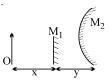
An object $O$ is placed in front of a small plane mirror $M_1$ and $a$ large convex mirror $M_2$ of focal length $f$. The distance between $O$ and $M_1$ is $x$, and the distance between $M_1$ and $M_2$ is $y$. The images of $O$ formed by $M_1$ and $M_2$ coincide. The magnitude of $f$ is
A body falling from a height of $10\,m$ rebounds from hard floor. If it loses $20\%$ energy in the impact, then coefficient of restitution is
A frame of reference that is accelerated with respect to an inertial frame of reference is called a non-inertial frame of reference. A coordinate system fixed on a circular disc rotating about a fixed axis with a constant angular velocity $\omega$ is an example of a non-intertial fiame of reference. The relationship between the force $\vec{F}_{\text {rot }}$ experienced by a particle of nass in moving on the rotating disc and the force $\vec{F}_{\text {in }}$ experienced by the particle in an inertial frame of reference is

$\vec{F}_{\text {rot }}=\vec{F}_{\text {in }}+2 m\left(\vec{v}_{\text {rot }} \times \vec{\omega}\right)+m(\vec{\omega} \times \vec{r}) \times \vec{\omega},$

where $\vec{v}_{\text {rot }}$ is the velocity of the particle in the rotating frame of reference and $\bar{r}$ is the position vector of the particle with respect to the centre of the disc.

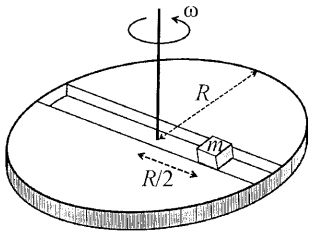
Now consider a smooth slot along a diameter of a disc of radius $R$ rotating counter-clockwise with a constant angular speed $\omega$ about its vertical axis through its center. We assign a coordinate system with the origin at the center of the disc, the $x$-axis along the slot, the $y$-axis perpendicular to the slot and the $z$-axis along the rotation axis $(\vec{\omega}=\omega \hat{k})$. A sm a $1$ block of mass $m$ is gently placed in the slot at $\vec{r}=(R / 2) \hat{i}$ at $t=0$ and is constrained to move only along the slot.

(Image)

($1$) The distance $r$ of the block at time $t$ is

($A$) $\frac{R}{4}\left(e^{\omega t}+e^{-\omega t}\right)$   ($B$) $\frac{R}{2} \cos \omega t$   ($C$) $\frac{R}{4}\left(e^{2 \omega t}+e^{-2 \omega t}\right)$

($D$) $\frac{F}{2} \cos 2 \omega t$

($2$) The net reaction of the disc on the block is

($A$) $\frac{1}{2} m \omega^2 R\left(e^{2 \omega t}-e^{-2 \omega t}\right) \hat{j}+m g \hat{k}$

($B$) $\frac{1}{2} m \omega^2 R\left(e^{\omega t}-e^{-a t t}\right) j+m g k$

($C$) $-m \omega^2 R \cos \omega t \hat{j}-m g \hat{k}$

($D$) $m \omega^2 R \sin \omega t \hat{j}-m g \hat{k}$

Give the answer quetioin ($1$) ($2$)
A uniform heavy disc is rotating at constant angular velocity $\omega$ about a vertical axis through its centre and perpendicular to the plane of the disc.  Let $L$ be its angular momentum.  A lump of plasticine is dropped vertically on the disc and sticks to it.  Which will be constant
A body of mass $100\, g$ is sliding from an inclined plane of inclination $30^°$. What is the frictional force experienced if $\mu = 1.7$
A man in a lift throws up a ball, with velocity v m/s relative to the lift and catches it after t sec. The vertical acceleration of the lift is:
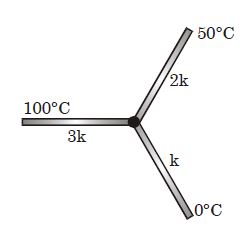
Three rods of the same dimensions have thermal conductivities $3k, 2k$ and $k$. They are arranged as shown, with their ends at $100\,^oC, 50\,^oC$ and $0\,^oC$. The temperature of their junction is
$A$ wire of cross-section area $A$, length $L_1$, resistivity $\rho_1$ and temperature coefficient of resistivity $\alpha_1$ is connected to a second wire of length $L_2$, resistivity $\rho_2$ , temperature coefficient of resistivity $\alpha_1$ and the same area $A$, so that wire carries same current. Total resistance $R$ is independent of temperature for small temperature change if (Thermal expansion effect is negligible)